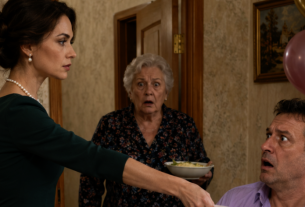
When Viktor packed his things and asked Nelli if they could remain friends, she didn’t scream or cry. She did something he never expected. And it changed everything.
Nelli stood at the sink counting the drops. The faucet had been leaking for three weeks, and every evening she promised herself she would call a plumber, but she never did.
Viktor stood in the kitchen doorway. Wearing his jacket. A backpack slung over one shoulder. She noticed the backpack before she heard his voice.
“Nell, we need to talk.”
She turned off the faucet. A drop fell anyway.
“Go ahead.”
“I’m leaving. You know who I’m going to.”
She didn’t know. Or rather, of course she knew—somewhere deep in her spine, in that place that aches before rain and before a lie. But no one had ever said it out loud to her. Not until this moment.
Viktor shifted from one foot to the other. His shoes were new, brown, with pointed toes. He used to wear sneakers, even to work. Nelli looked at those shoes and thought: This is it. This is the moment it became real.
“To Alina,” he said, even though she hadn’t asked.
Alina. Twenty-six years old, small hands, a voice like a cartoon character. Nelli had seen her once at her husband’s company party in December. She remembered her earrings—long, with green stones, inexpensive, though on Alina they had looked real.
“I don’t want us to become enemies,” Viktor continued.
His voice sounded rehearsed. Soft, even. The kind of voice people use after practicing the same sentence twenty times in front of a mirror.
“We’re adults. We have Gleb. Let’s stay friends.”
Friends.
Nelli turned toward him. She was forty-two years old, five foot four, with thin wrists and a mole just above her upper lip, slightly to the left. She stood barefoot on the cold tile floor and could feel each individual tile beneath her feet.
“Friends,” she repeated.
“Yes. It makes sense. For everyone.”
She nodded. Then she opened the top drawer, took down the notepad held to the refrigerator by magnets, and picked up a pen.
“What are you doing?” Viktor asked.
“Writing.”
“Writing what?”
“A list. Of what friends do.”
He fell silent. The backpack slipped slightly down his shoulder.
She wrote.
Her handwriting had always been small and slanted to the left, and Viktor had never been able to decipher it.
Gleb was in his room playing a game with headphones on. He was fourteen, and he heard everything, even through a closed door and two layers of music. But he didn’t come out.
Nelli didn’t blame him.
When the front door closed, she sat at the kitchen table and placed the notepad in front of her.
The list read:
“Friends don’t pay for each other’s apartments. Friends don’t wash each other’s socks. Friends don’t remember which blood-pressure pills the other one needs to take. Friends don’t lie beside each other at four in the morning when one of them is sick. Friends don’t owe each other anything.”
She underlined the last sentence twice.
The kettle had gone cold. She poured the water into a mug and drank it anyway. There was a faint taste of chlorine, almost unnoticeable.
But right now, she noticed everything.
The phone rang forty minutes later.
The screen said: “Vika—Sister.”
“So? He left?” Vika asked without even saying hello.
“He left.”
“For her?”
“For her.”
Vika was silent for a moment. Nelli could hear a dog barking somewhere in the distance and water running through the phone.
“How are you?”
“Fine.”
“Nell.”
“I really am fine. I made a list.”
“What list?”
“What friends do. He asked us to stay friends.”
Vika exhaled so sharply that the microphone rustled.
“And you agreed?”
“I agreed,” Nelli said. “Just on my terms.”
The next morning, she drove Gleb to school. He stayed silent the entire way, picking at a hangnail on his thumb. He had Viktor’s hands: broad palms, short fingers, and a slightly concave little fingernail.
“Mom.”
“Yes?”
“Is he coming back?”
“No, Gleb.”
She didn’t say, “We’ll see,” or “Time will tell.”
She didn’t lie.
Her son nodded and got out of the car. At the school gates, he turned around and raised his hand.
She raised hers in return.
At work, Nelli was an accountant for a construction company. Numbers, invoices, reconciliations. For eight hours a day, she lived inside spreadsheets, and it was the only place where the world obeyed logic.
Her colleague Zoya placed a cup of tea and a slice of pie in front of her.
“You’re pale,” Zoya said.
She was fifty-seven, dyed her hair copper-red, and always spoke directly, without beating around the bush.
“I didn’t sleep.”
“Viktor?”
Nelli looked up.
Zoya stood with her arms crossed, looking at her the way people look when they have already figured everything out.
“Zoya, how do you know?”
“I don’t. You just have the face of someone who made a decision, not someone who’s crying.”
The pie was apple. The pastry was crumbly, with a little more sugar than necessary. Nelli ate the entire slice and only afterward realized that her hands had stopped shaking.
Viktor called on the third day. His voice sounded cheerful, with a slight strain underneath, as if he wanted to make it clear that this wasn’t easy for him either.
“Nell, I need to pick up some things.”
“Of course. You’re a friend, after all. Come whenever it’s convenient. Just give me an hour’s notice.”
“An hour? This is my home too.”
“It was. Now you’re a friend. Friends give notice.”
He was silent for four seconds.
She counted.
“Fine. Tomorrow at six.”
“Agreed.”
She hung up and looked at her hands. Her palms were dry. Not a single vein was pulsing any harder than usual.
A strange calm.
Not dead. Not forced.
Just the understanding of what had happened finally settling into place, like the last piece in a puzzle she had been assembling for seventeen years.
Seventeen years.
Married at twenty-five. Gleb at twenty-eight. Their first major crisis when she was thirty-four, when Viktor lost his job and spent three months lying on the couch while she carried everything alone.
Back then, he hadn’t offered friendship.
Back then, he had asked for patience.
And she had been patient.
At thirty-nine, he had suddenly started jogging in the mornings. He bought a gym membership. He began looking at his phone more often and into her eyes less often.
Nelli noticed every change the way an accountant notices a discrepancy down to the last cent.
But she kept quiet.
Because she was convinced that if she said it aloud, it would become true.
It didn’t help.
It became true without words.
He arrived at exactly six.
Without Alina, although Nelli had considered that possibility too.
He had the same backpack, plus a large gym bag.
“Is Gleb home?”
“At a friend’s. I asked him to go.”
“Why?”
“Because he doesn’t need to watch you put your things into a bag that belongs in someone else’s home.”
Viktor opened his mouth and then closed it.
He went to the bedroom.
Nelli stayed in the kitchen.
She could hear him pulling open the dresser drawers. The clatter of hangers. The rustle of fabric.
Every sound seemed separate. Precise.
As if someone had turned down every frequency except this one.
Twenty minutes later, he came out carrying a full bag.
“Thank you,” he said.
“You’re welcome. Friends help each other.”
He put the bag down and looked at her.
For a long time.
It was the way he looked when he wanted to say something but didn’t know how.
“Nell, you’re acting strangely.”
“How?”
“You’re too calm.”
“How am I supposed to act?”
“I don’t know. I thought you would…”
“Scream? Smash dishes? Beg you to come back?”
He didn’t answer.
“Viktor. You asked for friendship. I agreed. Friends don’t scream or smash dishes. Friends respect each other’s choices.”
He picked up his bag, slung the backpack over his shoulder, and walked out.
On the landing, he stopped.
“You do understand this isn’t forever, right? I mean…”
“Goodbye, Viktor.”
The door closed.
The lock clicked.
Nelli stood in the hallway and looked at the hook where his jacket used to hang.
The hook was empty.
Small, brass, tilted slightly to the left.
She straightened it with her fingers.
The first week felt like recovering from a long cold.
Her head was clearer. The air felt different.
But her body still didn’t quite believe the fever was gone.
Nelli stopped cooking for two adults.
Soup for two: herself and Gleb.
White bread—the kind Viktor never ate because “white bread makes you fat.”
She bought a loaf, cut herself a thick slice, and spread butter over it more generously than she had allowed herself to in five years.
Gleb watched her eat.
“Mom, what are you doing?”
“Eating bread.”
“I can see that. You never ate it before.”
“There are a lot of things I didn’t do before.”
He smiled.
Quickly, with just one corner of his mouth.
But he smiled.
That evening, her mother called.
Raisa Pavlovna, sixty-nine years old, with a voice like sandpaper and a habit of beginning every conversation with a complaint.
“Nelli, Viktor called me.”
“And what did he say?”
“That you’re separating. That you took it calmly.”
“I did.”
“That’s not normal, Nelli. He told me, ‘She didn’t even ask me to stay.’ A man needs to be asked.”
Nelli held the phone between her shoulder and ear and turned on the faucet to wash her mug.
“Mom, I’m not going to ask someone to stay after he’s already left.”
“What if you had asked?”
“He would have stayed for a week. Out of pity. Then he would have left again.”
“How do you know?”
“I know.”
Raisa Pavlovna fell silent.
In the background, Nelli could hear her wall clock ticking. An old clock with a pendulum that had hung in her apartment since 1983.
“Did you at least cry?”
“No, Mom.”
“That isn’t normal either.”
“Maybe.”
She hung up, washed the mug, and turned it upside down on the towel.
Viktor’s mug stood on the shelf. Blue, with the words “Best Dad” printed on it.
Nelli took it down and held it in her hands.
The ceramic was warm and smooth.
She put it back.
She didn’t throw it away.
But she moved it to the top shelf, the one she had to stand on tiptoe to reach.
Two weeks later, Viktor sent her a message:
“Can I come by for my winter coat? I couldn’t find it in the bag.”
She replied:
“Wednesday after seven. Give me an hour’s notice.”
He came on Wednesday.
The hallway smelled different.
Nelli had bought incense sticks—sandalwood and orange. Viktor had never tolerated fragrances in the apartment. He said they gave him headaches.
“It smells different in here,” he said from the doorway.
“Yes. I like it.”
He stepped into the hallway and took his coat from the hanger.
He lingered.
“How’s Gleb?”
“Fine. He’s working with a physics tutor. Preparing for an academic competition.”
“A competition? He didn’t tell me.”
“You didn’t ask.”
Viktor grimaced.
Not because of the words, but because of her tone.
Nelli spoke evenly, without accusation or pressure.
Just a fact.
He hadn’t asked, so his son hadn’t told him.
Two plus two.
“Listen, I wanted to talk about the apartment.”
“I’m listening.”
“We could sell it and split the money, couldn’t we? Or you could buy out my share?”
Nelli leaned against the doorframe.
It was wooden, with a scratch left by Gleb’s scooter when he was six.
“Viktor, the apartment is in my name. My parents paid the down payment. I finished paying the mortgage myself while you were lying on the couch after losing your job.”
“That happened once.”
“For three months.”
“I paid you back afterward.”
“Part of it. Viktor, I don’t want to argue. You asked for friendship. Friends don’t make claims on each other’s apartments.”
He stood in the hallway holding his coat out at arm’s length and stared at her as though he were seeing her for the first time.
Something shifted in his expression.
Not anger.
Not resentment.
More like the surprise of a man who had lived beside someone for twenty years without ever truly seeing her.
“You’ve changed,” he said.
“No. I just stopped keeping quiet.”
He left.
Nelli closed the door, went into the kitchen, and opened the window.
February air rushed inside, cold and carrying the taste of wet snow.
She stood at the window until her fingers went numb.
March arrived with rain.
The snow turned gray, then brown, then disappeared.
The city began to smell of earth and something alive pushing its way through the asphalt.
Nelli signed up for driving lessons.
Before, Viktor had always driven, while she sat in the passenger seat or took the bus.
After their third lesson, her instructor—a man in his fifties with a mustache and a permanent piece of candy tucked inside his cheek—said:
“You learn quickly. You have a feel for the car.”
“I’m an accountant. I’m used to being in control.”
“This isn’t about control. It’s about trust. Trusting the steering wheel, the pedals, yourself.”
She thought about that later that evening while standing in the bathroom.
The mirror had fogged over.
She ran her finger across the glass.
The line came out crooked but clear.
Like a boundary.
Gleb started talking more.
Not about Viktor.
Not about Alina.
About his own life.
He told her about a physics problem he had solved faster than everyone else. About a girl named Yulia from another class who wrote poetry and wore a green hat in every kind of weather. About wanting to go to a summer camp where they taught programming.
Nelli listened and felt something inside her beginning to thaw.
Not happiness.
Not yet.
More like the possibility of happiness.
A place for it had opened up after the stone she had carried in her chest for so long finally disappeared—a stone she had carried for so many years that she had stopped noticing its weight.
“Mom, are you happy?” Gleb asked one evening over dinner.
She put down her fork.
“Not yet. But I’m becoming happy.”
“What does that mean?”
“It means you stop doing the things that make you miserable and start doing things you don’t yet know will make you happy. But you try.”
He nodded.
Seriously.
Like an adult.
Viktor appeared again in April.
Without warning.
He simply rang the doorbell on a Saturday evening.
Gleb opened it.
“Dad?”
“Hi. Is Mom home?”
Nelli came into the hallway.
She was wearing an old T-shirt, her hair still wet from the shower.
Viktor looked different from two months earlier.
Thinner.
Dark circles beneath his eyes that hadn’t been there before.
“I didn’t warn you. Sorry.”
“What happened?”
“Can I come in?”
She looked at Gleb.
Gleb shrugged and went back to his room.
“Come in.”
Viktor sat in the kitchen in what had once been his usual place.
Muscle memory: the chair on the left, closer to the window.
Nelli sat opposite him.
“Alina and I broke up,” he said.
Silence.
The refrigerator began humming as if even it felt awkward.
“I’m sorry,” Nelli said.
And she wasn’t lying.
She really was sorry.
Not for him.
Not for herself.
For the whole story, in which nobody had won.
“Nell, I realized I made a mistake.”
“Which mistake?”
“Leaving.”
“You didn’t make a mistake by leaving. You made a mistake by thinking you could leave without losing anything.”
He rubbed his face with both hands.
Stubble he had never allowed himself to grow before.
The smell of someone else’s home, someone else’s soap.
“I want to come back.”
Nelli stood, walked to the stove, and put the kettle on.
She lit the burner.
The blue flame flickered and then steadied.
“Viktor.”
“Yes?”
“Remember when you asked me to stay friends?”
“I remember.”
“I agreed. And I keep my word. We’re friends. But friends don’t move back into apartments they walked out of. Friends don’t climb back into beds they abandoned. Friends don’t ask for a second chance because their first choice didn’t work out.”
He stared at her.
She stood with her back to the stove, the light falling across her face so that half of it was in shadow.
The kettle was beginning to hiss.
“Are you serious?”
“Completely.”
“But I thought…”
“You thought friendship was a safety net. That you could leave and the door would stay open. Viktor, the door is open—for a friend. Not for a husband.”
He opened his mouth.
Closed it.
Stood up.
The chair scraped against the floor.
“You don’t love me anymore?”
Nelli took the kettle off the burner.
She poured water into her own mug.
His mug was still on the top shelf.
She didn’t take it down.
“This isn’t about love. It’s about respect. Respect for myself.”
He left.
This time, he didn’t say goodbye.
The door slammed.
The elevator hummed in the stairwell.
Nelli stood with the mug in her hands, looking out the window.
A streetlamp glowed in the courtyard.
Beneath it was a puddle reflecting the light.
Yellow against black.
The tea was hot.
She took a sip and burned her tongue.
It hurt.
Briefly and simply.
Like the truth.
May.
Nelli passed her driving test on her first attempt.
The mustached instructor shook her hand and said:
“There you go. See? You trusted yourself.”
She bought a used gray German car with a scratch on the left fender.
Gleb named it “Musya.”
Nelli didn’t argue.
On Saturdays, she drove to the market for fruit.
She bought sweet cherries when they came into season and apricots when they ripened.
She put a bowl on the table, and Gleb would steal fruit between study sessions, leaving the pits on a saucer.
Viktor wrote once a week.
Short messages. Practical.
Questions about Gleb: How was school? How had the competition gone? Maybe they could meet at a café?
Nelli answered:
“Call him directly. He’s fourteen. He can decide for himself.”
One day Viktor wrote:
“You were right. About the safety net.”
She read the message.
She didn’t answer.
She put her phone in her bag and went to pick Gleb up from school.
At work, Zoya brought her a jar of gooseberry jam and said:
“You look better.”
“I’m just sleeping at night.”
“Same thing, Nell.”
They laughed.
Nelli couldn’t remember the last time she had laughed at work.
Maybe a year ago.
Maybe longer.
June.
Gleb took second place in the city physics competition.
He came home with a certificate and an expression he was trying to make look indifferent, although his eyes were shining.
“Second place?” Nelli asked.
“Second. The guy who came first solved one problem faster.”
“That’s excellent, Gleb.”
“Dad called. Congratulated me. Said he was proud.”
Nelli nodded.
“Good.”
“Mom, aren’t you angry with him?”
“No.”
“Not at all?”
“Not at all. Anger is when you’re still waiting for someone to change. I’m not waiting anymore.”
Gleb placed the certificate on the shelf beside his microscope and a photograph of himself at five years old, sitting on Viktor’s shoulders.
He didn’t remove the photograph.
Neither did Nelli.
That evening, she sat on the balcony with a mug of tea.
The June air smelled of poplar fluff and sun-warmed concrete.
Somewhere below, children were kicking a ball, and the sound of it striking a wall repeated in an uneven rhythm, like a pulse.
She took out the notepad.
The same one with the magnets.
She opened the first page.
The list was still there:
“Friends don’t pay for each other’s apartments. Friends don’t wash each other’s socks…”
Nelli reread it.
Then she turned the page and wrote a new list.
A different one.
“What I want.
Learn to bake bread.
Visit Kaliningrad.
Finish the book I started three years ago and abandoned halfway through.
Sleep late on a Sunday without setting an alarm.
Stop straightening the hook in the hallway.”
She reread it.
Smiled.
Then crossed out the last item.
The streetlamp in the courtyard came on.
Its light fell across a puddle left behind by the afternoon rain.
Yellow against darkness.
Just like that night in February.
But now it was warm, and the puddle was drying, shrinking around the edges.
Viktor called at the end of June.
His voice was different.
Quiet.
Unrehearsed.
“Nell, I sold the car. I want to send Gleb money for camp. Where should I transfer it?”
“To his card. He has his own.”
“He has a card?”
“Since May.”
“I didn’t know.”
“Now you do.”
A pause.
“Nell.”
“Yes?”
“Thank you for not becoming my enemy.”
She thought for a moment.
She chose her words the way someone chooses a key for a lock that hasn’t been opened in a long time.
“Viktor, I didn’t become your enemy because that takes too much energy. And I decided to spend my energy on myself.”
“Isn’t that selfish?”
“That’s called growing up.”
He was silent for a moment.
Then he hung up.
No resentment.
No slammed door.
Just the dial tone.
Nelli placed the phone on the table.
The kitchen was quiet.
The faucet no longer leaked.
She had finally called a plumber in March, a week after Viktor left.
The plumber came, replaced a washer, charged her eight hundred rubles, and said:
“You should’ve done this a long time ago, ma’am.”
A long time ago.
Nelli stood up, walked to the shelf, and took down the blue mug that said “Best Dad.”
She washed it.
Dried it with a towel.
Then placed it on the lower shelf, the ordinary shelf, beside her own mug.
Two mugs.
Not husband and wife.
Not enemies.
Something else that no one had invented a word for yet.
And she thought: maybe there was no need to invent one.
Maybe it was enough simply to put the mug back where it belonged and move on.
The light in the kitchen was warm.
Outside, a long summer evening was beginning.
Nelli closed the notepad, put it away in the drawer, and walked onto the balcony.
Below, Gleb was standing by the entrance to the building with a backpack, looking up.
“Mom! Want to go get some cherries?”
She nodded.
She picked up the keys to the gray car with the scratch on its left fender and walked out of the apartment.
The door closed behind her.
It didn’t slam.
It simply closed.