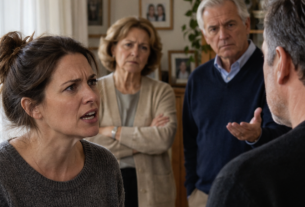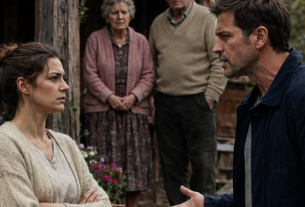
— Lera! How much longer are you going to sit around doing nothing?! It’s high time you got to work, but there you are, lounging about!
Her mother-in-law Nina Pavlovna’s voice struck the door before she even managed to open it. Lera did not so much as flinch. After living together for three years, she knew that voice as well as the multiplication table—sharp, demanding, with a special intonation that turned every word into an order.
Nina Pavlovna entered the room without knocking. Naturally. She never knocked—neither on other people’s doors nor before barging into their lives. She simply came in, rearranged everything she believed was out of place, and left behind the smell of cheap perfume and a sense of complete disorder—even though everything had been perfectly fine before her arrival.
“My son is tired today,” she announced, sitting in the armchair without being invited. “You could at least ask how your husband is doing instead of sitting here with your books.”
Lera put down her phone. There was no book. She had simply been sitting by the window, watching the September wind chase the first yellow leaves along the pavement. But explaining that to Nina Pavlovna would have been like talking to a streetlamp.
Anton—her husband, Nina’s precious little boy and the light of her life—appeared a minute later. He entered looking like someone who had been terribly wronged, dropped onto the sofa, and immediately began whining.
“Mom, will you make me some tea?”
“Of course, sweetheart. Right away.”
Lera watched the familiar scene with almost complete detachment. The man was thirty-four years old—an engineer by education, a machine operator in practice, and an eternal child sitting on his mother’s lap in the evenings.
Nina Pavlovna fussed around him as though he were four rather than thirty-four. She adjusted his pillow, asked repeatedly what he had eaten for lunch, and cooed affectionately over him. But she looked at Lera with that familiar squint that clearly said, Why are you even here?
The apartment was small, with two rooms, and belonged to Lera. She had inherited it from her grandmother before getting married.
The country house was a different matter. They had bought it with their joint savings three years earlier, when Lera still believed that a family could truly be a family.
It was a small plot forty kilometers outside the city, with an old cottage and apple trees along the fence. Every summer, Lera planted vegetables, cleaned the property, and painted the shutters. Anton rarely visited, claiming village life was not for him.
Nina Pavlovna, however, came willingly. She walked around the property as though she owned it, gave advice nobody had requested, moved the benches from one place to another, and complained loudly that the strawberries had been planted in the wrong spot.
Lera discovered what had happened entirely by accident.
It was an ordinary day in the middle of June. She traveled to the cottage alone to check the locks and deal with the water supply. On the way, she stopped at the local public services center to clarify something concerning the property tax.
The pleasant young woman behind the counter found the property in the database, examined the information, and looked up.
“How are you related to the owner?”
“I am the owner,” Lera replied.
The woman looked at the monitor again and then at Lera. She paused.
“According to our records, the owner is Nina Pavlovna Sorokina. The transfer of ownership was registered in March.”
Lera did not understand at first. She asked the woman to repeat herself.
The employee patiently explained: the transfer had taken place in March under a deed of gift, and everything had been officially registered.
March.
Three months earlier.
Lera left the office and stood on the steps for a long time. It was an ordinary provincial day: pigeons sat on the wires, an elderly woman pulled a wheeled shopping bag, and a minibus drove away just before Lera could reach it.
Everything was as usual.
Only something inside her had shifted slowly and almost silently, like furniture being moved along the bottom of an aquarium.
A deed of gift. Her husband’s signature. Nina Pavlovna was now the owner of the cottage that Lera and Anton had purchased together—the place into which Lera had invested the money from selling her mother’s old piano, the place she had painted, weeded, and loved.
She did not call Anton that day. She did not make a scene.
She simply traveled home, looking through the bus window at the fields rushing past and wondering why she was surprised. Hadn’t she always known what kind of people she was living with?
Lera remained silent for three months.
Not because she was frightened, and not because she had accepted what had happened. She was simply thinking—quietly and methodically, like people who do not shout first but make sure they have nothing to regret afterward.
During those three months, she accomplished a great deal.
First, she visited a friend who worked as a notary’s assistant. Her friend explained several important details concerning jointly acquired marital property and spousal consent.
Then Lera arranged a consultation at a law office on Oktyabrsky Avenue. It was a small office on the fifth floor with a view over the rooftops. She was received by an older man named Vishnyakov, who spoke slowly and had exceptionally attentive eyes. He listened without interrupting and made notes in a notebook.
“Were you legally married when the transaction took place?” he asked.
“Yes.”
“Did you provide notarized consent for the property to be given away?”
Lera shrugged.
“Nobody asked me anything.”
Vishnyakov nodded as though this was precisely what he had expected to hear. He wrote something else and looked up.
“We have grounds to challenge the transaction.”
Lera walked home even though the journey took approximately forty minutes. October was already making its presence felt. The trees had turned copper and rust-colored, leaves rustled beneath her feet, and the air smelled of damp earth and distant smoke.
As she walked, she felt something strange and unfamiliar. It was not anger. It was more like the calm of someone who had finally made a decision.
Anton was watching television when she returned home. Nina Pavlovna was not there that day. Lera went into the kitchen, made herself some tea, and sat beside the window.
“Where have you been?” Anton called from the other room.
“Out walking.”
He did not come into the kitchen. He did not ask anything else.
It had always been that way: he was not interested; he did not need to know; it did not matter to him.
Never mind, she told herself. It will matter soon.
The letter arrived on Friday morning.
Nina Pavlovna called shortly after ten. Her voice sounded strange, carrying an unfamiliar note of confusion that Lera had never heard before.
“Anton!” she shouted so loudly into the phone that Lera could hear her from the next room. “Anton, I’ve received some kind of envelope from a law office! I don’t understand what this is, Anton!”
Anton took the phone, muttered something reassuring, and then looked at his wife.
“Do you know what this is about?”
Lera took a sip of tea. She looked through the window at the bare branches swaying outside. One final leaf clung stubbornly to the very tip of a branch, refusing to fall.
“I have an idea,” she answered calmly.
Anton stared at her as though she had suddenly begun speaking a foreign language.
“What do you mean, you have an idea?”
Lera slowly placed her mug on the table.
“It means exactly what it means.”
He was clearly expecting more—an explanation, an excuse, perhaps fear. He received none of those things.
Lera took her coat and left the apartment, abandoning her husband in the middle of the kitchen with the telephone in his hand and the expression of a man who had just lost a card game despite being certain he held all the trump cards.
Nina Pavlovna lived twenty minutes away, on the second floor of an old five-story apartment building. Everything inside her apartment had yellowed and faded long ago, but she refused to move or throw anything away. Withered plants stood on the windowsills, a pile of old newspapers rested on the refrigerator, and a pilled blanket that Nina Pavlovna described as “still perfectly good” covered the sofa.
When Lera rang the bell, the door opened almost immediately. Her mother-in-law had clearly been waiting for her.
Anton stood behind her. Evidently, he had rushed straight to his mother after her call.
Of course he had.
Another man was sitting in the apartment.
Lera did not know him, but she immediately took note of his appearance. He was a large man in his fifties, wearing a blazer over a knitted shirt, with a heavy, intimidating gaze. He sat beside the table with one leg crossed over the other, looking at Lera as though he already knew everything about her—and none of it impressed him.
“This is Valery Stepanovich,” Nina Pavlovna said coldly. “He’s my neighbor. He understands these matters.”
Lera did not ask precisely what sort of matters he supposedly understood.
Within the first two minutes, she realized that Valery Stepanovich understood legal matters about as well as a village veterinarian understood heart surgery.
He spoke loudly and forcefully, occasionally striking the table with his palm and throwing around phrases such as “according to the law,” “you have no right,” and “we’ll see about that,” without offering a single specific argument.
“This country house,” he began without properly introducing himself or offering Lera a seat, “was given to a mother by her son. He had every right to do that. Yes, the property was acquired during the marriage, but the son had the right to dispose of his share.”
“His share, yes,” Lera agreed evenly. “But not the entire property.”
Valery Stepanovich narrowed his eyes.
“So you think you know the law?”
“A little.”
Nina Pavlovna stood beside the refrigerator throughout the conversation, her arms folded across her chest. She wore the expression of someone accustomed to having everything decided in her favor simply because that was what she wanted.
There was no anxiety on her face. She was merely irritated that she had to explain herself at all.
“Tell her, Valery,” she snapped.
“There’s nothing to discuss,” he said dismissively. “Tell her to rein in that lawyer of hers. We weren’t born yesterday either. We’ll find the right person.”
Anton did not say a single word. He stood beside the door, looking from his mother to his wife and back again.
Lera looked at him for a long time without anger. She simply watched him.
Unable to endure her gaze, he was the first to look away.
That was the entire conversation.
Lera did not argue with Valery Stepanovich. She did not try to explain to Nina Pavlovna that legal reality differed from whatever her mother-in-law was accustomed to treating as obvious.
She simply stood, fastened her coat, and said:
“Vishnyakov is expecting the documents on Monday. From that point forward, we’ll deal with this in court.”
She was already in the hallway when Nina Pavlovna called after her:
“You think you’re smarter than everyone else? Do you know how many clever people like you I’ve dealt with?”
Lera closed the door behind her quietly and carefully. She did not even slam it.
Outside, it was an ordinary October day—gray, damp, and cold, with a wind that slipped beneath her collar. Lera walked one block and then entered a small café that was usually almost empty in the mornings.
She bought some coffee and sat by the window.
Her thoughts were calm—almost strangely calm, considering that an hour earlier she had been sitting in a smoke-filled apartment opposite a man who regarded her as an irritating inconvenience.
She remembered Valery Stepanovich’s heavy, domineering gaze. She had met people like him before. They knew how to speak in a voice that permitted no objections. They occupied all the available space, both physically and in conversation.
They expected the person opposite them to become confused, begin making excuses, and surrender simply from exhaustion.
Not this time.
Her phone vibrated. It was Anton.
Lera watched the screen and waited for the call to end. Then she sent Vishnyakov a short message:
I confirm our meeting on Monday. There are new developments.
His response arrived a minute later.
Very well. I’ll expect you at ten.
A light rain fell beyond the café window. Thin streams of water ran down the glass, blurring the streetlights into cloudy patches.
Somewhere in the same city, Nina Pavlovna was probably calling her acquaintances, complaining, and searching for someone who could help her. Anton would be sitting beside her and nodding—as always, as he had since school, as he had throughout his entire life.
Lera finished her coffee.
She did not yet know how everything would end. Court proceedings were lengthy and stressful, and lawyers cost money. Vishnyakov had warned her honestly that the process would not be quick.
But he had said something else too, and she remembered his words clearly.
“The transaction was completed in violation of the law. The second spouse did not give consent. Cases like this can be resolved.” He had paused. “As a rule, in favor of the person who comes to us first.”
She had come first—in June, before anyone suspected anything.
Lera put on her coat and stepped outside. The rain continued, but she did not have far to walk.
As she went, she thought that the cottage was, after all, merely a plot of land with an old house. Apple trees grew along its fence, and in autumn they stood bare and somewhat melancholy.
Every year, Lera gathered the apples in a blue plastic bucket. Anton had never helped her. Nina Pavlovna merely sat on the veranda complaining that there were too few apples that year and that everything had been planted incorrectly.
Perhaps this was not really about the cottage.
Perhaps it was about the fact that for three years, Lera had silently watched them ignore her, make decisions for her, enter without knocking, and dispose of things that belonged to her.
Enough.
Her phone vibrated again. This time, the number was unfamiliar. Lera stopped beneath the awning above an apartment entrance and answered.
“Valeria Igorevna?” said an unfamiliar, businesslike male voice. “My name is Igor Semyonovich. I represent Nina Pavlovna Sorokina. We would like to meet and discuss the situation before it goes to court.”
Lera paused for a moment.
“Does Vishnyakov have your number?”
“Excuse me?”
“All negotiations will go through my lawyer,” she said before putting the phone back into her pocket.
So they had found “the right person” after all—and quickly.
Well, this was becoming interesting.
Vishnyakov received her at precisely ten o’clock on Monday. His office was small but solid, with shelves of folders reaching the ceiling and neat piles of papers on his desk. There was nothing unnecessary in the room. It was the sort of office that encouraged serious conversation.
“A certain Igor Semyonovich called me,” Lera said as soon as she sat down. “He introduced himself as Sorokina’s lawyer.”
Vishnyakov nodded without appearing surprised.
“I know him. He’s been practicing for years and will take almost any case.” He paused. “This is a good sign, Valeria Igorevna. If they’re already seeking negotiations, it means they understand that their position is weak.”
He arranged the documents before her and explained everything methodically, without unnecessary words.
A deed of gift completed without the second spouse’s notarized consent could be challenged in court. The limitation period was one year from the moment the spouse learned about the transaction. Lera had discovered it in June. It was now October. They had plenty of time.
“They’ll claim that you knew,” Vishnyakov warned her. “They’ll say you signed something and agreed to it. That’s a standard tactic.”
“I didn’t sign anything.”
“I know. And we’ll prove it.”
Lera left the law office at eleven thirty. The weather had unexpectedly cleared, and although the October sun was pale and watery, it was still sunshine.
She walked to a nearby park and sat on a bench. A woman was walking her dog nearby, while an elderly man fed the pigeons.
Ordinary city life continued around her, indifferent to other people’s family dramas and lawsuits.
Her phone remained silent. Anton had not written since Friday.
The hearing was scheduled for the end of November.
During the following weeks, a great deal happened—and almost nothing happened at all.
Anton appeared one evening while Lera was arranging her bookshelf. He stood in the doorway, hesitating.
“Maybe we shouldn’t take this to court,” he finally said.
“Then what should we do?” she asked without turning around.
“Well…talk about it. Like reasonable people.”
Lera carefully returned a book to the shelf. Then she turned and looked at her husband—at the face she had known for so many years. It was a soft, somewhat bewildered face. The face of someone for whom others had always made every decision.
First, his mother had decided everything for him. Now the situation had slipped beyond his control, and he had no idea what to do.
“Anton,” she said calmly, “reasonable people would have talked before you and your mother transferred someone else’s property.”
He opened his mouth and closed it again. Then he went into the kitchen and returned ten minutes later.
“Mom says it was her idea to protect the cottage. She was afraid that something might happen between us.”
“Between us,” Lera repeated quietly. “I see.”
She said nothing more.
He did not return again.
Igor Semyonovich turned out to be a short, stocky man with an oily smile and a habit of looking slightly past the person speaking to him.
They eventually met in the courthouse corridor a few minutes before the hearing. He approached her, offered his hand, and introduced himself with the polished courtesy of someone attending a formal reception.
“Valeria Igorevna, let’s avoid unnecessary trouble. My client is prepared to offer compensation. A reasonable amount. We close the matter and go our separate ways.”
“No,” Lera said.
The smile remained on his face but seemed to freeze.
“You understand that the proceedings could drag on? The stress, the time, the expenses…”
“I understand.”
“The result isn’t guaranteed.”
“I know.”
He remained silent for a moment, then gave her a short, professional nod and walked away.
Vishnyakov, who had been standing nearby, watched him go and gave an almost imperceptible nod of approval.
The courtroom was institutional and cool, with long tables, a flag in the corner, and a judge whose tired face suggested that he had heard so many people’s stories that nothing surprised him anymore.
Nina Pavlovna sat across the aisle in a dark coat, her lips tightly pursed. Igor Semyonovich sat beside her with a folder of documents.
Anton was absent.
Lera noticed it immediately. He had not come to support either side. He had simply failed to appear.
It was so typical of Anton that she almost smiled.
The hearing lasted approximately two hours. The lawyers spoke dryly and directly.
Vishnyakov presented their position clearly: the deed of gift had been executed without the spouse’s consent, while the property had been purchased during the marriage with documented joint funds.
Igor Semyonovich objected, claiming that the cottage had supposedly been purchased primarily with Anton’s money and that Lera’s contribution had been minimal.
Vishnyakov placed the bank statements on the table.
Nina Pavlovna tried to speak several times. Each time, the judge patiently explained that she would be allowed to speak at the appropriate point in the proceedings.
This infuriated her. Lera saw her clutching her handbag, pursing her lips even more tightly, and casting meaningful glances at Igor Semyonovich. He responded with calming gestures.
No decision was announced that day. The judge adjourned the matter and scheduled another hearing. It was standard procedure, as Vishnyakov had warned her.
They stepped outside. It was cold, and thick clouds covered the sky.
Nina Pavlovna walked past without looking at Lera. Igor Semyonovich followed, speaking quietly to her as they went.
“Everything is proceeding normally,” Vishnyakov said. “Their position is weaker than they’re pretending.”
Lera nodded.
She watched her mother-in-law walking away, her back straight and her shoulders drawn tight. Nina Pavlovna had spent her life winning—not because she was right, but because she applied pressure. She used her voice, her forcefulness, and her certainty that everyone around her would eventually retreat.
Lera had not retreated.
The court’s decision arrived in the middle of December.
Vishnyakov called in the morning while Lera was at work in a small translation agency that always smelled of coffee and paper.
“The transaction has been declared invalid,” he said. “The cottage is being returned to the spouses’ joint ownership.”
Lera stepped into the hallway and leaned against the wall. Snow was falling outside—the first tentative flakes, barely visible.
“What happens next?” she asked.
“That’s up to you. You can divide the property if you decide to divorce, or negotiate for one of you to buy the other’s share. There are several options.”
She thanked him, put away her phone, and returned to her desk. Her colleagues asked no questions. She knew how to maintain a composed expression.
Anton sent her a message that evening—the first in several weeks.
I heard. Mom called me. Are you satisfied now?
Lera looked at the message and thought for a moment before replying.
I want a divorce and a division of the property. We can reach an agreement without going to court. It would be in your best interests.
There was no reply for a long time. Then a single word appeared:
Fine.
She put down her phone, switched on the kettle, and took out a mug—the same blue mug she had bought herself long ago, before any of this had happened.
She stood by the window.
The snow outside was no longer tentative. It fell thickly, covering roofs and ledges. The city became quiet, white, and almost unfamiliar.
In that silence, Lera suddenly realized how long it had been since she had experienced this simple, ordinary peace.
It was not happiness. No.
It was merely silence that belonged entirely to her.
The kettle boiled.
She poured herself some tea, sat at the table, and—for the first time in a very long while—thought about nothing.
The divorce was finalized in February.
There were no scandals. Anton became surprisingly cooperative when he realized that Vishnyakov already possessed all the documents concerning the apartment.
He signed everything required of him and collected his belongings in two trips. He remained silent, wearing the expression of someone who had been treated unfairly, although even he would have been unable to explain precisely how.
Nina Pavlovna called once.
She spoke for a long time and rambled about Lera’s ingratitude, about how she had destroyed the family, and about her son having nowhere to live.
Lera listened without interrupting. When her mother-in-law finally fell silent, she replied calmly:
“Nina Pavlovna, don’t call me again.”
Then she ended the call.
Anton found himself an inexpensive apartment in a neighboring district. According to rumors that reached Lera through mutual acquaintances, Nina Pavlovna helped him settle in. She brought him pots, hung his curtains, and came over to feed him lunch.
Everything was as it had always been. Nothing had changed.
In the spring, Lera visited the cottage alone for the first time—truly alone, without other people’s voices behind her.
April was cold, and the ground had not completely thawed. She opened the cottage and walked around the property.
The apple trees were bare, but their buds were already swelling. They were alive. They had not gone anywhere.
The bench beside the fence had become crooked during the winter, and the gate squeaked.
Lera found some tools in the shed and repaired the bench. Then she sat there for a long time, drinking tea from a thermos and watching the first birds circling above the property.
It was quiet.
It felt good.
She did not yet know what would happen next—whether she would keep the cottage or sell it, or what her life would look like a year from now.
But on that April day, none of it mattered.
What mattered was that nobody beside her was giving orders, pursing their lips, or watching her with narrowed eyes.
For the first time in three years, the property was simply a place—a quiet, slightly melancholy place, but one that belonged to her.
She finished her tea, returned the thermos to her bag, and went to inspect the apple trees.
There was a great deal of work to do.
And strangely enough, that made her happy.