Darya’s parents had bought her the apartment.
It wasn’t a wedding gift or a contribution to a young couple. They had simply bought it when she was twenty-six and put it in her name because they believed their daughter should have a home of her own. Her father sold their country cottage, her mother added her savings, and together they raised enough. It was a two-room apartment on the third floor of an old brick building, with windows overlooking the courtyard. It wasn’t new or stylishly renovated, but it was solid and warm, with good neighbors and thick walls that kept out most noise.
Darya lived there alone for almost three years. She grew used to the morning light coming through the kitchen window, the creak of the hallway floor, and the smell of the stairwell after rain. She grew used to finding her things where she had left them. To knowing that everything at home was hers.
Then Mikhail came along.
They met at work. He worked in a neighboring department, and for months they passed each other in corridors and at company events. Eventually they sat next to each other at a meeting and started talking afterward at a café near the office. They dated for a year and a half. She liked him: he was calm, straightforward, and didn’t waste words. When he proposed, she accepted without hesitation.
There was little discussion about where they would live. She had an apartment; he rented a room he was happy to leave. He moved in two weeks after the wedding, bringing three boxes of belongings and a large bookshelf they spent three hours assembling together. He had his own set of keys, as anyone living there would. Another spare set lay in a drawer of the hallway cabinet, just in case.
Their first year together was good.
Alexandra Petrovna, Mikhail’s mother, didn’t become a regular presence right away. At first, she visited only on holidays, bringing food in containers. Darya didn’t mind. She seemed like an ordinary mother-in-law: caring, a little loud, and rather convinced that her opinions mattered.
The trouble began when Mikhail brought up renovating the apartment.
“Dasha, it’s a good apartment, but it’s dated. We should update everything.”
“I’m not against renovating. But I’m saving for a car right now. We can think about it after that.”
“The car can wait. Living in a decent place matters more.”
“I’m comfortable here. I like it.”
Mikhail didn’t press her then. He nodded and changed the subject. But the subject kept returning, always in passing, as though the idea might gradually take root.
Alexandra Petrovna embraced it enthusiastically. She began visiting more often, sometimes with Mikhail and sometimes alone. She walked around the apartment as if preparing an estimate, touching doorframes, peering into corners, and shaking her head at the kitchen cabinets.
“Dasha, look at these doors. How old are they? Thirty years? You can tell.”
“They don’t bother me.”
“How can they not? An apartment should be modern. You’re a young family. You should live somewhere beautiful.”
“Alexandra Petrovna, I’m not planning a renovation now.”
“When, then? Are you going to keep putting it off?”
“I’ll do it when I decide to. It’s my apartment.”
Each time Darya said that, her mother-in-law’s face tightened slightly, as though the words stung. She didn’t argue outright. She would go into the kitchen, busy herself with something, and leave the subject until her next visit.
Then came a discussion about the wall between the rooms.
“If you took it down, you’d have a big living room. Very modern. Everyone does it now.”
“I don’t want to take it down.”
“Why?”
“Because I like having separate rooms. We have a bedroom and a living room. That suits me.”
“It’s probably not a load-bearing wall. You could—”
“Alexandra Petrovna.” Darya set her cup on the table. “Please don’t tell me which walls to remove in my apartment. I’ll decide that myself.”
Mikhail said nothing during the exchange. After his mother left, he spoke up.
“Why did you have to be so harsh? She just wants to help.”
“I didn’t ask for her help with renovations.”
“So what? You could have been more polite.”
“I was polite. I’m still not changing my mind.”
He shrugged and went into the other room. As Darya cleared the cups and wiped the table, she felt something deeper than irritation. It was as though their conversations about renovating were really about something else, something more important that no one had yet said aloud.
A couple of months before that Tuesday, Alexandra Petrovna called Darya directly, without going through Mikhail. She wanted to come over and look at the kitchen. “Maybe we can choose some improvements together,” she said. Darya told her she wasn’t planning to change anything.
Her mother-in-law came anyway, supposedly just to sit and have tea. That evening Mikhail said, “What would it have cost you? She’s my mother.” Darya didn’t answer. She remembered it.
That Tuesday, Darya came home from work earlier than usual. A meeting had been postponed, and her boss let everyone leave at two—a rare stroke of luck. On her way home, she imagined having a proper lunch and perhaps even taking a nap. She bought a coffee in a paper cup and climbed to the third floor.
She heard the noise while she was still on the stairs: a dull, rhythmic banging and something like metal scraping. At first, she thought it was coming from a neighbor’s apartment. The closer she got to her door, the clearer it became.
Her door was open.
Darya stopped on the threshold. A heavy gray bag of construction debris sat half full in the hallway. Dust hung in the air. It smelled of crumbled concrete and plaster.
A worker in overalls came out from deeper inside the apartment, carrying a tool. He saw her, nodded, and went back in as casually as if he belonged there.
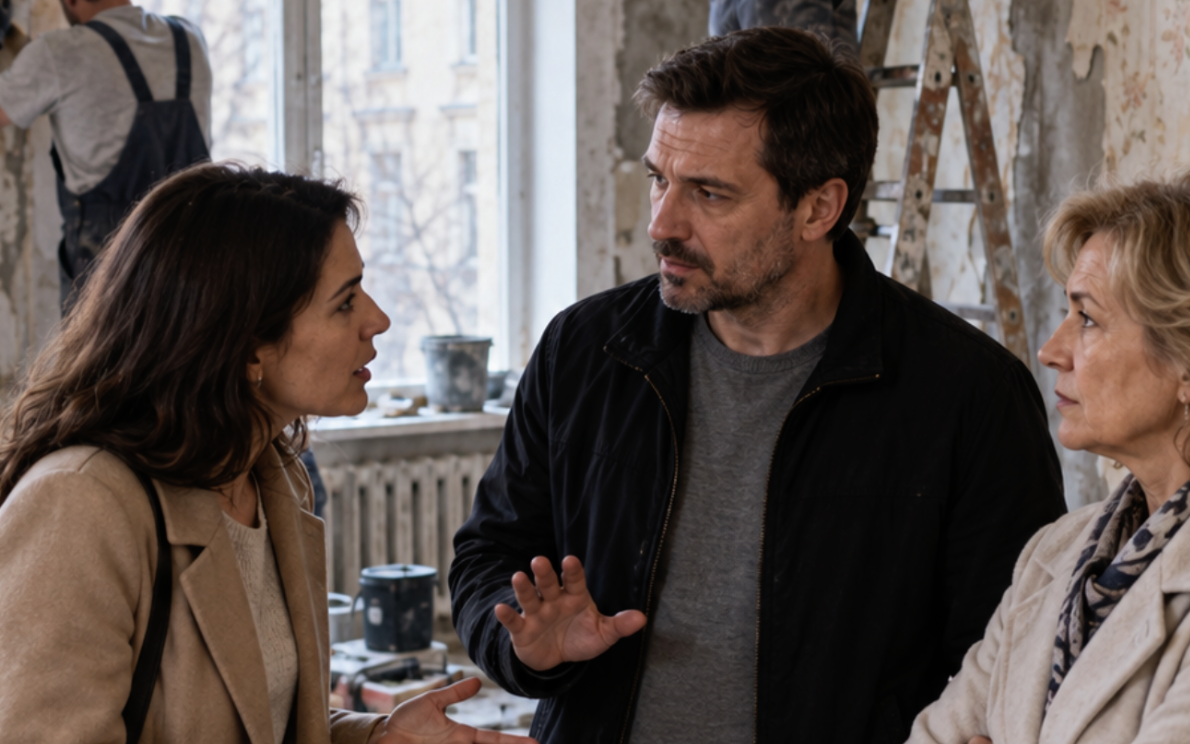
Darya walked down the hall toward the rooms. One doorway had no door. The door itself leaned against the wall, off its hinges, with scrape marks along its edges. Two men were stripping old plaster from a wall, preparing the surface. A power drill lay on the floor beside them.
Alexandra Petrovna stood by the window, pointing something out to them on a sheet of paper. She didn’t notice Darya at first.
“Do this part here,” she was telling a worker. “And when you’ve finished, we’ll remove this wall too. Misha said it could be done—”
“What is going on here?” Darya asked.
Alexandra Petrovna turned. Her face wore an expression Darya knew well: slightly surprised, faintly condescending, like someone interrupted in the middle of important work.
“Oh, Dasha. You’re early today. We got started while you were at work.”
“Started what?”
“The renovation. Misha arranged everything with the crew. We discussed it ages ago. First we’re changing the doors and removing the old finish. Then the wall, like I said.”
Darya looked at the door against the wall, the debris bag, and the workers carrying on as though nothing unusual was happening. For a moment, her mind went blank. She wasn’t angry yet; she couldn’t quite take it all in.
Mikhail came out of the kitchen.
He had apparently been there from the beginning. He had taken the day off work to meet the crew and oversee the start. Darya was supposed to return at six; perhaps he had planned to be gone by then. He hadn’t managed it. He looked a little guilty, but mostly determined, like someone who had expected a difficult conversation and rehearsed for it.
“Dasha, I meant well. You kept putting it off, and the crew happened to become available. Mom helped arrange it. Don’t worry. It’ll be fine.”
“You hired workers to renovate my apartment. Without telling me.”
“Well, it’s our apartment. We both live here.”
“Legally, it’s mine.”
“Dasha, why are you being—”
“Who gave you permission to do this to my apartment?” She wasn’t shouting. Her voice came out level and firm. “Who signed the contract with this crew?”
“I did. Technically, yes. But it’s for both of us—”
“Without my consent. Without my signature. In my apartment.”
Mikhail looked at her, then spoke with the certainty of someone who had decided in advance that he was right.
“We’ve already started the renovation, so don’t make a scene.”
She didn’t make a scene.
She walked past him to the foreman, an older man holding a tablet. He regarded her calmly, as if years on the job had prepared him for all sorts of surprises.
“Are you in charge of this crew?”
“I’m the foreman, yes.”
“I own this apartment. The contract was made without my knowledge or consent. I’m asking you to stop work immediately.”
The foreman glanced at Mikhail. Mikhail began to speak, but Darya continued.
“I can show you the ownership documents if you like. I have an extract from the property register. I’m the owner. My husband and my mother-in-law aren’t.”
The foreman paused and looked from Mikhail back to Darya.
“Understood. Boys, stop,” he said quietly. “Pack up. Until you sort out who has the authority to approve the work, we’re not continuing.”
“Wait,” Mikhail protested. “We signed a contract—”
“You’ve paid a deposit under the contract,” the foreman replied evenly. “You’ll still have to pay for the work already done. But I can’t continue while there’s a dispute like this. Call when you’ve settled it.”
The workers packed their tools without a fuss. Ten minutes later, only Darya, Mikhail, and Alexandra Petrovna remained.
Darya approached her mother-in-law.
“The keys,” she said.
“What?”
“The spare apartment keys. Mikhail gave them to you so you could let the workers in. Please give them back.”
Alexandra Petrovna looked at her son. Mikhail stood there, apparently trying to work out how to salvage the situation.
“Dasha, you’re overreacting. We meant well.”
“The keys, Alexandra Petrovna,” Darya repeated without looking at her husband.
After a pause, her mother-in-law reached into her handbag, took out the keys, and tossed them onto the cabinet. She looked deeply offended.
“Ingratitude is an ugly quality, Dasha.”
“I didn’t ask you to judge my character. Thank you for the keys.”
Alexandra Petrovna left first, upright and silent. The front door shut firmly behind her.
Mikhail stayed. For several minutes, he paced from the kitchen to the room and back to the hallway. Darya sat at the kitchen table, watching him over the coffee that had long since gone cold. At last, he sat opposite her.
“Explain something to me,” he said. “Why does this matter so much? We were going to renovate anyway.”
“We weren’t. You wanted to. I told you now wasn’t the time.”
“You kept putting it off. When would you ever have decided?”
“It’s my apartment, and I decide when to make changes to it and what those changes are.”
“Dasha, I live here too.”
“Yes. And that matters. In a healthy relationship, we would have discussed it together. Chosen a time and a crew. Decided what work to do. Together. Instead, you took the spare keys from the cabinet, gave them to your mother so she could let the workers in, and started removing doors in my apartment without me.”
“I wasn’t tearing down walls. They only—”
“Mikhail.” She waited until he looked at her. “The door is off its hinges. There’s a bag of construction debris in the hall. They’ve stripped plaster from the wall. What exactly were you planning to tell me?”
He said nothing.
“You expected me to come home at six, find the work under way, and accept it because it was too late to argue. You and your mother decided that together.”
“You always turn simple things into something complicated.”
“This is simple?” She glanced at the door still leaning against the wall. “Fine. Then answer me plainly: do you think it’s acceptable to order renovation work in an apartment you don’t own without the owner’s permission?”
“It’s not some stranger’s apartment. I live here.”
“You live here, but the apartment belongs to me. That’s a fact, not an accusation. I’m not telling you to leave. I’m saying some decisions are mine to make, and this is one of them.”
Mikhail stood up.
“You know what? You always make it perfectly clear whose apartment this is. Maybe you should live in it alone.”
He went into the other room. Darya heard him open the wardrobe and move his things around. About half an hour later, he emerged with a bag.
“I’m going to Mom’s. I need to think.”
“All right,” Darya said.
“You’re not going to stop me?”
“No.”
He looked at her for a few more seconds, then left.
Darya closed the door and walked slowly through the apartment, taking everything in: the door against the wall, scratches on its frame, dust on the floor, patches where the workers had stripped the plaster. Other people had put their hands on her home without asking, as if it were already theirs.
She felt tired. More than angry or hurt, she felt the exhaustion that comes from explaining something simple over and over while no one listens. From saying, “This is mine,” and seeing irritation instead of understanding in the other person’s eyes.
She took out her phone and found the number of a locksmith a friend had once recommended.
“Good evening. I need to change a lock. Could you come today?”
He arrived two hours later and fitted a new one.
She also called a carpenter, who could come the following day. He rehung the door and inspected the places where Mikhail’s workers had removed the plaster. It could be repaired, he told her; the damage wasn’t serious.
Darya entered all the repair costs into a spreadsheet, simply so she could see them and know what they amounted to. Mikhail would have to deal with the crew’s contract and deposit himself. He was the one who had signed.
He called two days later.
“Dasha, can we talk properly?”
“Yes. Go ahead.”
“You changed the lock.”
“Yes.”
“That was… harsh.”
“You gave your mother the spare keys so she could organize work in my apartment without me. I changed the lock because I don’t know how many copies of those keys exist now. It seems like a reasonable response.”
A pause.
“Do you want a divorce?”
She didn’t answer immediately. She sat with the phone in her hand, thinking about the past few months—not just the renovation. About how Mikhail had increasingly sided with his mother whenever they discussed the apartment. About how the words “It’s my apartment” had irritated him instead of making sense to him. About how he had stood in her home that Tuesday, utterly certain he was right.
“I think we need to live apart for a while. I need to figure some things out.”
“What things?”
“Do you understand that what you did was wrong? I don’t mean because it hurt my feelings. I mean because it was actually wrong.”
There was a long silence.
“I wanted to make things better for us,” he finally said. “I thought you were just afraid of change.”
“That doesn’t answer my question.”
“Dasha…”
“Mikhail. You took the spare keys from the cabinet and gave them to your mother so she could let workers into my home and start removing the doors. Without my knowledge. That isn’t simply wanting what’s best. You decided the apartment owner’s opinion didn’t matter. Do you understand the difference?”
He didn’t answer. She ended the call.
He called about three more times. Each conversation went in circles. Mikhail explained that his intentions had been good. Each time, Darya asked whether he understood that what he had done was wrong. Each time, he avoided answering.
Alexandra Petrovna called once, at ten on a Sunday morning.
“Dasha, you have to understand that Misha was doing it all for the family. It’s normal for a man to improve his home. You’re too easily offended.”
“Alexandra Petrovna,” Darya said, “the apartment belongs to me. Deciding how to improve it is my right. Mikhail could have suggested it, asked me, or tried to persuade me. Instead, he brought in workers. That isn’t taking care of the family.”
“You’re always talking about your apartment, as if Misha were a stranger.”
“He isn’t a stranger. But the apartment is mine. That’s the truth, not an accusation.”
“A good wife—”
“Alexandra Petrovna, I’m not going to discuss what a good wife should be. Thank you for calling.”
She ended the call.
Then she called her own mother for no particular reason. They talked for half an hour about the weather, a neighbor’s cat, and meeting up the following week. Darya didn’t mention the renovation or Mikhail. She just talked. After they said goodbye, she sat for a long time with the phone in her hands.
Three weeks later, she asked Mikhail to come and collect the rest of his things.
He arrived and packed them neatly into several boxes. They worked almost without speaking. Before leaving, he stopped in the doorway.
“Are you sure?”
“Yes.”
“Maybe we could give it a little more time…”
“Mikhail. I’m sure.”
He nodded and left.
They divorced without a fight. They had no substantial shared property, and Darya had owned the apartment before the marriage. She filed the documents, signed what she needed to sign, and stepped outside. It was an ordinary, unremarkable day. She bought coffee at a nearby kiosk and went to work.
She began renovating eight months later.
By then, she had bought the car she’d been saving for since before any of this happened. The money left over, together with several more months of savings, paid for the apartment work. A colleague recommended a crew. Darya met the foreman herself and asked every question she had about timing and materials. She chose the tiles herself, after visiting three stores, and approved every stage of the work. It was a modest renovation, with no change to the layout and no major demolition. The crew finished in two weeks.
She replaced the doors—not because Alexandra Petrovna had been right, but because Darya herself had wanted new ones for a long time. She chose simple, light-colored doors.
During the work, she stayed with her mother for two weeks. They had dinner together every evening, watched old films, and talked until midnight. It turned out to be a good time together, unexpectedly so.
When Darya returned to the finished apartment, she stood in the hallway for a long while. The new wallpaper and lighting made it brighter, but what mattered most was still there: the thick walls, the wooden window frames, the quiet. She had lived there long enough for the apartment to become truly hers.
She went into the kitchen and put the kettle on—the same old kettle that had spent the renovation in a box. Then she walked back to the hallway and opened the front door, just to look. The staircase. The third floor. Everything as it had always been.
She closed the door with her own key, in her own lock.