Here you go, bloodsucker.”
Dasha slapped a printed sheet onto the counter and pinned it down with a stapler as though the paper might try to escape.
“Twenty-two percent. I sold my soul, my reputation, and the last scraps of my conscience to headquarters for this discount.”
Vlada grabbed the paper with both hands and made a thin, delighted sound no one expected from a grown woman.
“Dasha, you’re a goddess. Seriously. The best thing that ever happened to this city.”
“I’m just an angry woman who knows how to yell at corporate in an accountant’s voice,” Dasha said. “Flight’s on the twenty-second, six in the morning. At six in the morning, you won’t be a goddess. You’ll be a sack.”
“I’ll be a happy sack.”
Vlada pressed the paper to her chest.
“I’ve spent seven years gluing other people’s hair onto other people’s heads. I want two weeks where nobody needs anything from me.”
“You’re brilliant at it.”
“Brilliance doesn’t warm me. Sunshine does. And martinis.”
Vlada left the travel agency and immediately called her husband.
Artyom answered on the second ring. In the background, she could hear pumps humming from the giant aquarium where he worked as a diver.
“We got it!” she announced. “Twenty-two percent off. We can afford it.”
“I knew Dasha would break them eventually.”
“Don’t feel sorry for them. Now listen. New swimming trunks for you because the old ones are an insult to sharks. Hat for me. Sunscreen. Rubber sandals. Medicine kit. And maybe a new suitcase because yours will die before we reach baggage claim.”
“Vlada.”
“Yes?”
“I was four meters underwater twenty minutes ago. Let me breathe.”
“You can breathe on the beach.”
She laughed.
“Two weeks, Artyom. I mean it. I want to lie there and do absolutely nothing. No calls. No favors. Nobody asking for anything.”
“Deal. I’ll stop by Mom’s tonight. Promised to look at her faucet.”
“Fine. Just don’t stay long. We have packing lists.”
That evening, Artyom went to his mother’s apartment.
The place smelled of the renovation that had somehow been going on for seven years. His sister Zhanna was sitting on the sofa, scrolling through her phone with the expression of an offended government.
“Oh,” she said. “Look who finally appeared.”
“Nice to see you too.”
Their mother, Lydia Markovna, came from the hallway wiping her hands.
“Why are you glowing? Get a bonus?”
“Better. Vlada and I are going south. Two weeks. Sea, sand, sun.”
His mother carefully placed the towel over a chair.
“Congratulations.”
Her tone sounded more appropriate for congratulating a neighbor on buying a new refrigerator.
“What’s with the enthusiasm?”
“I’m happy for you. I’m only thinking… does it have to be the sea? That must cost a fortune. You could go to a sanatorium. Or visit your aunt. There’s a river there.”
“A river?”
Artyom laughed.
“I carry oxygen tanks for work. I’ve had enough fresh air. We can afford the trip. Vlada has wanted the sea for years.”
“We can afford it,” Zhanna repeated.
Something in her voice should have warned him.
Instead, Artyom smiled.
“Not millions, but enough for a proper vacation.”
“You promised me money.”
“For what?”
“For Miron. I told you last month we needed things for him. You said you’d help.”
“I said I’d see what I could do.”
“So?”
“So now there’s nothing left. We paid for the vacation.”
Zhanna stared at him.
Artyom, still unaware of the hole he was digging, added casually:
“Vlada handles the money anyway. Talk to her.”
His mother looked at him as if he had voluntarily placed his hand inside a tiger cage.
“Artyom…”
“What?”
But Zhanna had already picked up her phone.
She wasn’t reading anything.
She was calculating.
The next morning, someone rang Vlada’s doorbell as if the building were on fire.
Vlada opened the door with sewing pins between her lips. She was shortening the lining of a summer dress and had been in a wonderfully foolish pre-vacation mood.
“Zhanna?”
She removed the pins.
“Why didn’t you call?”
“What, do I need an appointment to visit family?”
Zhanna walked in and kicked off her sneakers.
“Coffee?”
“I didn’t come for coffee. I came to talk.”
She sat on the hallway stool, folded her hands over her knees and looked like a teacher preparing to discuss a difficult student.
“Vlada, let’s do this nicely. Artyom promised me money for Miron. Yesterday he said everything is with his wife, so I should come to you.”
“How much did he promise?”
“Well… whatever he could give. Maybe forty thousand.”
“Forty thousand?”
Vlada put down the dress.
“What exactly for?”
“For the child!”
Zhanna’s voice rose.
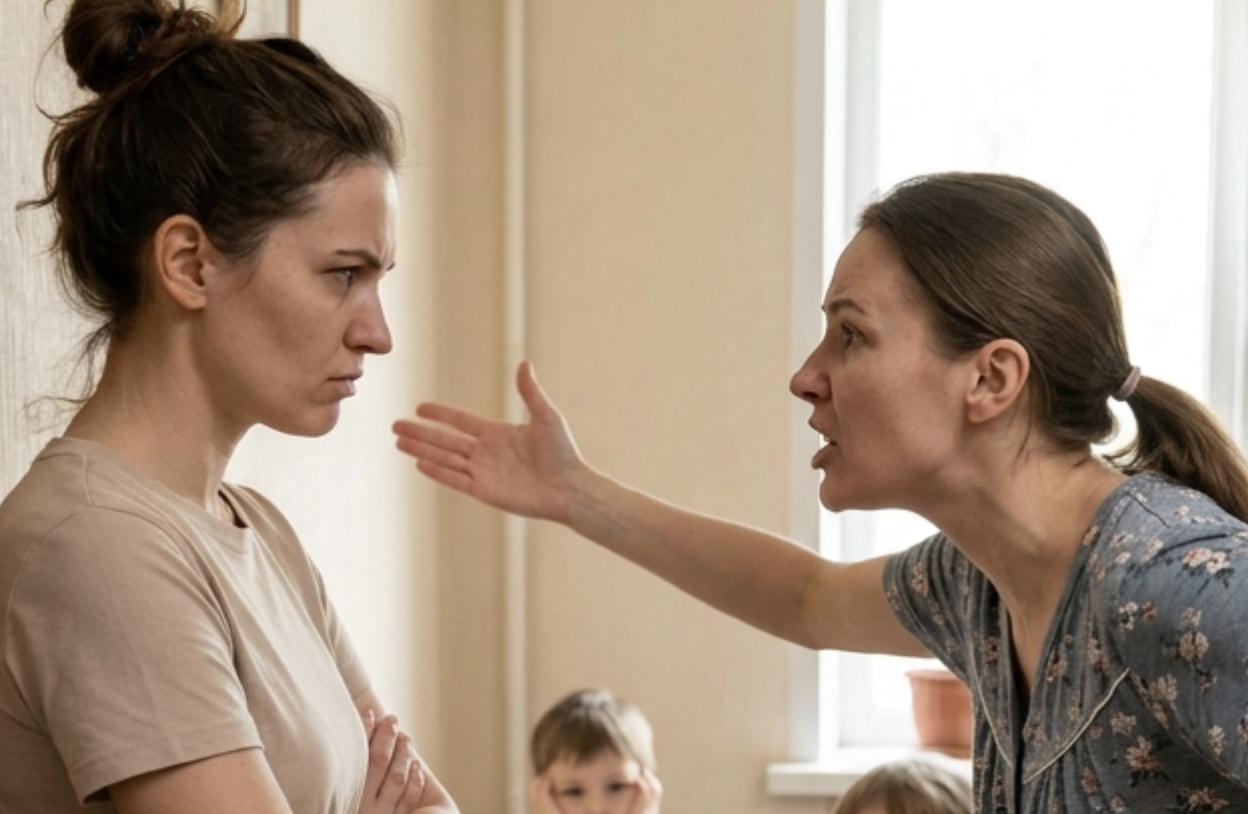
“My children are hungry while you two are running off to the south! Aren’t you ashamed?”
Vlada stared at her.
“Hungry?”
She slowly repeated the word.
“Zhanna, I saw your photos yesterday. Miron has new sneakers. Asya has a tablet. Your hunger seems remarkably well accessorized.”
“The sneakers are on installments!”
“And our vacation is already paid for. What does one have to do with the other?”
Zhanna straightened.
“You’ll cancel the trip.”
Vlada blinked.
“I’ll what?”
“You’ll cancel it. Then you’ll give me the money Artyom promised. And your conscience will be clear.”
For several seconds, Vlada said nothing.
Then she took out her phone and called her mother-in-law.
“Lydia Markovna, hello. Could you please explain what’s happening? Your daughter is sitting in my hallway demanding forty thousand from me and telling me to cancel our vacation—”
“What are you doing?!”
Zhanna jumped up, snatched the phone from her hand and ended the call.
“That conversation was between us!”
“Between us?”
Vlada calmly took the phone back.
“You came into my house and demanded my money. ‘Between us’ is when someone asks for help. You aren’t asking.”
“I’m talking to you as family!”
“As family, you call, explain the situation, ask politely, and accept no for an answer. What you’re doing has another name.”
“You’re insulting me?”
“No. I’m defining the situation.”
Vlada walked into the bedroom.
Zhanna followed.
Vlada pulled a large straw hat from the wardrobe, put it on and looked in the mirror.
“What do you think?”
Zhanna stared at her.
“Are you mocking me?”
“I’m packing.”
Vlada opened the suitcase.
“Sundress. Swimsuit. Second swimsuit. Dasha says we have a room with a view. I’ve always wanted to wake up and see the sea instead of the neighbor’s balcony.”
“You understand what you’re doing?”
“Yes. Folding a sarong.”
“You’re destroying this family.”
“I’m not destroying anything. I worked, saved, and bought a vacation. The person who arrives with an ultimatum is the one creating the problem.”
Zhanna lifted her chin.
“Fine. I expect the transfer by the end of the week.”
Vlada looked at her.
“Excuse me?”
“You heard me. By the end of the week. Otherwise everyone will know what kind of person you are.”
“Tell everyone,” Vlada said. “Just tell the whole story. Quote yourself accurately. Especially the part where you told me to cancel my vacation.”
“You’re rotten.”
“And you’re energetic. Your shoes are in the hallway. Door’s on the left.”
Zhanna slammed the door so hard the figurines in the cabinet rattled.
When Artyom came home that evening, his expression told Vlada he had already heard.
“My mother called,” he admitted. “I was an idiot. I opened my mouth.”
Vlada raised her hand.
“Stop. Opened your mouth about what? That we’re going on vacation? Is that a crime now?”
“I meant I shouldn’t have said it in front of Zhanna.”
“So your sister can’t know we have money because she immediately assumes some of it belongs to her?”
“She has two children.”
“And a husband.”
Vlada stepped closer.
“Egor is alive, healthy, employed. He repairs escalators in the metro. Why exactly am I responsible for financing their household?”
“Don’t twist it.”
“I’m not twisting anything. She came here and ordered me to cancel our trip. She gave me a deadline, Artyom. End of the week.”
“A deadline?”
“Exact words. ‘I expect the transfer by the end of the week.’ And apparently her children are starving while we’re going south.”
Artyom gave a humorless laugh.
“Miron got a scooter worth fifteen thousand last month.”
“Exactly.”
Vlada sat across from him.
“These are our savings. We didn’t win them gambling. We scraped them together for two years. If we want to spend them on a vacation, we can.”
“You’re right.”
“Then why do you look guilty?”
“Because I sent her to you.”
He rubbed his face.
“I told her, ‘Talk to my wife,’ because I wanted her off my back. I basically placed you in front of the firing squad. That’s what I’m ashamed of. Not the vacation.”
The next day, Lydia Markovna asked them to come over and “talk like a family.”
Vlada started getting ready.
“I’m going.”
“No,” Artyom said.
“Artyom.”
“No. Stay home. It’s my sister, my mother, and my mistake. If you go, you’ll spend three hours listening to speeches about starving children. I’ll handle it.”
Vlada studied his face.
“If you come home saying, ‘You have to understand her situation,’ I’ll give you an answer the walls will remember.”
“I won’t.”
“You promise?”
“I’ve promised enough this week. I’m just going.”
At six the next evening, Artyom arrived at his mother’s apartment alone.
Zhanna was there.
So was her husband, Egor.
Their children were playing on the carpet.
Zhanna immediately looked toward the hallway.
“Where’s Vlada?”
“Home.”
“We were waiting for her.”
“You want my wife or my money?”
Zhanna frowned.
“Don’t be rude. Did you bring it?”
“Bring what?”
“The money!”
Artyom turned toward Egor.
“Egor.”
“What?”
“You’re Zhanna’s husband?”
Egor frowned.
“Obviously.”
“Legally married?”
“Eight years.”
“And Miron and Asya are your children?”
“What kind of interrogation is this?”
“Just answer.”
“Yes. They’re mine.”
“And Zhanna is your wife. You live together, pay bills together, raise the kids together?”
“Yes.”
“Perfect.”
Artyom leaned back.
“Then give me money.”
The room went silent.
“What?”
“Money. I need some.”
Egor stared at him.
“We’re going on vacation. But vacations are expensive. Martinis. Fruit. Excursions. Boat trips. So give me forty thousand.”
“Are you drunk?”
“Completely sober. Forty should be enough. You can pay in installments. I’m reasonable.”
Zhanna shot to her feet.
“Have you lost your mind? We have plans! We wanted to buy Miron a proper scooter! The children need clothes for autumn!”
“You can buy the scooter later.”
Artyom waved dismissively.
“Autumn’s still far away. The kids can wear their old clothes. I need the money now. I want to enjoy my vacation properly.”
“Artyom! They’re children!”
“Yes. So?”
“What do you mean, ‘so’?”
“The same thing you meant when you came to my wife and told her to cancel the vacation we spent two years saving for.”
Zhanna froze.
Their mother quietly stood up.
“Artyom. Enough.”
“Not yet.”
He turned back to Egor.
“Forty thousand. By the end of the week. I’ve got a deadline.”
Egor stared at him.
Artyom leaned forward.
“Feels unpleasant, doesn’t it? A grown man comes into your home and demands your money for his own pleasure. Makes you angry?”
Slowly, understanding appeared on Egor’s face.
Artyom finally looked at his sister.
“You don’t like me demanding money from your husband?”
“That’s different!” she shouted. “You have everything! An apartment, decent salaries, a wife who works! You get paid well!”
Artyom laughed without humor.
“So we’re arrogant because we work?”
“You don’t understand how hard it is with two children!”
“I understand perfectly. What I don’t understand is why having children supposedly gives you access to everyone else’s wallets.”
“Don’t bring my children into this!”
“I’m not attacking the children. I feel sorry for them. Because their mother uses them as a shield.”
Egor suddenly stood.
“Zhanna. Be quiet.”
She spun toward him.
“What?”
“Be quiet.”
He looked at Artyom.
“I didn’t know she went to your wife. She told me she talked to you. I thought you offered to help.”
“I didn’t.”
Egor nodded slowly.
“Understood.”
“You’re taking his side now?” Zhanna shouted.
“I’m taking nobody’s side. But tomorrow I’ll buy the kids their jackets myself, like I always do. Just stop telling people we’re starving. I heard that tonight and it made me sick.”
Then Artyom stood.
“Zhanna, here’s what will happen from now on. You will not go to my wife for money. You will not walk into our apartment and give her deadlines. You will not make your problems her responsibility. She is not your emergency fund.”
He looked at Egor.
“Clear?”
“Clear.”
Zhanna looked desperately at their mother.
“Mom! Say something!”
Lydia Markovna folded her hands.
“What should I say? I warned you yesterday. I told you this was wrong.”
Zhanna’s face reddened.
Artyom took his jacket.
“I love your children. They’re good kids. And if one of them were in the hospital and you called me at midnight, I’d come without thinking.”
He zipped his jacket.
“But that’s what family is for. Family isn’t a cash machine.”
Then he left.
For several minutes, nobody spoke.
Eventually Egor lifted Asya into his arms and took Miron’s hand.
“Come on. We’re going home.”
Zhanna stared at him.
“What about me?”
“You can stay with your mother tonight.”
“You’re leaving me?”
“I’m taking the children home. I need some time alone because right now I’m looking at you and I’m not sure I know who you are.”
“Egor!”
“For eight years I thought we were struggling but honest. Now I find out you’re going around telling relatives I don’t feed my family.”
“I didn’t say that!”
“You said I should work harder. I heard you.”
He opened the door.
“I’ve been working underground for twelve years. Seven in the morning, every day. Thanks for noticing.”
Then he left with the children.
Zhanna sat among the scattered toys.
“You happy now?” her mother asked.
“Be quiet.”
“No. I was quiet yesterday. Look where that got us.”
“You always defend him.”
“I defended neither of you. I told you the truth.”
“It’s all Vlada’s fault,” Zhanna suddenly said.
Her mother stared.
“Vlada?”
“She called you. She turned it into a scandal. It was a normal conversation between two women!”
“You went into her house and demanded money.”
“She’ll have children someday too! What if she needs help? She could have understood my situation instead of putting on that stupid hat and packing swimsuits in front of me!”
“So Vlada is the villain.”
“Of course! She turned my brother against me. He used to be kind.”
“He is still kind,” Lydia Markovna said quietly. “He just stopped being convenient. Those are not the same thing.”
Meanwhile, Artyom walked home.
On the way, he stopped at a pharmacy.
“Strongest sunscreen you have.”
“SPF fifty or sixty?”
“Sixty. My wife has pale skin. She’ll burn on the first day and complain for two weeks.”
At home, Vlada was ironing the same shirt sleeve for the fourth time.
Artyom walked in and silently handed her the sunscreen.
She looked at the tube.
Then at him.
“Well?”
He pulled her into his arms.
“We’re going. We’ll lie in the sun, drink tequila, and do absolutely nothing.”
“Nothing?”
“Nothing. I’m not even swimming. I do enough swimming at work.”
She laughed.
“What happened?”
“I asked Egor for forty thousand.”
She stared.
“You did what?”
“I asked him for forty thousand for cocktails and excursions. Gave him a deadline too.”
Vlada slowly sat down.
“And?”
“Zhanna didn’t like it.”
“You’re a terrifying man,” Vlada said with sincere respect.
“I’m ordinary. I just held up a mirror.”
He told her everything.
For a moment, Vlada was quiet.
“I feel sorry for Egor. And the children. Even Zhanna a little.”
“So do I. But we didn’t go looking for this fight. It came into our hallway.”
“She’ll blame me.”
“Obviously. You’re the easiest target. You’re not blood. You’re the wife with the theater job and the wigs.”
“I love being reduced to wigs.”
“I prefer to define you by twenty-two-percent discounts and pirate hats.”
“It’s a beach hat.”
“It’s definitely a pirate hat.”
Vlada finally switched off the iron.
“I really thought you were going to give in.”
“So did I.”
“What changed?”
“I walked into Mom’s place and saw Zhanna sitting there waiting for you. Not me. You. She thought if everyone pressured you together, you’d surrender.”
“And?”
“And suddenly I had no desire to ‘understand her situation.’”
Vlada nodded.
“Thank you.”
“For what?”
“For not making me pay for family peace.”
Artyom looked at the suitcase.
“You know what I realized? If I’d given her forty thousand today, next month it would be eighty. Eventually it wouldn’t even be a request. It would become a subscription.”
“Exactly.”
“I’m her brother. That means if something serious happens, I’m there. Hospital, emergency, disaster—I don’t even ask questions. But being a brother doesn’t mean being an ATM with a friendly face.”
Two days later, Egor went back home with the children, groceries, and a long handwritten list. He and Zhanna spent half the night talking through their finances, sometimes raising their voices, sometimes lowering them.
Artyom and Vlada never found out exactly what they decided.
On the twenty-second, at six in the morning, they were already standing in the airport check-in line: exhausted, irritated, and absurdly happy.
Dasha saw them near the desk.
“Sack,” she told Vlada. “I said you’d look like a sack at six in the morning.”
“I’m a happy sack.”
“Did you bring sunscreen?”
“Yes.”
“Good. Your skin has the color of theater curtains.”
On the plane, Artyom fell asleep seven minutes after takeoff.
Vlada sat by the window with the large straw hat resting on her knees—the same ridiculous pirate hat she had shown Zhanna.
She looked at the clouds below and thought that politeness was probably overrated.
But a husband who knew when to hold up a mirror?
That was worth a great deal.
Vlada put on the hat, slid lower into her seat, and closed her eyes.
The sea was waiting three and a half hours away.
And, unlike certain relatives, it wasn’t going to ask them for anything