«Taras Petrovych, you’re counting as if you’re tossing cement bags onto a truck again. One-two-three, not ONE! TWO! THREE!»
Solomiya, the instructor who looked no older than twenty-five, was laughing without a trace of malice. Taras smiled too, even though his shirt was already sticking to his back with sweat, and once again, his left foot missed the right step.
Inside the cultural center hall, the air smelled of fresh paint and dust from the heavy burgundy curtains. The radiators barely warmed the space, and October had landed cold—by morning, frost was already sparkling on the windowpanes. Along the wall, chairs from yesterday’s amateur concert were still lined up. In the wall-sized mirror, Taras saw the reflection of a sixty-five-year-old man in his best dress shoes—the same ones he wore when walking his daughter down the aisle. Even now, this man’s hands didn’t know what to do with themselves.
«Put your left palm on my shoulder. And hold your right hand just like this, as if there’s a sparrow sitting in it. Don’t squeeze it.»
Taras could picture a sparrow easily—he’d spent his entire life gripping a hammer, a planer, a trowel, and wrenches of various sizes. But how to hold a woman’s hand gently, so it felt effortless to her? That was something no one had ever taught him.
For the third week now, he’d been coming here every Tuesday and Thursday. And for the third week, no one at home knew about it.
* * *
It all started with the gate. At the end of September, the hinge had loosened, so Taras walked out with an oiler and a screwdriver. Iryna was sitting on the bench by the fence with the neighbor Valentyna, both shelling beans into bowls on their laps. Neither of them seemed to notice him or the squeaky gate.
«Valya, do you know what I used to dream about when I was young?» Iryna suddenly asked. «Learning how to waltz. For real—so that the dress would spin and swirl.»
«You?» Valentyna laughed. «Why didn’t you ever learn?»
«When would I have? First Olenka came, then two years later Andriyko. Then there was the garden, the cow, my mother-in-law. Then the grandkids arrived. And who would I have danced with? My Taras is always by the tables at weddings—bringing a bench, rolling a barrel here and there. Dancing’s just not his thing.»
She said it lightly, without any reproach, the way you’d talk about the weather. Valya just snorted, and their conversation drifted on to the price of onions at the market.
Taras just stood there by the gate with his screwdriver, even though the screw had long since been tightened.
That night, he couldn’t fall asleep for ages. He lay there, going over every gift he’d given her during their forty-two years together. The washing machine he’d hauled in from the district center on Stepan’s trailer, huffing it into the house while Iryna held the door. The gas stove with an oven, because the old one was barely hanging on. Sheepskin boots, when Iryna had once mentioned her feet froze at the market in rubber ones. And every March 8th, flowers—three tulips from the market, wrapped in cellophane.
Everything practical. Everything with a purpose. Iryna had always thanked him for each gift and never asked for anything. But now, lying in the dark, Taras realized that in forty-two years, he’d never once asked her what she truly wanted for herself—not just for the house.
By morning, he knew exactly what he had to do.
* * *
The announcement for the adult dance club hung on the doors of the cultural center, right next to the library schedule. Taras read it three times. Twice he wandered across to the shop opposite and came back, and only on the third pass did he finally tug at the door handle.
Solomiya listened to him attentively, never once smiling. Later, he was truly grateful to her for that.
«For the anniversary, you say? How much time do we have?»
«Three weeks. Maybe a little more.»
«We’ll make it,» she said with such confidence that Taras almost believed her.
At home, he needed to come up with something to say. Taras wasn’t good at making things up—nor did he like it—so he went with something that sounded most believable: his old friend Stepan Markovych was replacing the floor in his summer kitchen and had asked for help.
When it came to Stepan, though, he had to tell the whole truth. Stepan was silent for a long time, then burst into such laughter that the cat jumped off the windowsill.
«You? A waltz? Taras, at your grandson’s graduation you spent half the evening propping up the wall!»
«That’s exactly why I’m doing this,» Taras grumbled.
Stepan stopped laughing and patted him on the shoulder.
«Off you go, dancer. If Iryna asks, I’ll say you helped me move half my kitchen. I’ll even praise you for it.»
Iryna only asked once: whether he was hungry over there. From then on, every Tuesday and Thursday, she packed cabbage buns “for Stepan” in his bag. Taras ate the buns himself, sitting on the bench outside the community center, because after the lesson he was as hungry as after a whole day on the scaffolding.
* * *
The hardest part turned out not to be memorizing the steps. The hardest thing was getting his body to listen. Legs used to standing steady on a ladder didn’t want to glide across the parquet. After three circuits around the hall, his back reminded him of every bag he’d lifted in his life. In the evening, Taras would gently lower himself onto the bed, and Iryna would ask:
«So, Stepan’s boards giving you trouble?»
«Yeah, they’re oak,» he’d reply, and he always felt a pang of guilt.
In the second week, for the first time, he danced the whole sequence without a mistake. In the third week, Solomiya turned on the music and said, «Now, no counting. Just listen.» And he did listen. A slow waltz floated under the high, ornate ceiling, and suddenly Taras stopped thinking about his feet. All he could think about was Iryna.
«That’s it,» Solomiya said quietly when the music ended. «That’s how you should dance with her.»
* * *
He bought the dress in the regional center, taking the first bus at six in the morning, telling everyone he needed spare parts. The shop assistant, a woman his age, looked at him suspiciously at first. But once she understood who he was buying for and why, she started pulling out one dress after another from the racks herself.
«What size does your wife wear?»
Taras hesitated. He knew her shoe size, her glove size as well. But the dress…
«She’s just about to here on me,» he said, placing his hand under his chin. «And when I hug her, my arm fits just right.»
The shop assistant gave him an odd look, blinked, and quickly turned back to the rack.
They chose a dark blue dress with long sleeves and a skirt that flared out at the bottom. «So it’ll twirl,» Taras said, and the shop assistant nodded as if she understood perfectly. She tied up the box with a satin ribbon.
At home, while Iryna was visiting Valentyna, Taras tore a page from his grandson’s math notebook leftover from summer, and using a carpenter’s pencil, wrote in his neatest letters possible:
«I invite you to our very first real dance.»
He thought for a second and added at the bottom: «Yours, T.»
* * *
The anniversary fell on a Saturday. The kids called in the morning, and Olenka promised to bring the grandkids over next weekend. Iryna baked apple pies and put the kettle on. Outside, a fine, cold rain drifted down, dahlias dug up for the winter were drying in the hallway, and the whole house was filled with the smell of baked dough and cinnamon.
The box was in Taras’s workshop, hidden under a tarpaulin. He went out there twice, supposedly to check if he’d locked up the rabbits, and both times came back empty-handed.
Now he sat at the table over a cup of tea that had long gone cold, unable to make himself get up.
What if she laughs? Not maliciously—no, Iryna never laughed to hurt anyone. But maybe kindly, the way you laugh at children: «Taras, really? At our age? A dress? Where would I even wear it, to go milk the cow?» And she’d be right, of course. He’d get over it, obviously. Just three weeks, and Solomiya, and the pies on the bench, and that waltz under the stuccoed ceiling—all of it would become just a strange little adventure for an old man who’d suddenly gotten a wild idea.
«What’s up with you?» Iryna sat across from him, resting her chin in her hand. «You’ve been out of sorts all evening.»
Taras exhaled, stood up, went out to the workshop, and came back with the box. He set it down on the oilcloth, between the sugar bowl and the plate of pies.
«I’m sixty-five now, Iryna,» he said, surprised himself by how rough his voice sounded. «And for the first time in my life, I’m afraid to give you a gift.»
* * *
Iryna untied the ribbon slowly and carefully, just as she always did everything in life, so it could be used again later. She lifted the lid. She saw dark-blue fabric and froze. Then she took out the note and read it. She read it again.
And she was silent.
She was quiet for so long that Taras could hear the clock ticking on the wall and the rain pecking at the window. He had already taken a breath to say something like, «it’s okay, we can just exchange it,» when Iryna suddenly got up and left the room.
He heard the wardrobe door creak open. Something rustled on the top shelf, where she kept documents, letters from the kids, and a cookie tin filled with all sorts of odds and ends. Then Iryna returned and placed a small, black-and-white photo with a bent corner in front of him.
At first, Taras didn’t recognize it. A village yard, long tables set under a tent, musicians with an accordion and a trumpet. Off to the side, near the fence, there was a girl with a long braid in a light dress. A few steps away from her, a boy in an embroidered shirt, hands in his pockets, looking off to the side.
«That was at Mykhailo’s wedding,» Taras said. «Your cousin. We…»
«That’s when we first met,» Iryna said quietly. «The musicians started a waltz. All the couples went to dance, but I stood by the fence and waited. I thought: now that tall, dark-haired guy who’s been looking at me all evening will come over. But he just stood there for a while and then went to help the men move the tables.»
Taras remembered. He remembered how his cheeks burned, how his hands shoved themselves into his pockets. How he decided a girl like that would never dance with him anyway, and hauling tables was better than just standing around in the yard for everyone to see and laugh at.
«But then you walked me home,» Iryna said. «And the next evening too. And a year later, we got married. Only, we never did have that waltz.»
She touched the photo with her finger, that girl by the fence.
— Tarasyk, I’ve waited forty years for you to invite me…
Her voice trembled, and she laughed. That same laugh that had always made him uneasy. Only now, tears were streaming down her cheeks, and this time, the laughter wasn’t about him at all.
* * *
Iryna tried on the dress right there in the bedroom while Taras stood outside the door, not knowing what to do with his hands. Just like back then, by the fence. Then she came out, stood in the middle of the kitchen, and tugged at the hem of her dress.
— Well? Just don’t you dare laugh.
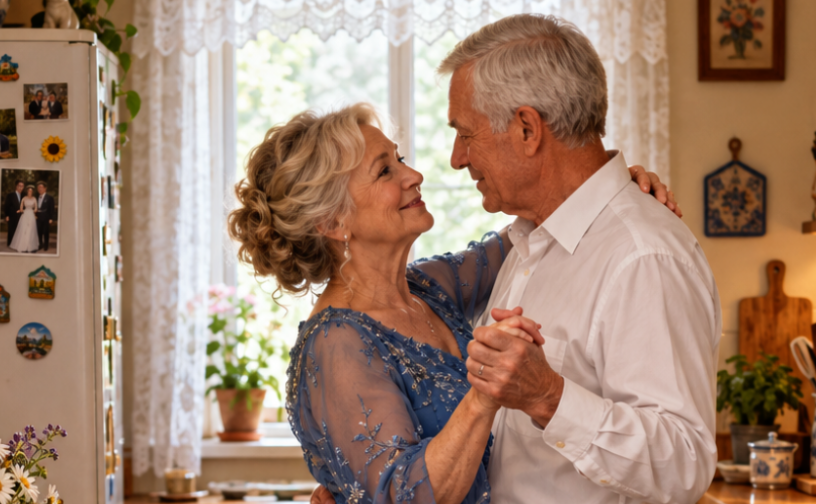
He didn’t laugh. Instead, he took out his phone—where his grandson Matviyko had set everything up for him over the summer—and played the only tune that Solomiya had saved. A slow waltz filled the kitchen.
There were only about five steps between the table and the stove. Taras placed Iryna’s left hand on his shoulder, gently took her right in his own—careful as if holding a sparrow—and started to lead.
One-two-three. He was counting silently in his head, but Iryna must have sensed it, because she softly whispered into his shoulder:
— You’re counting. I can hear you.
— I am.
— Don’t. I’m not letting you go anyway.
They bumped into a chair, Iryna almost stepped on his foot, and both started laughing. The pies were cooling on the table, the tea in Taras’s cup had long since gone cold, and the rain kept tapping at the window. None of that mattered to them.
On Thursday, Taras didn’t come to the community center alone. Solomiya glanced at the woman in the dark blue dress under her open coat, then at him, and for the first time in three weeks, she flashed a wide smile.
— So this is who we were counting for, Taras Petrovych.
That evening, Taras didn’t need to count anymore.