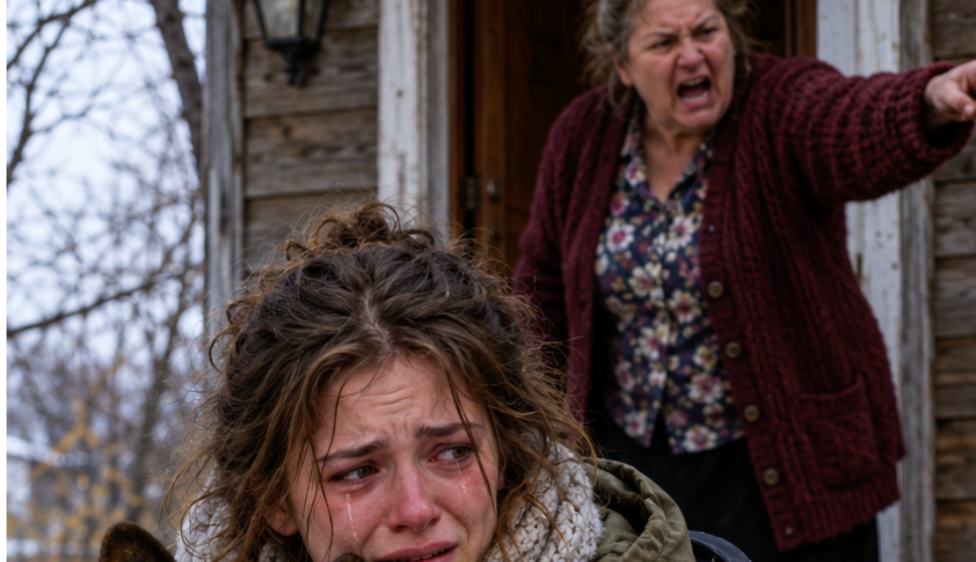
«Take the dog and don’t come back here again,» Aunt Zoya said, bracing the gate with her knee. «Your grandfather left her to you, so you should be happy.»
She set my suitcase down on the wet gravel. Next to it, she put a metal bowl, which clinked against a stone. Tuman, the old German shepherd, pressed up against my leg. One of his eyes had been cloudy for ages, while the other watched my aunt so intently, it was as if he understood every word.
Nine days ago, Grandpa Alexei Fyodorovich passed away. That morning, we were at the notary and learned the details of his will, written two years earlier. He left the house and property to his son Boris, his savings to his daughter Zoya and her grown son Gleb, and to me, his granddaughter Nadezhda — Tuman, the dog. The notary warned us that we still needed to file claims to figure out exactly what was still in Grandpa’s name at the time of his passing. But my relatives only heard the parts they wanted.
At the office, Gleb even whistled. He’s thirty, but still talks about money as if tomorrow someone will just hand him exactly what he needs.
«Nadya got the watchdog,» he told his mother. «Comes with a bowl. But the watchdog can’t even tell the gate apart anymore.»
I told him to stop talking. Gleb just smirked, and Uncle Boris looked away. After the office, they headed straight to Grandpa’s house. By evening, they started clearing out the rooms «for sale.» Zoya took old photos off the wall, while Gleb taped a note with the possible price of the house onto the kitchen table. I tore it off, and Aunt Zoya snapped:
«Don’t touch that! Boris is the owner now. You’ve been living here for three years with everything already done for you. You should be grateful we’re not asking you to pay for staying here.»
Three years. I could list every morning Grandpa needed my help to get up, every night I lay awake listening to his breathing through the wall. But to them, any words from me sounded like excuses. I gathered my clothes and Grandpa’s old wool vest he used to give me in the evenings. Zoya yanked it out of my hands: «That’s dad’s, leave it.» Then, deciding it was no good, she tossed it out onto the porch after my suitcase.
Uncle tried to ask if they could give me a week, but his sister cut him off. In the end, Boris silently carried out Tuman’s leash. He didn’t look at me when he closed the door.
It was drizzling outside. Through the windows, shadows of relatives moved about the house, while the dog and I stood by the car Grandpa once helped me buy. I still didn’t know that no one had read his most important instruction today.
Three Years by the Stove
Before I moved to the village, I worked at the district library and was planning to get married. I was twenty-nine. Grandpa fell seriously ill, and Boris said that he had to deliver construction materials and couldn’t leave his orders. Zoya claimed her job and household chores kept her busy. Gleb visited once, walked around the yard, and asked how much a house with a sauna would fetch these days.
I came for a week and ended up staying three years. My fiancé called every night at first, then less and less. In the end, he said he’d been offered a position in the regional center and wouldn’t wait any longer. I wished him well, hung up, and went to Grandpa—he was struggling to button his shirt at the time.
Not everything was noble and beautiful. Sometimes I got annoyed by spilled soup and my own lack of sleep. One day, in frustration, I told Grandpa that I just couldn’t do it anymore. He looked at me for a long time, then slowly pushed a piece of paper across the table and wrote with his left hand: “You have the right to be tired.” I felt ashamed, but he wouldn’t let me apologize. Instead, he asked if I could open the window—Fog had sprawled out by the stove, making the room stuffy.
Before he got sick, Grandpa worked with leather—he made belts, horse harnesses, and fixed bags. In the annex, he had a big workbench, and awls and wooden forms hung on the wall. When his hand started failing him, I would help push the thick needle through the pre-made holes. Grandpa would laugh, saying that even my librarian fingers were good for something.
Fog followed him everywhere. If Grandpa got up from his chair, the dog stood up too and patiently waited while he put on his slippers. It was Fog who woke up the neighbors one day with desperate barking when Grandpa needed help in the yard. After that, Grandpa started calling him his senior assistant.
Family only visited on major holidays. Boris brought a box of chocolates and always asked where Grandpa kept his documents. Zoya tried to figure out if the china cabinet would fit in her living room. Gleb debated how much the house would be worth if the workshop was removed and the yard was leveled. After they left, Grandpa would sit by the window, stroking Fog behind the ears for a long time.
Last spring, he asked me to take him to the notary. He was direct: he wanted to give me the house so I wouldn’t be left without a roof over my head. I argued and cried, but he got upset: “You think I’m helpless? I decided this myself.” The contract was signed by both of us. The notary said she would send the papers for registration, but all I remember from that day is Grandpa’s request not to explain anything to the family yet. I didn’t check the result or get the new ownership statement. Later, Grandpa never brought it up again.
Now, hearing the old will being read, I was confused. Maybe something went wrong with the paperwork? Maybe Grandpa had changed his mind after all? I didn’t want to blame him after everything he did for me. My hesitation cost me dearly.
A Stitch That Wasn’t There Yesterday
When I got to the former owner’s house in town, she was happy to see me—until she saw Fog and hesitated. She had a cat in the house and wouldn’t agree to take in an old dog. I didn’t even bother calling my friend—her younger son had a serious allergy to pet fur.
By midnight, we were sitting in the car by the parking lot of a 24-hour bakery. I bought Fog some food, but he turned away. Since Grandpa passed, the dog had barely eaten. The car windows were fogging up. The old collar was rubbing Fog’s neck, so I unbuckled it to let the skin dry in the warm air from the heater.
That’s when I noticed a row of new stitches on the inside of the collar. The rest of the leather was worn, but the waxed thread was still bright. I recognized that stitch: Grandpa always finished with two short stitches side by side, so the thread wouldn’t unravel. Just a few days before he left, I’d seen him turning the collar over and over in his hands. I figured he just wanted to fix it.
Using manicure scissors, I carefully snipped the thread. Between two layers of leather, I found a flat packet wrapped in thick plastic. Inside was a letter, folded in four. The handwriting was shaky—Grandpa wrote slowly after his illness, but I recognized his script instantly.
«Nadyushka, if you’re reading this, it means Tuman is with you. You didn’t leave him, just as I hoped. Do you remember our trip to the notary? It all worked out. The house is in your name, and I left proof. Let them read my old will first—it’ll show who was thinking about what. But if they start taking over, don’t put up with it, defend what’s yours. In the garage, behind the boxes of pet food, you’ll find papers and a big envelope for everyone. Arkady Sergeyevich knows where to look. He’ll also tell you about the money. I’m sorry you’re left to sort this all out after me. Take care of Tuman. Grandpa.»
I read the letter three times. At first, I got angry: why set up such a test if he knew how they treated me? Then I remembered his fingers, struggling to push the needle through thick leather. He was preparing a way for me to protect myself, while he still could.
Tuman stretched his muzzle toward me from the back seat. I gave him some water in the travel bowl, then poured out some kibble. For the first time in days, he started to eat. I sat beside him, clutching the letter and crying so hard I couldn’t even close the packet back up.
In the morning, I received an electronic statement confirming ownership of my house and land. Under «owner,» my name was listed, with last April as the registration date. I immediately called Arkady Sergeyevich, Grandpa’s neighbor. He listened to me and said only: «Come over. You won’t need the key for my gate, I’ll open it myself.»
The box that almost got taken away
Arkady Sergeyevich was seventy-four. He and Grandpa had been friends since they were young—repairing the village club together and helping each other gather firewood. The neighbor put the kettle on, spread out my printouts on the table, and studied the letter for a long time.
«He asked me to keep an eye on you,» he finally admitted. «But I thought Boris would at least have a bit of conscience. I was wrong.»
Just then, the neighbor from across the street called. She had seen a big container by Grandpa’s garage: Boris and Gleb were tossing tools out, and Zoya was directing what to save for buyers. We went outside and saw Grandpa’s box of belts being thrown into the metal dumpster. Next came a wooden chair he’d built with his own hands.
Arkady Sergeyevich wanted to storm over and argue right away. I stopped him: we needed to get the documents out of the garage first, and the relatives had the only key. We circled the property along the street. Through cracks in the gate, I spotted the box of animal food—it was already at the top of the dumpster, next to bags of wood shavings. When the relatives left for lunch, we approached the container parked by the gate. I put on work gloves, while the neighbor held a small step ladder. I managed to reach the box without climbing inside. At the bottom, under empty cans, was a thick packet with the deed of gift and a second envelope sealed by Grandpa’s own hand.
«Hey! What are you taking from us?» someone suddenly shouted from behind.
Gleb came out through the gate and shone his phone’s flashlight right in my face. I clutched the bag to my chest. Arkady Sergeevich stood next to me, holding Tuman tightly on a short leash. The dog growled quietly but didn’t step forward. Gleb backed away, but immediately started yelling that we were stealing grandpa’s things.
“They were thrown out,” I replied. “And the documents are in my name. If you want to argue about it, let’s talk with the district officer present.”
At the neighbor’s house, I took a photo of the contract and pulled a notarized copy out of my bag. Then I messaged Boris, including an excerpt: “The house and land belong to me. Do not sell, remove, or dismantle anything. I’ll come by for the keys tomorrow.” He read my message and didn’t reply. An hour later, Zoya called me and yelled that I had tricked grandpa. I offered to meet with a lawyer, but she just hung up.
The next day, I came with Arkady Sergeevich. When I saw workers in the yard, I called the district officer and reported that strangers were dismantling property registered to me. He arrived, listened to both sides, and took a statement about the removal of items and damages. He made it clear he wasn’t going to resolve inheritance disputes.
By that time, my relatives had already cut down the old apple tree—every fall, grandpa would pick the biggest fruit from it for me—and they’d started removing part of the workshop’s roof. I took photos of the yard, stopped the workers by showing proof of ownership, and asked them not to touch anything else. The foreman took his tools and said he’d only come back after speaking to the real owner.
It didn’t give me any relief. That evening, I stood in front of the dismantled addition, holding grandpa’s awl in my hands, thinking how easy it is to lose everything if you stay silent too long. I could have come a day earlier myself. Arkady Sergeevich didn’t try to comfort me. He just helped pack the remaining tools under the dry shed.
The money nobody got
Meanwhile, Boris managed to find buyers. While we were looking for the box, he showed the house to a young couple from the city and received three hundred and sixty thousand rubles from them based on a preliminary agreement signed in his own name. The realtor said she’d request documents later, before the main deal, and the buyers believed Boris because he insisted the house was his by inheritance. He was quick to take the money for his car repairs and to pay his supplier.
I learned about this from our neighbor, who overheard Boris bragging about the deposit. Arkady Sergeevich and I found the agency, handed over an official extract, and asked them to contact the buyers. I didn’t want strangers to show up with the rest of the money and learn the truth at the gate. The realtor replied that Boris claimed our documents were fake and was gathering relatives for a talk on Saturday. The buyers decided to come with a lawyer.
Meanwhile, Zoya found out that there was almost nothing in the accounts grandpa had left her. She stopped me in the bread aisle at the store, accused me of stealing grandpa’s savings in front of the cashier, and threatened to go to the police. Gleb, standing nearby, said he’d already gotten a car loan, planning to pay it off with his share of the inheritance. I kept quiet because I didn’t know the whole truth about the money.
Arkady Sergeevich drove me to the shelter outside the district center. A new sign at the gate read “Warm Home,” and behind it stretched rows of enclosures with wooden floors and insulated doghouses. The shelter’s director, Antonina Lvovna, spotted Tuman and immediately recognized him. She crouched down, and the dog—who hadn’t even lifted his tail for days—suddenly started wagging it with such joy that my eyes filled with tears.
It turned out that Grandpa had visited here with a neighbor a year ago. He saw the older dogs, the ones that hardly ever got adopted, and decided to use his savings to help. According to bank documents shown by the director, he transferred 2,400,000 rubles to the shelter for insulating the pens and buying food for elderly dogs. The money wasn’t lost or stolen: it was spent exactly as he had directed, while he was still alive.
Antonina Lvovna walked me through the yard. On one enclosure, there was a small plaque with Grandpa’s last name. Inside, an old, gray stray with three legs was warming itself, and two puppies lay sleeping nearby. I touched the edge of the plaque and remembered how Zoya had laughed at Tuman by the gate. Grandpa had seen these dogs before I ever did, and he found a way to give them a warm place for the winter.
“Aleksey Fyodorovich said he had a granddaughter,” the director told me. “He asked, if you ever came, not to thank him. It’s better to visit and help out. And he also said: ‘She knows how to care for others, but she should also learn to stand up for herself.’”
On Saturday, I decided to read the second letter in front of the whole family. But first, I called the buyer and told her: the house isn’t for sale and she should ask Boris for her money back. The woman was silent for a long time, then asked if she could come with her husband and a lawyer. I told her that’s exactly what I wanted.
The day Grandpa’s letter was read aloud
That morning, three cars pulled up in front of Grandpa’s house. Boris stepped out in a new jacket, Zoya adjusted the collar of her expensive coat, and Gleb fidgeted with car keys in his hands. At the gate stood the buyers—Matvey and Sveta—with their lawyer and a realtor. Sveta, waiting for a baby, looked at the house as if she could already picture a stroller by the porch.
I came out of the side gate with Tuman and Arkady Sergeevich. Boris started to walk toward me, but Zoya got ahead of him.
“You’ve come back again?” she asked loudly. “What, want to take the dog back too? No way. We’re selling the house.”
“You can’t sell it,” I said, now speaking to the buyers. “It belongs to me. Here’s an extract from the registry and the notarized gift agreement.”
The lawyer took the documents, compared the data with an extract he’d already obtained on his own, and asked Boris to show paperwork proving his right to sell the property. My uncle offered a copy of the will. The lawyer explained to him that the old will doesn’t make him the owner of a house that, while Grandpa was alive, had already been transferred to his granddaughter. The inheritance proceedings weren’t even completed.
“That can’t be,” Boris whispered. “He wrote in his own hand that the house is mine.”
“He wrote that before he gave it to Nadya,” said Arkady Sergeevich. “And nobody forced his hand. He understood perfectly well what he was doing.”
Zoya demanded to contest the gift, and Gleb shouted that Grandpa couldn’t have handled such things on his own. I showed them a copy of the notary-certified agreement and told them that if they wanted to go to court, they were free to do so. But today, I said, they needed to stop making decisions about my property.
Matvey turned to Boris and asked him to return the money he’d received. The lawyer explained that the potential size of the claim would depend on the terms of the signed agreement and how it was made; if an agreement couldn’t be reached, the matter would have to go to court. Boris looked at his sister in confusion, almost hoping she’d pull the necessary sum out of her purse. Zoya looked away.
I took out Grandpa’s envelope. On it, in shaky handwriting, was written: ‘Read this if they start dividing up what doesn’t belong to them.’ Inside was a single sheet and a small empty envelope for Gleb. I slowly read Grandpa’s letter out loud.
Grandpa didn’t scold them or call them bad people. He listed three simple things: who came when he asked for help; who cared about what he needed; who would agree to take in Tuman if Grandpa could no longer feed him. He wrote that the old will was made when he still hoped to see his children more often. Later, he changed his mind and decided while still alive to handle the house and money as he saw fit. ‘Nadya,’ the letter ended, ‘you don’t have to justify your care to anyone. And to you three, I leave what you yourselves brought into this house: the memory of your own actions.’
Gleb ripped open the little envelope right at the gate. There was nothing inside. He clenched the paper, but for the first time all morning, he had no words. Zoya started blaming her brother for rushing the sale. Boris shot back that she was the one who threw out Grandpa’s things and ordered the apple tree cut down. I listened for a few seconds, then opened the gate and asked them to take their personal bags. Grandpa’s cabinet, tools, and books were to stay. They gathered their things with me watching and left without further argument.
A week later, Boris returned all the money to Matvey and Sveta. After talks with the lawyer, he paid them separately for expenses related to the failed deal. Zoya still tried to contest the gift, claiming Grandpa didn’t understand what he was signing. The court reviewed the documents and circumstances but found no reason to overturn the agreement. After a separate complaint, my aunt agreed to pay part of the cost to repair the workshop’s damaged roof. Gleb ended up selling the car he’d bought on credit for less than he’d hoped and took a second job to pay off the remaining debt.
It took some time before I could get back to normal life. First, I fixed the gate, then, with Arkady Sergeyevich, put a new roof on the workshop. He helped me level the workbench so the legs wouldn’t wobble on the old wooden floor. I took Grandpa’s awls and waxed threads out of the box and, for the first time, sewed a collar for the big dog by myself. The stitches came out uneven, so I had to take them apart and start over.
Late in the autumn, I put a new soft collar on Tuman. I placed the old one, with its ripped secret pocket, in the drawer of my grandfather’s workbench. In the pocket of the wool vest—which I finally hung by the stove—I found another note: “Don’t forget to feed yourself, Nadyushka. Tuman will remind you.” I read it aloud, and the dog lifted his gray muzzle from the rug.
In the spring, I brought home a ginger puppy from the shelter, one they hadn’t been able to find a home for. At first, Tuman grumbled when the little one got tangled under his paws, but within a week he let him snuggle up beside him. One morning, I opened the workshop door and saw them both sleeping in a sunbeam by the workbench. The old dog had gently rested his chin on the puppy’s back. I didn’t wake them—just closed the door softly so the draft wouldn’t disturb them.