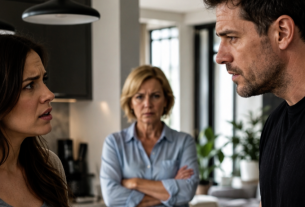
“You do understand that this is the right thing to do, don’t you? You don’t have children, and Kristina is due in two months,” her mother said calmly.
Valentina Andreyevna was already taking off her coat in the hallway and arranging her bags along the wall as though the move had been agreed upon long ago.
“Mom, what are you even talking about?” Oksana asked in confusion.
“The apartment. I’m giving it to the young couple. And I’ll stay here. I don’t need much space.”
Oksana stared at her mother, unable to believe that she had seriously decided to give her home to her granddaughter without consulting anyone and then simply move in with her daughter.
A wave of indignation slowly rose in her chest. Outside, a light April rain was falling, and droplets ran down the glass, blurring the familiar outlines of the courtyard. Oksana suddenly thought that the boundaries of her own life—the life she had spent years building—were now being blurred in exactly the same way.
“Dima, did you hear that?” Oksana whispered when her mother went into the room.
Her husband stood in the hallway, clutching the car keys in his hand. He had just returned from the store and had caught the beginning of the conversation.
“I heard,” Dmitry replied curtly. “But this is absurd.”
Oksana leaned against the wall. A familiar pain from childhood throbbed in her head—the feeling that her opinion did not matter.
It had always been different with Artyom. When her brother turned twelve, their mother bought him a new bicycle even though money was tight. Oksana had been eight and dreamed of getting roller skates, but she kept quiet. Artyom traveled to football tournaments, and their mother took time off work to go with him. Oksana stayed with a neighbor.
After their parents’ divorce, everything became even more obvious. Valentina Andreyevna lived for her son: she helped him with his studies, found money for his first car, and celebrated his wedding as though it were the most important event of her life.
Oksana became accustomed to handling everything on her own. She graduated from university with honors, found a job at an insurance company, and met Dmitry there.
They paid the mortgage together, gave up vacations, and renovated the apartment in the evenings and on weekends. The apartment became their shared achievement. They had no children—after several years of examinations and treatment, the subject had become closed.
Artyom had been married for a long time. His daughter Kristina was now expecting a baby. At every family dinner, their mother talked only about her future great-grandchild and how the young couple needed a home of their own.
“She’s serious,” Oksana said quietly.
The first strange signs had appeared back in winter. Oksana stopped by her mother’s place and discovered that the old display cabinet had disappeared from the living room.
“I sold it,” Valentina Andreyevna explained briefly. “It was only taking up space.”
Then the bookshelves disappeared, followed by half the dishes.
“I gave them to Kristina. She’ll need them,” her mother said when Oksana asked about their grandmother’s cups.
At a family dinner in March, Valentina Andreyevna did not stop talking for a single moment.
“Can you imagine? Kristinochka found such a beautiful stroller yesterday! Silver, with big wheels. And they’ve already chosen a crib—white, with a canopy. Just like in a fairy tale!”
Oksana ate her salad in silence. Dmitry sat beside her and occasionally squeezed her hand under the table—he understood everything without words.
A week later, Oksana accidentally overheard a phone conversation. Her mother was standing on the balcony and did not notice that her daughter had returned for a forgotten scarf.
“Don’t worry, Artyom. They’ll have their own place soon. I’m telling you—it’s all settled.”
At the time, Oksana did not attach much importance to those words. She assumed her mother was talking about some plans her brother had made.
But in April, Artyom called with a request.
“Oksana, can you go to Mom’s place? Some boxes need to be moved. I’m busy, and they’re too heavy for her.”
She went over and helped load the belongings. There were many boxes—clothes, bed linen, and photo albums.
“Mom, are you moving?” Oksana asked, trying to make her voice sound light.
“I’m just clearing out the junk,” her mother replied evasively.
On the way home, an unpleasant thought occurred to Oksana for the first time: the decision had already been made. Without her. As always.
The old resentment rose in her chest—the same childhood pain she had felt when she realized that there was one important child in their family.
And it was not her.
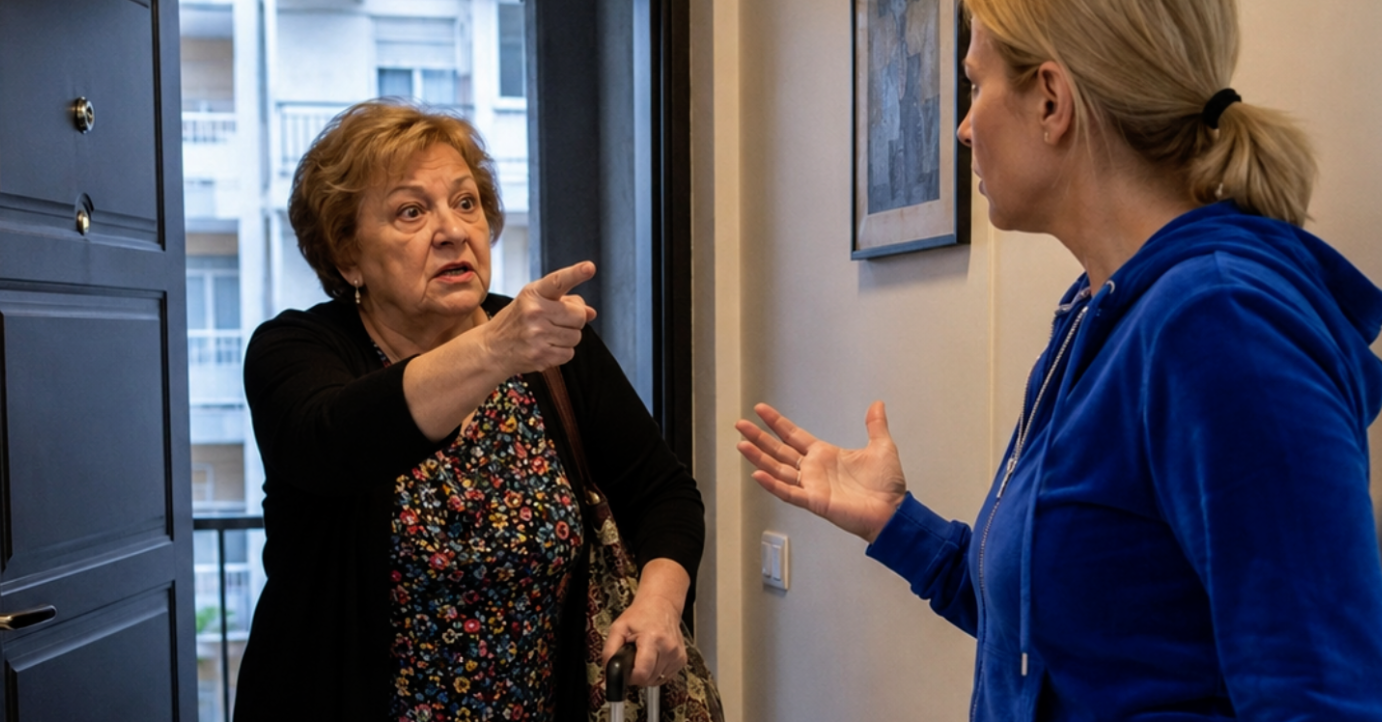
On Saturday morning, Valentina Andreyevna appeared at the door with two enormous plaid bags and a battered travel suitcase.
“Come in, Mom,” Oksana said in confusion.
While she put the kettle on, her mother walked into the living room, settled herself on the sofa, and straightened the cushions. Dmitry came out of the bedroom, still not fully awake.
“Valentina Andreyevna? Has something happened?”
“No, no, everything’s fine,” she replied cheerfully. “Actually, I’m here permanently.”
Oksana froze with a cup in her hands.
“What do you mean?”
“I’m transferring the apartment to Kristina. The young couple needs a place of their own—the baby will be born soon. And I’m moving in with you. You have plenty of space anyway. You’re both at work all day.”
“Mom,” Oksana said slowly, “were you planning to discuss this with us?”
“What is there to discuss?” Valentina Andreyevna asked in surprise.
Dmitry stepped forward.
“Valentina Andreyevna, this decision affects our family. You can’t just—”
“You don’t have any heirs anyway,” her mother interrupted. “And a child is about to be born. A great-grandchild! You should understand.”
Oksana set the cup down on the table.
“Mom, this isn’t about the apartment. It’s about the fact that you didn’t even ask us.”
Valentina Andreyevna pursed her lips.
“You’ve always been like a stranger. You’ve never understood family values.”
The words burned. Oksana felt something inside her snap—a thin thread that had still connected her to the hope that one day she might be heard.
Dmitry took her hand. Silence hung in the air, heavy and sticky like the spring slush outside the window.
Something broke inside her. Oksana felt years of silence tightening into a knot and bursting outward.
“A stranger?” she repeated slowly. “You know, Mom, maybe I am a stranger. Because all your life, Artyom was the only one you considered your own.”
“Don’t start,” Valentina Andreyevna said with a grimace.
“No, I’m going to start. When he got his car, you paid the down payment. Two hundred thousand rubles. Remember?”
“He was a young man. He needed—”
“And when his auto-parts business failed? You gave him another hundred and fifty thousand. And when it failed a second time, you helped him again. I never asked you for anything because I knew my problems didn’t matter.”
Dmitry stood beside her, and Oksana could feel his support.
“You always exaggerate,” her mother snapped irritably.
“You’ve already decided everything for me,” Oksana said calmly. “But I’m not going to live according to your plan.”
She picked up the suitcase and carried it into the hallway. Valentina Andreyevna stared at her in disbelief—clearly convinced that her daughter would come to her senses.
“You are not moving in here,” Oksana said firmly. “Our apartment is not a dormitory for relatives.”
“Heartless!” her mother cried. “You’re throwing your own mother out!”
Oksana opened the door.
“Leave, Mom. Please.”
Artyom called that evening. Oksana recognized his number on the screen and hesitated for several seconds before answering.
“Have you completely lost your mind?” her brother blurted out instead of greeting her. “Mom is in tears! Apologize to her immediately.”
“No.”
“She only wanted what was best! She was thinking about the family, about her great-grandchild—”
“Artyom, answer me honestly,” Oksana interrupted. “Would you agree if she gave her apartment to my child and moved in with you without asking?”
Her brother fell silent. For about ten seconds, there was no sound on the line.
“That would be different,” he finally muttered.
“How would it be different?”
“You don’t have children! And you’re always offended and jealous. You’ve been like that your whole life.”
“Jealous?” Oksana felt her fists clench. “Jealous that everything was handed to you for free? Yes, I’m jealous. And you know what? I’m tired of pretending it’s normal.”
“You’re ungrateful—”
Oksana ended the call. The phone immediately rang again, but she silenced it. Then several messages arrived. Oksana did not read them.
A week later, a neighbor told her that Valentina Andreyevna had transferred the apartment to Kristina and moved in with Artyom.
Conflicts began almost immediately. The apartment was cramped, Artyom’s wife was unhappy, and his mother constantly gave unwanted advice.
Oksana listened and felt nothing but exhaustion.
No satisfaction. No pity.
Only exhaustion.
A year passed almost unnoticed. Oksana and Dmitry decided to renovate the bedroom. They painted the walls a soft gray, bought a new bed, and installed bookshelves. In May, they went to Turkey for the first time in five years.
“Don’t you feel guilty?” Dmitry asked her on the beach.
“No,” Oksana replied with a smile. “For the first time, I don’t.”
Her mother occasionally sent brief messages. Oksana replied politely and coldly. On Valentina Andreyevna’s birthday, she transferred money to her account—without congratulations or warm words.
Rumors reached her through acquaintances: her mother complained about her ungrateful children and about how difficult her life had become. Artyom was also exhausted by the constant conflicts, but he could not bring himself to throw his own mother out.
Oksana did not take pleasure in other people’s problems. She simply no longer wanted to return to her former life—to waiting for attention that no one intended to give her.
She understood that being related to someone did not give them the right to control another person’s fate.
One evening, sitting on the balcony with a cup of tea, Oksana looked at the city lights and felt something new.
Not resentment.
Not pain.
Relief.
She had finally let go.
And she began living her own life—the life she had built herself, with her own hands, beside the person who had chosen her.