“Daddy, why is it always so dark?”
These six words, whispered by seven-year-old Luna Wakefield, stopped billionaire Richard Wakefield in his tracks. For years, doctors had told him that his daughter was blind from birth. He had installed ramps, hired specialists, and eventually accepted this cruel verdict. But this question—asked on a quiet morning in their Manhattan penthouse—shook him more than any boardroom battle ever could.
Richard’s life had been reduced to two things: business meetings and his daughter. His wife had died in a car accident, leaving him emotionally paralyzed. Raising Luna became his only reason for living, yet her silence and lack of progress broke his heart. He signed blank checks to every specialist, never receiving even a shred of hope.
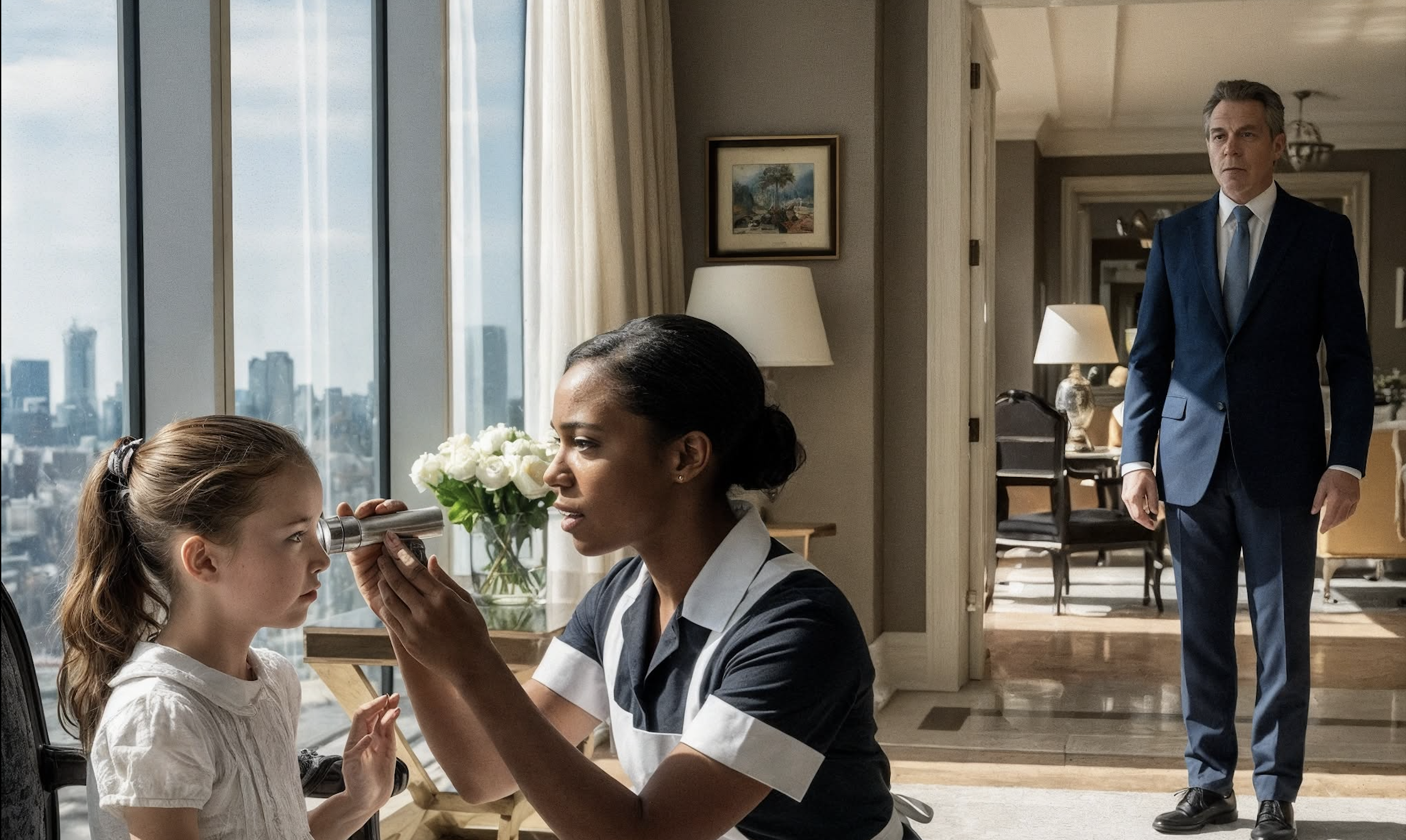
Then came Julia Bennett, a twenty-eight-year-old widow who had recently lost her own baby. Hired as a live-in housekeeper, her duties were simple: clean, organize, and keep Luna company. Yet Julia noticed what others did not. By her second week, she saw Luna tilt her head toward sunlight streaming through the curtains. Another time, Luna flinched when Julia dropped a glass, as if reacting to the bright shards glinting in the light. Julia’s curiosity grew. She began quietly testing Luna, lifting colorful toys, waving her hand in front of the girl’s face. To her astonishment, Luna followed the movement.
One afternoon, Luna whispered, “I like yellow.” Julia froze. Yellow. Blind children do not recognize colors.
Later that evening, Julia approached Richard gently.
— “Mr. Wakefield… I don’t think Luna is completely blind.”
Richard looked at her, exhausted and incredulous.
— “Do you realize how many experts I’ve paid? The best hospitals? They all agree: she cannot see.”
But Julia did not relent.
— “Then how did she describe the color of my scarf? Why does she squint at the sun? Something is not right.”
Richard wanted to dismiss her, but doubt crept in. That doubt grew when Julia found a small bottle of eye drops on a shelf. Luna was supposed to take them every day, supposedly to protect her eyes. Julia’s instincts whispered that something was wrong.
She had no proof yet—but she had planted the first seed of suspicion. And Richard, for the first time in years, felt something dangerous awaken inside him: hope.
Julia’s discovery haunted her. At night, in her small maid’s room, she searched online for information about the medication. What she found alarmed her: in the long term, the active ingredient could actually dull vision rather than improve it.
She returned to Richard, this time with printouts of medical articles.
— “This medication does not match Luna’s diagnosis. It could hinder her visual development.”
Richard’s hands shook as he read. Anger boiled beneath his calm exterior. For years, he had trusted Dr. Atacus Morrow, the family ophthalmologist who had diagnosed Luna at birth. He had signed enormous checks, convinced he was acting in his daughter’s best interest. Had Morrow been lying all this time? Richard decided to test it himself. On Julia’s suggestion, he secretly stopped the drops for a week. On the fifth day, Luna pointed to an object.
— “Look, Daddy—a red ball.”
Richard’s knees went weak. His daughter could see—maybe imperfectly, but far more than he had been led to believe.
Fueled by anger, Richard hired an independent specialist, outside Morrow’s influence. The verdict was clear: Luna had a visual impairment, but she was not blind. With proper therapy, her vision could improve.
The betrayal was staggering. Richard confronted Dr. Morrow in his office.
— “You stole years of my daughter’s life,” he growled, slamming the results onto the desk.
Morrow stammered apologies—technicalities, misdiagnoses, experimental treatments. But Richard had already connected the dots: the doctor had been collaborating with a pharmaceutical lab, using Luna as a long-term test subject to secure research funding.
Julia’s calm voice cut through the tension.
— “He exploited her because she couldn’t defend herself. But we can.”
Richard’s fury turned into determination. For the first time since his wife’s death, he felt alive—with a mission. They gathered every document, prescription, and test result. Supported by Julia, he prepared for war—not in the boardroom, but in court.
The trial captured national attention. Headlines blazed: “Billionaire’s Daughter Used in Illegal Experimentation.” Cameras camped outside the courthouse. Morrow, once respected, was now portrayed as a predator who had manipulated wealthy clients for years.
Julia testified with quiet strength, recounting how she first noticed Luna’s reactions to light. Richard spoke with raw emotion, describing the betrayal of entrusting his daughter’s life to a man who saw her as a research subject. Independent specialists confirmed everything: Luna’s condition had been deliberately misrepresented.
The jury deliberated briefly. Morrow was found guilty of malpractice and fraud, sentenced to prison and disbarred. The lab faced massive fines.
But for Richard and Julia, the true victory was not legal—it was personal. Luna began rehabilitation sessions with honest doctors. She started painting with watercolors; her first strokes were tentative, but the colors bloomed. Laughter returned to the penthouse, a sound Richard thought lost forever.
One evening, Julia watched Luna proudly show a painting of a sunrise to her father. Richard’s eyes welled with tears.
— “It’s beautiful,” he whispered. Then he turned to Julia. “I don’t know how to thank you. You gave me my daughter back.”
Julia smiled softly.
— “You gave me something too—a purpose, again.”
Months later, Richard officially named Julia Luna’s legal guardian in his absence. What began as a housekeeper’s job had grown into so much more: a family born not of blood, but of truth and love.
The empire Richard had built suddenly seemed small compared to the light returning to his daughter’s eyes. And it all began with the courage of one employee who dared to question what everyone else took for granted.