Vassili Stepanovich lived at the edge of the village, where time seemed to have stood still. His small house, old and seemingly flattened against the earth by fatigue, was surrounded by a rickety fence and heavy creaking gates that no one had repaired in a long time. All around, there was silence. The entire street was deserted: some neighbors had moved to the city, others had joined eternity. Only memory and recollections remained.
He was seventy years old. For forty years, he had served people as a nurse in the small local clinic, now closed, just like everything else that tied him to his past. After his wife’s death, he had remained alone. His children were rare visitors: sometimes they called, sometimes they thought of him. But he had grown used to the solitude for so long that the habit had become his shield, his protection against pain and futile conversations.
That year, winter had come early and merciless. The wind howled so loudly that even the window frames trembled with fear. The snow fell in a thick curtain, sliding off the roofs and swirling in the air, as if to sweep away the last traces of human life.
Vassili Stepanovich’s lamp was the only one still shining. He tended his stove, prepared a frugal dinner: potatoes boiled in their skins, accompanied by a few salted pickles taken from the barrel. It was his everyday meal, simple and without frills. Nothing extravagant, nothing useless.
Just as he was about to retire, he heard a strange noise. At first, he thought it was the storm wind. Then again: a light breath, almost a murmur, as if someone were begging for help. His heart froze, then began to beat hurriedly.
It wasn’t just an alert: it was his professional instinct, intact after all those years of emergency service. A sharp breath awakened his compassion like a pain in his chest.
Without hesitating, he put on his fur coat, pulled on his felt boots, and grabbed his flashlight with its worn casing, the very one that had gotten him out of trouble many times during his night calls. He went out. The cold whipped his face, his breath turning into clouds of steam. Step by step, alert, he advanced along the road until he spotted a silhouette by the side of the path.
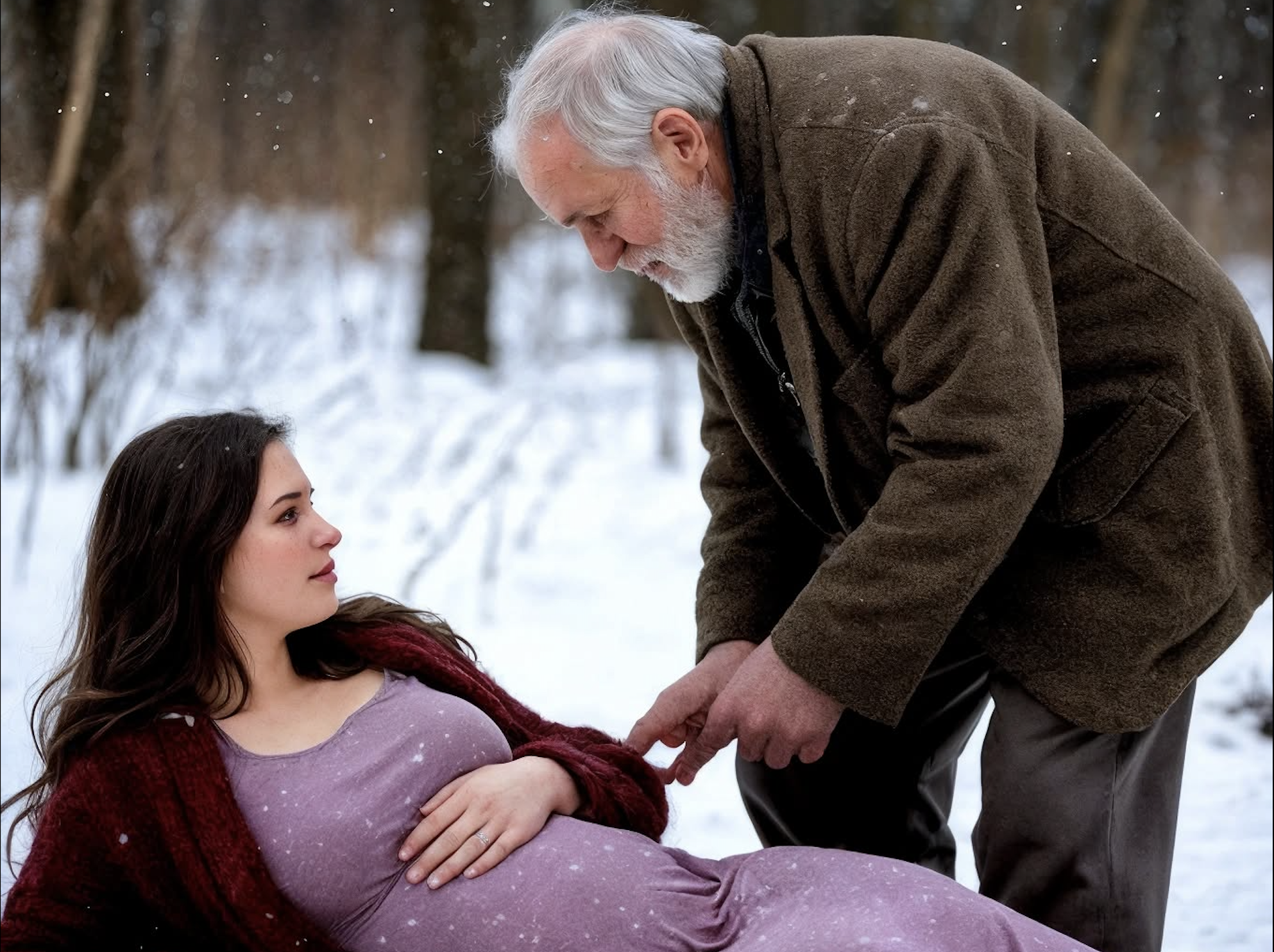
At first, he thought it was a sack or a pile of trash. Then, as he approached, he understood: it was a woman. She was crawling in the snow, leaving only a faint trail behind her. Her fingers were blue, her lips trembled, and under her old coat, her very round belly betrayed an advanced pregnancy, close to term.
Vassili knelt beside her. He leaned down gently: «Miss… can you hear me?»
She slowly opened her eyes, looked at him with difficulty, and whispered: «Help me… I… hurt so much…» Then she lost consciousness.
The old man didn’t waste a second. He lifted her carefully—she seemed incredibly light, almost like a ghost, life seeming to flee from her body. He made his way back to his home, fighting against the snowdrifts, the gusts, and the cold, aware that if help wasn’t fast enough, two lives would be at stake: hers, and the one she carried.
Back at the house, the storm seemed even fiercer, but as soon as he crossed the threshold, a forgotten flame rekindled within him: the meaning of life, usefulness. The house, which had sheltered only silence for years, suddenly filled with disorder, warmth, and hope.
He settled the woman on the old but cozy bed, covered her with several blankets, and stoked the stove until the fire whistled in the flue. Water began to boil in the pot. He gathered all his obstetrical knowledge—his hands had forgotten nothing—and remembered the exact gestures to help best.
The woman remained unconscious, her body shaken by convulsions, sweat beading on her forehead. Vassili went to the shed to fetch an old wooden box containing what was needed: bandages, antiseptic, scissors, and even a swaddling cloth carefully kept «just in case» for years.
He placed a hand on her forehead: fever. Then took her pulse: weak but steady. He moistened her lips and spoke to her in a low voice: «Wake up, dear. You are home. No one will abandon you.»
She opened her eyes, a tiny glimmer of life appeared in them. «The baby… soon… pain…» «Hold on. I’m here. We’ll make it. I promise you.»
The birth was difficult. But Vassili spared neither his strength nor his courage. He fetched water, changed sheets, assisted the mother with her breathing, and supported her when she wanted to give up. In that moment, he felt neither his age, nor the pain in his back, nor the cold seeping under the walls. He became the nurse again, the savior, the friend he had always been.
And suddenly, in the middle of the night, a cry rang out: sharp, vigorous, full of life. A little boy came into the world—red, wrinkled, but alive. The mother burst into tears. Vassili tenderly wrapped the child in a cloth and placed him on his mother’s chest.
For the first time in years, tears welled up in the old man’s eyes. He whispered: «Welcome, little one. You arrived on the most terrible night. Maybe that’s why you will bring the light.»
Dawn broke discreetly. The snow continued to fall, but the storm had calmed. A soft, gray light filtered through the frosted window. Vassili, sitting in his armchair, held a cup of steaming tea. The woman slept, huddled against her son, a slight smile on her lips. When she woke up, her gaze was lucid and filled with gratitude.
«Good morning! How do you feel?» he asked, approaching to adjust the blanket. «Better… thank you. It’s you… you saved us!» Tears rose to her eyes.
«You’re the one who endured everything, dear. I only helped a little.»
She remained silent for a moment, then sat up painfully. «My name is Marina. I ran away… my father disowned me when he found out about my pregnancy. He said I had dishonored the family. I didn’t know where to go. I walked until my legs had no strength left. I thought I was going to die.»
Vassili listened to her without a word, without the slightest judgment, only with compassion. He had long understood that there was no black or white in life, only people struggling to survive.
«Where did you live before?» «Near Vologda. I have no one left… except him, now,» she said, looking at her son. «I’ll call him Alexei.»
Vassili nodded. This name sounded strong and right, like a gift from destiny. «Then you have a new path. Here, no one will judge you. In this village, truth is rare, but you will have a roof, peace, warmth… and the company of this old grump that is me.»
Marina managed a smile through her tears. «I would like to stay… I don’t even know your name.» «Vassili Stepanovich. Just call me Vassili if you want.»
A peaceful silence settled. She hugged her child to her, while he went to pour himself some more tea. Quiet life resumed—unexpected, unplanned, but full of hope.
A few weeks passed. Winter slowly lost its grip. The snowdrifts remained high, but the days grew longer and the sun warmed like spring.
One morning, there was a knock at the door. Few residents remained in the village, and rare were those who dared to ring at Vassili’s without reason. He opened it. Before him stood a man in an elegant coat, with a cold gaze and drawn features. «Does Marina Karpova live here?»
Vassili frowned. «Who is asking?»
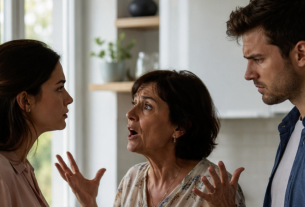
Marina appeared behind him, frozen, eyes wide. A moment seemed to last an eternity. «Dad…»
The man took a step forward, his face marked by the years. In his eyes, one could read uncertainty and repentance. «I looked for you. I realized my mistake when I learned you were alive. Forgive me… I had no right…»
Marina remained mute, pain and strength mingled in her gaze, the strength she had forged through the storm, childbirth, and solitude. «Why did you come?» «Because I can no longer live with my guilt. I wanted to see my grandson… even just once. And, if you allow it, to help him.»
She looked at him for a long time, then rested her eyes on Alexei, peacefully asleep in her arms. Finally, she stepped aside and said: «Come in. But know that I am no longer the little girl you drove away. I am a mother. And this house is my fortress.»
Vassili stayed back. He didn’t say a word, but a feeling of pride and gratitude warmed him inside. He thought: «Even in the harshest of winters, destiny can offer a second chance. The important thing is not to ignore those freezing in solitude.