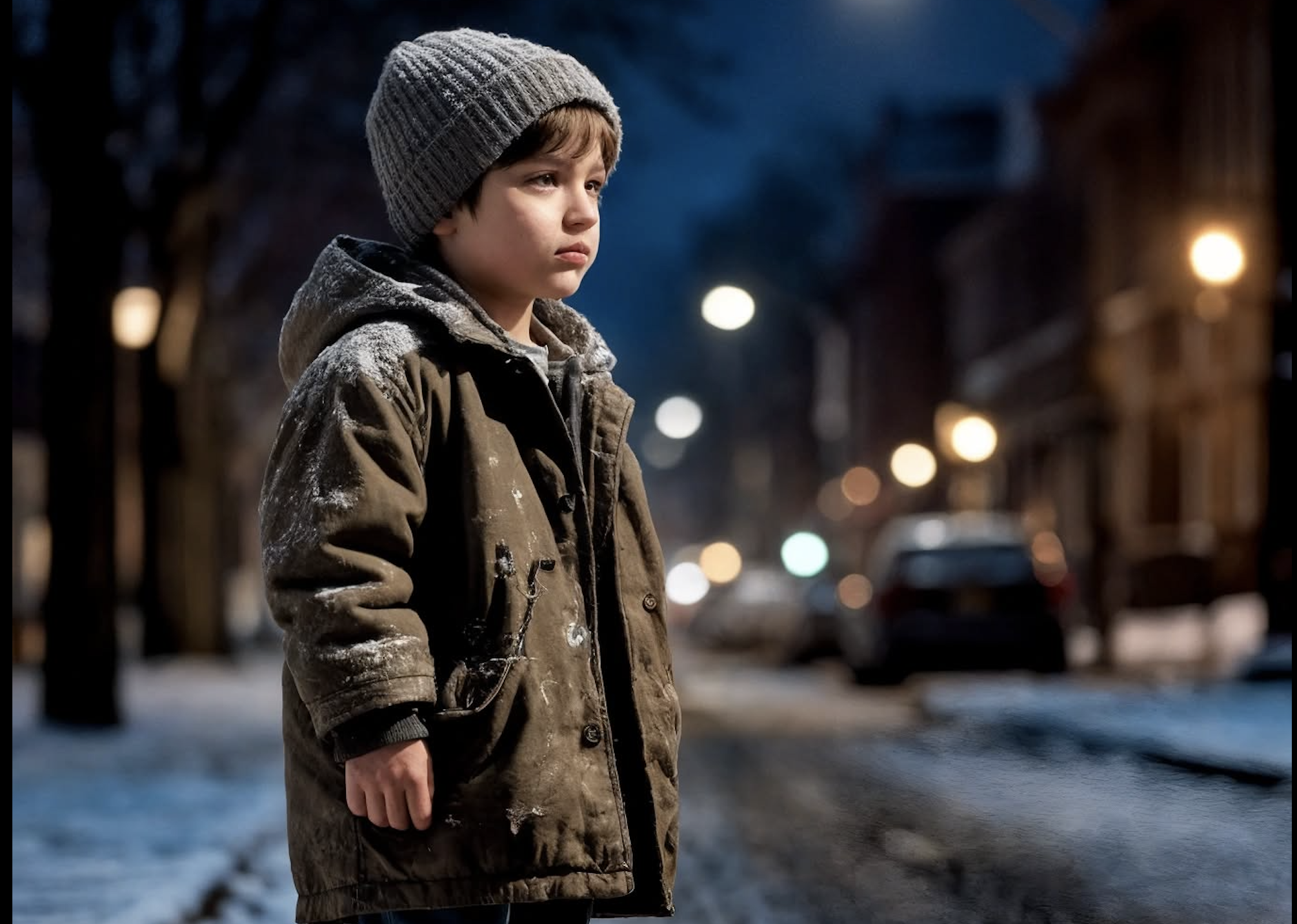
Through the windows of the houses, garlands with warm lights twinkled, Christmas trees were reflected in the shop windows, and Christmas tunes resonated. But beyond those walls, a white and motionless silence reigned. Snow fell in large flakes, as if an invisible hand were tirelessly dropping celestial cotton balls. A calm so dense it seemed almost sacred, like a temple. No footsteps, no voices. Only the howling of the wind in the ducts and the soft rustle of snow crashing to the ground, as if to cover the city in a shroud of forgotten stories.
Kolya Soukhanov stood on the porch. He hadn’t yet understood that all this was real. It felt like a cruel and absurd nightmare. Yet, the cold seeped through his clothes, soaking his socks, while the icy wind lashed his face. The backpack abandoned in the snowbank reminded him of the terrible reality.
“Get the hell out of here! I never want to see you again!” — his father’s hoarse, hateful voice jolted him from his torpor. Then, the door slammed, closing right in front of his nose.
His father had just kicked him out. On Christmas night. Without his things. Without goodbyes. Without the possibility of returning.
As for his mother? She was there, against the wall. Arms crossed over her chest. She hadn’t said anything. Hadn’t tried to stop her husband. Hadn’t uttered: “He’s our son.” She had merely shrugged her shoulders, helpless, and bitten her lip to hold back her tears.
She had remained silent.
Kolya slowly walked down the porch steps, feeling the snow seep into his slippers and prick his skin with a thousand icy needles. He didn’t know where to go. Deep inside, a vast emptiness, as if his heart had fallen below his ribs.
There, Kolya. You’re good for nothing. No one wants you. Especially not them.
He didn’t cry. His eyes were dry; only a sharp pain in his chest reminded him he was alive. It was too late to cry. Everything had already happened. The way back was closed.
So he walked, aimlessly, through the storm, under streetlights illuminating deserted streets. Behind the shop windows, people were laughing, drinking tea, opening gifts. He was alone, in the heart of the celebration, with no place to be.
How many hours did he wander? He no longer remembered. The streets blurred together. A parking attendant had chased him away; passersby avoided his gaze. He was a stranger, useless, unwanted.
Thus began his winter: his first season of solitude, his winter of survival.
The first week, Kolya spent his nights wherever he could: on benches, in underpasses, at bus shelters. He was pushed away everywhere: by vendors, guards, strangers. In their eyes, he saw no pity but irritation. A kid in a worn-out puffer jacket, red-eyed, unkempt: a vivid reminder of their own fears.
He ate what he found: scraps from bins, and once, he stole a loaf from a kiosk while the vendor was distracted. For the first time, he became a thief, not out of malice, but out of hunger, out of fear of dying.
Around nightfall, he discovered a refuge: an abandoned basement in an old five-story building on the outskirts. The air smelled of mold, cat tracks, and heavy dampness, but it was warm: nearby heating pipes gave off a gentle steam, enough to survive the night. This basement became his home: he spread out newspapers, gathered cardboard, covering himself with rags found in dumpsters.
Sometimes, he stayed there, silent, fighting back a sob. But no tears came; only the pain in his chest shook him.
One day, an old man with a cane and a long beard found him there. A simple glance, then: “You alive? Good. I thought it was the cats that knocked over the bags.”
He left a can of stew and a piece of bread. Without a word. Kolya didn’t say thank you. He ate, greedily, with his hands.
After that, the man returned occasionally while remaining discreet, bringing food, without asking questions. Only once did he mumble: “I was fourteen too when my mother died and my father hanged himself. Hang in there, kid. People are bastards. But you, you’re not like them.”
These words remained engraved in Kolya. He repeated them to himself when he couldn’t take it anymore.
One morning, he couldn’t get up: nausea, chills, his whole body shook. Fever burned his temples, his legs gave way. Snow was piling up in the basement, as if it wanted to finish him off. He didn’t know how he got out; later he recounted that he had crawled, clinging to the steps, until arms supported him.
“My God, he’s frozen to the bone!” — a female voice, strict but tender, pierced his delirium.
That is how he first saw Anastasia Petrovna, an educator from child social services. Tall, wearing a dark coat, her gaze tired but attentive. She hugged him to her, as if he were her own son, a strong embrace, as if she knew he hadn’t felt such warmth in months.
“Hush, my little one. I’m here. Everything will be fine. Do you hear me?”
He heard. Through the delirium and shivering. These words were the first burst of humanity after long months of isolation.
He was taken to a shelter on Dvoretskaya Street: a dilapidated building but with clean sheets and the reassuring smell of a hot meal—potatoes, cabbage soup, and a glimmer of hope. He had a bed, a thick blanket, and, an unhoped-for gift, sleep without fear. For the first time in a long time.
Anastasia Petrovna returned every day: inquiring about his health, bringing him books. Not children’s tales, but real authors: Chekhov, Kuprin, and even a collection of the Constitution.
“Listen, Kolya,” she told him, handing him a book. “Knowing your rights is protecting yourself. Even if you have nothing. If you know them, you are no longer powerless.”
He nodded. He read. He absorbed every word like a thirsty sponge.
Every day, he regained a little confidence. A lively strength grew in him: the desire to know, to protect, to never again pass by a defenseless child in the snow.
At eighteen, he passed his Russian high school exams and entered the law faculty at Tver State University. It was almost unbelievable, more a dream than reality. He feared he wouldn’t make it, that he would fail. But Anastasia Petrovna reassured him: “You’re going to make it. You have what many don’t: inner strength.”
He studied by day and worked by night as a dishwasher in a snack bar near the station. Sometimes, he slept in the back room between shifts. He drank black tea from a thermos, read everything he found, skimped on food until the end of the month. Little sleep. Assignments written late. But he never said: “I can’t.” He never gave up.
In his second year, he became an assistant in a law firm: filing documents, sweeping the floor, performing the smallest tasks. But he learned, listening to cases like listening to music. Like a living textbook.
In his fourth year, he drafted appeals for clients, free of charge, especially for those who couldn’t pay. One day, he was called to a woman in a worn puffer jacket.
“You don’t have money, do you?” — he asked frankly. — “Don’t worry. I’m going to help you.” “Who are you?” she asked him. “A student. But soon, I’ll be the one who can officially defend you.”
She offered him a smile, as if it were the first time she heard: “You are not alone.”
At twenty-six, he worked in a large firm, while continuing to volunteer to assist those who had no one: children from shelters, battered women, elderly people swindled out of their homes. No one left empty-handed.
He never forgot the feeling of uselessness. And he never wanted another to suffer what he had lived through.
His parents had disappeared from his life on Christmas Eve. He didn’t look for them, didn’t call them anymore, didn’t think about them anymore. That night, he had ceased to be their son; and they, his parents.
This winter, as the snow fell again, two people walked through the door of his office. A stooped man and a woman in an old headscarf. Kolya recognized them immediately. A strange shiver ran through him, as if he were rediscovering voices from another world.
“Kolya…” his father murmured in a weak and hoarse voice. — “Forgive me, son.”
His mother gently brushed his hand. Her eyes were filled with tears, but not those of the past: different tears.
Kolya remained silent. He looked at them, without pain, without an inner scream, only a great void.
“You’re late,” he said calmly. — “I died for you that night. And you died for me.”
He stood up, approached the door, and held it open.
“I wish you health and happiness. But there is no going back.”
They stood for a moment, then left slowly, without fanfare, without justification, aware that they had let their only chance pass by.
Kolya returned to his desk, opened a new file: a runaway teenager from a shelter. He immersed himself in reading, focused. He no longer trembled and no longer doubted.
Everything he had gone through had not been in vain: every night in the basement, every piece of stolen bread, every “get out.” It had made him who he was: someone capable of saying in turn:
“I am here. You are not alone.”
And, somewhere in his memory, Anastasia Petrovna’s voice still echoed:
“Rights are your shield, even if you have nothing.”
Today, he was that shield. For all those who, one day, find themselves barefoot in the snow.