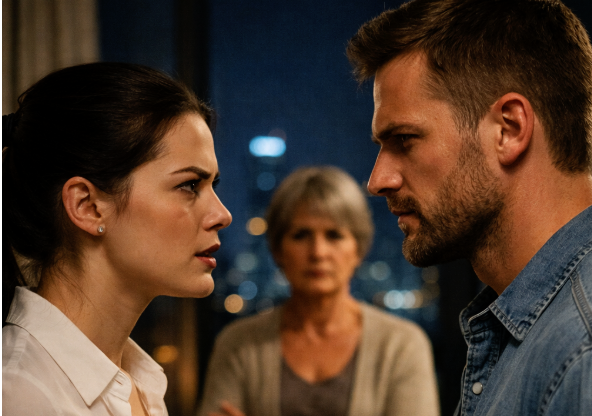
“Yes, I have my own apartment now. No, my mother-in-law cannot live there! I’ve had enough of your ‘family’!” Zhanna declared.
“Are you serious?” Sergey’s voice trembled with surprise. He even set aside his phone, its screen still glowing with a message from his mother.
Zhanna stood in the middle of the kitchen with her arms crossed over her chest. The fingers of her right hand nervously gripped the edge of her sweater sleeve — an old habit that appeared every time everything inside her was boiling, but all she allowed to come out were cold, precise words.
“Absolutely,” she replied. “I lived in your two-room Khrushchyovka for seven years. Seven years of listening to your mother explain how I cut onions the wrong way, hang laundry the wrong way, raise a child the wrong way, and basically breathe the wrong air.”
Sergey opened his mouth, about to object, but Zhanna raised her hand — a small gesture, but very exact. He fell silent.
“I’m not shouting,” she continued, more quietly now. “I’m simply stating a fact. For two years I saved every kopeck beyond the mortgage, beyond the utility bills, beyond our son’s extracurriculars. For two years I lived on buckwheat and discounted chicken thighs so I could scrape together the down payment. And now — I did it. The keys are in my bag. A one-bedroom apartment, forty-two square meters, twenty minutes on foot from the metro, windows facing the courtyard instead of the road. Mine.”
Sergey slowly lowered himself onto a stool. The kitchen suddenly seemed smaller than usual.
“So what… you’re just going to leave now?” he asked, almost in a whisper.
“No, Seryozha. I’m not leaving. I already left. Our son’s things and mine were moved yesterday. All that’s left is to pick up the documents and a few boxes of books.”
He looked at her as if he were seeing her for the first time. Zhanna’s hair was pulled back into a low ponytail, dark circles lay under her eyes from exhaustion, but there was some new, unfamiliar firmness in her posture.
“Mom…” he began, then stopped short, because Zhanna suddenly lifted her gaze sharply.
“Your mother has already called me twice today. The first time at nine in the morning — to find out if it was true that I bought an apartment. The second time at eleven forty — to inform me that she had already mentally arranged where to put the furniture and that her kitchen set was better than mine anyway. I didn’t answer. Not once.”
Sergey ran a hand over his face.
“She’s just in shock, Zhan. She spent her whole life in a communal apartment, then in that two-room flat. For her, a separate apartment is… like another planet.”
“I understand,” Zhanna nodded. “I understand so well that my heart tightens every time she starts talking about how she slept on a folding cot in the hallway when she was young. But that doesn’t mean I’m now obliged to hand over my planet to her.”
Silence hung in the air. Only the wall clock ticked and the refrigerator hummed softly.
“And Tim?” Sergey finally asked. “How did you explain to our son that we’re going to live… separately now?”
“I didn’t say ‘separately,’” Zhanna softened her voice a little. “I said that now we have a place of our own. That he’ll have his own room — small, but his alone. That he’ll be able to draw on the walls with washable crayons and nobody will scold him. That in the evenings we’ll read books together, the three of us — you, me, and him — and no one will come in asking, ‘Why is the light still on?’”
Sergey lowered his head. His fingers lay motionless on the table, as though he was afraid to move and destroy the fragile balance of the moment.
“I thought…” he began, then fell silent.
“What did you think?”
“That we’d still stay together. That you bought the apartment as an investment. Or as a backup option. Or… I don’t know. That we’d live there on weekends. Or rent it out.”
Zhanna looked at him for a long time. Then she exhaled softly, almost soundlessly.
“Seryozha, I lived for seven years in ‘just endure it’ mode. Endure your mother walking in without knocking. Endure her rearranging the dishes. Endure her telling every relative how I ‘don’t know how’ to cook borscht. Endure the fact that we didn’t have a single corner where we could close the door and just sit in silence. I endured it. Because I believed we were saving up for something better. Together.”
She paused, as if letting the words settle.
“And then I realized that ‘together’ was an illusion. Because every time I tried to set a boundary, you said the same thing: ‘But it’s Mom. She’s lonely. She has it hard. She loves us.’ And I backed down again. Because I didn’t want to be the evil daughter-in-law. Because I was afraid of who you would choose between us.”
Sergey raised his eyes. There was something childlike and lost in them.
“I wasn’t choosing,” he said quietly. “I was just trying to hold everyone together.”
“I know,” Zhanna nodded. “And that’s exactly why I made the choice for both of us.”
She walked over to the windowsill and opened the small window vent. Cold March air rushed into the kitchen, carrying the smell of wet asphalt and the distant noise of cars.
“I’m not forbidding you from seeing your mother,” she continued without turning around. “I’m not forbidding you from staying the night here if you want. But I will no longer live in her apartment. And she will not live in mine.”
Sergey stood up. He came up behind her, but did not embrace her — he simply stopped a step away.
“And what if I say I want to move there with you?” he asked very quietly.
Zhanna slowly turned around. She looked him straight in the eyes.
“Then you’ll have to talk to your mother. Honestly. Without ‘we’ll figure it out later,’ without ‘let’s not upset her,’ without ‘but she’s old.’ You’ll have to say it plainly: your family is me and Tim. And that family now has its own address.”
He stayed silent for a long time. Thirty seconds, maybe forty. Then he nodded — short, sharp, as though putting a period at the end of a long inner argument.
“I’ll talk to her,” he said. “Today.”
Zhanna did not answer. She only smiled faintly — very restrained, just with the corners of her lips.
And outside the window a fine, cold rain had already begun, and the drops tapped softly against the tin windowsill, as if counting down the final minutes of an old life.
That same evening Valentina Ivanovna called again.
Zhanna looked at the glowing number on the screen and — for the first time in many years — simply declined the call. Without anger. Without guilt. Calmly, like someone who had finally closed the door behind her.
“I’ll talk to Mom. Today,” Sergey repeated, but his voice no longer held the confidence with which he had said those words five minutes earlier.
Zhanna merely nodded. She did not hug him or say, “I believe you.” She just picked up her bag, slung it over her shoulder, and headed for the door.
“I’ll leave the apartment keys on the little table in the hallway,” she said from the corridor. “If you decide to come and see it — come. But don’t come without warning. I want this to be my home. Not ours. Mine.”
The door closed quietly, almost soundlessly. Sergey was left alone in that very kitchen where, for seven years straight, the three of them had eaten dinner together, where Valentina Ivanovna loved to stand at the stove and comment on every movement of her daughter-in-law, where he himself had more than once told his wife, “Just endure it, she means well.”
He took out his phone and dialed his mother’s number. The ringing went on for a long time — unusually long.
“Seryozha?” Valentina Ivanovna finally answered. Her voice was cheerful, almost festive. “Well? Did you talk to her? Has she changed her mind already?”
Sergey closed his eyes. His fingers tightened around the phone.
“Mom,” he began, and then fell silent, not knowing from which side to approach this conversation.
“What do you mean, ‘Mom’?” the woman asked at once, suddenly wary. “Why do you sound so gloomy? She’s filled your head with nonsense, hasn’t she? Is she saying I’m in her way?”
“She bought an apartment,” Sergey said quietly but firmly. “In her own name. And she moved out. With Tim.”
Silence fell on the other end of the line. So deep that Sergey even heard his mother sharply inhale.
“What do you mean — in her own name?” Valentina Ivanovna’s voice rose half an octave. “And where were you? You just let her go and… take the child?”
“She didn’t take him away. She took what she earned herself.”
“Herself?!” his mother almost shrieked. “You gave her that money! Our family saved for that! I transferred ten thousand rubles to you every month so you could put money aside!”
Sergey felt something inside him contract painfully.
“Mom, you transferred it to me. Not to her. And not for the apartment. It was for groceries, clothes for Tim, medicine when he was sick. But Zhanna… she worked nights. Took side jobs. Slept four hours a night. So we could have a place of our own. Without чужие взгляды. Without чужие замечания.”
“Without strangers’ looks?!” Valentina Ivanovna almost shouted. “Am I a stranger to you? I raised your son, I helped you, I—”
“Mom, listen,” Sergey tried to speak calmly, though everything inside him was trembling. “I love you very much. You know that. But Zhanna also has a right to her own life. To her own territory. She can’t keep living the way she’s lived all these years.”
“And I can?!” his mother’s voice broke. “I lived in that communal apartment, and then in your three-room flat I slept on a folding cot? I thought… I thought that when you finally got on your feet, I would at least spend my old age in peace. Near my grandson. Near my son.”
Sergey said nothing. His mother’s words fell heavily, like stones, and every blow echoed with pain somewhere beneath his ribs.
“Mom,” he finally said, “I don’t want you to feel unwanted. But I also don’t want my wife to feel like a stranger in her own home. And if we all keep living together… she’ll just leave. For good. And take Tim. And I won’t blame her.”
A short sob came through the receiver. Then another.
“You’re choosing her,” Valentina Ivanovna said quietly, almost lifelessly. “Your wife. Not your mother.”
“I’m choosing my family,” Sergey replied. “The one I created. Where I am a husband. And a father.”
He heard his mother put down the phone. She did not slam it down — she set it down. Slowly, carefully, as though afraid to break something fragile.
For a long time Sergey stood there with the phone to his ear, listening to the short beeps. Then he slowly sank to the floor, leaning his back against the kitchen cabinets. He sat there for about twenty minutes, staring into emptiness.
Meanwhile, Zhanna was opening the windows in her new apartment.
The air was cold, March-like, smelling of dampness and melting snow. But she liked it. She liked that it smelled of the street, not of someone else’s soup that had been cooked without asking her. She liked that she could throw the window wide open and not hear five minutes later: “Close it, there’s a draft, the child will catch cold.”
Tim was asleep in his room — small, but his own. His first drawing was already hanging on the wall: a blue house with yellow windows and three little figures — Mom, Dad, and him. Zhanna had taped it there herself because she wanted her son to wake up and immediately see: here, everything is different.
She sat down on the windowsill and pulled her knees to her chest. The phone lay beside her, its screen dark. Sergey had not called. And she had not called him either.
Instead, she thought about how strangely life was arranged. For seven years she had been afraid to say the word out loud, afraid of being alone, afraid of being called selfish, greedy, heartless. And now, after saying it — and doing it — the fear had vanished somewhere. All that remained was exhaustion. And a quiet, careful joy.
She did not know whether Sergey would come today. She did not know whether he would be able to say to his mother the words he had promised. She did not even know whether their family would remain a family after all this.
But she knew one thing for certain: today, for the first time in many years, she was going to sleep in a home where no one would open her bedroom door without knocking. Where no one would say, “Well, if I were you…” Where she could simply be.
And for now, that was enough.
And the next morning, as Zhanna was making cocoa for Tim, the doorbell rang.
She froze, a spoon in her hand…“Are you serious?” Sergey’s voice trembled with surprise. He even put down his phone, on whose screen a message from his mother was still glowing.
Zhanna stood in the middle of the kitchen with her arms crossed over her chest. The fingers of her right hand nervously clutched the edge of her sweater sleeve — an old habit that appeared every time everything inside her was boiling, but only cold, precise words were allowed to come out.
“Absolutely,” she replied. “I lived in your two-room Khrushchyovka for seven years. Seven years listening to your mother explain to me that I chop onions wrong, hang laundry wrong, raise our child wrong, and generally breathe the wrong air.”
Sergey opened his mouth, ready to object, but Zhanna raised her hand — a small gesture, but an incredibly exact one. He fell silent.
“I’m not shouting,” she continued, now more quietly. “I’m simply stating a fact. For two years I saved every kopek beyond the mortgage, beyond the utility bills, beyond the after-school clubs for our son. For two years I lived on buckwheat and chicken thighs bought on sale so I could put together the down payment. And now — I did it. The keys are in my bag. A one-bedroom place, forty-two square meters, twenty minutes on foot from the metro, windows facing the courtyard instead of the road. Mine.”
Sergey slowly lowered himself onto a stool. Suddenly the kitchen seemed smaller to him than usual.
“So what… you’re just going to leave now?” he asked in almost a whisper.
“No, Seryozha. I’m not leaving. I already left. Yesterday we moved my things and our son’s things. All that’s left is to pick up the documents and a few boxes of books.”
He looked at her as though he were seeing her for the first time. Zhanna’s hair was tied back in a low ponytail, shadows of exhaustion lay beneath her eyes, but there was some new, unfamiliar firmness in the way she carried herself.
“Mom…” he began, then broke off at once, because Zhanna suddenly lifted her gaze sharply.
“Your mother has already called me twice today. The first time at nine in the morning — to find out whether it was true that I’d bought an apartment. The second time at eleven forty — to let me know that she had already mentally figured out where she would put which furniture, and that her kitchen set was still better than mine. I didn’t answer. Not once.”
Sergey ran a hand over his face.
“She’s just in shock, Zhan. She spent her whole life in a communal apartment, then in that two-room flat. For her, a separate apartment is… like another planet.”
“I understand,” Zhanna nodded. “I understand so well that my heart tightens every time she starts telling stories about how, in her youth, she slept on a folding cot in the corridor. But that doesn’t mean I’m now obligated to hand over my planet to her.”
Silence hung in the room. Only the wall clock ticked, and the refrigerator hummed softly.
“And Tim?” Sergey finally asked. “How did you explain to our son that we’re going to live… separately now?”
“I didn’t say ‘separately,’” Zhanna softened her voice a little. “I said that now we have a place of our own. That he’ll have his own room — small, but his alone. That he’ll be able to draw on the walls with washable crayons, and no one will scold him. That in the evenings we’ll read books together, the three of us — you, me, and him — and no one will come in asking, ‘Why is the light still on?’”
Sergey lowered his head. His fingers lay motionless on the table, as though he was afraid to move and destroy the fragile balance of the moment.
“I thought…” he began, then stopped.
“What did you think?”
“That we’d still stay together. That you bought the apartment as an investment. Or as a backup plan. Or… I don’t know. That we’d live there on weekends. Or rent it out.”
Zhanna looked at him for a long time. Then she exhaled quietly, almost soundlessly.
“Seryozha, I lived for seven years in ‘just endure it’ mode. Endure your mother walking in without knocking. Endure her rearranging the dishes. Endure her telling all the relatives how I ‘don’t know how’ to cook borscht. Endure the fact that we don’t have a single corner where we can close the door and just be in silence. I endured it. Because I believed we were saving up for something better. Together.”
She paused, as if giving the words time to settle.
“And then I realized that ‘together’ was an illusion. Because every time I tried to set a boundary, you said the same thing: ‘It’s Mom. She’s lonely. She has it hard. She loves us.’ And I would back down again. Because I didn’t want to be the wicked daughter-in-law. Because I was afraid that between the two of us, you’d choose.”
Sergey raised his eyes. There was something childlike in them, something lost.
“I wasn’t choosing,” he said quietly. “I was just trying to hold everyone together.”
“I know,” Zhanna nodded. “And that’s exactly why I made the choice for both of us.”
She walked to the windowsill and opened the little vent window. Cold March air rushed into the kitchen, carrying the smell of wet asphalt and the distant noise of traffic.
“I’m not forbidding you to see your mother,” she continued without turning around. “I’m not forbidding you to spend the night there if you want. But I’m no longer going to live in her apartment. And she is not going to live in mine.”
Sergey stood up. He came up behind her, but did not embrace her — he simply stopped a step away.
“And what if I say that I want to move in with you?” he asked very quietly.
Zhanna slowly turned around. She looked straight into his eyes.
“Then you’ll have to talk to your mother. Honestly. Without ‘we’ll sort it out later,’ without ‘let’s not upset her,’ without ‘but she’s old.’ You’ll have to say plainly that your family is me and Tim. And that this family now has its own address.”
He was silent for a long time. Thirty seconds, maybe forty. Then he nodded — short and sharp, as though putting a full stop at the end of a long inner argument.
“I’ll talk to her,” he said. “Today.”
Zhanna did not answer. She only smiled faintly — very restrained, just at the corners of her lips.
And outside, a fine cold rain was already beginning, and the drops tapped softly against the tin windowsill, as though counting down the last minutes of the old life.
That same evening, Valentina Ivanovna called again.
Zhanna looked at the glowing number and — for the first time in many years — simply declined the call. Without anger. Without guilt. Calmly, like a person who had finally closed the door behind her.
“I’ll talk to Mom. Today,” Sergey repeated, but there was no longer the same certainty in his voice that there had been five minutes earlier.
Zhanna only nodded. She did not hug him, nor did she say, “I believe you.” She simply picked up her bag, slung it over her shoulder, and headed for the door.
“I’ll leave the apartment keys on the little table in the hallway,” she said as she reached the corridor. “If you decide to come and have a look — come. But not without warning. I want this to be my home. Not ours. Mine.”
The door closed quietly, almost soundlessly. Sergey remained alone in that same kitchen where for seven years the three of them had eaten dinner, where Valentina Ivanovna had loved to stand at the stove and comment on every move her daughter-in-law made, where he himself had more than once told his wife, “Just endure it, she means well.”
He took out his phone. Dialed his mother’s number. The rings went on for a long time — unusually long.
“Seryozha?” Valentina Ivanovna finally answered. Her voice was brisk, almost festive. “Well? Did you talk to her? Has she changed her mind already?”
Sergey closed his eyes. His fingers tightened around the phone.
“Mom,” he began, then stopped, unsure how to approach this conversation.
“What do you mean, ‘Mom’?” the woman said at once, suspicious. “Why do you sound so gloomy? She’s filled your head with nonsense, hasn’t she? Is she saying I’m getting in her way?”
“She bought an apartment,” Sergey said quietly but firmly. “In her own name. And she moved there. With Tim.”
There was silence on the other end of the line. Such deep silence that Sergey could even hear his mother inhale sharply.
“What do you mean — in her own name?” Valentina Ivanovna’s voice rose half an octave. “And where were you? You just let her go and… take the child away?”
“She didn’t take him away. She took what she earned herself.”
“Herself?!” his mother almost screamed. “You were giving her money! Our family was saving for that! I sent you ten thousand every month so you could put something aside!”
Sergey felt something contract painfully inside him.
“Mom, you sent it to me. Not to her. And not for the apartment. For groceries, clothes for Tim, medicine when he got sick. But Zhanna… she worked nights. Took side jobs. Slept four hours a night. So we could have a place of our own. Without чужие взгляды. Without чужие замечания.”
“Without strangers?!” Valentina Ivanovna was nearly shouting now. “Am I a stranger to you? I raised your son for you, I helped you, I—”
“Mom, listen,” Sergey tried to speak calmly, though everything inside him was trembling. “I love you very much. You know that. But Zhanna also has a right to her own life. To her own territory. She can’t keep living the way she has all these years.”
“And I can?!” his mother’s voice broke. “I lived in that communal apartment, and then in your three-room place I slept on a folding cot? I thought… I thought that when you finally got on your feet, at least I’d spend my old age in peace. Near my grandson. Near my son.”
Sergey was silent. His mother’s words fell heavily, like stones, and every blow echoed with pain somewhere under his ribs.
“Mom,” he finally said, “I don’t want you to feel unwanted. But I also don’t want my wife to feel like a stranger in her own home. And if we keep living all together… she’ll simply leave. For good. And take Tim with her. And I won’t blame her.”
A short sob came through the receiver. Then another.
“You’re choosing her,” Valentina Ivanovna said quietly, almost lifelessly. “Your wife. Not your mother.”
“I’m choosing my family,” Sergey answered. “The one I created. The one where I am a husband. And a father.”
He heard his mother hang up. She didn’t slam the phone down — she set it down. Slowly, carefully, as if afraid of breaking something fragile.
For a long time Sergey stood there with the phone pressed to his ear, listening to the short beeps. Then he slowly sank down to the floor, leaning his back against the kitchen cabinets. He sat there for about twenty minutes, staring into emptiness.
And at that same time, Zhanna was opening the windows in her new apartment.
The air was cold, March air, smelling of dampness and melting snow. But she liked it. She liked that it smelled of the street, not of someone else’s soup cooked without her asking. She liked that she could fling the window wide open and not hear five minutes later, “Close it, there’s a draft, you’ll make the child sick.”
Tim was sleeping in his room — small, but his own. His first drawing was already hanging on the wall: a blue house with yellow windows and three figures — Mom, Dad, and him. Zhanna had taped it there herself, because she wanted her son to wake up and immediately see: here, everything is different.
She sat down on the windowsill and drew her knees up to her chest. Her phone lay beside her, the screen dark. Sergey had not called. And she had not called him.
Instead, she thought about how strangely life was arranged. For seven years she had been afraid to say the hard thing out loud, afraid to be alone, afraid of being called selfish, greedy, heartless. And now, when she had said it — and done it — the fear had gone somewhere. Only fatigue remained. And a quiet, cautious joy.
She didn’t know whether Sergey would come today. She didn’t know whether he would be able to say to his mother the words he had promised. She didn’t even know whether their family would remain a family after all this.
But she knew one thing for certain: today, for the first time in many years, she would go to sleep in a home where no one would walk into her bedroom without knocking. Where no one would say, “Well, if I were you…” Where she could simply be.
And for now, that was enough.
The next morning, when Zhanna was making cocoa for Tim, the doorbell rang.
She froze, spoon in hand.
Tim came running out of his room, barefoot, in dinosaur pajamas.
“Is it Dad?” he whispered, as if afraid to scare away a miracle.
Zhanna went to the door. Looked through the peephole.
Sergey was standing on the landing. In his hands — a large paper bag from their favorite pastry shop. And a little bouquet of mimosa — the first spring blossoms, still wrapped in cellophane.
She opened the door.
“May I?” he asked quietly.
Zhanna stepped aside.
“Come in.”
Sergey entered. He set the bag on the floor and held out the flowers.
“I talked to her,” he said. “I said everything. Just like I promised.”
Zhanna took the bouquet. Her fingers trembled slightly.
“And now what?”
Sergey looked at her for a long, attentive moment. Then his gaze shifted to Tim, who was already tugging at his sleeve.
“And now…” he drew in a deep breath, “now I want to understand whether you’ll let me into your home. At least for breakfast.”
Tim tugged harder.
“Dad, come on! Mom made cocoa! With marshmallows!”
Zhanna looked at her husband. Then at her son. Then again at Sergey.
“Come in,” she said. “But take your shoes off. It’s clean in here.”
He smiled — for the first time in the past twenty-four hours, genuinely.
And he stepped over the threshold.
“Come in,” Zhanna repeated a little louder.
Sergey obediently bent down to untie his boots. Tim was already hanging from his neck, swinging his pajama-clad legs with the dinosaurs on them.
“Dad, will you stay?” the boy asked right into his ear. “Forever?”
Sergey froze for a second, then hugged his son more tightly.
“If Mom allows it,” he answered softly.
Zhanna stood in the kitchen doorway, holding the damp cloth she had just used to wipe the table. She looked at them — at the big man in the wet jacket and the little boy clinging to his father as though afraid he might disappear again.
“Breakfast is getting cold,” she said at last. “But the cocoa is still hot. Sit down.”
Sergey set Tim down on the floor. The boy immediately pulled him by the hand toward the small round table Zhanna had bought the week before. Three chairs. Exactly three.
They sat down. Sergey opposite Zhanna, Tim between them. Like before. And at the same time, nothing like before.
Zhanna poured cocoa into three mugs. The one with Mickey Mouse went to Tim. The plain white one to Sergey. She took the one that said “Best Mom” — a gift from her son on March 8 two years earlier.
“I spent the night at a friend’s place yesterday,” Sergey began, staring into his mug. “I couldn’t go back to that apartment. I kept feeling like Mom would come out of her room any minute and start… explaining.”
Zhanna said nothing. Only her fingers tightened a little more around the mug handle.
“She cried,” he continued. “For a long time. Then she said that if I chose you… she wouldn’t stand in our way. Or she’d go stay with Aunt Nina in the Moscow region.”
He raised his eyes.
“I told her I don’t want her to leave the city. That we’ll help her find decent housing. A small one-room place not far from us. So she can pick Tim up after school, walk with him, come over. But — come over. Not live there.”
Zhanna slowly nodded.
“And what did she say?”
“She said… she’d think about it.” Sergey gave a bitter little laugh. “First time in my life I’ve heard her say, ‘I’ll think about it.’ Normally she always knows right away what’s right.”
Tim, who until then had been silently blowing on his cocoa, suddenly raised his head.
“Will Grandma cry?”
Sergey stroked his son’s head.
“Maybe. But that’s not because she doesn’t love us. It’s just hard for her to get used to the fact that now we have our own rules.”
“Are we going to have rules?” Tim asked, looking from his father to his mother.
Zhanna smiled — for the first time that morning, truly.
“We are. The most important ones. First: no one goes into anyone’s room without knocking. Second: everyone decides for themselves what to draw on their own walls. Third: on Saturdays, we all make pancakes together. Even if someone is very tired.”
“And fourth,” Sergey added, looking straight at his wife, “we don’t stay silent anymore when something bothers us. We say it right away. Honestly.”
Zhanna met his gaze. For a long moment. Then she reached her hand across the table and covered his with hers.
“The fourth rule is accepted.”
Tim clapped his hands happily, splashing cocoa.
“Then I want pancakes with chocolate spread! And I want Grandma to come for pancakes too!”
Sergey laughed — quietly, but sincerely.
“Deal, champ. Grandma can come for pancakes too.”
They sat there for a long time. Drinking their cooling cocoa, wiping the table, getting Tim ready for kindergarten. Sergey helped Zhanna zip up their son’s jacket, and then the three of them went outside together — under that same March sun, which had finally decided to start warming the earth for real.
A month later, Valentina Ivanovna came to look at her future apartment — a small studio in the neighboring building, a ten-minute walk from Zhanna’s one-bedroom flat. The realtor handed her the keys, while Sergey and Zhanna waited downstairs by the entrance.
When the old woman came back down, she was carrying a bag with some belongings — not everything, just the essentials.
“Well then,” she said, looking at her daughter-in-law. “Shall we… go celebrate the housewarming?”
Zhanna nodded.
“Let’s go. But first we’ll stop for cake. Tim asked for one with cream.”
Valentina Ivanovna looked at her closely. Then suddenly she reached out and quickly, almost furtively, touched her shoulder.
“Thank you,” she said quietly. “For not crossing me out completely.”
Zhanna covered her hand with her own.
“We never intended to.”
They walked to the car together — Valentina Ivanovna between her son and daughter-in-law. Tim ran ahead, waving a bag of balloons.
And behind them, March was already turning into April — warm, smelling of buds and the first real heat. And somewhere there, in that new air, another life was beginning. Not perfect. Not without difficulties. But their own.