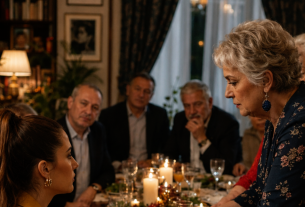
“Katya, please try to understand me. It’s very hard for me to carry this burden alone. What if we split the loan payments fifty-fifty? From our shared budget. That way it won’t be so difficult for me, and we’ll be able to pay it off faster. And Mom will somehow compensate us later… maybe.”
Family life is not only romantic evenings, cozy weekend breakfasts, and shared vacation plans. It is also the ability to set boundaries, protect the interests of your new, newly created family unit, and, as banal as it may sound, share financial responsibility.
Katya married Slava out of deep, sincere love.
She thought they understood each other without words, looked in the same direction, and were ready to overcome any difficulties hand in hand. The first six months after the wedding really did feel like a prolonged fairy tale. They were building their little nest in a small rented apartment, dreaming of getting their own mortgage, and making grand plans. Slava was caring and attentive. He hurried home after work to spend the evening with his young wife. Nothing foretold the storm that would soon break over their family harbor.
It all began with what seemed, at first glance, to be an innocent wish from Katya’s mother-in-law, Lyudmila Viktorovna. She was an active woman, youthful, full of energy and ambition. One weekend, after inviting the young couple over for tea and her signature apple pie, she announced with a heavy sigh that she desperately needed a car. She said age was catching up with her, that she no longer had the strength to travel to the dacha in stuffy commuter trains, and that going grocery shopping was hard too — her back hurt, her legs ached.
Katya only nodded sympathetically then. The desire to have a means of transportation was perfectly understandable and justified. No one could have imagined what this idea would turn into.
A few weeks later, the active search for a suitable car began. Lyudmila Viktorovna quickly rejected all the budget options, saying she needed comfort and status, even if the car was used. Her choice fell on a beautiful silver foreign-made sedan. The price was steep, but her mother-in-law assured everyone that she had savings for the down payment, and she would easily take out an auto loan for the rest.
And that was when the real performance began — one worthy of a theater stage.
On the day of the deal, Lyudmila Viktorovna suddenly began complaining of high blood pressure, a migraine, and her complete inability to understand financial documents.
“Slavochka, my son,” she lamented, clutching her heart and fanning herself with dealership brochures right there in the car showroom. “I’m a weak woman. I don’t understand all these percentages, rates, and insurance policies. They’ll deceive me, they absolutely will! They’ll slip papers in front of me, and I’ll sign without looking. And besides, the bank may refuse me because I’m a pensioner. Put the loan in your name, will you? You’re smart, you earn well, they’ll approve any amount for you. And I’ll transfer the money to you every month, on the exact day, down to the last kopeck. What difference does it make whose name is on the papers if I’m the one paying?”
Slava, being a soft-hearted man who loved his mother beyond measure, gave in under the pressure of her tears and persuasion. Katya tried timidly to object, reminding her husband that they themselves were planning to take out a mortgage and did not need an extra credit burden. But Slava only waved her off.
“Katya, come on, she’s my mom. She’ll pay. Don’t worry. I’m just acting as a guarantor on paper.”
And so, a loan fell onto the young husband’s shoulders — no more and no less than exactly one million rubles. For their budget, the amount was enormous, but Slava was confident in his mother’s decency.
However, the problems began practically the next day. As often happens with beautiful but used cars, the silver sedan came with “surprises.” The car required constant attention, investment, and repairs. First the suspension started knocking, then the engine warning light came on, then oil began leaking. And every time, the faithful son had to save the situation.
Katya’s life turned into a series of lonely evenings. After work, Slava no longer came home to his wife. Instead, he rushed to the other side of the city to his mother, to take her precious “swallow” to the repair shop, negotiate with mechanics, and find the necessary parts. Weekends, which they had once spent together walking in parks or watching movies under a warm blanket, were now spent in garages. Slava came home late at night, smelling of gasoline, motor oil, and unbearable exhaustion. He had no strength left for conversations or tenderness.
Lyudmila Viktorovna’s demands grew at a terrifying pace. Realizing that her son was ready to act as her personal mechanic and chauffeur at the first call, she began abusing his inability to say no. It reached the point of absurdity.
“Slavik,” she would call on a Wednesday evening, just as Katya had set a hot dinner on the table, “I drove through puddles today, and the car is dirty. There’s a line at the car wash, and I don’t want to wait. My head hurts. Come over, take it, wash it, and then park it under my windows.”
And Slava, sighing heavily, would push away his plate of cooling meat, put on his jacket, and leave. Katya would remain alone in the empty apartment, feeling a dull resentment boiling inside her. She stopped seeing her husband. Their marriage, which had not even lasted a year yet, was rapidly rolling downhill, turning into a fiction where Katya played the role of a convenient attachment waiting for her spouse to return from his endless sonly duties.
Another six months passed like that. Katya’s birthday was approaching. It was a special day for her, a small ray of light in the hopeless routine of the past few months. She did not want to arrange a grand celebration, but she dreamed of gathering her closest friends in a cozy, atmospheric café in the city center, drinking good wine, eating beautiful desserts, laughing from the heart, and forgetting — at least for one evening — about garages, spare parts, and her eternally dissatisfied mother-in-law.
Katya had chosen a new dress in advance, booked a table, and a couple of weeks before the celebration decided to discuss the budget with her husband.
That evening, when Slava miraculously happened to be home before midnight, Katya poured him some tea and began the conversation with a smile.
“Slava, my birthday is next week. I booked a table at Magnolia and invited the girls. We need to set aside about fifteen thousand from the budget so we can have a nice evening and not deny ourselves anything.”
Slava choked on his tea. His face turned pale, and his eyes darted around, avoiding his wife’s direct gaze. He nervously rubbed the bridge of his nose and said quietly, stumbling over his words:
“Katya… you see… we don’t have any money. None at all. We need to live more economically. Why don’t you just bake a cake at home this year and have tea with them? Or go to a pizzeria, something more modest.”
Something inside Katya dropped. She knew their income. They both earned good money, they had no children, and they lived in a rented apartment, but the rent did not swallow their entire budget. Where could the money have gone? They had not traveled anywhere, bought any major appliances, or indulged in expensive clothes.
“What do you mean, there’s no money?” Katya’s voice trembled, but she forced herself to speak evenly. “Slava, I don’t understand. I’m putting my salary into our account for the mortgage down payment, just like we agreed. We live on yours. Your salary should be more than enough for living expenses and holidays. Where is the money going?”
Slava lowered his head like a guilty schoolboy. A heavy, oppressive silence fell, broken only by the ticking of the wall clock.
“I’m paying the loan,” he finally squeezed out.
“What loan?!” Katya felt as if the floor had disappeared beneath her feet.
“For Mom’s car.”
The air in the room seemed to thicken. Katya sat there, unable to believe what she was hearing.
“Wait… Are you saying Lyudmila Viktorovna isn’t paying her own loan? The very same one you took out in your name while swearing to me that it was just an empty formality?”
“Well… she had some unexpected expenses,” Slava began justifying himself, shrinking further into his chair. “She said things are hard for her right now. Her blood pressure keeps jumping, medicine is expensive. Plus gas, insurance… She asked me to help. I thought it would be for one month, but then it somehow dragged on. I’ve been making the monthly payments from my salary for six months now. Almost thirty thousand goes out every month.”
Katya covered her face with her hands.
Six months. For six months, her husband had secretly been paying for his mother’s whims, robbing their own family, depriving them of a normal life, forcing them to save on everything just so his mother could comfortably drive to the dacha. And all that time he had kept silent, lied to her face, and dodged the truth.
But what Slava said in the next minute became the absolute point of no return. It was the height of audacity and a complete misunderstanding of the situation.
“Katya, please try to understand me. It’s very hard for me to carry this burden alone,” her husband said ingratiatingly, trying to take her hand. “What if we split the loan payments fifty-fifty? From our shared budget. That way it won’t be so difficult for me, and we’ll be able to pay it off faster. And Mom will somehow compensate us later… maybe.”
Katya sharply pulled her hand away as if she had touched red-hot iron. It was as though a bomb exploded inside her. All the fatigue accumulated over those months, all the resentment over ruined evenings, loneliness, lies, and betrayal burst out in a devastating stream.
“Split it fifty-fifty?! For your mother’s car?!” Katya jumped up from the chair, her eyes flashing. Her voice rang with indignation. “Slava, are you out of your mind? I did not marry a bank branch, and I did not adopt your mother! I work like a slave, save every kopeck for our future home, and deny myself so much, while your mother drives around in a car worth a million rubles and you run errands for her and pay for her whims!”
“Katya, don’t shout, she’s my mother…” Slava tried to interject, but Katya could no longer be stopped.
“Exactly! Your mother! An adult, capable woman who deliberately dumped a huge debt on you! And you dare suggest that I pay for her comfort out of my own pocket?! That I give up my birthday so Lyudmila Viktorovna can conveniently drive around for potatoes?!”
Katya paced the kitchen, trying to calm her wildly pounding heart. She went to the window and pressed her hot forehead against the cool glass, beyond which the lights of the night city flickered. At that moment, everything became crystal clear to her. This could not continue. If she swallowed this now, if she agreed, she would forever remain in second place in this marriage — convenient, obedient, a servant and wallet for solving her husband’s family problems.
She turned around, looked straight into Slava’s confused eyes, and said in an absolutely calm, icy tone that allowed no objection:
“Here is how it’s going to be, Slava. Listen carefully and remember. I will celebrate my birthday exactly as I planned. With my friends, in a nice café, with good food. I will take the money from my own account because I earned it and have the right to spend it on myself. And you… you must solve these new problems. This is your loan, your mother, and your irresponsibility. I don’t care how you do it. But if you don’t solve this issue, if you try to take even one kopeck from our family budget for this debt, or if you continue lying to me, I will file for divorce tomorrow. And this is not a threat, Slava. It is a fact. I will not live in a marriage where I am treated like nothing. The choice is yours.”
She turned around and went into the bedroom, closing the door firmly behind her. That night, they slept in different rooms.
The next day, Katya did exactly as she had promised. She put on her most beautiful dress, did her makeup and hair, and went to meet her friends. She laughed, drank champagne, accepted congratulations and gifts, but inside, everything in her was wound up like a tight spring. She did not know whether she would return to her husband that evening or start packing her suitcases. It was the hardest, most pivotal decision of her life, but she knew she had done the right thing.
Slava stayed home alone. All day he paced the living room, replaying his wife’s words in his head. Katya had never given ultimatums before, never spoken about divorce. Suddenly, with crystal clarity, he realized that he was standing on the very edge of an abyss. He could lose the woman he loved right now, destroy his family and his future, all for the sake of remaining a convenient son to a mother who was openly manipulating him. The fear of losing Katya turned out to be stronger than his habit of obedience.
That evening, when Katya returned home, ready for any outcome, Slava was waiting for her in the kitchen with a huge bouquet of her favorite white roses.
“Happy birthday, my love,” he said quietly, handing her the flowers. “Forgive me. You were right. Right about everything. I was a complete idiot, a blind fool. I made my choice.”
He told her that he had gone to his mother during the day. The conversation had been difficult, unpleasant, full of tears and mutual accusations. Slava, gathering all his willpower, told Lyudmila Viktorovna that his family was on the verge of collapse because of her debts. He set a firm condition: if she could not manage the loan payments, the car would have to be sold immediately, the debt to the bank paid off, and something more modest and affordable bought with whatever was left.
His mother-in-law’s reaction was predictable and, at the same time, shocking in its cynicism. Lyudmila Viktorovna was terribly offended by her son and accused him of callousness, ingratitude, and of “trading his own mother for that witch.”
But the most interesting thing came out in the heat of the scandal.
It turned out that his mother-in-law had money.
She had not been refusing to pay the loan because she lacked money for medicine. No — she was planning to fly to the seaside in the summer, to a nice sanatorium, and had been methodically saving money for that trip, deciding that it would cost her son nothing to take the financial burden on himself. Why spend her own money if she could ride on the young family’s finances?
The prospect of losing the comfortable foreign car she had already grown used to — and which she so loved showing off to the neighbors — frightened Lyudmila Viktorovna far more than her son’s divorce. She categorically refused to sell the car. Realizing that Slava was determined and no longer intended to sponsor her whims at his wife’s expense, she took out her hidden savings with tears in her eyes and curses on her lips.
From that day on, the romance in Slava and Katya’s relationship took on a new, more mature shape. His mother, mortally offended that her brilliant plan had failed, stopped calling her son over every little thing and demanding that he wash the car. She sulked and refused to speak to her daughter-in-law, but every month, on the exact day, she transferred the necessary amount to Slava’s account to repay the loan until the debt to the bank was fully closed.
Katya, meanwhile, learned one very important life lesson.
A real family is built not only on love and trust, but also on the ability to defend your boundaries. Her husband had tried to make her pay his mother’s loan, counting on her obedience and softness. But he was wrong.
Sometimes, in order to save yourself and your marriage, you must not be afraid to show your teeth and say a firm “no,” even if it threatens to cause a scandal. Because loving your husband does not mean voluntarily agreeing to become a convenient doormat for his relatives.
And only after going through that crisis, after defending her right to respect, were she and Slava truly able to become a family where each other’s interests came first.