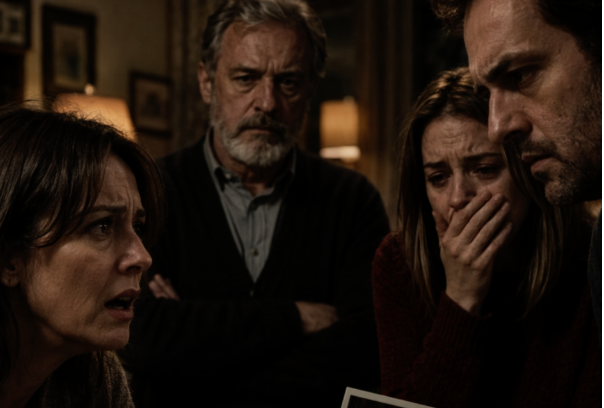
“Who is that in the photo with your daughter?” Larisa asked, pointing at her husband. “Her suitor — the father of my granddaughter.”
Larisa pulled up beside a slightly crooked fence and stayed in the driver’s seat for a moment, in no hurry to get out. So much snow had drifted in that there was no way to drive straight into the yard: the main road had been cleared by a tractor, but the approach to the house had turned into one solid wall of snow. Larisa sighed, but there was nothing to be done — she would have to clear her own property herself.
She pulled on her mittens, climbed out of the car, and the sharp, biting frost hit her in the face at once, as if someone had lashed her across the cheeks.
Opening the trunk, Larisa took out a shovel and started throwing the snow aside. It was heavy and packed down; her arms began to ache quickly, her breathing grew ragged, but Larisa kept going in silence, stubbornly, the way she always did. If she started something, she finished it.
At last, the driveway was more or less cleared. Larisa dusted off her mittens, put the shovel back, exhaled with relief, and got back into the car, ready to drive into the yard. Then, out of the corner of her eye, she noticed movement. At first she thought it was a dog or some other animal — anything could happen in a village. But a second later Larisa felt colder than the frost itself had made her.
A little girl was running down the snowy road, stumbling and flailing her arms. Her coat was unbuttoned, she had no hat on, and her hair was all disheveled. The huge felt boots on her feet were clearly too big for her — she kept tangling herself in them and nearly falling.
“My God…” Larisa breathed.
She understood immediately: a child would not run out into the freezing cold dressed like that for no reason. Her heart tightened painfully. Larisa switched off the engine, jumped out of the car, and hurried toward her. Seeing her, the girl ran faster, reached her, and stopped right in front of Larisa, breathing hard. Her cheeks were bright red, her eyelashes stuck together with frost, and her lips were trembling.
“Mister, please save my grandma!” she blurted out, almost choking on the words. “She’s dying! She’s burning up and won’t get up, and I screamed and screamed, but nobody came…”
Larisa acted automatically: she quickly unwound the scarf from her own neck, threw it over the girl’s head, straightened it carefully, and tied it.
“All right, calm down,” she said firmly, looking straight into the frightened eyes. “Breathe through your nose. And button your coat.”
The girl obediently fumbled with the buttons, but her trembling fingers would not cooperate. Larisa helped her, then took her hand — the little palm was ice-cold.
“Come on. Show me where your grandmother is.”
And they hurried down the street in the direction the girl had come from.
The house turned out to be small and wooden, and inside it was almost as cold as outside. In the room, an elderly woman lay on an old sofa. Her face was flushed scarlet, her uneven breathing broken and shallow. Her eyes were closed, and her lips were muttering something, as if in delirium. Larisa stepped closer and carefully touched her forehead — the heat burned her palm.
“Grandma…” the girl sobbed. “Grandma, I brought the lady…”
Larisa closed her eyes for a second, forcing herself to calm down. Panic would be the worst possible adviser right now.
“All right, listen to me carefully,” she said gently, crouching in front of the girl so they were at eye level. “You’re a smart girl, understand? You’re going to help me now. What’s your name?”
“Darina…”
“Darina, bring some warm water. Is there any vinegar? And a towel,” Larisa said clearly and without fuss.
The girl nodded and rushed off to do it. Meanwhile, Larisa went over to the stove. Firewood had been neatly stacked beside it — apparently the grandmother had meant to light it, but had not had the strength. Larisa quickly laid the logs, lit some bark. At first the flame caught reluctantly, then more confidently, licking the wood with a bold tongue.
Darina returned, clutching everything she had managed to find. Larisa mixed vinegar into the water, dampened the towel, and began carefully wiping the woman down. Gradually the fever started to subside. The woman stopped tossing about, and her breathing evened out, becoming deeper.
Little by little the room grew warmer. Finally, the woman slowly opened her eyes. Her gaze was cloudy and confused, and when she saw an unfamiliar face hovering over her, she tensed in fear at once. She tried to raise herself, but all her strength failed her — her body only jerked weakly.
“Who… who are you?” she asked hoarsely, almost soundlessly, struggling to form the words.
“Hush, don’t be afraid,” Larisa said calmly and gently, carefully supporting her by the shoulder so she would not make any sudden movement. “Everything is fine. You’re at home. I’m your new neighbor. Your granddaughter ran for help, so I came.”
The woman shifted her gaze and saw the girl standing nearby with her hands tightly clasped in worry.
“Grandma, don’t scold me,” Darina said at once in a rush. “I brought the lady. She’s nice.”
The woman smiled faintly.
“Thank you…” she breathed, and closed her eyes again. Larisa checked her forehead — the heat was no longer so frightening; the temperature had clearly gone down. Not to normal, of course, but the worst had passed.
“Darina, you did a wonderful job,” Larisa said. “Right now the main thing is to keep Grandma warm and give her hot tea. Is there any raspberry jam in the house?”
“Yes…” the girl nodded.
“Excellent. Make some tea and put in the jam. Sit beside her and make sure she drinks it in small sips. All right?”
“All right,” Darina answered seriously.
Larisa looked around the room once more. The stove was already giving off more heat, and the house felt cozier. It seemed the worst was over, but she could not leave them alone for long.
“I’m going to step out for a little while,” Larisa said. “I need to do something. I’ll definitely come back, all right?”
Darina nodded.
Outside, Larisa stopped, took a deep breath of the frosty air, and looked at the white, silent road. And suddenly she caught herself with a strange, quiet feeling — as if none of this had happened by accident. As if she had ended up exactly where she was meant to be.
After driving the car into the yard, Larisa first carried her things into the house. The little place greeted her with cold and a faint smell of dampness — it was obvious no one had lived there for a long time. She set the bags on the table, and then remembered the container of stewed potatoes. She pulled it out of the sack and smiled faintly. Her husband, as always, had been right. Yuri had insisted that morning that she take food with her.
“You know yourself,” he had said with a smile. “You’ll get busy, forget to eat, and then end up hungry. Take it, don’t argue.”
At the time she had brushed him off — when would she even have time to eat with so much to do? But now she thought that maybe everything really was falling into place for a reason. She put the container into a bag and hurried back to the neighbors.
By the time she got to Olga Stepanovna’s house, it was already noticeably warmer; the logs in the stove were crackling pleasantly. Larisa reheated the potatoes and first of all sat Darina down at the table. The girl ate with such appetite that Larisa could not help sighing. It was obvious — they had not had hot food here in a long time.
“Don’t rush,” she said gently. “Eat slowly, all right?”
Then Larisa helped Olga Stepanovna sit up a little and propped pillows behind her.
“Here, try some,” she said. “At least a little.”
The woman ate slowly, with difficulty, but after every bite she looked at Larisa with gratitude.
“I’ve had this cold for the second week now,” she finally said quietly, setting the spoon aside. “I kept thinking it would pass… I can’t go to the hospital. You can’t leave Darina alone. Where would I put her? There are hardly any neighbors left… some moved to the city, others went to live with their children.”
She waved her hand as if brushing away heavy thoughts.
“I treated myself with herbs, the best I could. And today… I finally went down. Couldn’t light the stove, couldn’t make dinner. I thought I’d get back on my feet by evening… but this is how it turned out.”
“It’s a good thing Darina didn’t lose her head,” Larisa said. “She saved you.”
At those words, Darina grew shy, lowered her eyes, and said softly,
“I was just scared…”
“And that was the right thing to be,” Larisa answered warmly.
Olga Stepanovna looked first at her granddaughter, then at Larisa, and kept repeating:
“Thank you… Thank you for not passing by…”
“Continuation just below in the first comment.”
Larisa stopped the car by a slightly crooked fence and lingered behind the wheel for a minute, in no hurry to get out. So much snow had drifted in that it was impossible to drive straight into the yard: the tractor had cleared the main road, but the approach to the house had turned into a solid wall of snow. Larisa sighed, but there was nothing for it—she would have to clear her own patch herself. She pulled on her mittens, climbed out of the car, and the sharp, biting frost hit her face at once, as if someone had slapped her across the cheeks.
Opening the trunk, Larisa took out a shovel and began throwing snow aside. It was heavy, packed down, and before long her arms started aching and her breath grew ragged, but she kept going silently and stubbornly, the way she always did. If she started something, she saw it through to the end.
At last, the driveway was more or less cleared. Larisa brushed off her mittens, put the shovel back, let out a relieved breath, and got into the car again, preparing to drive into the yard. And then, out of the corner of her eye, she noticed movement. At first she thought it was a dog or some other animal—anything could happen in a village. But a second later, Larisa felt colder than she had from the мороз.
A little girl was running down the snow-covered street, stumbling and waving her arms. Her coat was unbuttoned, she had no hat on, and her hair was in disarray. The huge felt boots on her feet were clearly too big for her—she kept getting tangled in them and nearly falling.
“My God…” Larisa breathed.
She understood immediately: a child would not run out into the freezing cold dressed like that for no reason. Her heart tightened painfully. Larisa killed the engine, jumped out of the car, and hurried toward her. The girl, spotting her, ran faster, reached her, and stopped right in front of Larisa, panting hard. Her cheeks were bright red, her eyelashes stuck together with frost, and her lips were trembling.
“Auntie, save my grandma!” she babbled, almost choking on the words. “She’s dying! She’s burning hot and won’t get up, and I screamed and screamed but nobody came…”
Larisa reacted automatically: she quickly pulled the scarf from her neck, draped it over the girl’s head, adjusted it carefully, and tied it.
“All right, calm down,” she said firmly, looking straight into the frightened eyes. “Breathe through your nose. And button your coat.”
The girl obediently fumbled with the buttons, but her trembling fingers would barely obey. Larisa helped her, then took her hand—it was icy cold.
“Come on. Show me where your grandma is.”
And they hurried down the street in the direction the girl had come from. The house turned out to be small and wooden, and inside it was cold, almost as cold as it was outside. In the room, an elderly woman lay on an old sofa. Her face was flushed crimson, her uneven breathing broken and ragged. Her eyes were closed, and her lips were mumbling something, as if in delirium. Larisa stepped closer, cautiously touched her forehead—and the heat almost burned her palm.
“Grandma…” the girl sobbed. “Grandma, I brought a lady…”
Larisa closed her eyes for a second, forcing herself to stay calm. Panic would be the worst adviser right now.
“All right, listen to me carefully,” she said gently, crouching in front of the girl so they were at eye level. “You’re very brave, do you understand? Now you’re going to help me. What’s your name?”
“Darina…”
“Darina, bring me some warm water. Do you have any vinegar? And a towel,” Larisa listed clearly, without fuss.
The girl nodded and rushed off to do it. Meanwhile, Larisa went to the stove. The firewood had been neatly stacked nearby—it was obvious the grandmother had meant to light it, but didn’t have the strength. Larisa quickly arranged the logs and set some bark alight. At first the flame caught reluctantly, then more and more confidently, licking at the wood with bold little tongues.
Darina came back, clutching everything she had managed to find. Larisa mixed vinegar into the water, dampened the towel, and began gently wiping the woman down. Gradually, the fever began to subside. The woman stopped thrashing about, and her breathing evened out, becoming deeper.
The room slowly grew warmer. At last, the woman opened her eyes. Her gaze was cloudy and confused, and when she saw an unfamiliar face above her, she tensed in alarm. She tried to rise, but all her strength failed her—her body only gave a weak jerk.
“Who… who are you?” she asked hoarsely, almost soundlessly, struggling to form the words.
“Easy, don’t be afraid,” Larisa said calmly and softly, gently supporting her shoulder to keep her from making a sudden movement. “It’s all right. You’re at home. I’m your new neighbor. Your granddaughter ran for help, so I came.”
The woman shifted her gaze and saw the girl standing nearby, her hands clenched anxiously.
“Grandma, don’t scold me,” Darina said at once in a rush. “I brought the lady. She’s nice.”
The woman gave a faint smile.
“Thank you…” she breathed, and closed her eyes again. Larisa checked her forehead—the fever was no longer so frightening; the temperature had noticeably dropped. Not to normal, of course, but the worst of the danger had passed.
“Darina, you did wonderfully,” Larisa said. “Right now the most important thing is for your grandmother to stay warm and drink hot tea. Do you have raspberries in the house?”
“Yes…” the girl nodded.
“Excellent. Brew some tea and put in some jam. Sit beside her and make sure she drinks it in little sips. All right?”
“All right,” Darina answered seriously.
Larisa looked around the room once more. The stove was giving off more heat now, and the house felt cozier. The worst seemed to be behind them, but she could not leave them alone for long.
“I’m going to step out for a little while,” Larisa said. “I need to do something. I’ll definitely come back, all right?”
Darina nodded. Outside, Larisa stopped, took a deep breath of the frosty air, and looked at the white, silent road. And suddenly she caught herself feeling something strange and quiet—as if none of this had happened by chance. As if she had ended up exactly where she was meant to be.
After driving the car into the yard, Larisa first carried her things into the house. The little place greeted her with cold and a faint smell of dampness—it was clear no one had lived there for a long time. She set the bags on the table, and then remembered the container of stewed potatoes. She took it out of the bag and smiled faintly. Her husband, as always, had been right. Yuri had insisted that morning that she take food with her.
“You know yourself,” he had said, smiling. “You’ll get busy, forget to eat, and then you’ll end up hungry. Take it, no arguing.”
At the time, she had waved him off—when would she even have time to eat with so much to do? But now she thought that everything really was coming together for a reason. She slipped the container into her bag and hurried back to the neighbors.
At Olga Stepanovna’s house, it was already noticeably warmer, the logs in the stove crackling pleasantly. Larisa heated up the potatoes and first of all sat Darina down at the table. The girl ate with such appetite that Larisa could not help sighing. It was obvious—there had not been enough hot food here for a long time.
“Don’t rush,” she said gently. “Eat slowly, all right?”
Then Larisa helped Olga Stepanovna sit up and propped pillows behind her.
“Here, try some,” she said. “At least a little.”
The woman ate slowly, with difficulty, but after each mouthful she looked at Larisa with gratitude.
“I’ve had this cold for two weeks now,” she finally began quietly, setting the spoon aside. “I kept thinking it would pass… I couldn’t go to the hospital. I couldn’t leave Darina alone. Where would I put her? There are hardly any neighbors left… Some moved to the city, some went to live with their children.”
She waved her hand as if brushing away heavy thoughts.
“I treated myself with herbs, the best I could. And today… well, I collapsed. I couldn’t light the stove or cook dinner. I thought I’d feel better by evening… but it turned out like this.”
“It’s a good thing Darina didn’t panic,” Larisa said. “She saved you.”
At those words Darina grew shy, lowered her eyes, and said quietly:
“I was just scared…”
“And you were right to be,” Larisa replied warmly.
Olga Stepanovna looked from her granddaughter to Larisa and kept repeating:
“Thank you… Thank you for not passing us by.”
Larisa only waved it off with an awkward smile.
“How could I pass by when trouble is right next door?”
Gradually, the conversation turned from frightening things to ordinary, everyday matters. Olga Stepanovna visibly came to life: strength returned to her voice, her breathing grew steadier, and her eyes regained a lively interest.
“So you’re the new neighbor, then?” she asked, studying Larisa closely.
“Yes,” Larisa nodded. “My husband and I bought a little house. We’d been looking for something like this for a long time.”
“And why would you come here?” the woman asked in genuine surprise. “It’s so quiet here… boring.”
Larisa smiled.
“That’s exactly why we came. For the quiet. We wanted a place where you could simply sit, look at the sky, the snow, the forest. A place where nothing asks anything of you except to be here, right now.”
“In the city it must be noisy,” Olga Stepanovna nodded understandingly.
“Very,” Larisa sighed. “And we were tired of it. Always rushing somewhere, always trying to keep up with something. So we decided: let there be a corner like this. Not forever, no… but a place we can come whenever we want to rest.”
She told her how she and Yuri had hesitated for a long time, how they had driven through more than one village, how they kept holding back—one house wasn’t right, another place didn’t feel right. And then suddenly they saw this one, and knew it was the one.
“We decided to spend New Year’s here,” Larisa added. “My vacation already started, so I came early. To tidy up, decorate the house. Yura will come on the thirty-first.”
“A good decision,” Olga Stepanovna said thoughtfully, looking out the window, where snow was slowly swirling down. “A holiday feels different in quiet. Not hectic. Real.”
And that was how they became friends—easily, as if they had known each other for a long time. Larisa started dropping in several times a day: to light the stove, bring water, cook food. She did it without thinking, as if it were only natural. Darina was always nearby—helping, or sometimes just sitting in a corner and watching silently, as if Larisa’s mere presence mattered to her.
Olga Stepanovna recovered surprisingly quickly. After just a couple of days she could get up by herself, and soon she was stepping out onto the porch, wrapped in a warm shawl, standing there for a long time breathing in the frosty air.
“You know,” she said one day, squinting in the winter sun, “I was thinking… maybe it wasn’t for nothing that I got so sick that day.”
“What do you mean?” Larisa asked, surprised.
“I mean,” Olga Stepanovna narrowed her eyes, “otherwise you’d have driven right past us. But this way… it brought you to us, and we met a good person.”
Larisa flushed and looked away.
“Oh, what are you saying…”
“But I believe it,” the woman said calmly and firmly. “Sometimes fate brings people together like that. Through pain, through fear—but right on time.”
Larisa said nothing, but somehow the words settled deep inside her. More and more often she caught herself thinking that she was going to the neighbors not because she had to, but because she wanted to. Because it was quiet and peaceful there. Because Darina greeted her with a happy smile, and Olga Stepanovna thanked her every time—not even with words, but with her eyes. And New Year’s was just ahead, and Larisa still had no idea that this holiday would be nothing like the ones they were used to.
On the morning of December thirtieth, Darina came running to Larisa flushed and excited.
“Aunt Larisa, come decorate our Christmas tree with us!” she blurted out right from the doorway.
“Let’s go,” Larisa agreed easily. At her own house she had already finished everything: washed the floors, hung the garlands, put a little tree in the corner. There was hardly anything left to do, and she didn’t feel like sitting alone anyway.
Olga Stepanovna welcomed her warmly and at once bustled about.
“Come in, come in. We put the tree up yesterday, but the decorations are in the shed. Will you get them?”
“I will,” Larisa nodded.
It was dark in the shed. Larisa found the light switch by feel—the bulb flickered, then came on. Two boxes stood on the shelf: one with a faded label that said “decorations,” the other completely unmarked. She reached for the first one, but accidentally brushed the second with her shoulder. The box fell to the floor with a dull thud, the lid flew off, and old photographs scattered across the wooden planks.
“Oh no…” Larisa muttered under her breath, and with a heavy sigh she crouched down.
She began gathering the photographs one by one, carefully putting them back into the box. And then one of them seemed to burn her eyes. Larisa froze. Her heart skipped a beat, then started pounding so hard her ears rang. In the picture was Yura. Her Yura. Young, with an open smile and that very look she knew so well.
He was holding a woman in his arms. Larisa recognized her immediately. That profile, the soft line of the chin, the warm, slightly tired look—the portrait of that woman hung in Olga Stepanovna’s room above the chest of drawers. Darina called her Mom.
Larisa’s hands began to tremble. She quickly slipped the photograph into her coat pocket without looking at it for another second. The rest she put back into the box and returned it to the shelf. She straightened up. Her movements felt mechanical, as if they belonged to someone else. Taking the box of Christmas decorations, she left the shed.
They decorated the tree merrily. Far too merrily for what was going on inside Larisa. Darina enthusiastically took out the ornaments—old glass balls, icicles, little figurines, carefully wrapped in paper.
“My mom used to hang this one too,” she said proudly, holding out an ornament to Larisa.
“It’s beautiful…” Larisa answered, and the word came out with difficulty. Somewhere inside, everything was tightening into a hard, painful knot.
She kept catching herself looking not at the tree, but at the girl’s face. Studying it too closely. And the longer she looked, the stronger that strange, frightening sense of recognition became.
When the tree was done, Darina, satisfied, ran off to her room to watch cartoons. The house suddenly became quiet, with only the crackle of logs now and then breaking the silence. Larisa understood: she could not stay silent any longer. Slowly she took the photograph out of her pocket, walked over to the table where Olga Stepanovna was sitting, and placed it in front of her. Her fingers were trembling.
“Tell me…” Her voice broke, but she forced herself to continue. “Who is this man in the photo with your daughter?”
Olga Stepanovna glanced at it and at once waved her hand, as though it were something of no importance at all.
“Oh, that… her former boyfriend. Darina’s father.”
Larisa’s breath caught; a rushing sound filled her ears.
“What… is his name?” she asked with difficulty.
“How should I know?” the woman shrugged. “Toma never told me his name.”
Larisa slowly sank into a chair. It would not fit into her mind. Darina looked about six years old. And she and Yura had been married nearly seven. Meanwhile Olga Stepanovna went on, not noticing how pale Larisa had turned.
“She left for the city to study back then. Sometimes she came home and said she’d met a man, that she was going to marry him… Then, right before the birth, she came back, stayed quiet for a long time… Only after the baby was born did she admit everything…”
She sighed heavily, as if reliving it all.
“She said that after she got pregnant, she met someone else. Young, handsome. She realized she wasn’t tying her life to the right man. She left the first one without even telling him about the child.”
Larisa listened without breathing.
“And that other one,” the woman continued, “promised her everything. Said he’d accept the child, love her, marry her. So she moved in with him… And half a year later she came back in tears. Turned out he was married. His wife had gone away to study, then came back early. And she threw Toma out with nothing but the clothes on her back.”
“And…?” Larisa asked, almost inaudibly.
“And then she went to the child’s father,” the woman nodded. “But he wasn’t living there anymore. The new tenants said he’d gotten married and bought a new apartment. So she came back to me… empty-handed.”
Olga Stepanovna fell silent, pressing her lips together as if she didn’t want to go on. But in the end she did.
“And when Darina was born…” Her voice shook. “She left her. Went away at night. All she left was a note. ‘Forgive me, Mom, I need to build my personal life.’”
“Why didn’t you look for Darina’s father?” Larisa asked quietly, not lifting her eyes from the photograph.
Olga Stepanovna only waved her hand.
“And how was I supposed to look for him? Tamara never even told me his name. And what for? If he got married, then he probably has his own children by now. What would Darina be to him? Extra. A burden. No…” She sighed heavily. “Better she stays with me. I’ll somehow manage.”
Larisa was silent. The words stuck in her throat, unwilling to come out. She listened and could not quite believe that this was not some distant tale, not someone else’s made-up story, but something that had suddenly become far too close.
Another picture rose before her eyes then—bright and vivid. The way she had met Yura.
That too had happened just before New Year’s. The end of December, when the whole city already lives in anticipation of the holiday. A frosty evening, chaos outside a supermarket: people pushing carts, cars pulling out of the parking lot one after another, hurrying, honking. And her car had stalled. Right in the middle of the lane. At the worst possible moment, absurdly, as if out of spite. The car had died crosswise, blocking everyone. Larisa had been so flustered her hands began to shake. She jumped out of the car, looking apologetically at the other drivers, feeling her cheeks burn with embarrassment and tears gathering in her eyes. It seemed that one moment more and she would burst into tears right there, under strangers’ stares and irritated horns.
And at that moment, a man came up to her.
“Let’s take a look,” he said calmly, as if nothing special were happening, as if there were no frost, no rush, no annoyed people all around.
He opened the hood, adjusted something, checked something—confidently, without fuss, as though he had done it a hundred times before. His calm somehow passed to her as well. A few minutes later the engine came back to life, humming evenly as if nothing had happened.
“Oh… thank you so much,” she had said then, flustered. “I don’t even know how to thank you…”
“Let’s spend New Year’s together,” he suddenly suggested, as simply as if it were the most natural continuation of the conversation. “My mood today is so bad I could howl.”
Larisa laughed—from surprise, from the absurdity of the proposal, from the fact that the tension had finally let go. And for some reason, everything immediately felt easy.
And then… then they really did spend New Year’s together. With tangerines, an old movie, quiet music, and long conversations until morning—about life, about chance, about how strangely things sometimes come together.
By then Larisa had already been divorced for a year. She and her ex-husband had separated peacefully, without scandals or mutual reproaches. He had simply wanted children very much, and Larisa could not have them. She had taken a long time to tell him, afraid of destroying another person’s hopes, but in the end she had told him honestly, and they had parted wishing each other happiness.
She had told Yura about it right away. She did not want to build illusions, did not want anything left unsaid between them.
“I won’t be able to give birth,” she had said directly, almost in one breath. “If that matters to you…”
He had not even let her finish.
“What matters to me is that you’re by my side,” he had said calmly and confidently. “In my heart I feel that you’re my destiny.”
They got married quickly, unexpectedly for everyone. And from then on they lived in complete harmony. They rejoiced in every day, made plans, supported one another. Larisa had been sure there were no secrets between them. Not big ones, not small ones.
And now… She sat in Olga Stepanovna’s kitchen, looking at the photograph, feeling a strange bitter wave rise inside her. It hurt to realize that her husband had a daughter. That there was a past he had kept silent about. But along with the pain, another feeling suddenly appeared. A quiet, cautious premonition… of happiness.
Larisa raised her eyes and looked toward the room from which the muffled sound of a cartoon could be heard. And suddenly she understood: this story was only beginning. And now far more depended on her decision than she had been ready to admit. Not only her own life, but the life of that little girl.
She could barely wait for Yuri to arrive. The day dragged on endlessly, as if the clock had deliberately slowed its pace. Larisa picked up her phone several times, then put it down again, then picked it up again. What should she say? How should she begin? How could she ask without destroying everything? Dozens of phrases ran through her head, but none of them seemed right.
Yuri arrived in the evening. He carried bags of groceries and gifts into the house, shook the snow off his jacket, and smiled—happy, content, the way he always was when he escaped the city.
“Well, I made it,” he said, bending down to kiss Larisa. “Happy almost New Year, my love…”
She did not even let him finish—she could not wait another minute.
“Yura,” she said from the doorway, looking him straight in the eyes, “who is Tamara?”
The smile slowly faded from his face. Yuri silently set the bags on the floor, took off his jacket, hung it on the hook, and only then let out a heavy sigh, gathering his thoughts.
“There was something there…” he said quietly, not looking at Larisa. “We dated. Not for long. I was never going to marry her.”
He fell silent for a moment, choosing his words, and then continued:
“And when she said she had found someone else… I was actually relieved. Because none of it was real. It all felt empty somehow. I always had the feeling I was waiting for my person. And then I saw you, and I understood at once—that was it. That was my destiny.”
Larisa said nothing. Her fingers clenched so tightly that her nails dug into her palms.
“I never even thought about Toma again,” Yuri went on more quietly. “That all stayed in the past. But how did you—”
“She has a daughter,” Larisa interrupted, almost in a whisper. “And she lives here, with her grandmother.”
For several seconds Yuri simply stared at her, as if he had not immediately grasped the meaning of the words.
“A daughter?..” he repeated dully, and looked away. “I didn’t know.”
Larisa took a deep breath.
“All right, come on, you must be tired from the road,” she said after a short pause. “We’ll talk later.”
They prepared the holiday dinner together, as always. Cutting salads, putting meat into the oven, laying the table. Everything was familiar, known down to the smallest detail—and that made it especially strange. Something heavy and alien hung in the air. There was no laughter, no joking, none of the excitement that usually accompanied them before the holiday.
When the chimes rang, they raised their glasses, congratulated each other, and then suddenly Larisa said, as if she had made the decision long ago:
“Let’s go to Darina and her grandmother.”
Yuri looked at her carefully, as if checking whether she might change her mind.
“Are you sure?”
“Yes.”
They gathered the gifts. For Darina, a box of sweets. For Olga Stepanovna, Larisa took out a shawl. She had bought it for a friend, but the friend had not been home when Larisa had stopped by on her way to the village.
The neighbors were delighted by their visit. Darina at once rushed to show them her presents, speaking quickly, breathlessly, unable to hide her joy.
“Grandma and I made a snowman! A big one, with a carrot nose! I’ll show you tomorrow!”
She laughed, boasted about the doll from Father Frost, bustled about. Olga Stepanovna smiled, but from time to time she cast furtive glances at Yuri, frowning. Yuri remained restrained, hiding his tension. His eyes kept lingering on Darina. He looked at her long and closely, as though searching for something familiar in her features—and apparently finding it.
When Darina had been put to bed, silence settled over the house. Olga Stepanovna cleared the table, sat down opposite her guests, and was clearly about to ask a question. She had even opened her mouth, but Larisa spoke first.
“Olga Stepanovna,” she said calmly, “my husband is the man in that photograph.”
The woman froze. Slowly she turned her gaze to Yuri.
“So that’s it…” she said quietly.
“After the holidays,” Yuri said, “I’ll do a DNA test. So everything will be fair. And after that… we’ll see.”
Olga Stepanovna nodded.
“That’s the right thing.”
The results came two weeks later. Those days dragged by especially slowly—as if time had decided to test their patience. Yuri took a deep breath and opened the envelope. He read in silence. His fingers trembled when his eyes ran over the lines, as if he could not believe what was written there. Larisa did not rush him. She simply watched—closely, calmly, ready for any outcome.
At last Yuri raised his head.
“She’s mine,” he said quietly, almost in a whisper. “Darina is my daughter.”
Larisa nodded. Without surprise, without an outburst of emotion. Somewhere deep inside she had known it long before papers, stamps, and signatures. She stepped closer and embraced him.
Olga Stepanovna took the news hard. For a long time she sat by the window, looking out at the snowy yard, slowly stroking Darina’s head. There were tears in her eyes, but her voice remained even and composed.
“She’ll probably be better off with her father,” she said. “You’re good people, that’s obvious right away. And the conditions…” She sighed. “A child needs more than love. A child needs a future.”
The decision came painfully to her. Every word seemed to echo with hurt. But she did not cling to her granddaughter out of fear or selfishness. Love, as she understood it, sometimes means knowing how to let go.
They explained everything to Darina carefully, without unnecessary details. At first the girl grew wary and pressed herself to her grandmother, as though afraid they were about to take her away forever. But then her eyes lit up.
“And I’ll still be able to visit Grandma?” she asked at once.
“Of course,” Larisa smiled. “Any time. Whenever you want.”
Only then did Darina agree to go with her new parents.
Larisa accepted her husband’s daughter as if she had always known that this was how it would be. As if she had been waiting for this moment all her life. Without jealousy, without doubt, without trying to compare herself to anyone from the past. She simply opened her heart. She and Darina quickly found common ground. The girl turned out to be affectionate and attentive, she loved helping, asked a thousand questions, and was always drawn to Larisa, as if she had long been searching for exactly such a mother.
A year passed.
Right before New Year’s, they came to the village again. Darina was the first to jump out of the car; she flung open the door and shouted from the threshold, unable to hold back her joy:
“Gra-a-andma! Hooray! Father Frost granted my wish! Soon I’m going to have a little brother or sister!”
Olga Stepanovna froze, then came over and hugged her granddaughter tightly. Tears were running down her cheeks, but a happy smile played on her lips.
“Happiness to you,” she whispered. “Great, real family happiness.”
Later, over tea, she told Larisa and Yuri that Tamara had come to visit her.
“She’s doing fine,” Olga Stepanovna said. “She got married. She’s raising a son.”
Yuri tensed, but the woman continued calmly.
“When she found out Darina was living with her father, at first she flew into a rage. But then she cooled down. Looks like she understood that it was the right thing.”
Larisa exchanged a glance with Yuri.
“So everything turned out the way it was meant to,” she said.
Olga Stepanovna nodded.
Outside, snow was falling softly. Inside the house it was warm—truly warm—not only from the stove, but from the people gathered around one table. And each of them knew: sometimes fate makes strange, painful turns only so that, in the end, everything can fall into its proper place.