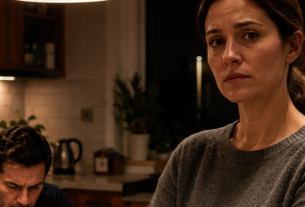
“I’m telling you, the car needs to be put up for sale. And preferably urgently. I’m having serious problems with that loan. In a couple of years, I’ll get back on my feet, and we’ll buy you a brand-new car from the dealership. I promise.”
Spring that year turned out to be unusually temperamental. Warm, almost summerlike days were suddenly replaced by a damp wind from the Volga, hurling sharp icy grains into the faces of passersby. But no bad weather bothered Daria. As soon as she got behind the wheel of her snow-white crossover, gleaming with cleanliness, the outside world with all its slush, problems, and fuss remained behind tightly closed windows.
Inside, the cabin smelled of expensive perfume and new leather, her favorite music played softly, and the climate control maintained the perfect temperature. For the thirty-two-year-old woman, this car was not merely a means of transportation. It was her personal fortress, a zone of absolute comfort, and a symbol of independence that she valued above all else.
Daria worked as a senior specialist at a large advertising agency. Her schedule was irregular, the clients were demanding, and her bosses were strict. That was why the forty minutes she spent driving from the office home were sacred time for her to reset. She loved her car with all her heart, took care of it, and regularly took it to the car wash and for maintenance.
But at home, a completely different reality awaited her. Her husband, Vadim, to whom she had been married for five years, was in a permanent state of “finding himself.” Before the wedding, he had seemed like an ambitious and promising young man, bursting with ideas.
But in practice, all his ideas shattered against harsh reality the moment they came into contact with the need for systematic, persistent work. Vadim did not accept working “for someone else,” considering it the fate of losers. Again and again, he got involved in dubious startups that inevitably ended in failure and financial losses.
His latest grand venture, which had begun about a year earlier, was opening a company for luxury apartment renovations. Vadim was certain he had found a gold mine. Using their small jointly owned dacha as collateral, he took out a substantial bank loan to buy professional equipment. Daria remembered that scandal down to the smallest detail. Her husband had dragged mountains of tools into their already not very spacious two-room apartment, the crown jewel being a gigantic, unbelievably expensive construction vacuum cleaner designed for industrial collection of concrete dust.
“Dasha, you don’t understand!” Vadim had proclaimed then, his eyes burning as he patted the plastic side of the vacuum cleaner. “This is an investment! Without good equipment, we won’t get wealthy clients! We’ll do turnkey renovations in premium-class new buildings. In six months, I’ll close the loan, and in a year, we’ll buy a new apartment!”
But no miracle happened. It turned out that luxury renovations required not only expensive vacuum cleaners, but also highly qualified craftsmen, a competent foreman, and the ability to communicate with demanding clients. Vadim, however, only wanted to sit in the director’s chair and count profits.
The workers he hired through an advertisement ruined materials on the very first job. The client demanded a penalty, and the “business empire” collapsed before it had even properly spread its wings. Now that ill-fated construction vacuum cleaner gathered dust like an orphan on the glassed-in balcony, serving as a silent monument to male arrogance, while Vadim gnashed his teeth every month as he handed over a huge portion of their shared budget to the bank to repay the loan.
Daria had long since grown tired of these swings. She carried the main household expenses on her shoulders, paid the utilities, and bought groceries. The only thing that saved her was that three years earlier, that very snow-white car had appeared in her life, allowing her to feel confident.
The story of how that car appeared was quite remarkable and, in many ways, defined the nature of relationships in Dasha’s family. The car had been bought by her mother, Tamara Ilyinichna. Tamara Ilyinichna was a woman of steel, who had spent her whole life working as chief accountant at a large factory. She possessed an incredibly sharp, analytical mind and never made rash decisions.
After retiring, she found an outlet in complex, professional knitting. Dasha often watched with a smile as her mother sat in an armchair, armed with knitting needles and a notebook, calculating with mathematical precision where exactly sixteen stitches needed to be decreased evenly over ten rows so that the armhole of a cardigan would fit the body perfectly. She applied the same jewel-like precision and cool calculation to life.
When Tamara Ilyinichna learned that her daughter, tired of endless rides on overcrowded minibuses to a residential district, dreamed of having a car, she made a decision. She sold the small village house she had inherited, added her substantial savings, and took Dasha to a car dealership.
Vadim had refused to go with them at the time, citing an important business meeting, which, as usual, led nowhere. And that became a fatal mistake for his future plans.
While arranging the purchase at the dealership, Tamara Ilyinichna pulled her daughter aside and said quietly, but in a tone that allowed no objection:
“Dashenka, the car will be registered in my name. You’ll be included in the insurance without restrictions, drive it in good health, it’s your gift. But on paper, I will be the owner.”
“Mom, why make things so complicated?” Daria had asked in surprise.
“Because, my dear, your Vadim is a financial catastrophe. Today he builds castles in the air, and tomorrow he’ll get into such debt that bailiffs will come to inventory your property. And I will not allow my car to be sold off because of his stupidity. Or, God forbid, if you decide to divorce, that mama’s little businessman will demand half the car as marital property. No, thank you. The mathematics of life is simple: what’s mine is mine, what’s yours is yours, and his problems should remain only his problems.”
Dasha had laughed then at her mother’s excessive caution, but she did not argue. The documents were issued in Tamara Ilyinichna’s name. Vadim, seeing the new car near the building, was so thrilled by the possibility of occasionally taking it for his “director” trips that he did not even bother to look at the vehicle registration certificate. He was firmly convinced that the car had been bought by Dasha with money gifted by her mother and, naturally, registered in his wife’s name. Dasha did not correct him, and over time that nuance faded from her memory as unnecessary.
Until that fateful April evening.
For the past few weeks, Vadim had been darker than a storm cloud. He was constantly texting someone on his phone, getting irritated over every little thing, sleeping badly, and smoking one cigarette after another on the balcony, flicking ash straight onto the forgotten construction vacuum cleaner. Daria understood: creditors or cheated clients had started backing him into a corner. The amount of debt was apparently significant. Dasha tried not to pry with questions, reasonably believing that an adult man should clean up the mess he had made himself.
That evening, Daria came home from work exhausted. Layoffs were looming at work, and to protect herself, she had been secretly studying vacancies on HeadHunter for several days, looking for remote work options so she would have a backup plan. She made dinner and set the table. Vadim ate in silence, staring at one spot. Suddenly, he put down his fork, dabbed his lips with a napkin, looked Dasha straight in the eyes, and announced:
“Dasha, we’re going to sell your car. We need the money!”
A ringing silence hung in the kitchen. Daria froze with a cup of tea in her hands, unable to believe her ears. Her husband’s tone was not pleading or apologetic. He spoke as if he were informing her that tomorrow they would buy a new kind of pasta. Calmly, casually, and categorically.
“What, excuse me?” she asked again, trying to hold back the wave of indignation rising in her throat.
“I’m saying the car needs to be put up for sale. And preferably urgently,” Vadim said, nervously drumming his fingers on the table. “I’m having serious problems with that loan for the renovation business. The bank is threatening to hand the case over to collectors, and penalties have piled up. Plus, one of the old clients is threatening to sue over the ruined parquet floor.
“I urgently need to close these gaps. I’ve already checked the prices. Your crossover is worth excellent money on the used market right now. It’s in perfect condition. We’ll sell it, I’ll pay off all the debts, and with the remaining couple hundred thousand, we’ll get you some old small car for the time being. In a couple of years, I’ll get back on my feet, and we’ll buy you a brand-new one from the dealership. I promise.”
Daria looked at her husband, and it was as if a veil fell from her eyes. She did not see a loved one who had found himself in trouble, but a brazen, infantile egoist who intended to solve the problems created by his own stupidity and laziness at her expense. At the expense of the only thing that brought her joy and gave her a sense of security.
“Vadim, are you out of your mind?” Dasha said slowly, enunciating every word. “This is my car. I drive it every day. Why on earth should I switch to a rusty bucket or take the bus because you imagined yourself to be a great entrepreneur and went bankrupt?”
“Because we’re family!” Vadim suddenly raised his voice, red blotches spreading across his face. “We’re supposed to help each other in difficult moments! A wife is supposed to be a reliable support! And you’re acting like a complete egoist! Is that piece of metal more important to you than your husband’s peace of mind?”
“My piece of metal is my safety. And your peace of mind has cost us nerves, money, and constant scandals. Sell your precious construction vacuum cleaner, sell the remaining tools! Go drive a taxi at night, get a job as a loader, a courier! Why are you solving your problems with my property?”
“Who needs that vacuum cleaner secondhand?! They’ll give pennies for it!” Vadim roared, jumping up from the table. “That’s it, conversation over. I am the head of the family, and I make the decisions. I’ve already called a reseller I know. He’s coming tomorrow evening to look at the car. And don’t you dare throw a tantrum in front of him! Prepare both sets of keys and the documents. We’ll take it off the register in the next few days.”
Vadim turned and went into the bedroom, slamming the door loudly. Daria remained sitting in the kitchen. A hurricane of emotions raged inside her: hurt, anger, disappointment. But through that storm, a thin, cold ray of vengeful joy suddenly broke through.
She remembered her mother’s words at the dealership. “What’s mine is mine, what’s yours is yours.” Vadim, in his blind self-confidence and consumer-like attitude toward her, had no idea what land mine he was about to step on. Daria decided not to start a scandal right then. She decided to let him go all the way so she could enjoy the moment of his complete, crushing defeat.
The next day, Dasha came home from work on time. She parked her snow-white crossover near the entrance and went upstairs to the apartment. Vadim was already home, fussy and sweaty.
“The reseller is here, waiting downstairs,” he threw out instead of a greeting. “Give me the documents and keys. Hurry up, he doesn’t have much time, he’s a businesslike man.”
Daria silently took off her coat, went to her bag, and pulled out the pink plastic vehicle registration certificate, the vehicle passport, and the keyring. She went downstairs after her husband, feeling everything inside her tighten in anticipation of the outcome.
A stocky man in a leather jacket was waiting by the car. He walked around the crossover like an owner, tapped the tires, and peered into the cabin through the window.
“Well, the condition seems decent, original paint,” the reseller rumbled. “Vadik explained the situation to me. You need money urgently, so the price will be about fifteen percent below market. You understand, urgent purchase. Show me the documents.”
Vadim, shining like a polished brass basin, held out his hand to Dasha.
“Give me the papers.”
Maintaining icy calm on her face, Daria handed the plastic registration card to the reseller. With a professional gesture, he turned it over in his hands, reading the information, then suddenly frowned.
“Hey, Vadik, I don’t get it,” the man said, raising his eyes to Vadim. “Who is Tamara Ilyinichna Morozova?”
“What Tamara Ilyinichna?” Vadim blinked in confusion, his smile sliding from his face. “Dasha, what is this?”
“That is the name of the owner of the vehicle,” Daria calmly explained to the reseller, folding her arms across her chest. “My mother.”
“What do you mean, your mother?!” Vadim squealed, snatching the document from the man’s hands. He stared at the line marked “Owner,” and his face began to turn pale rapidly. “The car is yours! It was given to us for the wedding… I mean, it was given to you! We were married!”
“The money was gifted to me, Vadim. But my mother, being a wise and far-sighted woman, bought the car in her own name. And according to the documents, it belongs exclusively to pensioner Morozova. I am listed on the insurance. That’s all.”
The reseller, realizing that this smelled like family drama and a failed deal, spat onto the asphalt.
“Listen, Vadik, have you lost your mind? Were you trying to sell me someone else’s car without a general power of attorney? Sort out your mother-in-law problems yourselves. I’m leaving. Clowns.”
The man turned around, got into his car, and sharply drove away. Vadim remained standing in the middle of the courtyard, clutching the pink piece of plastic in his trembling hands.
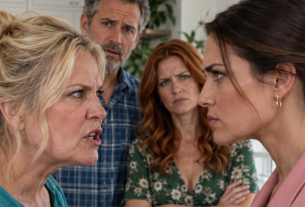
“You… you did this on purpose!” he hissed, advancing on his wife. “You hid assets from me! You set me up! How am I supposed to pay my debts now?! They’ll ruin me! Call your mother! Right now! Let her write a general power of attorney with the right to sell! This is marital property, she has no right!”
Daria did not even flinch. She took her phone out of her pocket and dialed her mother’s number, demonstratively turning on speakerphone.
“Hello, Dashenka?” Tamara Ilyinichna’s cheerful voice came through the speaker.
“Mom, Vadim is demanding that you write a general power of attorney for selling the car. He has no way to pay off the debts from his business. He says it’s marital property.”
There was silence on the line for a second, and then the former accountant burst into sincere, ringing laughter.
“Oh, that’s hilarious! Marital property? Vadik, are you there? Listen to me carefully, you half-baked businessman. My car has as much to do with your marriage as ballet has to do with astronautics. You didn’t earn a single kopeck for that car. You didn’t even fuel it once. And if you thought you could climb out of your financial pits on my daughter’s back and at my expense, then your grade in mathematics is a solid F. And if you dare raise your voice at Dasha again or even stammer about selling someone else’s property, I will personally file a police report for attempted fraud and extortion. Do you understand? End of call.”
Tamara Ilyinichna hung up. A grave silence followed, broken only by the sound of wind in the tree branches.
All of Vadim’s arrogance, all of his false authority, deflated in an instant. He stood there pitiful, confused, realizing the scale of his catastrophe.
“You have exactly two hours to pack your things,” Daria said in an absolutely even, lifeless voice, taking the car documents from his hands. “You can take your stupid vacuum cleaner too. I’m putting the apartment up for sale. I’ll transfer your share to your account, minus what you owe me for utilities. Tomorrow I’m filing for divorce.”
She turned around and pressed the button on the key fob. The snow-white crossover flashed its headlights in greeting as it disarmed the alarm. Dasha got into the cabin and slammed the heavy door shut, cutting herself off from Vadim, his problems, and his debts. She inhaled the scent of expensive perfume and new leather.
Ahead of her lay a difficult divorce process, a job change, and a move. But there was no fear. There was only an incredible, intoxicating feeling of freedom. She started the engine, turned up the music, and smoothly drove out of the courtyard toward her new, real life — one in which there was no place for parasites.