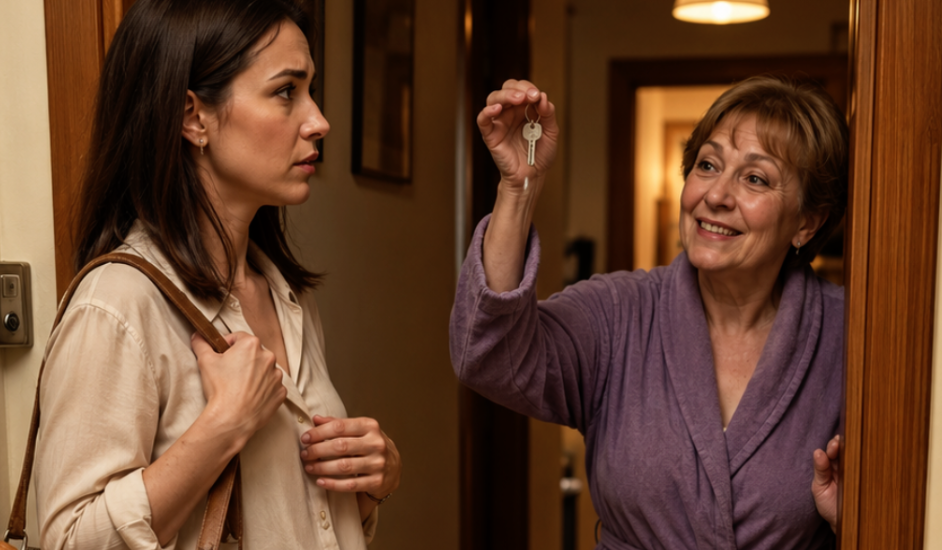
“This is my apartment now, sweetheart,” the mother-in-law said, standing in the doorway with a triumphant smile as she slowly turned a shiny new golden key between her fingers. “Go take a walk somewhere. We’re having a family council here.”
Anna froze on the threshold of her own home. In her right hand she held a bag of groceries from the nearest supermarket, and in her left, a set of keys that had calmly opened this lock exactly two minutes ago.
And now they did not open it.
Not at all.
Lyudmila Petrovna, her husband’s mother, blocked the entrance with her solid figure, dressed in her favorite lilac robe. Behind her shoulder, Anna could see the familiar cream-colored hallway. From deeper inside the apartment came the smell of borscht Anna had not cooked, and the quiet murmur of a man’s voice — her own husband was talking to someone on speakerphone and clearly had no intention of coming out to meet her.
“Lyudmila Petrovna, what family council?” Anna tried to keep her voice steady, but the grocery bag in her hand began to tremble treacherously. “What is going on here? Why don’t my keys work?”
“The lock was changed this morning,” her mother-in-law announced calmly, adjusting the thin gold chain around her neck. “Sergey called a good locksmith. The old one had become completely loose, and this new one has European protection. Very reliable. Would you like me to give you the locksmith’s number? It will come in handy when you’re settling into some little rented room somewhere.”
“What are you talking about? Sergey!” Anna raised her voice, hoping her husband would finally come out of the room. “Seryozha, can you hear me? Open the door properly. I’ve just come home from work!”
From inside the apartment came an awkward cough, then the rustle of slippers over the laminate floor, and her husband appeared in the hallway. Sergey was wearing his favorite striped house shirt, his glasses perched on his nose, and in his hands he held some thick paper folder.
Anna had never seen that folder before in her life.
“Anyut, just don’t get nervous,” he forced out, avoiding her eyes. “Come in. We’ll explain everything calmly. Mom is right, we need to talk like adults.”
“Come in?” Anna laughed nervously. “Into my own apartment? Seryozha, do you even hear yourself? My keys have been taken away from my home like I’m a stranger, and now you’re graciously allowing me to come in?”
Her mother-in-law sharply lifted her chin, and a cold spark flashed in her pale gray eyes — a spark Anna knew all too well. It appeared every time the daughter-in-law dared to raise her voice at the beloved son.
“My girl, let’s not have hysterics,” Lyudmila Petrovna said slowly, in a singsong tone. “If you start shouting on the landing, I’ll call the district police officer. Seryozhenka and I don’t need any unnecessary gossip from the neighbors. Come in quietly and listen to what your elders have to say.”
Anna stepped inside.
The entryway looked unusually empty. Her pink house slippers were not on their usual shelf. Her winter coat was not hanging on its hook. Instead, two large checkered bags stood neatly on the floor, her own belongings sticking out of them.
Someone — either her husband or her mother-in-law — had thoughtfully packed up her life while she had been working at the office.
“What is this?” she asked, nodding toward the bags. Her voice had become strangely quiet, as if she were saving her breath for an important conversation.
“That is yours, Annushka,” her mother-in-law said with the sweetest of her smiles. “I tried my best and folded everything neatly. Your blouses, your skirts, even all that makeup of yours that takes up an entire box. Go into the living room. We need to sign a few papers, and then you can take your little bags.”
In the living room, a table had already been prepared for Anna.
Not for tea, no.
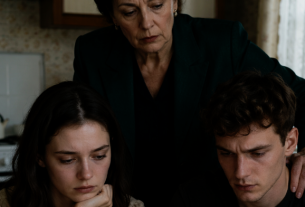
On the tablecloth lay that same paper folder, two cheap plastic pens, and a printed document several pages long. Her mother-in-law lowered herself heavily into the master’s armchair. Sergey sat beside her like a timid assistant next to a director. Anna was not even offered a seat.
“You see,” her husband began, nervously fiddling with the arm of his glasses, “Mom and I have been thinking for a long time, and we came to one important conclusion. This marriage of ours… well, it has run its course. We’ve had different views for a long time. You’re completely absorbed in your career, and I’m focused on my business with Mom. We haven’t had children in five years. That’s… generally not right.”
“What business?” Anna blinked. “Seryozha, three years ago you opened a sole proprietorship and closed it after four months. You don’t have any business.”
“Not yet!” her mother-in-law took offense on behalf of her son. “Seryozhenka is just getting started. We’re planning to open a wonderful little shop with eco-friendly products. Only there’s one problem, Annushka — starting up requires capital. And real estate as collateral. So my son and I have re-registered a few things.”
Anna felt the tips of her fingers go numb. She put the grocery bag straight down on the floor and stepped closer to the table.
“What did you re-register?” she asked in an even tone. “This apartment was bought by me. Before the wedding. With my money, in my name. There is nothing here to re-register.”
“Anyut, just don’t be angry,” Sergey began squirming. “You see, Mom made a gift agreement with us. Well, in our favor — I mean, in my favor. And I… I just agreed so Mom would feel calmer. And as your husband, I have rights here too. We’re family.”
“What gift agreement, Seryozha?” Anna spoke slowly, feeling rage rising inside her in a hot wave. “Who supposedly gave what to whom?”
“Well, let’s say you gave it,” her mother-in-law smiled. “You know, there’s a good saying, darling: what belongs to the husband belongs to the wife, and what belongs to the wife belongs to the husband. Seryozha is my son. And a mother must be sure of her child’s future. A notary helped us out as a relative, actually. He did us a small favor.”
Anna silently picked up the printed document from the table. It was a copy of some kind of agreement, and on it there was a signature — her signature, at first glance. Only she had never seen this document in her life, let alone signed it.
“This is a forgery,” she said calmly. “I didn’t sign any papers for you. Not yesterday, not a month ago. Never.”
“Anyut, why are you saying that?” Sergey flushed red all the way to the tips of his ears. “Remember, in April, when we were at the bank getting a card issued, and you signed a bunch of forms there? Well, this paper was among them. You simply didn’t read carefully.”
“So you, my husband,” Anna looked him straight in the eyes, “slipped me a document at the bank to sign, transferring my apartment to your mother as a gift? Do I understand you correctly, Seryozha? Is this your great business plan?”
Her mother-in-law grimaced as if bothered by an annoying fly.
“Girl, don’t be so ungrateful,” she sighed. “Seryozhenka is thinking about the family. The two of you had more than enough space here anyway, and my husband and I need money for the dacha, plus the shop, of course. Sign here in the corner saying you have no claims, take your checkered bags, and go to your mother. Live with your parents for a couple of months, calm down, and we’ll even pour you some tea when we meet.”
Anna quietly placed the printout back on the table.
“Here is how this is going to work,” she said in a calm, almost gentle voice. “Now both of you are going to listen to me very carefully.”
Sergey cautiously leaned back in his chair. Her mother-in-law, on the contrary, straightened up and folded her arms across her chest, preparing to repel any attack.
“This apartment was purchased in 2017,” Anna began. “With my personal funds, which I had saved over eight years of work, and with money my father gave me for my thirtieth birthday. I have the original sale and purchase agreement, a bank statement confirming the transfer of funds, and a notarized agreement that Sergey and I signed before the registry office. That agreement states directly that this apartment is my personal property and is not subject to division in the event of divorce.”
Her mother-in-law turned as pale as sour cream.
“What agreement? Sergey, what is she talking about?”
“Mom, I don’t know,” her husband mumbled. “I vaguely remember something like that. We went to a notary before the wedding, but I thought it was just a formality…”
“It was a prenuptial agreement, Seryozha,” Anna almost smiled. “The very one you signed without looking because my father said there would be no wedding without that paper. Remember? You even laughed and said, ‘What difference does it make? I love you. I’ll sign anything.’ Well, that ‘difference’ is now the reason I get to keep my own apartment.”
Her mother-in-law’s face slowly went from pale to gray. The thin gold chain around her neck trembled slightly.
“Sergey, are you an idiot?!” she shrieked, instantly forgetting her loving-mother act. “What did you sign, you fool?! Do you understand that we have completely lost now?!”
“Mommy, I don’t remember!” her husband whined. “That was a hundred years ago! Her father insisted on it. Back then I was agreeing to everything just so the wedding would happen!”
Anna watched this rapid transformation with interest. Just a minute earlier, her mother-in-law had been calling her “sweetheart” and “my girl,” and now she was screeching at her own son like a market vendor.
The perfect family portrait, framed by a lilac robe and a merchant-like armchair, was crumbling right before her eyes.
“I’ll continue,” Anna said softly, cutting into their quarrel. “Tomorrow morning I’m going to my lawyer with a copy of your, forgive me, fraudulent document. The signature on it is probably very similar to mine, but a handwriting expert will identify the forgery in fifteen minutes. After that, my lawyer and I will file a police report for large-scale fraud. This is not a threat. It is simply a description of the next item on my work plan.”
“Anyut, don’t go to the police!” Sergey jumped up instantly. “Anyut, we’re family! Mom got carried away, I was an idiot too, we’ll sign everything back, return the gift deed, and forget it like a bad dream!”
“Shut up, you oaf!” his mother shouted at him. “Why are you crawling on your knees in front of this upstart?! Anna, dear, you’re a smart woman. Let’s settle this peacefully. Why do you need scandals and courts? You and Sergey can just divorce calmly, the apartment stays with you, Sergey and I return to my two-room place, and we forget this unpleasant story.”
“How generous of you, Lyudmila Petrovna,” Anna said, shaking her head slightly. “You have just returned my own apartment to me and believe you’ve done me a favor. Your logic is astonishing. Worthy of a psychology textbook on manipulation.”
“Sergey,” she turned to her husband. “Tell me honestly. This idea, to squeeze me out of my apartment with a forged gift deed — did it come from your mother, or from you?”
Her husband stood in the middle of the living room with his shoulders lowered, not knowing what to do with his hands. First he shoved them into his pockets, then pulled them out, then clasped them in front of himself like a naughty schoolboy outside the principal’s office.
“Anyut… well, Mom suggested it,” he finally forced out. “But I agreed. I… I didn’t think it was all so serious. I thought we would explain everything to you nicely afterward. You’re kind. You would understand. Mom is my own mother. I’m obligated to take care of her. She really needs the little shop.”
“She needs the little shop,” Anna repeated thoughtfully. “You see, Seryozha, in a normal family, people earn money together. They start a business with their own funds, with loans, with money borrowed from friends. Not by forging documents and fake gift deeds against a wife. You lived in my apartment for five years. You ate the food I cooked. You wore shirts I bought for you. And the first independent thing you did in this marriage was try to deprive me of the roof over my head for the sake of ‘Mommy’s little shop.’”
“I was going to give it back later!” Sergey shouted. “When the business took off! We would have bought you a second apartment, even better than this one!”
His mother-in-law let out a heavy sigh beside him, as if listening to the delirium of a dying man. It was clear from her face that she had already understood everything: the game was lost, the train had left, and it was urgently necessary to regroup and save at least what remained.
“Annushka,” she cooed again in her gentlest voice. “As a mother, I simply wanted what was best for my son. You must understand, I raised Seryozhenka alone after the divorce. I worked for him, denied myself everything for him. I thought we were all one family. I thought of you as a daughter too…”
“Lyudmila Petrovna,” Anna interrupted her gently. “Do you know what I’m going to say to you now? I’m going to say thank you.”
Her mother-in-law blinked.
“For what, dear?”
“For the truth,” Anna explained. “For finally showing me your real face. Yours and Seryozha’s. For five years, I convinced myself that my mother-in-law was simply a strict, demanding woman. That her criticism of my borscht came from love. That her endless ‘back in our day’ remarks were just a generational difference. That Sergey was a kind, soft boy who simply needed help growing stronger.”
She shifted her gaze to her husband. He stood there hunched over, looking more than anything like a drooping teenager in front of a strict teacher.
“But it turned out that my mother-in-law is the director of a play called ‘How to Con a Naive Daughter-in-Law Out of Her Apartment,’” Anna continued. “And soft little Sergey is the lead male actor. Thank you. Without tonight, I might have wasted another twenty years on this performance.”
Sergey took an uncertain step toward her.
“Anyut, wait. Don’t do this. I love you. Truly. It’s just that Mom… well, she’s the only mother I have. I can’t refuse her. When she asks, something inside me seems to break, and I nod, nod, nod. And then I look at you and realize what I’ve done. Anyut, let’s start over. Tomorrow I’ll take you to the lawyer myself. I’ll personally write a refusal of this whole agreement. I’ll set boundaries with Mom…”
“Seryozha, you won’t set any boundaries with your mother,” Anna said wearily. “You’re thirty-four years old, and you still live as if you’re eight. Mom said it, Mom ordered it, Mom knows best. I am not a kindergarten teacher. I am an adult woman. I have my own job, my own apartment, and my own plans for this life. I don’t need a husband who has to be taught how to walk and how not to sign forged documents against his own wife.”
“Anya…”
“Tomorrow I’m filing for divorce,” she finished calmly. “Tonight, you and Lyudmila Petrovna will gather all your things and leave this apartment. You have exactly one hour. In one hour, I’m changing the lock. The one Lyudmila Petrovna so thoughtfully chose for me today turns out to be an excellent initiative. My locksmith is on his way.”
“This is tyranny!” her mother-in-law shrieked, instantly losing all her sweetness. “Where am I supposed to go at night with my things?! I’m an elderly woman! I have blood pressure!”
“You have your own two-room apartment on Victory Avenue,” Anna reminded her calmly. “Sergey showed it to me many times. We even ate your borscht there on weekends. It’s twenty minutes by minibus. You’ll make it before midnight, don’t worry.”
“And where did you crawl out from, anyway?!” her mother-in-law shouted, finally dropping the caring-mother mask. “Who were you when my son found you?! Sitting in your accounting department chewing on dry crackers! I was the one who let you into this family. I elevated you. I arranged your life for you all these years!”
“Lyudmila Petrovna,” Anna almost smiled, “five years ago I was already a senior economist at a large bank. I already had this apartment and a loan that I fully paid off in four years. I fed Sergey while he was searching for his ‘true calling.’ I paid the utilities while he dreamed of becoming an investor. I took you to a sanatorium in the spring, remember? In the Caucasus. With my own money. So let’s not rewrite history. I have a good memory too.”
Her mother-in-law opened her mouth but could find no answer. She stood in the middle of the living room for a little while longer, breathing heavily, then suddenly turned and went to the bedroom to collect her things. From the hallway came loud snorting and the clatter of hangers — Lyudmila Petrovna was urgently preparing for retreat.
Sergey remained standing where he was. His face held the expression of a man who had just been woken up at three in the morning and told that the world outside the window had changed. He kept taking his glasses off and putting them back on. The folder with the forged documents still lay on the table — a useless, pathetic piece of evidence from their failed family enterprise.
“Anyut…” he tried once more. “I really do love you. I’m just… weak. Forgive me. Give me a chance.”
“Seryozha,” Anna looked at him almost with compassion. “I am not punishing you. I am simply finally choosing myself. You know, for five years I was a support beam. For your career that never happened. For your relationship with your mother, which you couldn’t build on your own. For the budget that you and Lyudmila Petrovna successfully drained together. I am tired of being the foundation for people who, in gratitude, try to tear me down.”
She walked to the window and looked out at the dark courtyard. Somewhere below, a minibus rumbled. Somewhere, a neighbor’s dog barked. Somewhere, a completely different world existed — a world in which everything would now be different for Anna.
“I don’t want to be a foundation anymore,” she said quietly. “I want to be myself. Just Anna, thirty-six years old, with a good job, favorite books, and quiet mornings. Without a sofa genius carrying his mother’s ambitions. Without a mother-in-law who considers my apartment a bargaining chip. Without the endless ‘just be patient, it’s Mom…’”
“So what am I supposed to do?” Sergey muttered helplessly.
“Pack your things,” Anna answered gently. “Go to your mother. The second room in her two-room apartment is free. The two of you can build your eco-friendly little shop together. With honestly earned money, without forged documents. That’s actually a very useful experience. I’m sure you’ll succeed.”
An hour later, the apartment was empty.
Her mother-in-law left first, chin held high, dragging behind her a huge checkered suitcase — the same one on whose little wheels her husband had returned from the seaside ten years ago. She did not say goodbye, only threw something over her shoulder about “ungrateful career women who end up lonely old hags.”
Sergey lingered at the door. He fussed with the laces on his sneakers for a long time, clearly hoping Anna would change her mind, come out of the kitchen, and say, “All right, let’s try again.”
Anna did not come out.
She sat calmly on the sofa in the living room, her laptop open, making a to-do list for tomorrow: lawyer, locksmith, divorce petition, call parents.
“Anya,” he called from the door. “Anya, I’m leaving.”
“Have a good evening, Seryozha,” she answered evenly, not looking up from the screen. “Leave the keys on the cabinet.”
The door slammed shut.
Anna sat motionless for another fifteen minutes, listening to the silence of the empty apartment. It was a strange, very new silence — without the muffled droning of the television, without his mother’s calls on speakerphone, without the constant “Anyut, where are my chargers?”
A silence in which she could hear her own breathing.
She got up, went to the kitchen, put the kettle on, and took out her favorite mug — the blue one with the little white daisy. Her mother-in-law hated that mug and constantly “accidentally” put it on the highest shelf. Now Anna calmly took it down, poured herself strong tea with lemon, and sat by the window.
She dialed her father’s number.
“Dad,” she said simply, “I’m leaving Sergey. Actually, I’ve already left. More precisely, I threw him and his mother out of the apartment. They staged a whole performance here with forged gift documents. They wanted to steal the apartment.”
There was a pause on the other end. Then her father replied very calmly:
“All right, daughter. I’m coming over now. And I’ll bring a lawyer with me. I have a good acquaintance who specializes in these cases. We’ll start working on it tomorrow morning. How are you holding up?”
“I’m holding up, Dad,” Anna unexpectedly smiled. “You know, somehow I’m holding up too well. I thought it would be terrifying. But it isn’t. It feels light.”
“That’s because you’re a smart girl,” her father said seriously. “And because we didn’t force Seryozha to sign that prenuptial agreement for nothing back then. I saw through that weak-willed guy right away. Forgive me, my daughter.”
“Dad, you were right,” Anna admitted quietly. “I was stubborn for too long. But I’m not being stubborn anymore. Thank you.”
Half an hour later, the doorbell rang. It was the locksmith — the very same one her mother-in-law had called that morning, only Anna had managed to phone him and ask him to install the lock again, this time under her name and with her keys.
The locksmith turned out to be a calm man of about fifty, carrying a large blue tool bag. He quickly removed the daytime mechanism, installed a new one, and handed Anna three neat keys in transparent packaging.
“Good lock,” he praised. “No one will open this one, even if they really want to. And no copy can be made without your personal presence and passport.”
Anna paid him in cash, thanked him, and closed the door behind him. She pulled the handle. The lock clicked securely and finally.
That sound was probably the most pleasant one of the entire day.
She returned to the living room, took the paper folder with the forged gift deed from the table, carefully placed it in a thick envelope, and put it in her work bag. Tomorrow she would need to show it to the lawyer. The forged signature had been done rather clumsily. Anna had no doubt that an expert would expose it in a matter of minutes.
Then she walked through the apartment slowly, as if moving through a space that was both foreign and newly familiar.
In truth, the apartment was hers, and every little thing in it was hers — the blue floor lamp by the armchair, the rug with small diamond patterns, the old bookcase inherited from her grandmother. It was just that for five years, all of it had seemed covered with other people’s throws, other people’s slippers, and the foreign smell of men’s cologne.
Now those covers were gone.
The apartment exhaled.
And Anna exhaled with it.
The next morning, Anna woke up at seven — an hour before her alarm. Before, she had always jumped up anxiously: to make Sergey breakfast, to check whether he had remembered to take his vitamins, to make sure he hadn’t offended his mother on the phone.
Now, for the first time in five years, she woke up in peace.
No one needed to be fed. No one needed to be pleased.
She made herself coffee, opened the window, and listened as the courtyard woke up. Next door, an old woman was hanging freshly washed towels on a line. Children were running to school. The janitor swept leaves in a steady rhythm. Life was going on as usual, and strangely enough, Anna fit into this life much better than into the one she had lived yesterday.
At nine in the morning, she was at the lawyer’s office.
Two weeks later, the handwriting analysis confirmed that the signature on the gift deed was forged. The police report was accepted quickly. A case was opened, and Lyudmila Petrovna was summoned for questioning. At first, the mother-in-law screamed about “slander,” then cried, then began insisting that “Seryozha came up with all of it, and I am just a trusting woman.”
Meanwhile, Sergey sat in his mother’s two-room apartment, ate buckwheat without butter, and sent Anna pitiful messages every day.
She did not answer them.
The divorce was finalized in two months. The apartment remained Anna’s — thanks to the very same prenuptial agreement her father had forced Sergey to sign five years earlier. The criminal case over the gift deed never reached court. At the last moment, her mother-in-law and son wrote an official waiver of all claims, just so Anna would withdraw the complaint.
Anna withdrew it.
Not out of pity, no.
Simply so she could finally erase those people from her life and not waste another hour on courts and hearings.
A year later, she received a promotion at work and became head of the department. She bought herself a small car, one she had dreamed about since university. She did some light renovation in the apartment: changed the wallpaper, repainted the kitchen a warm peach color, and hung the very paintings her mother-in-law had once called “tasteless.” She enrolled in Spanish classes. She started going to the swimming pool on Saturdays.
One spring day, as she was leaving the entrance of her building, she ran into Sergey. He was standing by her car and had obviously been waiting, but when he saw Anna, he somehow shrank, as if he had become shorter. He was wearing that same striped shirt — older now, faded. Dark circles hung under his eyes.
“Anya,” he forced out. “Hi. I… I just wanted to say. Mom’s little shop closed. There’s no money. She’s very ill, always arguing, always nervous. I wanted to ask, maybe…”
“Seryozha,” Anna interrupted him gently. “Go home. I won’t help you. And I don’t want to help you. We became strangers a long time ago.”
“I understand,” he lowered his head. “Sorry for coming up to you. You look… you look very good, Anya.”
“Thank you,” she answered. “Take care of yourself.”
She got into the car, calmly started the engine, and pulled away. In the rearview mirror, Sergey grew smaller and smaller until he disappeared completely around the corner. Anna turned on her favorite radio station, turned onto the avenue, and drove to work.
She felt good.
A mother-in-law and a daughter-in-law are two women who, in an ideal world, should become a source of support for one another.
In Anna’s world, that support had long been a forgery.
But true support, as it turned out, had always been inside Anna herself.
And now she knew it with absolute certainty.