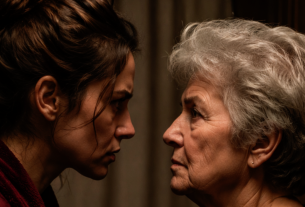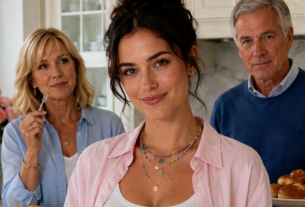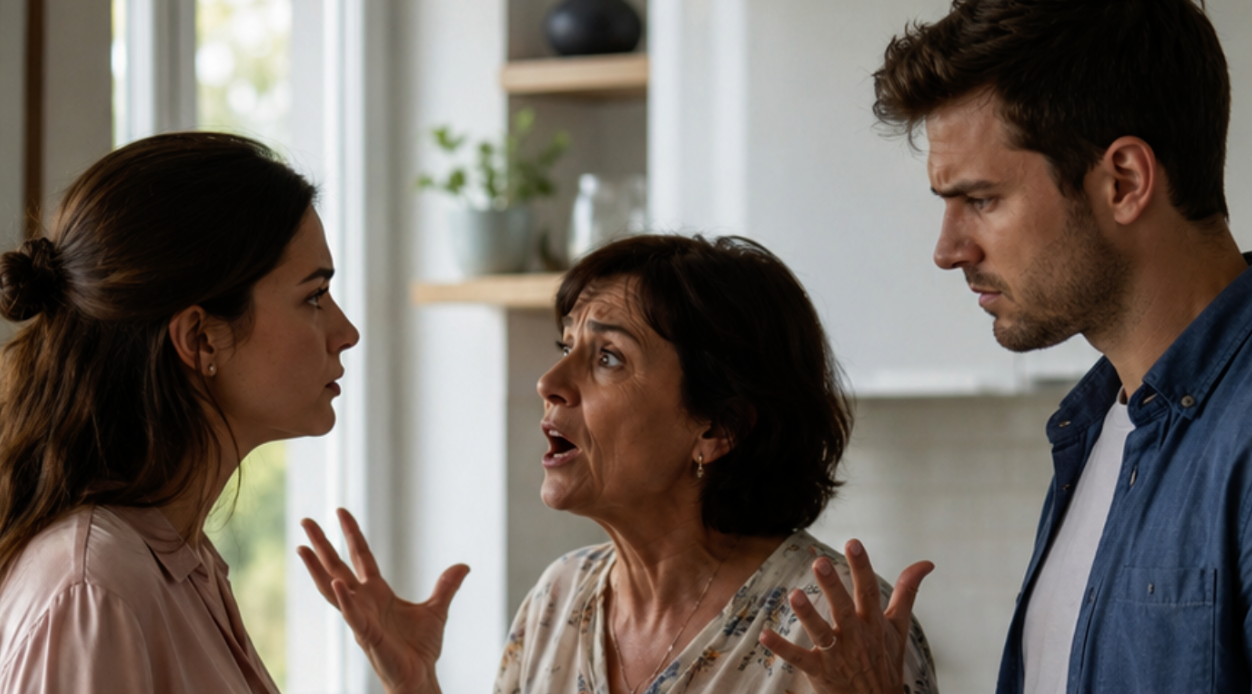
“Someone like you? My son could find a dozen women like you. Don’t doubt it.”
Valentina Petrovna said it calmly, almost without malice — the way people state something obvious, something that requires no proof. As if she were announcing the price of a kilogram of tomatoes at the market. And it was precisely that calm certainty that hit Vera harder than any shouting could have.
They were standing in the kitchen. A small, cozy kitchen — or one that had once been cozy — in the apartment on Lesnaya Street, where Vera had lived for three years now. Her mother-in-law had arrived without calling, as usual. She had simply rung the doorbell at half past six in the evening, holding a jar of jam and wearing the expression of a person who had come not for a visit, but for an inspection.
Vera said nothing. She stared at the stain on the tablecloth — an old coffee stain — and thought that she should have washed it long ago. Strange how the mind clings to small things when it does not want to think about the main thing.
“Do you even understand,” Valentina Petrovna continued, adjusting the sleeve of her beige jacket, “that Kirill could have long ago… Well, what is there to say? My son is not the type to sit alone and pine away. Women call him, by the way. They write to him.”
“I know,” Vera said.
“Exactly. You know, and still he bothers with you. Honestly, I don’t understand.”
That was her mother-in-law’s favorite construction: “I don’t understand.” She always said that when she understood everything perfectly well and simply wanted you to finish the sentence in your own head. Vera had long ago learned to hear what stood behind those words. Today it meant: leave on your own before you are asked to.
Outside the kitchen window, darkness was slowly falling. Kirill should have come home from work an hour ago.
Kirill had been standing behind the door for fifty-three minutes.
At first he had simply wanted to ring the bell — press the button, walk in, put the bag of food on the table. But when he heard his mother’s voice through the door, his hand lowered by itself. He leaned against the wall in the stairwell, ran a hand over his face, and stayed there.
There was a ring in the pocket of his coat. A small dark-blue velvet box. He had bought it three days ago at a jewelry store on Pervomayskaya Street — he had spent a long time choosing it, while the saleswoman looked at him with that professional warmth found only in such shops. Kirill had turned the ring over in his hands, tried it against his fingers for comparison, and at some point felt something very simple and very important: he wanted to go home. To Vera. For good.
Now he was listening to his mother explain to his fiancée that she was temporary.
He was not angry. Or rather, he was angry, but not the way he used to be. Before, he had always found explanations for his mother’s words: she was worried, she did not know how to act differently, she was simply that kind of person. Today those explanations did not help. He heard his mother’s voice — even, convinced — and thought about how many times Vera must have stood alone in this kitchen like this. And stayed silent. Because she knew how to stay silent in places where he himself had not even known how to notice.
The little box in his pocket was light. Almost weightless. But Kirill felt its weight every second.
“Valentina Petrovna,” Vera said, and her voice was surprisingly calm, “let me make you some tea.”
It was not peace. It was a pause. Vera knew the difference.
Her mother-in-law looked at her with mild surprise — apparently she had expected tears or objections — and slowly nodded. Vera put the kettle on and took out two mugs. While the water boiled, she looked out the window at the courtyard, where children were kicking a ball under a streetlamp, and thought that something would end today. She did not yet know exactly what. But she felt it as clearly as people feel a change in air pressure before a thunderstorm.
“You don’t even have any proper cookies,” Valentina Petrovna remarked, peering into the cupboard.
“There are crackers.”
“Crackers,” her mother-in-law repeated with the intonation of someone who had been served the wrong glass. “Well, fine.”
Vera placed a mug in front of her and stepped over to the windowsill. Behind her came the clinking of a spoon — her mother-in-law was stirring sugar slowly and methodically, as if something important depended on it.
“Do you even think about the future?” Valentina Petrovna asked. “About children, at least?”
“I do.”
“And?”
“And that is my conversation with Kirill. Not with you.”
A pause. The spoon stopped clinking.
“Oh, really,” her mother-in-law said slowly. “So now I can’t even ask.”
“You can do whatever you want,” Vera said. “But some answers are not mine to give.”
It sounded gentle. Almost tender. But something in those words made Valentina Petrovna purse her lips.
Kirill rang the doorbell at 7:47 p.m.
When the door opened and he saw Vera — slightly pale, with a mug in her hand, wearing that expression he had long ago learned to read as everything is fine, but actually it isn’t — he stepped inside without taking off his coat and embraced her. Just like that. Without a word.
Behind Vera, his mother was sitting in the kitchen.
Kirill met her eyes over Vera’s shoulder. Valentina Petrovna looked at him with an expression that said: well, finally, I have already explained everything here.
“Hi, Mom,” he said evenly.
“Hello. I stopped by, thought I’d check on you…”
“Yes. I heard.”
It was a short phrase — and there was something in it that made his mother fall silent. Kirill slowly let Vera go, unbuttoned his coat, took the dark-blue box from his pocket, and placed it on the table. Between his mother’s mug and the little bowl of crackers.
Vera looked at the box. Then at Kirill.
“I wanted to do this differently,” he said. “But it seems the moment has chosen itself.”
Valentina Petrovna slowly set down her mug.
The silence in the kitchen was so dense that they could hear someone’s joyful shout outside in the courtyard — apparently the ball had gone into the goal.
Vera stared at the box. Dark blue, velvet, slightly worn on one corner — clearly Kirill had taken it out more than once. Her hand reached for it by itself, but she stopped herself. She lifted her eyes to him.
“Have you been carrying this around for long?”
“Three days,” he said simply.
Three days. That meant he had gone to work, come home, eaten dinner — and all that time, this box had been lying in his pocket. Vera did not know whether to laugh or cry.
At the table, Valentina Petrovna did not move. She looked at her son with the expression of a person caught off guard — and one who very much disliked it.
“Kirill,” she finally said, “perhaps there’s no need to do this like that, in the kitchen…”
“Mom.” He turned to her, and there was no rudeness in his voice — only exhaustion, quiet and long-standing. “I love you. But right now I am talking to Vera.”
After that, Valentina Petrovna left.
Not immediately — first she finished her tea, then spent a long time searching in the hallway for the scarf that was lying right in front of her on the shelf. Kirill helped her put on her coat, called a taxi, and walked her to the door. Everything was polite, everything was calm. But when the door closed behind her, Vera heard him lean his back against it and exhale — long, like a person who had been carrying something heavy and had finally set it down.
She came out into the hallway. For a while they simply looked at each other.
“Did she hear you ring the doorbell?” Vera asked.
“No. I stood behind the door for more than an hour.”
“What?”
“I heard the conversation. Not all of it — but enough.”
Vera slowly nodded. She did not pretend everything was fine and that her mother-in-law had simply dropped by for tea. He knew himself that nothing about it had been fine.
“Let’s go to the kitchen,” she said. “The little box is still there.”
The box lay exactly where Kirill had left it — between the empty mug and the bowl of crackers. Vera picked it up. Opened it.
The ring was simple — thin gold, with a small stone the color of water. No extravagance, no curls or flourishes. Exactly the kind she would have chosen herself if anyone had asked. But no one had asked — Kirill had simply known.
“I’m not good at beautiful speeches,” he said, sitting across from her. “You know that.”
“You are,” she objected. “Just rarely.”
He gave a faint smile.
“Vera. I want you to be my wife. Not because it’s expected, not because the time has come. Because I spent three days walking around with this ring in my pocket, and every time I thought of you, it felt… right. Do you understand? Just right.”
She looked at the ring. She thought about how he had stood behind the door for more than an hour and listened to his mother explain that there were a dozen women like her. And still he had come in. And taken out the box.
“Yes,” Vera said.
Just yes. No tears, no drama. He put the ring on her finger — it fit as if it had always belonged there.
But things did not become easy.
Vera understood that the very next day, when Kirill called his mother to tell her. She did not hear the conversation; she was in another room. But from the way he paced from corner to corner, and how long he sat afterward with the phone in his hands, staring at the wall, everything was clear without words.
Valentina Petrovna knew how to stay silent in a way that made silence louder than shouting.
Two days later, she called Vera herself. Vera was just returning from work — she taught classes at a small art studio on Sadovaya Street, and after six hours with children aged five to twelve, her head hummed quietly and steadily, like a transformer. When she saw Valentina Petrovna on the screen, she stopped for a second right there on the sidewalk.
Then she answered.
“Vera,” her mother-in-law’s voice said. Dry, even. “We need to meet. Without Kirill.”
“Why?”
“There is something we need to discuss. Something important.”
Vera looked at the window of the coffee shop across the street, where someone had stuck a paper heart to the glass — probably left over from the previous week. It was already crumpled, but still holding on.
“All right,” she said. “When is convenient for you?”
They met at a café on Rechnaya Street — Valentina Petrovna had chosen the place herself and sent the address in a short message, without unnecessary words. The place turned out to be expensive and quiet, with white tablecloths and waiters in black. Not the kind of place people went simply to talk. The kind of place people went so the other person would feel a little smaller.
Her mother-in-law was already sitting at a table — upright, in a gray coat, with a small handbag on her lap. Before her stood an untouched glass of water.
“Sit down,” she said, as if it were her table and her café.
Vera sat. She ordered coffee — simply so her hands would have something to do.
“I’ll speak plainly,” Valentina Petrovna began. “I have nothing against you personally. You are a… decent girl. But there are circumstances you do not know about.”
“What circumstances?”
Her mother-in-law was silent for a moment. She picked up the glass, then set it down again.
“Kirill has a girl. Had one. Or rather…” She paused, clearly weighing her words. “Not exactly had. They still communicate. Her name is Irina. They have known each other for ten years. Her family and our family have been friends for a long time. Her father helped us during a very difficult time. And…”
She did not finish.
Vera held the cup with both hands. The coffee was hot, almost burning her fingers — but she did not let go.
“And what?” she asked quietly.
“And her parents are waiting. They have been waiting for a long time. Waiting for a wedding, Vera. Do you understand? This is not nothing. These are obligations. Adult, serious obligations, which Kirill apparently has told you nothing about.”
Outside the café window, a tram passed by. Vera looked at her ring — thin gold, a stone the color of water — and thought of one thing: had he known? Had Kirill known when he stood behind the door with the little box in his pocket?
Vera did not call Kirill right away.
She left the café, walked to the embankment — fortunately it was only about ten minutes away — and simply stopped at the parapet. Below, the water moved slowly, dark and shining. On the opposite bank, the windows of apartment buildings glowed, where people were having dinner, watching TV shows, putting children to bed. Ordinary life, calm life. Vera looked at those windows and tried to understand what she was feeling.
Anger? A little.
Fear? That too.
But mainly, she wanted to hear his voice. Not to shout. Just to hear it. And in the first two seconds, understand the truth.
She dialed his number.
Kirill answered after the second ring.
“Where are you?” he asked, and there was something wary in his voice. “It’s already late.”
“I’m on the embankment. Kirill, who is Irina?”
A pause. A long one — three seconds at least. For a person with nothing to hide, that was a lot.
“Where did you hear that name?”
“Your mother. We met today.”
The pause became even heavier.
“She called you herself?”
“Yes.”
He fell silent. Vera heard his breathing and waited. The streetlamp above her flickered once, then again, and steadied.
“Come home,” Kirill finally said. “I’ll explain everything. Please.”
He explained for a long time.
They sat on the sofa, a cushion lying between them — not intentionally, it had just happened that way — and Kirill spoke. Slowly, without trying to embellish anything.
Irina had been in his life for a long time — since college. They had dated for two years, then broken up, then kept in touch for several years. Her father, Gennady Pavlovich, really had helped his family — when Kirill’s father died and his mother was left with the apartment loan, Gennady Pavlovich had given them money without any written agreement. He had simply given it, humanly.
“And since then, Mom believes we owe him,” Kirill said.
“Owe him marriage?”
“That’s how she sees it. Irina does too. And I…”
He fell silent.
“Irina is not a bad person. But I don’t want to live with her. I knew that three years ago, when I met you. I tried to explain it to Mom, but she only hears what she wants to hear.”
Vera looked at the ring. Then at him.
“Does Irina know you proposed to me?”
Kirill nodded.
“Mom told her. Earlier than I should have done it myself.”
The next morning, Vera received a call from an unknown number.
She was at the studio, arranging brushes before class. She answered without thinking.
“Good afternoon,” said a woman’s voice. Pleasant, even, well-trained. “Vera? My name is Irina. I think you already know who I am.”
Vera slowly set the brush down on the table.
“I know.”
“I’m not going to turn this into a drama,” Irina said. “I simply want to meet and talk. Humanly. Without mothers-in-law and without Kirill.”
It was unexpected. Vera had expected anything — tears, threats, theatrical speeches — but not this calm, almost businesslike tone.
“All right,” she said. “Where?”
Irina turned out to be beautiful. Not in a glossy way — just well-groomed, slim, with a short haircut and intelligent eyes. One of those women you look at and think: she has everything under control. Always.
They met at a small café near the park. Irina arrived earlier and was already holding a cup — cappuccino, the foam perfectly smooth.
“I am not making a claim on Kirill,” she said as soon as Vera sat down. “I want you to know that immediately. I understood everything long ago. About a year and a half ago.”
“Then why?..”
“Because there is Gennady Pavlovich. My father.” She paused. “He knows about the debt. And he has not forgotten. And this is where the part begins that no one will tell you directly.”
Vera listened.
Irina spoke quietly and clearly — like a person who had rehearsed this conversation for a long time. Her father had invested a very large sum in Kirill’s family. Without a receipt, yes. But with an understanding. And now, having learned about the engagement, he called Valentina Petrovna every day. He did not threaten her — he simply reminded her. Gently. Persistently. In such a way that Valentina Petrovna’s eye had already started twitching.
“He is not a bad man,” Irina said. “But he is used to debts being repaid. In one form or another.”
“What does he want?”
“Money. Just money.” Irina smiled faintly, bitterly. “No romance. No wedding. He understood long ago that nothing would come of Kirill and me. But the sum is hanging over them. And it matters to him that it be settled officially.”
Vera slowly exhaled.
“Why are you telling me this?”
Irina looked straight at her.
“Because Valentina Petrovna will not tell you. Kirill does not know the full amount — his mother hid it from him. And if you enter this family without knowing what is hanging over it, that would be unfair. To you.”
That evening, Vera sat at the kitchen table and stared at one spot. Kirill came in, saw her face, silently poured himself some water, and sat down across from her.
“You met with Irina,” he said. He did not ask.
“Yes.”
“She told you about her father?”
Vera lifted her eyes to him.
“Did you know?”
“I knew there was a debt. I didn’t know how much. Mom… she always said everything had been settled. That there was no need to bring it up.”
“Kirill,” Vera said quietly. “We need to talk to your mother. The three of us. Today.”
He looked at her — and there was something new in his gaze. Not confusion, not fear. Something like relief. As if he had been waiting for someone to finally say it out loud.
Valentina Petrovna opened the door and stopped short — clearly she had not expected both of them.
The conversation was long. Unpleasant. At first his mother deflected, then got angry, then suddenly — unexpectedly for everyone, perhaps even for herself — began to cry. Real tears, without theatrics. She said she had been afraid. That after her husband’s death, she had been afraid of everything, and Gennady Pavlovich had seemed like a safe shore, and she had promised too much, and now she did not know how to get out of it.
Kirill sat beside her and held her hand.
Vera looked at them both — at this aging, proud, deathly frightened woman, and at the man with the ring in his pocket who had stood behind the door for an hour just so he would not walk away — and thought that family was not a celebration. It was this. Kitchen light, an uncomfortable conversation, and someone’s hand in someone else’s hand.
“We’ll deal with the debt,” Kirill told his mother. “Together. But you have to tell me the truth. Always.”
Valentina Petrovna nodded. She did not say a word, simply nodded — and that was more than any promise.
Already in the hallway, while putting on her coat, she suddenly stopped and looked at Vera. For a long time. Without a smile, without warmth — but also without that old cold certainty.
“You are not what I thought,” she finally said.
“I know,” Vera replied.
They went outside together. Kirill took her hand — just like that, silently. Streetlights reflected in the puddles. Somewhere far away, a tram hummed.
“Will you regret it?” he asked quietly.
Vera looked at the ring. Thin gold, a stone the color of water. Slightly cold from the evening air.
“Ask me in twenty years,” she said.
And they went home.
A month later, Kirill met with Gennady Pavlovich.
Without his mother, without intermediaries — he called him himself and chose the place himself. They sat in an ordinary cafeteria near an office center, where Gennady Pavlovich had lunch every day, and spoke calmly, like two adults who had no reason to pretend.
The amount turned out to be large. But not catastrophic.
Gennady Pavlovich listened to Kirill attentively, without interrupting. Then he sat in silence for a long time, twisting a paper napkin in his fingers. He said he respected it when a man came himself and looked him in the eye. That he and Irina had long ago moved on to a different life, and he had accepted it. That money was money, nothing personal. They agreed on installments and shook hands.
No written agreement. Only a word.
Valentina Petrovna wore a blue dress to the wedding and spent the whole evening sitting upright — proud, somewhat distant, but present. That was already something.
At one point, Vera caught her eye across the hall. Her mother-in-law did not smile. But she did not look away either. She simply looked at her — studying her, almost honestly.
Vera nodded to her. Quietly, barely noticeably.
Valentina Petrovna nodded back.
Not peace. Only a truce for now. But even that was already a beginning.
Irina sent a message the day after the wedding. Short, without anything extra.
Congratulations. Be happy.
Vera replied: Thank you. For everything.
They did not write to each other again. But Vera sometimes thought of her — of the woman with perfectly smooth cappuccino foam and tired, intelligent eyes. Of the fact that honesty at the right moment is also a kind of courage.
On the evening after the wedding, she and Kirill sat at home in the kitchen. No guests, no music. He had taken off his tie; she had taken off her shoes. Two mugs and the remains of the cake stood on the table.
“Well,” Kirill said. “Now it’s official.”
“Scary?” Vera asked.
He thought for a second.
“No. Right.”
She looked at the ring — the very same one, from the dark-blue box, carried for three days in the pocket of his coat, for an hour behind a closed door. Simple, thin, with a stone the color of water.
Outside the window, the city murmured. Somewhere a tram hummed, someone laughed in the courtyard. Life went on — ordinary, real, with all its debts and difficult conversations and unexpected allies.
Exactly the way it was supposed to be.