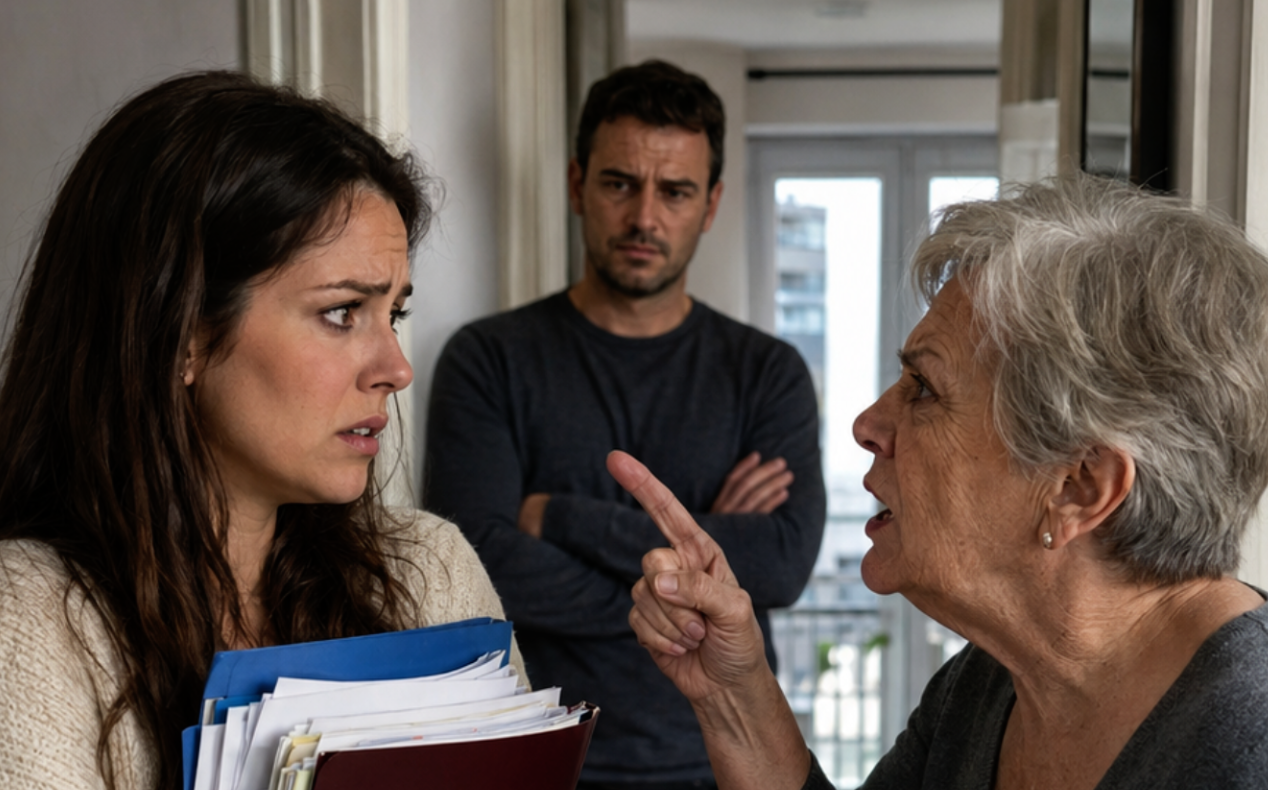
Alisa returned from work later than usual. She had been delayed by an unexpected audit of the company’s documentation. Her legs ached, her head throbbed with exhaustion, and the only things she dreamed about were a hot shower and silence.
Before she could even turn the key in the lock, the door swung open. Her mother-in-law, Tamara Nikolayevna, stood in the doorway wearing a housecoat and the expression of someone who had been waiting for a long time and had already managed to become angry.
“Finally,” she snapped instead of greeting her. “I’ve been sitting here since lunchtime.”
Alisa blinked.
“Tamara Nikolayevna? What happened? Where’s Yegor?”
“Yegor is at work. Where else would he be?” Her mother-in-law walked back into the apartment as though she owned it. “Come in. We need to talk. It’s serious.”
Alisa slowly entered, kicked off her shoes, and hung up her bag. A sense of foreboding tightened inside her. Tamara Nikolayevna always used that tone when she was about to announce something that was supposedly “important for the entire family.”
“Sit down,” her mother-in-law ordered, pointing toward the sofa before settling into an armchair and folding her arms. “Here’s what’s going to happen. Yegor and I have discussed everything. You’re selling this apartment.”
Alisa froze halfway to the sofa.
“What?”
“You’re selling the apartment,” Tamara Nikolayevna repeated clearly, like a teacher explaining something to a particularly slow student. “You’ll take the money, add it to our savings, and buy Pyotr Ivanovich and me a house outside the city. We’ve already found one we like in the Sosnovy Bor settlement. It’s a lovely place.”
Alisa slowly lowered herself onto the sofa. Her mother-in-law spoke so casually that she might have been discussing the purchase of a new kettle.
“Tamara Nikolayevna, this is my apartment,” she said quietly.
“So what?” Her mother-in-law shrugged. “You don’t need it. You live with Yegor at our place. You can continue living there, and we’ll put this apartment to good use.”
“But I don’t live at your place,” Alisa replied, feeling a strange, cold calmness beginning to rise inside her. “I only spend the occasional night there when I work late. I have my own apartment.”
“An apartment you don’t even use!” Tamara Nikolayevna raised her voice. “Why do you need an empty home? Pyotr Ivanovich and I have spent our entire lives crammed into that little two-bedroom apartment. We need a house—for our health and for the fresh air. We deserve it!”
“You deserve it?” Alisa repeated.
“Of course! We’ve worked our entire lives. We raised Yegor. Now it’s our time to rest. You’re young. You can earn the money again.”
Alisa stared at her mother-in-law and suddenly understood that the woman was completely serious. She genuinely believed she had the right to decide what happened to someone else’s apartment.
“Tamara Nikolayevna, I’m not selling it.”
“What do you mean, you’re not selling it?” Her mother-in-law’s eyebrows shot upward. “We’ve already decided!”
“Who is ‘we’?”
“Yegor and I. He agrees.”
“Yegor agrees that I should sell my apartment and buy you a house?”
“Yes.” Tamara Nikolayevna nodded as though it were the most obvious thing in the world. “He understands that family comes first. Children are supposed to help their parents.”
Alisa slowly stood up.
“Where is Yegor?”
“I already told you. He’s at work.”
“When will he be back?”
“Probably around eight.”
“Fine. I’ll wait for him here.”
Tamara Nikolayevna narrowed her eyes.
“Do you think he’s going to take your side? He won’t. He’s my son, and he knows that children must respect their parents.”
Alisa said nothing. She walked into the kitchen and put the kettle on. Her hands were trembling, but she forced herself to breathe slowly and evenly.
Yegor arrived at twenty minutes to eight. Alisa heard the front door slam and his mother immediately rush toward him.
“Yegor, she’s refusing! She says she won’t sell it!”
Alisa came out of the kitchen. Yegor was standing in the hallway, taking off his jacket. His face looked tired and detached.
“Yegor, we need to talk,” Alisa said calmly.
“Just a minute, Lis.” He hung up his jacket and rubbed his face with both hands. “At least let me change first.”
“Yegor, this is important.”
He sighed, walked into the living room, and collapsed onto the sofa.
“I’m listening.”
Tamara Nikolayevna sat beside him, folding her hands in her lap like a judge preparing to deliver a verdict.
Alisa sat opposite them.
“Yegor, your mother says you agree that I should sell my apartment and buy them a house.”
Yegor did not look up. He remained silent.
“Yegor, is that true?”
“Mom said they needed a house,” he muttered. “I thought… well, maybe she was right…”
“Maybe what?” Alisa felt the coldness inside her harden into something sharp. “Maybe I should sell my home?”
“Well, you hardly ever live there.” Yegor finally looked at her. There was such helplessness in his expression that Alisa almost felt sorry for him.
Almost.
“And my parents really do need…”
“Yegor, it is my apartment,” Alisa said slowly, emphasizing every word. “I bought it with my own money before we got married. It belongs to me.”
“So what?” Tamara Nikolayevna interrupted. “You’re a family. Everything is shared.”
“The apartment is registered in my name. It is not marital property.”
“Alisa, don’t try to be clever,” her mother-in-law said, pursing her lips. “We have already decided everything. Yegor, tell her!”
Yegor remained silent, staring at the floor.
“Yegor.” Alisa leaned forward. “Look at me.”
He raised his eyes. They were guilty and miserable.
“Do you honestly believe I should sell my apartment?”
“I… I don’t know, Lis. Mom says…”
“I’m not asking what your mother says. I’m asking you.”
“Well… maybe it would be the right thing to do? To help my parents?”
Alisa leaned back against the sofa.
Everything suddenly became perfectly clear.
“I understand,” she said quietly.
“Alisa…”
“I understand everything, Yegor.”
She stood up and picked up her bag.
“Where are you going?” Tamara Nikolayevna jumped to her feet as well.
“Home. To my apartment. The apartment I am not selling to anyone.”
“Alisa, wait!” Yegor tried to stop her, but she was already walking into the hallway.
“Ungrateful woman!” her mother-in-law shouted after her. “We welcomed you into our family, and this is how you repay us!”
Alisa slammed the door behind her.
She walked down the stairs without waiting for the elevator. She needed to move, to walk, to breathe.
It was a cool October evening. Alisa got into her car, started the engine, and sat there for several minutes, staring into the darkness.
Then she drove home.
Alisa was thirty years old. She worked as a logistics specialist for a large company and earned a good salary. Three years earlier, she had bought a one-bedroom apartment in a newly constructed building—her first home, paid for through years of hard work and sacrifice.
She had met Yegor six months after buying it. He was gentle, kind, and attentive. They dated for a year and then got married.
Yegor lived with his parents in a two-bedroom apartment on the outskirts of the city. Alisa suggested that he move in with her, but Yegor refused.
“Lis, I can’t abandon them. Mom raised me alone. My father died young. I don’t have the right to leave her.”
Alisa understood. She did not insist.
They agreed that they would officially live with his parents, while Alisa kept her apartment. She occasionally spent the night there whenever she wanted peace and solitude.
From the very beginning, Tamara Nikolayevna made it clear that Alisa was merely a guest in their home.
A daughter-in-law.
Not real family.
“Yegor, tell Alisa that dinner is at six,” she would say, even when Alisa was standing less than six feet away.
“Alisa, you’re washing the dishes incorrectly. We have a different system,” she commented on her every movement.
“Yegor, tell your wife not to touch my things,” she would complain whenever Alisa accidentally moved something on a shelf.
Every time, Yegor apologized.
“Lis, you know what Mom is like. She’s simply used to controlling everything.”
Alisa endured it. She loved Yegor. She believed everything would improve with time.
But now, sitting in the silence of her own apartment, she suddenly understood that nothing would ever improve.
Yegor was not on her side.
He was on his mother’s side.
He always had been, and he always would be.
Her phone would not stop ringing.
Yegor.
Tamara Nikolayevna.
Yegor again.
Alisa silenced it.
She woke up early the next morning, made coffee, and sat beside the window.
Her phone came to life again. It was a message from Yegor.
“Lis, forgive Mom. She lost her temper. Come back, and we’ll discuss everything calmly.”
Alisa replied:
“Yegor, your mother demanded that I sell my apartment. You supported her. We have nothing to discuss.”
His response arrived a minute later.
“I didn’t support her! I just didn’t want an argument!”
“That is exactly how you supported her. Your silence was support.”
She did not respond again.
Two days later, Yegor came to the apartment himself. He rang the doorbell, and Alisa opened it—not because she wanted to talk, but because there was no point postponing the inevitable.
“Lis,” he said, standing in the doorway with a guilty expression. “May I come in?”
She let him inside.
Yegor walked into the living room and sat on the edge of the sofa.
“I’ve thought about everything. Mom was wrong. Of course you shouldn’t have to sell your apartment.”
“Thank you for giving me permission,” Alisa said, sitting opposite him with her arms folded.
“Lis, don’t be like that. I’m on your side.”
“Yegor, you remained silent for two days. When I asked you directly, you said that selling it might be ‘the right thing to do.’”
“I was confused! Mom was putting pressure on me…”
“She always puts pressure on you,” Alisa said calmly, without anger. “And you always give in. Every single time.”
“She’s my mother.”
“And I’m your wife. But for some reason, I’m always in second place.”
Yegor said nothing.
“Yegor,” Alisa sighed, “I’m tired. I’m tired of being a guest in your home. I’m tired of being told that I do everything incorrectly. I’m tired of you being unable to say no to your mother.”
“I can say no!”
“No, you can’t. Otherwise, you would have told her that very evening, ‘Mom, this is Alisa’s apartment, and we have no right to discuss what she does with it.’”
“I… I simply didn’t want to upset her.”
“But upsetting me is acceptable?”
Yegor covered his face with his hands.
“What do you want, Lis?”
“I want you to choose. Either you choose me, and we begin building our own family separately from your mother, or you choose her, and you and I go our separate ways.”
“Is that an ultimatum?”
“No. It’s simply reality.”
Yegor remained silent for a long time. Then he looked up.
“I can’t abandon her.”
Alisa nodded.
She had expected that answer.
“I understand.”
“Lis…”
“Go, Yegor.”
“Alisa, wait…”
“Go. Please.”
He stood up and slowly walked toward the door. At the threshold, he turned around.
“Do you really want a divorce?”
“I want to live my own life. And you want to live yours—with your mother.”
The door closed quietly behind him.
Alisa sat down on the floor, rested her back against the wall, and cried—long and bitterly, but somehow with a sense of liberation.
Their divorce was finalized three months later. It was quick and free of scandal. There was no property to divide. Alisa’s apartment remained hers, and Yegor did not make any claims against it.
After the final hearing, he approached her.
“Lis, forgive me. I truly wanted things to work out between us.”
“So did I,” Alisa replied. “But you weren’t ready to change.”
“And were you?”
“I was ready to build a family. I was not ready to surrender my life to you. Those are two different things.”
Yegor nodded, turned around, and walked away.
Six months later, Alisa learned through mutual acquaintances that Tamara Nikolayevna and her husband had never moved into a house. They did not have enough money. It turned out that their “savings” were not nearly as substantial as they had claimed.
Yegor still lived with his parents.
Alisa did not feel triumphant.
She simply did not care anymore.
For a year after the divorce, she lived alone. She worked, met with friends, and went on small, inexpensive trips that she planned entirely for herself.
She renovated the apartment according to her own taste. It had bright walls, plenty of plants, and a comfortable workspace beside the window.
One evening, as she sat on the balcony with a cup of tea, she suddenly realized that she felt good.
Truly good.
For the first time in a very long time.
Two years later, Alisa met Dmitry, an architect she encountered at an exhibition. They began dating slowly and cautiously.
The first time he saw her apartment, he said:
“It’s wonderful. You can tell that someone who knows what she wants lives here.”
“I didn’t always know,” Alisa said with a smile. “I had to learn.”
“And did you?”
“Yes. I learned how to say no. It turned out to be the most important skill in life.”
They married a year later. Dmitry moved into Alisa’s apartment—the apartment she had refused to surrender and would never surrender to anyone.
Sometimes, when she passed the old building where Yegor’s family lived, Alisa remembered the evening when Tamara Nikolayevna had declared, “Sell the apartment.”
Every time, she silently thanked her former self—the frightened woman who had nevertheless found the strength to say no.