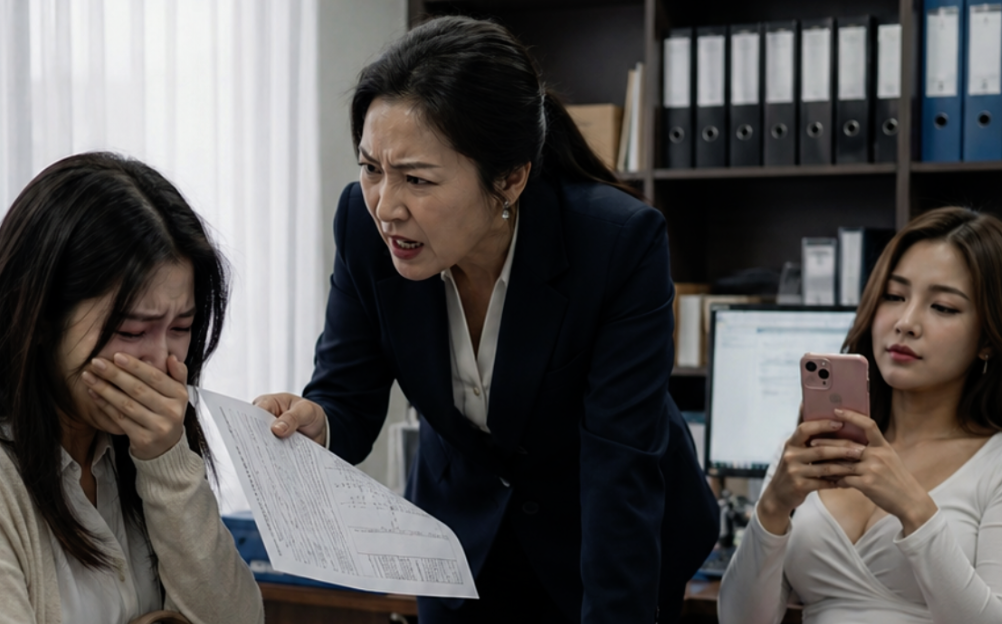
— Get up. Svetlana Yuryevna didn’t even look at me. She walked over to my desk and, with one careless sweep of her hand, knocked the stack of my folders onto the floor. Straight into the dust.
Oksana froze with her mouth open. Tanya from HR, sitting by the window, suddenly became very interested in studying some old form. Anything not to look in my direction.
“Good morning, Svetlana Yuryevna…” I forced out. For some reason, my voice had gone hoarse.
“Your position in the company has now been taken by my daughter. Write your resignation. Voluntary. Now!”
She threw a blank sheet of paper onto the desk. The dry, sharp edge sliced across my index finger—thinly, viciously. A drop of blood appeared at once. I watched as it slowly swelled red and fell right onto the white page. Dead center.
“Get out!” the boss was almost shouting now. “Irisha, sit down. This place is a snake pit, of course, but we’ll throw everything out. We’ll order a new chair from Ozon today; this one goes to the dump.”
Irisha pushed my cactus aside with two fingers, as if it disgusted her. The very cactus I had nursed for three years from a weak little sprout.
“Mom, it smells weird here,” she drawled, looking at me as though I were a stain on the wallpaper.
“We’ll air it out,” Svetlana Yuryevna snapped. Then she turned to me, her eyes like two cold pieces of ice. “Why are you standing there? Write, I said. You have five minutes to pack. Tanya will bring your work record. Your payment… well, what payment? Your fines this month are through the roof. So you’ll get the bare salary on your card.”
Seven thousand eight hundred rubles.
Instead of the promised eighty thousand.
I stayed silent. Inside, everything felt empty and somehow terribly cold. For three years, I had redone everyone’s reports here while Svetlana went off to sanatoriums.
“Kristina, well…” Oksana started, but immediately fell silent under the boss’s heavy stare.
“Don’t stick your nose where it doesn’t belong, Oksana,” Svetlana Yuryevna threw at her. “Kristina, I’m waiting. Your five minutes have started.”
I slowly reached for the computer mouse.
“Hands off!” she barked, slapping her palm on the desk. “That’s company equipment. Leave the passwords on a piece of paper.”
She didn’t know. She had absolutely no idea, the fool, that the entire supplier database, all the SBP keys, and most importantly, access to the organization’s Gosuslugi account were permanently tied to my personal phone number. Because she had been too cheap to buy a company phone last year, saying, “It’ll do as it is.” And the tax report I had submitted five minutes before her triumphant entrance was still hanging in “processing” status. One call from me to support, and it would be canceled. And then penalties would start piling up so fast Irisha wouldn’t have enough left for a new pink phone case.
I nodded. Just nodded. I took my bag and my cracked mug. I didn’t take the cactus. Let them look at it.
“I said write!” the boss jabbed her finger at the sheet where my blood was drying.
I wrote two lines.
“I request to be dismissed voluntarily…”
“That’s it. You’re free.” Svetlana snatched the paper from my hands.
I left the office. In the hallway, there was an empty paper box. I tossed my mug into it. I heard it clink against the bottom.
There wasn’t much time left until evening.
Until her personal hell—exactly six hours.
Outside, it had turned frosty. March in our city isn’t about snowdrops. It’s about gray slush underfoot and an icy wind that slips under your jacket like sticky fingers. I walked to my old Vesta—gray, the color of the sky. The door had frozen shut, and I had to yank it harder. The rubber seal cracked. A pity.
I got in. The cabin smelled of old “sea breeze” air freshener and dust. I didn’t start the car. I just sat there, looking at my hands. The finger cut by the paper still throbbed. The blood had dried into a thin dark stripe. It looked somehow dirty.
The phone in my bag vibrated. Short. Angry.
A WhatsApp message from Svetlana Yuryevna:
“Return the safe keys before lunch. Irisha says you hid them on purpose. Don’t be stupid, Kristina. It’ll be worse for you.”
I didn’t answer. I just watched the screen go dark.
Worse?
How much worse could it get? A “voluntary” dismissal, seven thousand eight hundred rubles on my card, and a utility bill ahead of me. Fifteen thousand for a two-room apartment in an old building, because they had charged full heating this month.
I exhaled slowly. The glass began to fog from my breath. With my finger, I drew a small dot on it.
Svetlana really did think I was nothing. That I would beg, crawl at her feet, anything not to lose those crumbs. After all, that was how she was used to doing things. Smile to your face, call you “my dear girl,” and then wipe her feet on you if a better option came along.
To place her daughter.
Irisha.
Who couldn’t tell Excel from Word, but just look at those lips.
And I had stayed silent for three years. I listened while she belittled me at every briefing.
“Our Kristinochka is diligent, but she doesn’t exactly reach for the stars.”
“Kristina should do some studying; she’s still doing everything like it’s the last century.”
Even though every report, every complicated scheme, every way out of cash gaps—that had all been me.
I reached into my bag. My hand touched cold plastic.
The flash-token.
The organization’s electronic signature.
The very one Svetlana Yuryevna had forgotten to take when she threw me out of the office. She hadn’t even remembered it. To her, it was just some “piece of hardware.” She thought all the passwords were in her notebook.
But a notebook is paper.
And the Metall-Snab database—and, more importantly, access to the legal entity taxpayer account—were all tied to my personal phone number.
I turned the ignition. The car growled, reluctantly warming up.
“You won’t go anywhere,” she had told me six months ago when I had dared to mention a bonus.
You were wrong, Svetlana Yuryevna.
Oh, how wrong you were.
I opened the banking app. My personal account was almost empty. But I had access to the corporate account management. Not as an owner, no. As a “technical administrator.” Legally, I had no right to withdraw money. And I wouldn’t. That would be a criminal offense, theft. I didn’t need that.
But I could block access to remote banking services.
With one tap.
“Due to loss of access keys.”
I imagined Irisha tomorrow morning trying to pay the invoice for metal from our main supplier. The very invoice whose deferral deadline was today. And the system would say:
“Access blocked. Please contact the bank in person with original documents.”
And the original documents—the charter, orders, certificates—Svetlana Yuryevna kept in the safe.
The key to which… I really had not hidden.
It was lying in the drawer of my desk. In the farthest corner, under a pack of old forms.
She simply wouldn’t find it.
Irisha even less so. She wouldn’t rummage through dust.
I pressed the button on the phone screen.
“Block.”
The system asked again:
“Are you sure?”
I looked at my cut finger.
“I’m sure,” I whispered into the emptiness of the car.
The second message arrived a minute later.
“Kristina, why aren’t you answering? Pick up the phone! Now!”
I turned off my phone completely.
Tomorrow there would be a line at the MFC. On Gosuslugi, the earliest appointment was in three days. And to restore access to the account through the bank, Svetlana would have to drag herself there in person.
On foot.
Because her personal driver—my second cousin Lyoshka—had quit that morning too. I had called him last night. I said simply:
“Lyosh, it’s time.”
He didn’t ask why.
He knew how Svetlana fined him for every mat “washed the wrong way.”
I shifted into first gear. The car slowly moved forward, crushing the dirty snow.
There was no triumph inside me. Only a quiet, ringing emptiness. And a strange feeling of freedom. As if I had spent three years carrying a sack of stones on my back, and now it had simply burst open.
Let Irisha sit in my chair.
Let her breathe burnt plastic.
Soon she would feel very, very hot.
Without any cooler.
I drove home. On the way, I stopped at Magnit and bought a pack of pasta and cheap tea. With seven thousand eight hundred, you can’t exactly go wild.
But that was all right.
It wouldn’t be for long.
That evening, I took out my laptop. The flash-token blinked with a little blue light.
At 6:45 p.m., I logged into the organization’s personal account on the tax service website.
My morning shipment notification was hanging there.
I clicked “Withdraw.”
Now officially: there was no product. No deal.
But the taxes on it had already been charged.
Svetlana Yuryevna, you loved saying I was “diligent,” didn’t you?
Well then.
I carried everything out to the end.
Tuesday morning. I stood on the threshold and felt my nose sting from the sharp smell of chlorine—Aunt Glasha the cleaner had clearly overdone it while trying to scrub “my” corner clean. On my desk, in the very spot where my cactus had lived for three years, stood a huge mug with the word “Princess” on it and a sticky puddle of spilled latte.
Dirty.
And stupid.
Irisha was sitting there, literally pressed into the chair. Her face was blotched crimson. One eyelash had come unstuck at the corner of her eye and was dangling like a dead spider. It looked pathetic.
“Mom, why won’t it let me in?!” she squealed, almost crying. “I enter your stupid ‘admin123,’ and it says ‘access error’!”
Svetlana Yuryevna floated out of her office. In her hands was an already-opened box of chocolates. She was chewing without embarrassment, and a crumb of dark chocolate had stuck to her lower lip, moving in rhythm with her words.
“Oh, you showed up,” Svetlana looked me over from head to toe. Her gaze lingered on my worn-out boots, where the March mud had not yet dried. “Did you bring the keys, my disaster? Put them over there, on the dirty spot. You can put them right in the puddle, we’re changing everything here anyway.”
I approached.
Quietly.
Eyes on the floor, shoulders lowered. My hands trembled slightly—it wasn’t hard to act. Coffee on an empty stomach and the cold outside always did that to me.
“I put them there, Svetlana Yuryevna. Here… and your token.”
I placed an old flash drive on the edge of the desk. A useless, non-working dummy I had found yesterday in a junk drawer.
The real token, the one tied to the database, was warming the pocket of my jacket.
“There’s a good girl,” the boss came closer. She jabbed a finger in my direction, as if I weren’t a person, but a defective part. “Look at her, Irisha. This is what a person who doesn’t want to grow looks like. Don’t be offended, Kristina. I only want what’s best. You’re dead weight. Just an old company habit. Like this peeling linoleum we’ll rip up tomorrow.”
She patted my shoulder.
Heavily.
Like an owner.
She smelled of Krasnaya Moskva perfume and something stale.
“Go with God. You’ll find yourself a place in some quieter little office. Somewhere you don’t have to think, just shuffle papers around. That was always hard for you, wasn’t it? Your ceiling is the archive. But Irisha and I will do more here in an hour than you did in a month. She has modern brains.”
“Of course, Svetlana Yuryevna,” I sniffled, pressing my empty bag to myself. “I’m sorry. I… I’ll go.”
“Go, go. Irisha, call the bank. Tell them we’re the ones in charge. Enough fiddling around.”
I left. The door closed behind me with the same nasty creak. In the hallway, a lightbulb flickered, buzzing unpleasantly under the ceiling.
That was it.
They thought I had broken.
That I was dead weight they had simply tossed to the roadside.
But the clock was already ticking.
There were less than two hours left until the call from the tax service about suspension of account operations due to “unverified data,” which I had just confirmed through the personal account.
I sat in the car. On the back seat lay an empty shoe box, and inside it, that same cracked mug clinked faintly. The cabin smelled of cheap windshield washer fluid—sickly sweet, like chewing gum that gives you a headache after five minutes. On my knees was a container of cold pilaf from Magnit. The rice had clumped together; the fat had hardened into white flakes.
Disgusting.
But with seven thousand eight hundred, you can’t exactly go wild.
My phone came back to life at 11:24.
The screen glowed with the name “Svetlana Yuryevna.”
I didn’t answer. I just watched it crawl across the dashboard.
Two minutes later—again.
And again.
Then WhatsApp messages started pouring in:
“Kristina, what did you give us?! The flash drive is empty! Irisha can’t log into T-Bank!”
“Pick up the phone, you bitch!”
“Our payment for the metal invoice expires in an hour! The discount will be canceled! That’s a five-hundred-thousand loss!”
I slowly chewed the disgusting rice.
Well, yes.
Five hundred thousand.
Exactly the annual bonus she had “withheld” from me last year.
Karma is like that.
Ordinary.
In the form of an authorization error.
At 12:15, I finally answered.
“Yes, Svetlana Yuryevna?” My voice was sleepy, drawn out.
“You!” she was practically shrieking into the phone. I could picture her face perfectly—like an overripe tomato. “What have you done?! The bank says access was blocked by the owner of the phone! Your number! Unblock it immediately!”
“Oh,” I even pretended to be frightened, “but I can’t. I was dismissed. The account is linked to corporate access, and now I’m a private individual. The security system was triggered. You yourself told me, ‘Hands off.’ So I took them off. Completely.”
Something crashed on the other end.
Probably the “Princess” mug flying into the wall.
“Kristina, listen carefully,” her voice suddenly became smooth, cold. “If you don’t come here right now and press those buttons, I’ll file a police report. For sabotage. For theft of digital keys.”
“Go ahead,” I wiped my mouth with a paper napkin. “Only the token I left you is yours. The old one. And my personal phone is my property. I’m not obliged to provide it to third-party organizations. And the fact that you tied taxes and SBP to my number to save money—that’s your management mistake. Irisha has ‘modern brains,’ doesn’t she? She’ll figure it out.”
I hung up.
But the most interesting part started half an hour later.
Lyoshka called me. My cousin, the one who used to drive her.
“Kristin, you’re something else,” he laughed so hard he was choking. “I’m standing outside the MFC, submitting documents for a new job. And then I see Svetka rushing in. No car, came by taxi. Hair all messed up, coat buttoned with just one button. She tried to get to the window ‘out of turn,’ shouting that her business was collapsing. The security guard escorted her out. They told her appointments through Gosuslugi were booked three days ahead, not earlier.”
And the final blow came from the tax service.
A friend of mine worked there, Mashka. We had shared a desk at school.
“Kristin,” she whispered into the phone, “did you sink Metall-Snab? A notice of unreliable data popped up in their account. Your Irisha, apparently, while trying to enter ‘admin123,’ withdrew the report three times and confirmed some other nonsense. Now their account is blocked under Federal Law 115. Until the director personally shows up with a stack of papers and proves they’re not terrorists, they won’t be able to withdraw a single kopeck.”
It was time to go.
I had an interview in an hour at a normal company.
And Svetlana Yuryevna still had a long time ahead of her explaining to the bank why the only person who knew the passwords had left with a salary of seven thousand eight hundred.
A week later, as I was told, Metall-Snab got hit with three hundred thousand in penalties. The supplier terminated the contract for non-payment. They say Irisha went gray—not literally, of course; just some bad hair dye incident when she was panicking and trying to play “business lady.”
And Svetlana Yuryevna now answers the phone herself.
If, of course, the phone isn’t blocked.