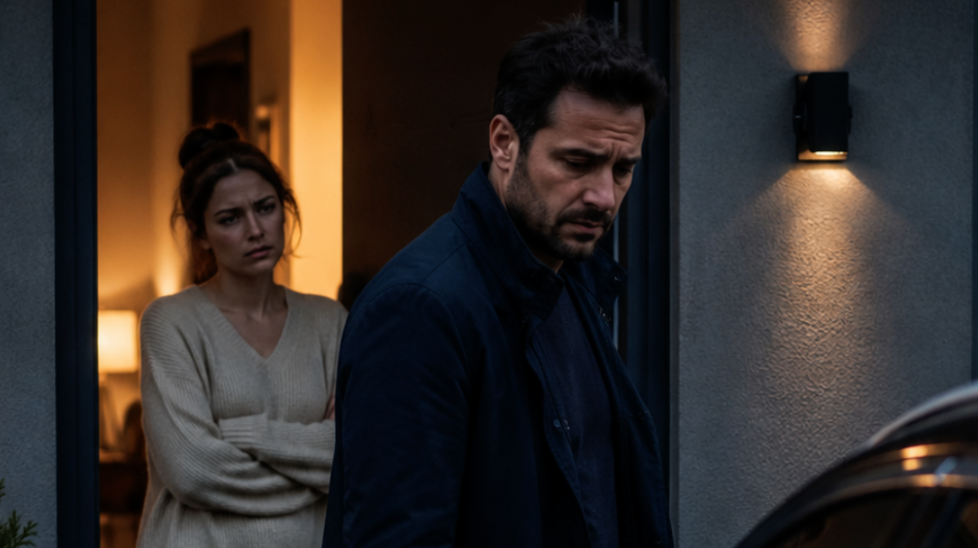
Svetlana placed a plate in front of Anton and sat down across from him. He did not even look at the food. He moved his fork across the table as if he were drawing an invisible escape map.
“I’m leaving,” he said. “For Regina. I’ve wanted to tell you for a long time, but I kept putting it off.”
Svetlana slowly lowered her spoon. Polina was sleeping in the next room, and every word now had to be spoken quietly. But that forced silence made everything happening feel unbearable.
“Wait. Are you serious?”
“As serious as it gets. You’ll leave me the apartment. The car too. You’ll find something for yourself. You’re strong, after all.”
She looked at the man she had lived with for six years. His voice was calm, as if he were reading out a shopping list. Not a shadow of doubt. Not a single pause.
“Anton, we have a daughter. She’s four years old.”
“I’ll see her. On weekends. Or however we agree.”
“And where are we supposed to live? On a park bench?”
“Don’t exaggerate. You have parents. You can move in with a friend. There are options if you want to find them.”
Svetlana clasped her fingers under the table. She was not going to scream. Not now, not with their child sleeping nearby, not in response to that indifferent tone.
“Do you even understand what you’re saying? Your mother bought this apartment. It’s registered in her name.”
“I’ll deal with my mother. She’ll sign a deed of gift, and that will be that.”
“Have you talked to her?”
“I will. I’m her only son. She won’t refuse.”
He stood up. He went into the room and began packing his things into a large sports bag. Svetlana remained at the table. In front of her sat an untouched plate, and somewhere behind the wall, four-year-old Polina was breathing softly in her sleep. In the morning, she would ask where Daddy was.
“You’re not even going to say goodbye to your daughter?” Svetlana asked, standing in the doorway.
“Why wake her? I’ll stop by during the week.”
He slung the bag over his shoulder. He stopped by the exit and turned around.
“Don’t turn this into a tragedy. We’re adults.”
The door closed. Svetlana stood motionless for several seconds, then took out her phone and dialed a number. One ring. A second. A third.
“Marina, are you asleep?”
“No. Did something happen?”
“He left. Just now. He said I have to leave him the apartment and the car.”
There was silence on the other end of the line for exactly three seconds.
“Come to my place. Right now. Bring Polina.”
“No. I’m staying here. This is our home. His mother bought this apartment for the family, for our wedding, not for his little games.”
“Then I’ll come to you in the morning. And don’t open the door for anyone.”
Her friend Marina arrived at eight. She was short, with cropped hair and the sharp gaze of someone life had already knocked down twice, and both times she had gotten back up.
“Tell me everything. From beginning to end.”
Svetlana poured her tea. Polina was sitting on the carpet, drawing something bright and orange. For now, they had told her that Daddy had gone away on business.
“He met a woman. Regina. He says it’s been going on for a long time. I didn’t notice. Or maybe I didn’t want to notice.”
“Whose name is the apartment in?”
“Galina Petrovna’s. His mother’s. She bought it four years ago, when we had just gotten married. She said, ‘This is for you and for my grandchildren.’”
“Does he remember that?”
“He’s convinced his mother will sign anything he asks her to.”
Marina placed her cup on the table.
“Svetka, I went through this. Eight years ago. My ex also thought he would take everything. The apartment, the summer house, even the dog. Do you know how it ended?”
“I know. You stayed in the apartment, and he rented a room.”
“Because I didn’t wait. I acted. While he was making plans, I had already closed every door. You need to call his mother.”
“I don’t know how to tell her. She’ll be on his side. He’s her son.”
Marina shook her head.
“You don’t know Galina Petrovna well enough. She went through a divorce herself. With little Anton. She knows what it’s like to stand there with a child and empty hands. Call her.”
Svetlana picked up the phone. Her fingers found the right number out of habit, the way they had found it hundreds of times before — when she asked for a pie recipe, when she asked what shoe size Polina wore, when she passed the phone around on holidays.
“Hello, Galina Petrovna. Anton left. Last night. He packed his things and went to his mistress.”
A long pause.
“He told me I have to leave him the apartment and the car. That you would sign a deed of gift.”
Her mother-in-law’s voice changed. It did not become sharp. It did not become loud. It became very even, the way a lake becomes still before a storm.
“He said that?”
“Word for word.”
“Svetlana, don’t go anywhere. I’ll be there in an hour.”
Galina Petrovna entered the apartment quietly. She took off her coat and carefully hung it on a hook. She saw Polina, crouched down, hugged her, kissed the tip of her nose, and the little girl laughed. Then she straightened up and looked at Svetlana.
“Tell me everything. Every word he said.”
Svetlana told her. Marina sat beside her and occasionally added the details Svetlana herself missed — because of nerves, confusion, and the anger that had begun rising from somewhere deep inside her.
“He said, ‘Mother will sign.’ Just like that, Galina Petrovna. As if it had already been decided.”
Her mother-in-law was silent. Then slowly, very slowly, she sat down on a chair.
“Twenty-eight years ago, his father said the same thing to me. Almost word for word. ‘I’m leaving. The apartment is mine. Find yourself a corner somewhere.’ I was twenty-four. Anton was eighteen months old. I left that apartment with one suitcase and him in my arms. We lived with my aunt. In one room. For four years, until I got back on my feet.”
“I didn’t know,” Svetlana whispered.
“I didn’t tell the details. I thought, why should I? I thought my son was different. I thought that since I had suffered so much, he would at least have seen and understood. But he didn’t see it. He was too little to remember.”
Marina leaned forward.
“Galina Petrovna, the apartment is registered in your name. You are the only one who decides.”
“I know, dear. And I have already decided. I bought this apartment for my future grandchildren. For Polina. Not for a son who repeats his father’s mistakes. Genetics is a strange thing. I thought he took after me, but he took after him.”
She took a folder out of her bag. Inside were the apartment documents — the certificate, the purchase agreement, and the extract.
“I’ll transfer the apartment to Polina. With restrictions until she comes of age. Svetlana, you will be her legal representative. No one will be able to sell it, mortgage it, or give it away. Polina will grow up and have her own home.”
“He’ll never forgive you for that,” Svetlana said.
“I don’t need his forgiveness. I need my granddaughter in a warm home, with a roof over her head. I already stood once at a bus stop in winter with a child and a bag. There will not be a second time for my granddaughter.”
Svetlana looked at Marina. Marina nodded.
“Agree, Sveta. It’s the right step.”
“And the car?” Svetlana asked.
Her mother-in-law raised an eyebrow slightly.
“I bought the car too. With my own money. Let him just try to take it. I kept all the payment documents. Svetlana, after that divorce, I started keeping everything. Every piece of paper. Every receipt. Because I know this: in this life, only what you can prove is truly yours.”
At that moment, Svetlana’s phone rang. The screen showed “Anton.”
“Answer,” Galina Petrovna said. “Put it on speaker.”
Svetlana pressed the button.
“Hi, Sveta. I’ll come by tomorrow for the car documents. And I need the spare apartment keys too, the ones in the drawer.”
“Anton, the apartment belongs to your mother.”
“I told you, I’ll deal with my mother. Stay out of it.”
Galina Petrovna leaned toward the phone.
“Anton. It’s me.”
Silence.
“Mom? What are you doing there?”
“Sitting with my daughter-in-law and my granddaughter. In the apartment I bought. With my own money. You said I would sign a deed of gift?”
“Well… we can discuss it…”
“There is nothing to discuss. The apartment will be transferred to Polina. The car stays with Svetlana. If you have questions, come over. But not tomorrow. Today, I have no time for you. And if you take the car without permission, I’ll report it stolen.”
She ended the call before he could answer.
Anton sat in Regina’s apartment and stared at his phone. Beside him, on the leather sofa, sat Oleg — heavyset, with the eternal cigarette tucked behind his ear, which he twisted in his fingers whenever he was nervous.
“So what now?” Oleg asked.
“My mother is playing dumb. She says she’ll transfer the apartment to Polinka.”
“Maybe she’s bluffing?”
“You don’t know my mother. If she said it, she’ll do it. That’s how she is. Stubborn.”
Oleg twirled the cigarette.
“Talk to her properly. Like a human being. You’re her only son. Is she really going to go against you because of some daughter-in-law?”
“She’s not doing it because of my daughter-in-law. She’s doing it because of Polina.”
“Then take Polina.”
Anton looked at him as if he were an idiot.
“Where would I take her? Here? To Regina’s?”
At that moment, Regina came out of the bedroom. Tall, upright, with a phone in her hand — she was always solving something, texting someone, coordinating someone. A woman used to being in control, and even at home she could not turn that mode off.
“Anton, I heard your conversation. Let’s clarify one thing.”
“What thing?”
“The child is not moving in here. I told you that from the very beginning.”
“I wasn’t planning to…”
“And second. You told me the apartment was yours. That your mother would sign it over. That you would come to me not empty-handed. Now it turns out your hands are empty. That changes the situation.”
“Regina, wait…”
“I don’t wait. I’m not one of those women who waits. You know that. I liked our relationship while it was easy. No obligations. No suitcases in the hallway. You decided on your own to leave your family. I didn’t ask you to.”
Oleg snorted. Regina turned her gaze on him, and he fell silent.
“Anton, you have one week. Sort out your affairs. Deal with the housing issue. But not at my expense. This apartment is mine. And I am not going to share it with anyone.”
She returned to the bedroom and closed the door. Oleg gave a low whistle.
“Hard woman.”
“Shut up, Oleg.”
“I’m just saying. Maybe you should go back to Svetka? Apologize, make peace…”
“After what I said to her? After my mother heard everything?”
“Well, what else are you going to do? You know I have a one-room apartment. It’s cramped even for one person.”
Anton stood up, went to the window, and immediately turned away. He began pacing around the room.
“I’ll go to my mother. I’ll talk to her one-on-one. Without Svetka, without that friend of hers. My mother will listen to me. She always listened to me.”
“And what if she doesn’t?”
“She will. I’m her son. Her only son.”
He dialed the number. Galina Petrovna answered on the fourth ring.
“Mom, we need to meet. To talk. Just you and me.”
“Come. I’ll be home.”
Anton grabbed his jacket and left. Oleg remained sitting on someone else’s sofa, twisting the cigarette and thinking that his own one-room apartment, cramped as it was, was at least his.
Forty minutes later, Anton was standing in his mother’s apartment. A small two-room place where he had grown up. The same wallpaper, the same bookshelf, the same smell — dried herbs his mother hung in the corners of the kitchen.
“Sit down,” Galina Petrovna said.
“Mom, do you understand what you’re doing? You’re basically choosing your daughter-in-law over your son.”
“I’m choosing my granddaughter.”
“Polina is my child too.”
“Then why are you abandoning her?”
“I’m not abandoning her! I’ll see her, I’ll help…”
“Like your father? He promised too. Do you know how many times he came in the first year? Twice. In the second — zero. Do you remember him?”
Anton swallowed.
“I’m not him.”
“So far, you’re an exact copy of him. The same words. The same tone. ‘Leave me the apartment.’ That’s exactly what he said to me — ‘Leave me the apartment, I’ll deal with it.’ I was left with you in my arms and a suitcase. In winter, Anton. In February.”
“That was a long time ago…”
“For you, it was long ago. For me, it is every day. I remember every hour of that February. And I will not allow my granddaughter to go through the same thing. The apartment will be transferred to Polina. This is not up for discussion.”
“Mom, you’re leaving me without an apartment!”
“No. I am not leaving you without anything. You left on your own. You told your wife yourself, ‘Leave me the apartment.’ Only you forgot that this apartment is not yours. It is mine. And I decide who gets it.”
“That’s unfair!”
“Unfair is when a four-year-old child loses her home because her father cannot control himself. That is unfair, Anton. What I am doing is the only fair thing that can be done.”
Anton stood before his mother — a grown man being told “no” for the first time in a way that left him with no answer. He opened the door and left without saying goodbye.
A month passed. During that month, several things happened, none of which Anton had foreseen. Regina asked him to move out after nine days. Not after a week, as she had promised, but after nine — because on the tenth day, a business partner from St. Petersburg was flying in, and Anton’s presence in the apartment was, in her words, “inappropriate.” She returned his bag to him, neatly packed, with his shirts washed. She zipped it up and placed it by the door.
“Nothing personal, Anton. We’re both adults. You’re free, I’m free. That was the idea from the beginning. You just decided otherwise.”
“I thought we were serious.”
“We were good together. That is not the same thing.”
Oleg let him stay for three days, then began hinting that he “hadn’t expected this kind of roommate situation.” A one-room apartment that barely had enough space for one person turned into a trap with two. Oleg smoked on the balcony every twenty minutes, dropped ash on the linoleum, and complained about life.
“I’m having a hard time myself, Anton. I understand you, but try to understand me too. There’s no room to move around here.”
Anton began looking for a rental apartment. Prices had risen so much that his salary was not enough for decent housing. Without the car — Svetlana had re-registered the insurance on Marina’s advice — getting around the city became harder. The life that had seemed so simple and controllable a month earlier fell apart.
He called Svetlana four times. The first two times, she answered briefly and coldly. The third time, she did not pick up. On the fourth, Marina answered.
“Svetlana is busy. Polina is preparing for her school performance. If it’s something urgent, write. But calling here every three days to complain is not an option.”
“This is my home, Marina.”
“This is Polina’s home. The documents have been signed. The notary certified them. That train has left the station, Anton. Choo-choo.”
Then he made up his mind. He went to the apartment — the very one where Svetlana lived with Polina. He went up to the third floor. He rang the bell.
Silence.
He rang again. Footsteps sounded behind the door. Then Svetlana’s voice.
“Who is it?”
“It’s me. Open up.”
A pause.
“What for?”
“To talk. Sveta, I’ve thought a lot. I lost my temper. I did stupid things. I want to fix everything. Let’s try again.”
“Anton, you didn’t lose your temper. You thought everything through. You came and calmly said, ‘Leave me the apartment, and the car too.’ You didn’t shout. You didn’t cry. You simply decided that Polina and I were trash you could take out and forget.”
“I didn’t think that!”
“You said it. And words, Anton, are actions. Only spoken out loud.”
“Sveta, open the door. Please.”
“No.”
“I want to see Polina.”
“Polina saw you last a month ago. You promised to come in a week. You didn’t come. You promised to call. You didn’t call. She waited for you every evening. She stood by the door and asked, ‘Is Daddy coming?’ Every evening, Anton. Fourteen evenings in a row. On the fifteenth, she stopped asking. Do you know what that means? It means a child learned not to wait. At four years old.”
Anton leaned against the wall.
“I’m guilty. I know. Give me a chance.”
“I gave you a chance. Six years was one big chance. You decided what to do with it.”
“My mother influenced you. She turned you against me.”
“Your mother did for Polina and me what you should have done. She protected us. You did not.”
Anton stood in the stairwell and listened as, on the other side of the door — in the apartment that had once been his home — there lived a family that no longer included him. He heard Polina’s quiet voice asking something. He heard Svetlana answer her gently. He heard a spoon clink against a cup.
He took out his phone and called Oleg.
“Oleg, can I stay with you for a couple more days?”
“Anton… I can’t. Sorry. My… well, my sister is coming to visit. From Voronezh. There’s no space here.”
“I understand.”
He sat down on the step. Then he called Regina. Voicemail. He called again. She rejected the call.
Then a message arrived: “Don’t call.”
He put the phone in his pocket. He sat for another minute. Then he stood up, went downstairs, and walked outside. The city was the same as ever — huge, noisy, indifferent. But for the first time in this city, Anton had nowhere to sleep.
Across the road, on a bench, sat Oleg. He had come after all, despite the “sister from Voronezh.” He was smoking, hiding the cigarette in his fist.
“Well?”
“She didn’t open the door.”
“So what are you going to do?”
“I don’t know, Oleg. For the first time in my life, I don’t know.”
Oleg took a drag. Let out smoke.
“I told you not to get into this. I told you. Svetka is a good woman. Your mother is made of steel. And you… you pushed your way in. And here’s the result.”
Anton did not answer. He stood in the middle of the sidewalk — without an apartment, without a car, without a family, without the woman he had left for. With one sports bag. Like his mother twenty-eight years ago. Only she had carried a child in her arms, someone worth fighting for. He did not even have that.
In the apartment on the third floor, Svetlana put away her phone. Polina was sitting at her little table, drawing something orange, as always.
“Who came?” she asked.
Svetlana hesitated.
“No one, sweetheart. Someone had the wrong door.”
Polina nodded and returned to her drawing. With an orange pencil, she was drawing a house. With a large window. With a chimney. With flowers on the windowsill. And with one figure inside — a woman with long hair.
Nearby, drinking a cup of tea, sat Galina Petrovna. She looked at her granddaughter and said nothing. Then she quietly said:
“I called the notary this morning. Everything is ready. The apartment belongs to Polina. I have the documents. Originals and copies.”
Svetlana nodded.
“Thank you.”
“Don’t thank me. I’m doing what his grandmother should have done for him twenty-eight years ago. But didn’t. Because back then, there was no one to stand up for us. Now there is.”
Marina, who was sitting in the kitchen and had heard every word, came over and hugged Svetlana with one arm and Galina Petrovna with the other.
“Do you know what I like about this story?” she said. “That everything was settled in one month. Not in three years. Not in five. In one month. Because you didn’t wait for him to come to his senses. You simply did everything right. And in time.”
Polina lifted her head from the drawing.
“Grandma, look. I drew a house.”
Galina Petrovna looked. A large window. A chimney. Flowers. A woman inside.
“A beautiful house, Polinka. This is your home. Remember that.”
Polina smiled. She picked up a red pencil and drew another figure beside the house. A small one, with little braids. And underneath, in large crooked letters, she wrote: “ME.”