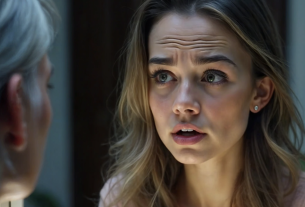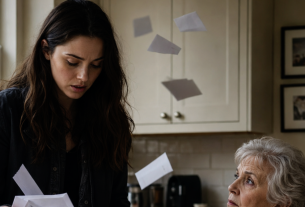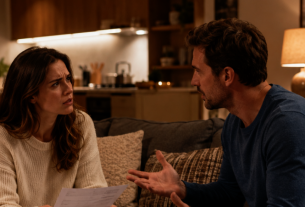
“You’re looking at that score sheet as if those numbers are poisonous insects crawling across the paper,” Viktor said without even turning his head, continuing to meticulously clean the lenses of his surveying level. “So she didn’t get enough points. It happens. Life doesn’t end there. She can go work.”
“Vitya, she missed it by just a little. This isn’t simply ‘she didn’t get enough.’ It was chance, a system failure,” Marina said softly, trying to wrap her husband in calm like a warm blanket, even though inside, everything in her was tightening into a hard knot. “We discussed this option back in the spring. Remember? If the state-funded place fell through, we would use the reserve.”
“What reserve?” he asked, finally setting the instrument aside. In the lamplight, the cold steel frame of his glasses flashed.
“The motorcycle,” Marina breathed, sitting down across from him and trying to catch his eye. “That Kawasaki you haven’t taken out of the garage for two years. The buyer your colleague mentioned is still interested. That money would be exactly enough for the first year, and then she can transfer. Nadya is talented. She can do it.”
“No.”
The word fell onto the table heavily, like a stone dropped into still water. Viktor took off his glasses and began wiping them with the edge of his flannel shirt with such care, as if the fate of the world depended on the cleanliness of the lenses.
“Vitya, listen,” his wife did not give up, patient insistence ringing in her voice. “It’s just sitting there doing nothing. You said yourself that you’re not the right age to race anymore, that your reflexes have dulled. But for Nadya, this is a chance. This is her future. We’re her parents. You promised.”
“The motorcycle is not for sale, Marina. The subject is closed,” he said, putting his glasses back on. Behind the lenses, his eyes looked enlarged and frighteningly indifferent. “Let her learn to answer for her own failures. She didn’t get in, which means she didn’t prepare well enough. I am not obligated to pay for someone else’s laziness with my own belongings.”
“Laziness? She spent six months with her head buried in textbooks!” Marina felt her softness beginning to give way to bitter bewilderment. “You saw it yourself. You praised her drawings yourself. Why are you being so stubborn? Is that pile of scrap metal more precious to you than your daughter?”
“Don’t call machinery scrap metal. I have other plans for that bike. And anyway, I’m tired. This conversation is over.”
Marina looked at her husband and saw a smooth wall in front of her. Not a single crack she could cling to, not a single ledge she could use to pull herself toward understanding. The hope that he was simply tired from work, that he would calm down and change his mind, melted like snow on hot asphalt. She stood up without saying another word and left the kitchen, feeling his heavy, unblinking gaze on her back.
Author: Vika Trel © 4037
Nadezhda, locked in her room, sat in the dark. She was not crying, but her dry eyes burned. Her father had always been stingy with emotion, but today his detachment felt like an icy crust. Marina looked in on her daughter and brought her mint tea, but she did not try to comfort her. Empty words would only irritate her now.
Three weeks passed. The tension in the house thickened like a storm front. Viktor behaved as if the conflict did not exist: he came home from work, ate, locked himself in his study, or went somewhere on weekends, returning late and smelling of someone else’s tobacco. Marina knew he often visited Vera, the widow of his brother Anton. Anton had died in an accident six months earlier, and that tragedy had shaken the whole family. Viktor’s face had darkened then; he had become withdrawn, and Marina, feeling sorry for him, had encouraged her husband herself to help Vera and her son Kirill.
She had thought it was noble. Helping with inheritance paperwork, fixing a faucet, simply talking. Vera had been left alone, and Kirill was at a difficult transitional age. It seemed natural to lend them support.
The phone rang on Saturday morning, when Viktor was not at home.
“Marinochka, hello!” Vera’s voice rang with some inappropriate excitement. “I just couldn’t keep quiet… Thank you so much! You and Vitya are simply saviors.”
“Thank you for what?” Marina shifted the phone to her other ear, wiping her hands with a towel. She had just been mixing mortar for her mosaics; her studio smelled of cement and dust.
“Why, for Kirill’s gift!” Vera laughed. “He had been dreaming about that motorcycle. Vitya brought it over yesterday and said, ‘For your coming of age, from your uncle.’ The boy is over the moon. He spent the whole night in the garage polishing the tank. It’s such a gesture… Vitya said Anton would have been proud.”
Marina slowly sank onto a stool. Her legs turned to cotton, and a roaring filled her ears, drowning out Vera’s chirping voice.
“Kirill’s birthday was a month ago,” she said mechanically.
“Yes, but the gift was delayed! Oh, all right, I have to run. Kirill is calling me. Thank you again, you are saints!”
Marina placed the phone on the table. The screen went dark, reflecting her pale face. She sat motionless for about ten minutes, staring at the bag of colored smalt. The multicolored pieces of glass from which she assembled her pictures now seemed to her like shards of her own life.
That evening, when Viktor returned, the house was quiet. Nadya sat in the living room, pretending to read. Marina stood by the window.
“You gave the motorcycle to Kirill,” she said.
It was not a question. It was a statement. Dry and lifeless.
Viktor froze as he unzipped his jacket. For a fraction of a second, something like fear flashed in his eyes, but he immediately hid behind a mask of arrogance.
“I did. The boy needs machinery. He’s a man; he needs to tinker with iron, not sit around with gadgets.”
“You said we had no money for our daughter’s education. And the motorcycle that could have paid for this year, you simply gave away?” Marina stepped toward him. “Vitya, Nadya asked you. I asked you.”
“Nadya is a girl!” he suddenly barked. “What does she need that institute for? She’ll study on a state-funded place wherever she gets accepted. But Kirill… Anton has no one else. I promised my brother I would look after the boy. Kirill is the continuation of the family line, the only heir to the surname. And Nadya will jump into marriage and change her last name.”
Something fell in the hallway. Nadya stood in the doorway, pale as chalk. She had heard every word.
“So I’m just a ‘girl’ who will change her last name?” Her voice was barely audible. “And he is the heir?”
“Don’t twist my words,” her father muttered, looking away. “You’re a woman. Life is easier for you. But a boy needs to forge his character. A motorcycle is about character. That’s it. I’m going to shower.”
He walked past his daughter, brushing her shoulder as if she were a piece of furniture. Nadya looked at her mother. There were no tears in her eyes, only a cold, adult understanding that aged her face. She turned around and went to her room, firmly closing the door behind her.
Marina remained standing in the middle of the hallway. The disappointment that had been building for weeks began to transform. It thickened, grew heavier, turning into a sticky, black anger.
The following week passed in a state of cold war. Viktor behaved with defiant independence. He stopped having dinner at home, citing emergencies at work, but his surveying equipment sat untouched in the corner of the hallway, gathering dust.
Marina observed. She saw how he shaved before “work,” how carefully he chose his shirts. She stayed silent because she needed to know for certain. Not suspect — know.
On Wednesday, he forgot his phone on the hallway cabinet when he went out to take out the trash. The screen lit up with an incoming message. Marina was not in the habit of spying, but her hand reached for the phone by itself.
The message was from a contact named “Vera”:
“I’m waiting for you. Without you, the house feels like an empty crypt. You are so much like him, but you’re alive. Come quickly. Kiryusha went out for a walk.”
And just above it was the conversation:
Viktor: “I’ll be there soon. Everything at home disgusts me. I look at them and see only demands. With you, I can breathe.”
When Viktor returned with the empty bucket, Marina was standing in the hallway. Beside her stood two large sports bags.
“What’s with the packing?” he smirked, hanging the keys on the hook. “Going to the dacha?”
“You are leaving,” she said evenly. “Right now.”
“What?” The smile slipped from his face, replaced by an expression of contemptuous confusion. “Why all of a sudden?”
“I saw the messages. Go where you can breathe. To Vera. To the heir of the family name. To your brother’s shadow.”
Viktor turned crimson. He wanted to shout, to slam his fist into the wall, to intimidate her as he had done before by raising his voice, but when he met his wife’s eyes, he stopped short. There was no fear in them. There was the ice of permafrost.
“Oh, so that’s how it is,” he narrowed his eyes angrily. “Fine. Excellent. I’ve wanted to leave for a long time. I’m tired of this swamp where all anyone wants from me is money. There, I’m a man, not an ATM.”
He grabbed the bags without even checking what was inside.
“Just remember, Marina. There will be no way back. I will nobly leave the apartment to you and Nadya. I’ll sign over my share as a gift, so you won’t whine later that I robbed you. I have pride. I’ll build a new life. A real one.”
“Sign it,” she nodded. “Tomorrow, at the notary.”
He left, confident in his own greatness and convinced that he had punished them by leaving. Marina slid the bolt shut. For the first time in a month, she breathed deeply.
Life with Vera turned out to be nothing like Viktor had imagined. The first days of euphoria passed quickly. He had expected to become the head of a new family, a patriarch replacing his fallen brother. But the role assigned to him was entirely different.
Vera lived in the past. The whole house was a museum to Anton. His photographs hung in every room, his trophies stood on the shelves, his clothes still hung in the wardrobe. When Viktor tried to hang up his own jacket, Vera gently but firmly moved it to the coat rack by the entrance.
“Tosha’s dress uniform is hanging there. Don’t wrinkle it,” she said.
At dinner, she was constantly comparing.
“Anton liked it saltier.”
“Anton cut bread in thicker slices.”
“Anton never sat with his back to the window.”
Viktor tried to joke, tried to show character, but kept running into a wall of polite incomprehension. He was not Viktor. He was Anton’s substitute. A bad copy. A living mannequin onto which Vera was trying to stretch the life of her dead husband.
With Kirill, it was even worse. The eighteen-year-old “heir,” having received the motorcycle, quickly lost interest in his “kind uncle.” He looked at Viktor with undisguised contempt. One day, when Viktor tried to lecture him about life, the boy simply put on his headphones.
“You’re not my father,” Kirill said without raising his voice. “You’re not even much of an uncle. You’re just a man who betrayed his daughter so he could sleep with my mother. You think I don’t understand? The motorcycle was the price of admission. Only Mom still loves Dad, and you’re here… temporarily. Like a bandage.”
Viktor tried to put the boy in his place and barked at him, but Kirill only smirked and walked away.
Viktor began staying late at work. He did not want to return to the “museum.” He realized he had made a monstrous mistake. He had chased after the ghost of his own greatness and ended up in the role of a cheap replacement. He was a shadow cast by someone else’s gravestone. Vera was not looking for a person in him; she was looking for comfort for her grief. And he, blinded by the desire to be a significant “man,” had lost everything that was real.
Two months later, Vera sighed over breakfast and said:
“You know, Vitya… Maybe we rushed things. I feel like I’m betraying Anton’s memory. You’re good, but… you’re not him.”
That same evening, he packed his things. There were not many of them. The October wind chased withered leaves around the courtyard. Viktor stood at the door of his former home, shifting from one foot to the other. He knew Marina was home — the light was on in the kitchen. He rehearsed the scenario in his head. He would repent. He would say the devil had led him astray. That it was a midlife crisis. That he had realized the value of family. Women loved to forgive; it was in their nature. After all, he had returned. He, the man, had taken the first step. He pressed the doorbell.
The door did not open right away. Marina stood on the threshold in a house suit, calm and composed. Behind her, deep in the hallway, Nadya’s shadow flickered, but her daughter immediately disappeared.
“I’ve come back,” Viktor said, trying to give his voice a velvety confidence seasoned with a note of guilt. “We need to talk.”
Marina remained silent, studying him as if she were seeing him for the first time.
“Marina, come on, enough. I made a mistake. Who doesn’t? There… it wasn’t right there. I realized that my home is here. I’m ready to start everything over. Forget what I said about the apartment, about the share. We’re family. I’m a father.”
He took a step forward, trying to enter the hallway, certain that she would move aside now, maybe cry, begin to reproach him, but let him in.
Marina did not move aside. She stood like a rock.
“You understood nothing, Vitya,” she said quietly. “You are not a father. You are a man who stole his daughter’s future for the sake of his own ego. You are not a husband. You are the one who ran after an easy life and ended up with nothing.”
“Oh, come on!” Viktor began to get angry. The fear that he would not be accepted transformed into good old aggression. “I came back, be happy! I’m a man, I have the right to make a mistake! And you are supposed to keep the hearth, not act like an offended queen! Let me in. I want to go home!”
He roughly grabbed her by the shoulder, trying to push her out of the way. That gesture — proprietary, brazen, painful — became the final straw.
Marina did not scream. She did not scratch or shove him in the chest. In all her work as a mosaic artist, she worked with a hammer and chisel in her hands, splitting hard stone and smalt. Her hands were strong and precise.
She swung shortly and punched him straight in the face. Right on the bridge of the nose.
The blow was so strong that Viktor’s head snapped back, and he himself, losing his balance, flew into the stairwell wall. Hot, dark blood spurted from his nose, instantly staining his light-colored jacket.
“You…” he wheezed, clutching his face with both hands, unable to believe what was happening. Pain blinded him. “What are you doing?! I’m…”
“You don’t live here anymore,” Marina’s voice sounded cold and clear, each sound falling like a heavy stone. “You have no share. You gave it away yourself. You have no family. And you have no home.”
Viktor slid down the wall, smearing the plaster with blood. He looked up at his wife from below and saw a stranger before him. Terrifying, strong, unyielding.
“And if you come near Nadya or me one more time,” she added, taking hold of the door handle, “I will file a police report. Now leave.”
The thick metal door slammed shut in his face with a clang. The locks clicked. One, then another, then a third.
Viktor remained sitting on the stairwell floor. Blood dripped onto the concrete, blooming into red blotches. He was alone. Absolutely alone. In his pocket were the keys to the car he would now have to sleep in, and behind him were the ruins he had created with his own hands, trying to catch someone else’s shadow.
THE END