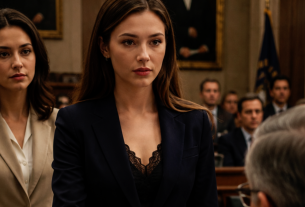
“Have you cluttered your desk with all this wastepaper again? Didn’t we discuss the complete digitalization of document management in plain Russian at the last planning meeting? And here you are again with folders, binders, colorful sticky notes. You might as well bring a wooden abacus from home!”
The voice of Veronika Andreevna, recently appointed regional director of the branch, carried down the entire corridor. She stood in the middle of the accounting department, nervously tapping a long fingernail with a perfect scarlet manicure against the screen of her expensive smartphone. She had barely turned twenty-eight. She wore an ultra-fashionable powder-colored pantsuit that clearly cost more than an ordinary employee’s monthly salary, and her sharp, sugary perfume made it hard to breathe in the cramped room.
Tatyana Mikhailovna, the chief accountant with twenty-five years of experience at this enterprise, slowly lifted her eyes from the monitor. She carefully removed her strict horn-rimmed glasses, placed them on the desk beside an old, reliable desktop calculator whose buttons had been worn down by years of use, and calmly looked at the young boss.
She was fifty-six. In that position, she had survived a default, three economic crises, four directors, and an endless series of changes in tax legislation. She knew every figure in the balance sheet by heart, remembered every nuance of the contracts with key suppliers, and could find an error in a tax return with her eyes closed.
“Veronika Andreevna,” Tatyana Mikhailovna said in an even, completely emotionless voice. “An electronic database is an excellent tool. We all work in it. But what you see in front of you right now are primary accounting documents from our main contractor for the construction of the new workshop. And if you pay attention to the dates, you will notice that they are closing the work completion certificates retroactively. Their electronic digital signature had expired during that period. If the tax inspectorate requests justification for a value-added tax refund, the system will simply reject the electronic version. We need real stamps and blue-ink signatures on paper. That is exactly why I am demanding the originals from them and filing them in a folder. This is our financial security.”
The young director snorted contemptuously, rolling her eyes so dramatically that the whites showed.
“What tax office? What blue stamps? Tatyana Mikhailovna, you are hopelessly stuck in the last century! These days everything is solved in two clicks. The system checks counterparties by itself. You are simply creating the appearance of frantic activity by moving these dusty papers from place to place. Do you know what your problem is? You don’t want to develop. You are afraid of new technology because your age no longer allows you to think flexibly and modernly. You should be growing tomatoes at your dacha and knitting socks for your grandchildren, but instead you are here slowing down the entire branch’s progress!”
A deathly silence fell over the accounting department. Three young employees sitting at neighboring desks hunched their shoulders, afraid even to move. Svetochka, a recent graduate of the economics faculty who sat closest to the chief accountant’s desk, blinked fearfully, looking back and forth between the furious boss and the completely calm Tatyana Mikhailovna.
Tatyana Mikhailovna did not blush, did not start making excuses, and did not raise her voice. Over many years of work, she had learned to keep her composure in any situation. She simply moved the folder of documents neatly to the edge of the desk and clasped her hands together.
“My age, Veronika Andreevna, allows me to see risks that are not built into any modern algorithm. A program works according to a template. But people, especially dishonest contractors, always look for loopholes. And my direct duty as chief accountant is to close those loopholes so the enterprise does not receive multimillion-ruble fines.”
“Your direct duty is to follow my orders!” Veronika shrieked, angrily stamping one elegant stiletto heel. “I am the manager here! And I am ordering all document flow to be transferred into electronic form by the end of the week. There must be no papers on desks. We are switching to a clean-desk concept. All originals are to be sent to the archive on the basement floor. And if you are unable to adapt to modern business realities, we will have to reconsider your position here. I have excellent young specialists in mind, with fire in their eyes, who grasp everything instantly and do not argue with management!”
Turning sharply, Veronika Andreevna fluttered out of the office. The door slammed behind her so hard that the calendar in its plastic frame rattled pitifully on the wall.
Svetochka immediately jumped up from her seat, ran to the water cooler, and poured a plastic cup of water with trembling hands.
“Tatyana Mikhailovna, please drink this,” the girl whispered, placing the water on the desk. “How can she act like that? She doesn’t understand production at all! She came from some fashionable capital holding company and thinks we run a smoothie factory here, not heavy machinery manufacturing! She’ll get us all into serious trouble with those electronic signatures of hers!”
Tatyana Mikhailovna nodded gratefully, took the cup, and had a small sip. The water pleasantly cooled her throat, which had gone dry from the tension, though outwardly she remained unshaken.
“Thank you, Svetochka. Sit back down and continue entering the bank statements. Don’t pay attention. New management always starts by breaking old procedures. They think no one worked here at all before they arrived.”
“But she threatened to fire you! Because of your age! That’s illegal!”
“Threatening and doing are two very different things,” Tatyana Mikhailovna remarked philosophically, putting her glasses back on. “To fire a chief accountant, one needs a very serious reason. And no one can find a single flaw in my accounting. Let her play at digitalization. But we are not sending the originals from the builders to the archive. Put them in the bottom drawer of my desk. And attach the little key to my key ring. My heart tells me we will still need them very badly.”
From that day on, life in the accounting department turned into a quiet, exhausting confrontation. Veronika Andreevna, obsessed with total control and novelty, introduced new rules every day. She demanded daily reports on completed work, implemented confusing spreadsheets that constantly froze, and held endless meetings where she spent hours talking about corporate culture and synergy.
She demonstratively ignored Tatyana Mikhailovna at planning meetings, addressing her subordinates directly. She tried to transfer part of the important authority to young girls who still did not fully understand the subtleties of tax accounting. Every time Tatyana Mikhailovna tried to point out an error in the calculations or warn of a risk of violating cash-discipline rules, the director interrupted her mid-sentence, making sharp comments about “senile grumbling” and “rigid thinking.”
The real problem ripened by the end of the quarter. The enterprise was preparing to close the reporting period, and the workload tripled. At that exact moment, Veronika Andreevna issued an order to switch to a new enterprise management system — completely raw and untested.
“This program will allow us to reduce document processing time by forty percent!” she proclaimed at yet another meeting, displaying beautiful, colorful graphs on the huge screen in the conference room. “All invoices will be uploaded and paid automatically. Tatyana Mikhailovna, your task is to transfer the balances from the old database to the new one by Friday evening. Starting Monday, we work only in the new system.”
Tatyana Mikhailovna carefully studied the printout describing the new program’s functionality, which had been given to her before the meeting began.
“Veronika Andreevna,” she raised her hand to attract attention. “Transferring balances in the middle of closing the quarter is a gross violation of accounting principles. The program is not integrated with our bank. In addition, the module for calculating depreciation on complex production equipment has not been configured. We will lose three months of data. If we switch to it now, we simply will not be able to calculate profit tax correctly. The tax office will freeze our accounts. I categorically refuse to take on such responsibility. Let us postpone the implementation at least until the first day of next month, after we submit the reports.”
Ugly red blotches spread across the director’s face. She could not tolerate objections, especially in the presence of other department heads.
“Tatyana Mikhailovna! Your cowardice before new technologies has crossed every line!” she snapped, clutching the laser pointer in her hand. “You are sabotaging management orders! I have already reported to headquarters that we are switching to the new platform. And we will switch to it. If you cannot cope with your duties because of your age or lack of competence, I will find someone who can. Follow the order, or write a resignation letter of your own free will!”
After that meeting, Tatyana Mikhailovna returned to her office pale but determined. She did not write a resignation letter. Instead, she gathered her girls.
“All right, my beauties,” she said, closing the door tightly. “Here is what we’ll do. We enter everything management requires into the new system. But! In parallel, we continue keeping accounts in our old, tested program. And we duplicate all important primary documents on paper. Print them, attach them, and put them in folders.”
“Tatyana Mikhailovna, we’ll be sitting here until midnight with this double work!” Svetochka exclaimed, almost crying.
“Then we’ll sit here. I’ll issue bonuses to you from the reserve fund. But if we abandon the old database now, we’ll never find the loose ends afterward. Trust my experience. This new toy will collapse under the first serious load.”
For two weeks, the accounting department worked itself to exhaustion. The girls came early in the morning and left late in the evening. Tatyana Mikhailovna practically slept at work during the tax declaration period. The new program, just as she had predicted, turned out to be a disaster. It duplicated payments, failed to recognize half the item list from the production warehouse, and absolutely refused to calculate payroll taxes correctly.
Veronika Andreevna, meanwhile, strutted around proudly. She sent beautiful reports to headquarters about how successfully the modernization was going and how the branch was moving by leaps and bounds toward a bright digital future. She paid no attention to the accounting department’s complaints, accusing them of not wanting to learn.
And then the thunder struck.
Tuesday morning began with a call to the director’s reception desk from the security service at the entrance checkpoint. Security reported that a black company car with Moscow plates had entered the plant territory.
Literally ten minutes later, a pale, disheveled Veronika Andreevna burst into the accounting department. Not a trace remained of her recent self-confidence. Her perfect hairstyle had come undone, and real, undisguised panic splashed in her eyes.
“Tatyana Mikhailovna! Girls!” the director’s voice trembled and broke into a squeak. “A comprehensive inspection from headquarters has arrived! A financial audit together with internal security! The commission is being led by Viktor Petrovich himself, the deputy general director for finance!”
Viktor Petrovich’s name was spoken at the enterprise in whispers. He was a man of the old school — strict, meticulous, and merciless. He was famous for firing branch managers in batches for the slightest financial violations or attempts to embellish reality.
“Calm down, Veronika Andreevna,” Tatyana Mikhailovna said calmly, taking a sip of tea from her favorite polka-dot mug. “Our quarter is closed. Taxes are paid. Salaries were issued without delay. We have nothing to fear.”
“You don’t understand!” the director grabbed her head in despair. “They came to inspect the targeted use of funds for the construction of the new workshop! That very contract for three hundred million! Viktor Petrovich is demanding the full package of closing documents for the past six months! And he wants to see it in our praised new system, the implementation of which I reported so loudly!”
Tatyana Mikhailovna slowly set her mug down on the desk.
“And those documents are not in the new system,” she stated. “Because, as I told you, the program cannot handle retroactive documents and does not recognize the contractor’s expired electronic signatures. The database is empty for that project.”
Veronika swayed and sank heavily onto a free chair. She suddenly looked very small and pathetic despite her expensive suit.
“What should I do?” she whispered, staring at one spot. “They’ll fire me. They’ll fire me under an article. And they’ll slap me with a penalty. Tatyana Mikhailovna, dear, you are an experienced person. Think of something! Tell them the server crashed, that a virus got into the system, anything! Help me!”
Tatyana Mikhailovna measured the young boss with a long, heavy look. She remembered every humiliation, every insulting word about her age, about the dacha and knitting socks, every threat of dismissal. Right now, she could simply step aside, fold her arms across her chest, and enjoy watching the arrogant young woman sink, dragging her own career down with her. That would be fair.
But the reputation of the entire branch was at stake. If the inspection deemed the construction expenses unjustified, the enterprise would lose its funding. And that would mean job cuts in the workshops, salary delays for ordinary workers who had families and loans. A real accountant protects not only herself, but also the enterprise she serves.
Heavy, confident footsteps sounded in the corridor. The office door opened, and Viktor Petrovich appeared on the threshold. He was a tall, heavyset man over sixty in a strict dark-gray suit. Sharp, cold eyes looked at everyone present from beneath thick gray eyebrows. Behind him stood two young assistants with laptops.
“Good morning, colleagues,” he said in a deep bass voice. “Veronika Andreevna, why did you run away from reception? I believe I made myself clear: I need the full financial report on the construction of Workshop Number Five. And I want to see all the primary documents. For three months, you reported to me about the tremendous success of your new digital platform. So demonstrate it.”
Veronika Andreevna jumped up from the chair, nervously straightening her jacket.
“Viktor Petrovich, hello. Of course, we’ll show you everything right away. It’s just… you see, we have a small technical delay here. The database was updated last night, and some registers are temporarily unavailable. We are about to contact technical support…”
The inspector twisted his face contemptuously.
“Save those fairy tales for schoolchildren, Veronika Andreevna. I have worked in audit for twenty years. Your technical delays usually mean one thing: missing documents and financial fraud. If I do not see confirmation of expenses for three hundred million in five minutes, I will suspend the branch’s operations and call the Investigative Committee.”
The director turned so pale that she almost blended into the wall. Her lips trembled. She tried to say something, but only a pitiful squeak escaped her throat. In panic, she turned toward Tatyana Mikhailovna, clasping her hands pleadingly against her chest.
Tatyana Mikhailovna unhurriedly rose from behind her desk. She adjusted her skirt, took the little key on its twisted cord from the desk, and walked over to the lower drawer of her cabinet. The lock clicked.
“Good morning, Viktor Petrovich,” she said calmly, turning to the formidable auditor. “I am glad to see you again. The last time we met was five years ago, when you conducted the audit during the company merger.”
Viktor Petrovich narrowed his eyes, peering into the older woman’s face, and suddenly his stern features softened slightly.
“Tatyana Mikhailovna? Are you still at your battle station? And our young talent here,” he nodded toward the trembling Veronika, “wrote in her memos that your accounting department was nothing but stagnation and incompetence. She demanded approval for your dismissal due to your failure to meet modern requirements.”
Svetochka, standing by the wall, quietly gasped and covered her mouth with her palm. Veronika Andreevna hunched her shoulders, not daring to raise her eyes. Tatyana Mikhailovna merely smiled faintly with the corners of her lips.
“Modern requirements are wonderful, Viktor Petrovich. But no one has yet abolished the laws of the Russian Federation or the requirements of the Tax Code.”
She took two thick, heavy lever-arch files from the drawer. They were impeccably clean, with neat printed labels on their spines: “Workshop No. 5. Primary Documentation. Volume 1 and Volume 2.”
Tatyana Mikhailovna walked to the large meeting table in the center of the office and placed the folders in front of the inspector with a dull thud.
“Here you are. This is the full set of documents for the construction of the fifth workshop for the entire period under inspection. Contracts, additional agreements, work completion certificates under Form KS-2, certificates of work value under Form KS-3, and invoices. All originals. With real blue stamps and signatures from the general contractor. All reconciliation statements have been completed and signed by both parties.”
Viktor Petrovich approached the table and opened the first folder. He slowly turned the pages. The documents had been filed with perfect precision. Every certificate was accompanied by a neatly attached invoice. Complicated areas were marked with green sticky notes containing explanatory comments written in clear, calligraphic handwriting.
The silence in the office was so deep that one could hear the fan humming inside Svetochka’s computer tower. The inspector’s assistants exchanged glances, realizing that their work had just become much easier.
“I see the contractor tried to close the work retroactively using an expired electronic signature?” the inspector said, instantly finding the weak spot as he pointed to a memo attached to one of the certificates.
“Exactly,” Tatyana Mikhailovna nodded. “That is why we refused to accept these documents through the electronic document management system and forced them to send paper originals with stamps by courier, re-signed with the current date. If we had let this pass electronically, as the new program required, the tax office would not have credited us twenty-five million rubles of input VAT.”
The inspector snapped the folder shut and placed his heavy palm on top of it. He slowly turned to Veronika Andreevna, who stood there more dead than alive, gripping the back of the chair with white fingers.
“So, stagnation and incompetence, Veronika Andreevna?” Viktor Petrovich’s voice sounded frighteningly quiet. “In other words, in your view, a professional who has just saved the company from a quarter-billion-ruble fine is dead weight that should be written off because of age? Do you even understand that your praised system, for the sake of which you destroyed a well-functioning workflow, is worthless without competent control? A program is just a tool. But brains, experience, and responsibility cannot be bought with money or downloaded from the internet!”
The director tried to mumble something in her defense. She began spouting some incoherent nonsense about how she had wanted the best, about process optimization and modern global practices. But the inspector cut her off sharply with a gesture of his hand.
“Enough. You may go collect your personal belongings. This evening, I will sign the order
“Enough. You may go collect your personal belongings. This evening, I will sign the order removing you from your position due to gross violations in management activity and the creation of a threat to the branch’s financial security. Your career in our holding company is over. And thank Tatyana Mikhailovna for covering for your stupidity. Otherwise, you would not be heading out onto the street — you would be heading to court.”
Veronika Andreevna ran out of the office, sobbing and smearing expensive mascara across her cheeks.
Viktor Petrovich sighed heavily, took a handkerchief from his jacket pocket, and dabbed his forehead. Then he turned to the chief accountant. In his eyes was the deepest respect, understandable only to people of the same generation, people accustomed to working conscientiously.
“Tatyana Mikhailovna, I apologize to you on behalf of company management for allowing that slip of a girl to run the branch. We chased fashionable trends, rejuvenating the staff… and this is what we got. Please don’t be angry with us old-timers.”
“I’m not angry, Viktor Petrovich,” the woman smiled softly. “Young people need to be given a road forward too. But they should only be trusted with the steering wheel once they understand how the engine works, not just how to press the buttons on the radio.”
“Golden words. While we look for a new, adequate director, I am assigning the duties of branch manager to you. With the appropriate additional pay, of course. And I will approve double bonuses for your girls for these folders. As for the new program, we will deal with it carefully, without rushing. You will describe all its weak points to me in an official memo. Agreed?”
“Agreed, Viktor Petrovich. Svetochka, please arrange some coffee for us. And I will meanwhile order all account cards to be brought to the meeting room. An inspection is an inspection — we need to work.”
By the end of the week, order and calm had returned to the branch. The nonfunctioning program was temporarily disabled, and they returned to the reliable database that had been tested over years. The girls in accounting started laughing again and calmly drinking tea during their lunch break.
Tatyana Mikhailovna sat at her desk in the office that now temporarily served as the director’s office. She was reviewing a fresh bank statement. On the desk in front of her lay that same old calculator with worn buttons, a stack of paper contracts, and bright yellow sticky notes.
She knew progress could not be stopped, and sooner or later paper folders would finally become a thing of the past. And she was ready to learn new things, master new programs and algorithms.
But she also knew one simple truth with absolute certainty: no artificial intelligence, no most advanced cloud system, would ever replace human experience, integrity, and that very professional intuition that comes only with years spent doing painstaking, real work.
She removed her glasses, wiped them with a cloth, smiled at the spring sun streaming through the window, and returned to work, because the reporting period would not close itself.