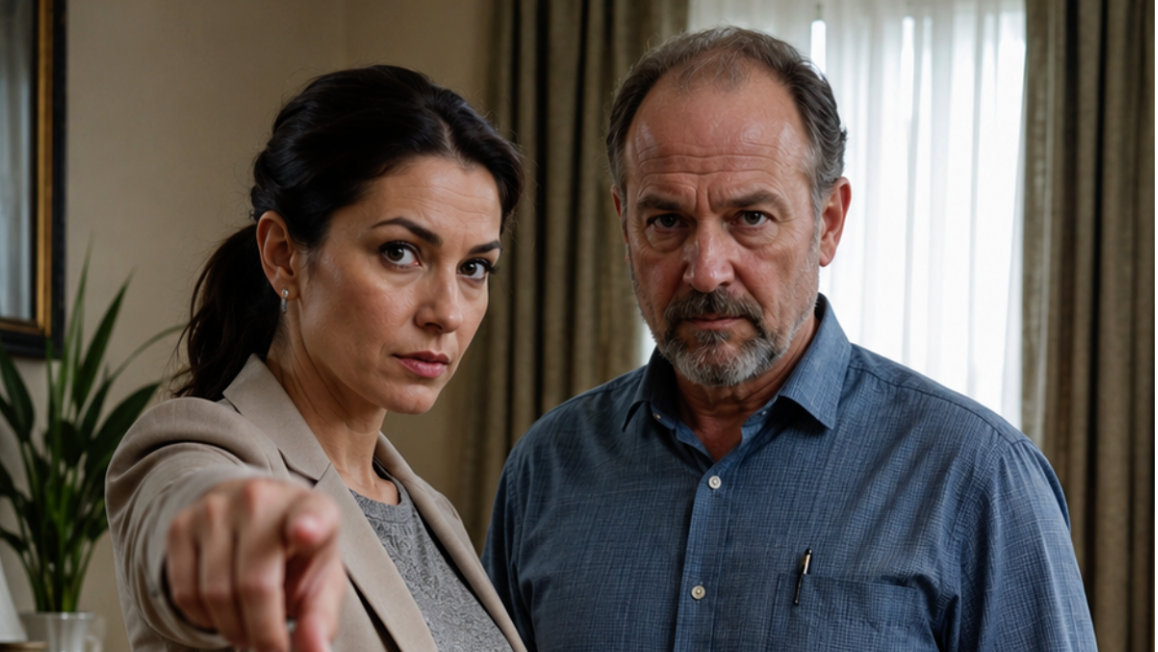
“You’re not going to hold me hostage here, Marina,” Oleg said in such an ordinary tone that he might have been discussing a grocery delivery rather than announcing that he intended to erase their shared life from his memory. “I’ve made up my mind, so don’t drag this out. We’re over.”
Marina felt as though she had been struck. The air suddenly seemed too thin, and her hands went cold. He sat across from her in a gray autumn jacket thrown over a T-shirt, not even trying to hide his boredom. Outside the window, the November wind whipped the bare branches in their courtyard, while the wet pavement gleamed beneath the streetlights. She had thought they were going to talk about something trivial. About buying a new light fixture for the hallway. Instead, he had dropped this on her without warning, without the slightest hesitation.
“Over?” she repeated quietly. “So everything was fine this morning, and now, by evening, we’re suddenly… over?”
“Everything was fine in your head,” he said dismissively, without even looking at her. “I figured it all out a long time ago. I was just waiting for the right moment. I’m leaving. I’ll pack my things tomorrow. We’ll handle it like civilized people. We’ll get the divorce done quickly, without unnecessary drama.”
He spoke evenly, with the same cold confidence Marina had once mistaken for emotional stability. Now she understood that it had simply been a convenient mask. He had not been worried for even a second. He had made his decision long ago. And apparently, she had been living in an illusion.
“All right,” Marina breathed, even though something inside her had fallen into a bottomless pit.
She did not even notice how visibly he relaxed. He was so certain of his own righteousness that he casually walked into the kitchen, poured himself a glass of water, took a sip, and tossed over his shoulder:
“And don’t deregister me from the apartment yet, all right? You never know. It’s just a formality. Nothing serious.”
A brittle chill swept through Marina.
Her apartment. Her grandmother’s inheritance. The only place where she had ever felt truly safe.
And he was asking her not to deregister him. Just in case.
As though she were a backup option. A spare toolbox kept in reserve.
“What do you need it for?” she asked, and her voice trembled.
He frowned slightly. He had not expected resistance.
“Why are you making such a big deal out of it? It just makes me feel more secure. I’ll have an official address instead of drifting from one rental to another. It doesn’t hurt you, does it? Let’s not turn this into a drama.”
He spoke as though it were perfectly obvious.
He was leaving for his new life, but he wanted to keep his safety net here.
With her.
The next day, as he packed his suitcases while whistling some irritatingly cheerful tune, Marina stood in the bedroom doorway, unable to believe this was happening to her. He folded his clothes with light, confident movements, almost happily, as though he were going on vacation rather than tearing their life in half.
She called Katya, the only person she could talk to at that moment.
Katya exploded immediately.
“He asked you not to deregister him? Are you kidding me?” Her outrage rang through the phone. “Marina, wake up. Nobody asks for something like that for no reason. He’s planning something. One hundred percent.”
“What could he possibly be planning?” Marina asked wearily. “He doesn’t have anyone except me… or rather, he didn’t.”
“You still believe in fairy tales,” Katya snorted. “Look at the bigger picture. Men rarely leave for nothing. And official registration is a tool, Marina. Money, loans, the banks’ trust. Do you think he just happened to remember it? Don’t be too soft, all right?”
Her friend’s words lodged inside her like a splinter.
Marina tried not to believe Oleg could be so calculating. They had spent ten years together. There had been noisy celebrations, trips, and late-night conversations in the kitchen.
Or had she imagined all of it?
The divorce went through quickly in a gloomy November registry office that smelled of wet coats and dust warmed by radiators. Oleg, bouncing impatiently on the balls of his feet, repeated once again:
“Don’t do anything reckless about the registration. There’s no need to go to extremes. We agreed.”
Marina clenched her teeth and said nothing.
Not here. Not within these walls.
But the increasingly forceful way he spoke unsettled her more and more. Katya’s voice kept echoing in her mind.
Her suspicions became reality a couple of weeks later when Marina accidentally ran into one of Oleg’s friends at a shopping center. The man broke into a broad smile.
“Oh, Marina! I saw Oleg here the day before yesterday with this stunning blonde. They were choosing furniture and laughing together. I thought maybe she was his sister, although… they didn’t look much alike.”
Marina felt the ground shift beneath her feet.
That was it.
There were the answers to all her questions.
There had been a plan.
There had been another woman.
And his request to remain officially registered in her apartment was part of the scheme.
November dragged on, heavy and gray.
Marina worked as an administrator at a clinic, completed her shifts, smiled at patients, and felt nothing but emptiness inside her head. In the evenings, the apartment rang with a silence more oppressive than any words.
Sometimes Oleg came by to collect the last of his belongings—old tools, a box of discs, some documents. Every time, he entered as though he were still the owner of the place. He did not even ask whether he could walk into the kitchen for a glass of water.
Then one day, he arrived with someone else.
A tall, slender woman swept through the doorway—the same striking blonde.
Sveta.
She had a predatory gaze, the cloyingly sweet scent of expensive perfume, and brightly painted lips. She looked Marina up and down in a way that made her chest tighten.
“This is Sveta,” Oleg said carelessly. “She’ll wait in the car.”
But Sveta stepped forward, clearly having no intention of waiting.
“In the car? No way. I want to see how you lived here.”
She walked through the hallway as though she were touring an exhibition, shamelessly opening cabinet doors and commenting aloud.
“Well. It’s modest. And the renovation looks like something from the early 2000s. I don’t understand how you managed to stay here for so many years.”
Marina felt a flame ignite inside her, real and scorching.
It was not hurt anymore.
It was anger.
“Take your things and leave,” she said evenly, struggling not to lose control.
Oleg rolled his eyes.
“Marina, come on. Sveta’s just looking around.”
Sveta gave a derisive snort.
“Come on, Oleg. We’re clearly not welcome here. Let the lady of the house stay in her little… burrow.”
They left behind a harsh cloud of perfume and the feeling that they had trampled all over Marina in filthy boots.
That evening, Marina did not cry for the first time.
She seethed.
And for the first time in a long while, she understood something with perfect clarity.
Enough.
The next day, she went to see a lawyer.
A week later, someone Marina least expected became involved in the situation.
Valentina Petrovna, Oleg’s mother.
Their relationship had never been warm, but there had never been any open conflict either. Valentina Petrovna was a strict, composed woman who spoke little, but every word she said hit its mark.
The phone rang in the evening. Marina did not recognize the number.
“Marina? This is Valentina Petrovna. We need to talk.”
Marina’s heart skipped.
She expected a lecture, accusations, anything.
“Come to the Romashka café after work tomorrow. I’ll be waiting.”
Marina agreed without fully understanding why.
The café was half empty. There was the clatter of dishes, quiet music, and the faint aroma of coffee. Valentina Petrovna sat near the window, her back straight, her suit formal, and her hair neatly arranged.
“Thank you for coming,” she said with a nod. “I’ll get straight to the point. I know about your situation.”
Marina tensed.
“I’m going to have him deregistered through the court,” she said, already bracing herself for condemnation.
Instead, Valentina Petrovna replied:
“And you’re right. That’s exactly what you should do. Don’t delay.”
Marina nearly dropped her cup.
“I… thought you would take his side.”
Valentina Petrovna sighed wearily.
“I love my son, but I’m not obligated to admire the foolishness in his head. And I refuse to be blind. He has always been selfish, but this… this has gone too far. And that Sveta… I’ve met her. All she has in her eyes are calculations. She’s hollow, but persistent.”
She leaned forward.
“I overheard them talking. By accident. They’re planning to take out a large mortgage. His registration in your apartment is one of their main advantages. And then… it gets worse.”
Marina froze, clutching the spoon in her trembling fingers.
Valentina Petrovna continued:
“If the loan is approved, they want to have a child. And Sveta is persuading him to register that child in your apartment.”
Marina felt the blood freeze in her veins.
Register a child there.
That would mean a trap of debts, court cases, and endless disputes. Removing a child from an official address required complicated legal procedures, which meant Sveta and Oleg would gain leverage they could use against Marina for years.
“They want to use my apartment?” she whispered.
“Exactly. They won’t be able to take it from you outright. But they’ll push you to the breaking point. They’ll sue, pressure you, and demand a share. Sveta only needs an excuse. And Oleg will follow her. He has always been drawn to people who push harder than he does.”
Marina sat there as though the floor had vanished beneath her feet.
“Thank you,” she said, barely finding her voice. “Thank you for telling me.”
“I’m not doing it for you,” the woman replied firmly. “I’m doing it so my son doesn’t turn completely into an empty shell. And one more thing. You are a good woman. Don’t let them crush you. Act quickly and decisively.”
Marina left the café as a different person.
Her pain and anger had melted into cold determination.
The very next day, her lawyer filed the claim.
When Oleg received the court summons, he stormed into Marina’s apartment that same evening, furious.
“What the hell are you doing?” he shouted, waving the paper in the air. “We had an agreement! I asked you for one thing, like a decent human being!”
“And what exactly does your honesty look like, Oleg?” Marina replied coldly. “Making plans behind my back? Using my address to get a mortgage? Planning to register someone else’s child in my apartment?”
He turned pale.
For one second, he looked confused.
Then he became angry again.
“It was my mother, wasn’t it? She’s turning you against me!”
“It doesn’t matter how I found out. What matters is that I know.”
“You’ll regret this, Marina!” he roared, slamming the door so hard that the windows shook.
But Marina no longer cared.
He called every day.
At first, he shouted.
Then he begged.
Then he tried to manipulate her with memories of their past.
Sveta sent Marina insulting messages, accusing her of jealousy and mocking her.
Marina blocked them and never replied.
The court hearing was cold and tense.
Marina sat in the corridor across from Oleg and Sveta. Oleg was visibly nervous, while Sveta looked confident, as though she had already won.
Inside the courtroom, Oleg portrayed himself as the victim. He invented a story about the possibility of getting back together, claiming Marina “needed time” and that he needed “an address he could return to.”
The judge listened in silence, her expression unreadable.
When it was Marina’s turn, her lawyer clearly laid out the facts.
A simple, precise list.
No emotion.
The judge asked Oleg only one question:
“Where do you actually live?”
He hesitated.
Sveta flushed.
His answer was weak and pathetic.
The outcome was obvious.
The claim was granted.
In the corridor, Sveta hissed at him:
“I told you! You ruined everything! What are we supposed to do now?”
Oleg tried to defend himself.
Marina walked straight past them.
For the first time in a long while, she could breathe freely.
A month later, she received the final ruling and had him officially deregistered.
She opened the apartment windows and inhaled the cold November air. It smelled clean and empty, but the emptiness belonged to her now.
It was new.
Valentina Petrovna called.
“Is it done?” she asked.
“Yes.”
“Good. Stay strong. And don’t look back.”
Marina hung up and, for the first time, felt steady on her feet.
“Do you have any idea what you’ve done?” Oleg practically spat the words the moment Marina opened the door. “Everything in my life is falling apart because of you! Are you happy now? Do you even understand what a normal human life is?”
Marina stood in the doorway of her apartment, with the quiet, damp December air behind her. The courtyard was flooded with murky streetlight. The snow kept melting and then freezing again into a thin crust of ice.
Oleg was trembling, either from the cold or from rage.
He looked worse than he had a month earlier—older, disheveled, as though he were falling apart.
But Marina did not care.
Not at all.
“Oleg, leave,” she said tiredly. “The court has already decided everything.”
“What court?” He stepped closer, his face twisted with anger. “You could have settled this with me! You used to be a reasonable person! What happened to you? Did my mother brainwash you? Or was it that Katya of yours? She’s always had it in for me!”
Marina said nothing.
He was looking for someone to blame.
Anyone except himself.
As always.
“Leave me alone, Oleg,” she said quietly.
“You leave me alone!” he shouted. “You’re ruining my life! Sveta is driving me crazy, the loan is in doubt, my mother refuses to see me… Do you understand what you’ve done?”
Marina closed the door.
Calmly, without slamming it.
She simply closed it.
His voice remained audible through the wall for another minute before gradually fading. Then the entrance door downstairs slammed shut.
Silence followed.
That night, Marina finally understood that this was not really about the divorce.
It was not about the registration.
It was not about the court.
It was about the fact that, for the first time in her life, she had stopped carrying someone else’s responsibility on her shoulders.
And that infuriated Oleg more than anything.
December covered the city in a dense, gloomy gray veil.
Marina went to work, returned home in the evenings, and lived a measured, cautious life. It was as though she were learning how to live alone from the beginning—not falling into the silence, but making it part of her space.
Oleg’s calls became less frequent. At first, he bombarded her with furious messages. Then he tried to gain her pity. Then he fell silent.
Sveta, on the other hand, continued sending cruel, vicious comments through social media, but Marina simply blocked her and moved on.
Gradually, life rearranged itself.
Or rather, it began rebuilding itself from the ground up.
Marina signed up for the dance classes she had dreamed about for years. She bought a new light fixture for the hallway—the one she and Oleg had never installed. She changed the curtains. She began clearing out the storage cabinets, throwing away old things she had kept for no real reason.
Sometimes, as she opened another box, she suddenly remembered Oleg—how he used to laugh, how they fried potatoes together late at night, how they talked about nothing in particular.
But those memories no longer cut her.
They simply existed.
Like old photographs that had lost their emotional weight.
One evening, the phone rang again.
Marina’s heart skipped when she saw that it was Oleg’s mother.
“Marina? Hello,” Valentina Petrovna said, sounding unusually tired. “Can you talk right now?”
“Of course. What happened?”
“He came to see me,” she said heavily. “Today. He shouted at me. Called me a traitor. Said I destroyed everything and tore the family apart. Said you are his enemy now. Said he has nowhere to live. Sveta is pressuring him… It was a complete hysterical breakdown.”
Marina closed her eyes.
Oleg was slowly collapsing.
“I’m sorry,” she said quietly. “I didn’t mean to create more problems for you.”
“This has nothing to do with creating problems,” Valentina Petrovna dismissed. “I’ve known what he is like for a long time. He’s dependent by nature. Easily influenced. Put a strong woman beside him, and he follows her. Had you been different, he would have followed you. But you’re kind and gentle. Sveta is… different. More aggressive, let’s say.”
Marina gave a faint, bitter smile.
“Do you think he’ll come to his senses?”
“Someday, perhaps. But that is no longer your concern, Marina. You are not his mother.”
Those words unexpectedly became important.
Marina had long felt that she had been something like a convenient support system for Oleg—a shoulder to cry on, a quiet harbor.
And he had expected her to remain that way forever.
But now it was over.
“Stay strong,” Valentina Petrovna said before saying goodbye. “You did well. Remember that.”
When January came, thin ribbons of snow stretched across the city. The temperature dropped, and the steps outside the clinic began to creak beneath people’s shoes.
Marina no longer recoiled from the silence in her apartment.
On the contrary, life became more comfortable within its calm rhythm.
In the evenings, she put the kettle on, played quiet music, and wrote plans in a notebook. Sometimes she watched films she had wanted to see five years earlier. Sometimes she did not turn anything on at all.
She simply existed.
But one day, something happened that she had not expected.
Near the end of the workday, the reception staff heard a commotion.
A deep voice, far too familiar, carried through the lobby.
“I need to speak with Marina Grigoryevna. It’s urgent. I’m her husband.”
Marina stepped into the lobby and saw Oleg.
He looked rumpled and furious, his eyes red. It seemed as though he had been wandering through the freezing streets for hours.
“Marina, we need to talk,” he said, struggling to control his emotions. “Not here. Please.”
She looked at him and barely recognized him.
The man standing before her seemed as though he had been shaken out of his own life.
Not victorious.
Defeated.
“Five minutes,” Marina said firmly. “And we talk here, in public.”
He exhaled as though surrendering in advance.
“Sveta threw me out,” he said. “We had a fight. She said I was… that I had no prospects. That I was dead weight and everything was falling apart because of me. Without the registration, without the loan… She has all these plans. She… Anyway, she doesn’t need me anymore.”
Marina stood perfectly still.
She was not even surprised.
“I understand,” she said calmly.
“Marina, I have nowhere to live,” he continued more quietly. “I’m not asking for much. Just some time. A week. Could you let me sleep on the couch? Just for a couple of days, at least. Until I sort things out. After all, I’m still… well… you understand.”
She felt no anger.
No satisfaction.
Only emptiness.
Because this was the predictable ending.
And she was ready for it.
“No, Oleg,” she said gently but firmly. “I can’t. And I won’t.”
He turned pale.
“Marina, you’re a human being! We were together! How can you do this? Do you want me sleeping in apartment building hallways?”
“These were your decisions,” she replied evenly. “You made them. Now live with the consequences. I didn’t create them. You did.”
He stepped closer.
“Marina, for God’s sake, just let me stay one night! Give me another chance! I understand everything now. I really do. I was an idiot. Forgive me. I’ll change. I don’t want to lose everything.”
She looked into his eyes and saw fear.
Real fear.
But it was no longer her responsibility.
“Oleg,” she said, pronouncing every word clearly, “go back to the place where you expected to win. Where you thought you would be appreciated. Where you were promised grand plans. That was your choice. Your place is there, not here. I will not become your safety net again. It is over. It has been over for a long time.”
With those words, she turned and walked back toward her office.
He remained standing in the middle of the lobby like a lost schoolboy whose parents had forgotten to pick him up.
But Marina did not look back.
After that day, he never appeared again.
No calls.
No messages.
Marina did not try to find out where he was living or whom he was with. She stopped following every trace of him online.
The world in which Oleg had played the central role was closing.
But one final scene still took place several months later, in early spring.
Marina was returning from work. The evening air smelled of thawing puddles and wet asphalt. Near a pedestrian crossing, she saw two people arguing loudly.
Sveta and Oleg.
They looked like two shadows from the past—tired, irritated, and exhausted.
Sveta waved her arms furiously.
Oleg tried to explain himself, his tone pleading.
Marina walked past them.
She did not even turn her head in their direction.
But from the corner of her eye, she noticed that Oleg saw her.
There was something strange in his gaze—a mixture of regret, hope, and emptiness.
But it changed nothing.
Marina simply kept walking.
At home, she took off her shoes, put the kettle on, and sat by the window.
A light rain tapped against the glass outside, while the occasional passerby hurried home.
The world was vast, alive, and cold.
But it was honest.
There were no tricks in it.
No hidden traps.
She no longer waited for explanations or apologies from the past.
She simply lived.
Marina opened her notebook and wrote in large, confident letters:
“New life. Begin.”
And for the first time in a very long while, it was not a promise.
It was reality.