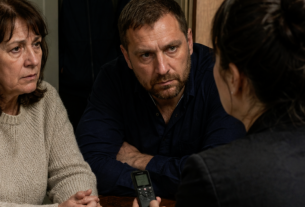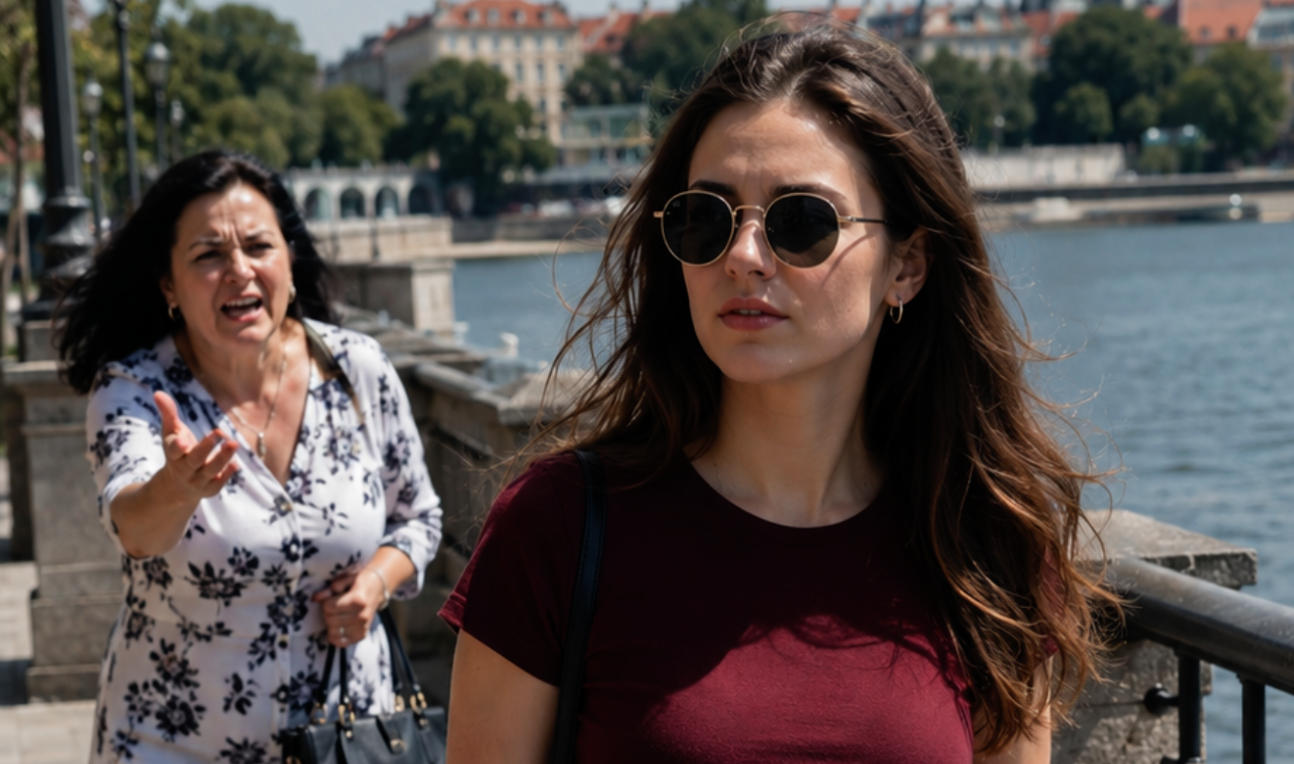
“You’ll have to give the apartment to dear Yura anyway! You and Vadim are settled people, you’ve got your own corner, but the boy needs to build a nest,” Antonina Vasilyevna declared flatly, dropping a heavy jar of pickled cucumbers onto the kitchen table with a dull thud.
Olga didn’t even flinch. She continued wiping the glossy white cabinet door with the methodical precision of a clockwork mechanism. The kitchen smelled of lavender cleaning spray and strong coffee. Outside the window, the familiar city traffic murmured; gray buses crawled lazily past the bus stop. And here, on the twelfth floor, another family drama was unfolding — one whose scale Antonina Vasilyevna clearly underestimated.
“Mom is right, Olya,” Vadim said without looking up from his smartphone. He was sitting on the little sofa, lounging with one leg crossed over the other, lazily scrolling through the news. “Yurka and Katya have been dragging themselves from one rented place to another for three years. Rent prices now are daylight robbery. And that two-room apartment you got from Aunt Klara is just sitting empty anyway. Why let a good thing go to waste? They’re family.”
“Empty?” Olga finally put the cloth aside and turned toward her relatives.
She was thirty-eight years old, fourteen of which she had spent heading the regional logistics department of a large trading company. At work, she was valued for her iron logic and her ability to resolve crises when trucks full of goods got stuck on snow-covered highways. But at home, for some reason, Olga had spent many years playing the role of “patient and understanding wife.”
Until today.
“Vadim, it is not empty. It’s being redecorated. I planned to rent it out so we could pay off the rest of our own mortgage five years early.”
Antonina Vasilyevna grimaced in annoyance, as if one of her molars had suddenly started aching. She adjusted her ever-present lurex cardigan and looked at Olga with that special, condescending pity people reserve for obedient but not particularly bright household pets.
“Oh, Olya, you really are so down-to-earth,” her mother-in-law sighed, sitting down and pulling the sugar bowl toward herself as if she owned the place. “All you have in your head are numbers and calculations. Just like Lyudmila Prokofyevna from Office Romance before her transformation — dry, hard-hearted, always looking for profit. What about family ties? We are family! In old movies, people gave away their last possession to help a brother or an in-law. And here we are talking about your own brother-in-law. Yurochka is a creative soul. He is searching for himself. He cannot get himself chained to a mortgage, or his wings will droop. You’ll get a bonus anyway. In that logistics business of yours, they throw money around. You can manage!”
“Yeah, Olya,” Vadim chimed in, still not raising his eyes. “Don’t make it dramatic. Mom is talking sense. We’ll give Yurka the keys, they’ll move in and settle down. And as for our mortgage… well, we’ll figure it out somehow. After all, what’s the rush?”
Olga looked at her husband.
At forty-one, Vadim had kept his boyish tuft of hair, the slight puffiness of his cheeks, and an absolute, crystal-clear innocence in his eyes. He worked as a “creative consultant” at a small advertising agency and earned a modest salary, almost all of which he spent on his hobbies — either a professional fishing rod, a new camera lens, or craft beer. All the main expenses — utilities, groceries, clothes for their thirteen-year-old daughter Liza, payments on their shared loan — were silently carried by Olga.
Fifteen years. That was how long their marriage had lasted.
And for all fifteen years, Antonina Vasilyevna had sincerely considered her daughter-in-law a naive, spineless fool who had been unbelievably lucky to marry her “intelligent boy from a good family.” Whenever she came to visit, the mother-in-law could rummage through Olga’s closet without asking, criticize Olga’s soup for not being rich enough, or authoritatively declare that Liza absolutely did not need an English tutor because “in our day, everyone studied from Soviet textbooks on their own, and we turned out just fine.”
Olga endured it. She avoided conflicts. She believed that a bad peace was better than a good quarrel, that Vadim would mature with time, and that her mother-in-law was simply getting older and needed attention. For the sake of this mythical family harmony, Olga swallowed insults, smiled at barbed remarks during holiday dinners, and obediently paid off the small debts of her eternally unemployed brother-in-law, dear Yurochka.
Tuesday began with pouring rain. Olga had gone through three difficult meetings, approved delivery schedules for the holidays, and, exhausted to the limit, decided to go home early. Vadim was supposed to be filming some low-budget commercial, and Liza was visiting a friend, so Olga was looking forward to a couple of blissfully quiet hours with a cup of herbal tea.
She opened the apartment door with her key. In the hallway, there was the smell of someone else’s perfume — too sweet and cloying. Bright laughter and voices came from the living room. Olga frowned, took off her shoes, and quietly walked down the corridor.
On the sofa, comfortably surrounded by the decorative cushions Olga had spent so long choosing to match the curtains, sat Antonina Vasilyevna, Yurochka, and his girlfriend Katya — a girl with brightly painted lips and a spoiled expression. Vadim was sitting beside them with a glass of wine.
“I’m telling you, Katyusha, you can consider the apartment yours,” Vadim was saying cheerfully, pouring the girl more wine. “Olka will grumble for form’s sake. She always starts by playing the proper little mommy, then she calms down. I’ll tell her I’m depressed because of a creative crisis, and she’ll do anything for me. She’s well-trained. In fifteen years, she has never once caused a scandal. A real gray mouse — dutiful, proper, and stupid. The main thing is to present it correctly: say Yura will only live there temporarily and keep an eye on the renovation. Then, in a couple of years, maybe we’ll get the deed transferred too, once Irka — well, Olga’s aunt — has finally been erased from the archives of memory.”
“Oh, Vadimchik, God willing!” Katya drawled affectedly, examining her fresh manicure. “Because Olga’s renovation… the colors are so boring, like a hospital. We’ll redo everything there. I want a loft. We’ll cover the walls with brick, put in a bar counter. That Klara of yours, the dead one, apparently had no taste at all.”
“The main thing, Katyenka, is that you inspire my Yurochka,” Antonina Vasilyevna cooed affectionately, stroking her younger son’s shoulder. “And we’ll pressure Olga until she gives in. She’s a village girl. Even if she sits in a managerial chair now, she still has a slave mentality. Tell her ‘it’s necessary for the family,’ and she’ll take off her last shirt. I’ve seen right through her for fifteen years. She’ll cry into her pillow, count her receipts, and bring the keys on a little plate.”
Yurochka gave a satisfied grunt and reached for the grapes in the bowl.
Olga stood in the doorway, feeling something inside her, somewhere around her solar plexus, slowly and terribly boil with an icy wave.
It was not hurt.
It was a deep, crystalline revelation.
As if the focus in an old pair of binoculars had suddenly been adjusted, and blurry spots had turned into clear, ugly faces of parasites.
They were not merely taking advantage of her kindness.
They despised her for that kindness.
They considered her stupid, limited, a “trained” little fool who, by the very fact of her existence, was obligated to serve their interests.
Olga took a deep breath, turned around, silently walked back to the hallway, got dressed, and left just as quietly, carefully closing the door behind her. The family on the sofa did not even notice.
For the next three days, Olga behaved impeccably. She did not make scenes. She did not cry. She cooked dinner as usual and even maintained Vadim’s empty conversations about the weather and football. Vadim was delighted, convinced that “the fortress had fallen” and his wife had finally accepted the loss of her aunt’s inheritance.
“Olyunya, leave the keys to Klara’s apartment on the dresser, all right?” Vadim said casually on Friday morning, tying his necktie in front of the mirror. “Yurka will drop by after lunch. He wants to take measurements for the furniture.”
“All right, Vadim. Everything will be done in the best possible way,” Olga replied calmly, pouring herself coffee. Her voice was unusually even, without a single emotional note, but Vadim, absorbed in his reflection, did not notice.
On Saturday at noon, the whole council gathered again in Olga’s kitchen. Antonina Vasilyevna arrived in a festive mood, bringing a fish pie with her “to celebrate Yurochka’s new home.” Yura and Katya were already sitting there with the air of rightful masters of life.
“Well then, Olenka, hand over the keys,” her mother-in-law smiled benevolently as she sat down at the table. “Vadim said you had prepared everything. Good girl. Family is sacred. Like in that movie: ‘Our people don’t take taxis to the bakery,’ but they must help one another!”
Olga calmly approached the table. In her hands was a large, thick envelope made of brown kraft paper with a blue official seal.
“Yes, Antonina Vasilyevna. I prepared everything. But the keys are not here. There is something better.”
Olga sat down on a chair, slowly opened the envelope, and took out a stack of official documents. On the first page, in large print, were the words: “Official Notice.”
“What is this wastepaper?” Vadim frowned, reaching for the papers.
Olga gently pressed the sheets to the table with her palm.
“This, Vadim, is a letter from a notary. More precisely, an official notice of termination of a free-use agreement and a demand to vacate the premises. But not for Yurochka. For you.”
Such silence fell over the kitchen that the faint rustling of the refrigerator’s freezing system became audible. Antonina Vasilyevna froze with her fork raised, a piece of fish pie trembling on it.
“Olya, have you lost your mind?” her mother-in-law was the first to recover, her voice instantly losing its affectionate notes. “What eviction? Who? Vadim is your husband! He is registered here!”
“He was registered here, Antonina Vasilyevna,” Olga said, turning the page and sliding it toward Vadim. “This apartment we are sitting in right now was bought with a mortgage registered solely in my name, because at the time Vadim had no official income. For ten years, I made the payments regularly. Three years ago, my parents sold their country plot and gave me a large sum of money, with which I fully paid off that mortgage. We formalized it with a notary as a targeted gift not subject to division in the event of divorce. Vadim only had temporary registration at this place of residence, and that registration expired exactly yesterday. I chose not to renew it.”
Vadim snatched the paper. His eyes darted across the lines, and red blotches began spreading rapidly across his face.
“Olya… what are you doing? What divorce? What notary? You staged this comedy because of Aunt Klara’s apartment? I was joking back then!”
“You were not joking, Vadim,” Olga said, looking at him with deep, sincere indifference. “For sixteen years, you took advantage of the fact that I kept silent. All of you considered me a naive fool, a ‘trained gray mouse’ who would silently work herself to the bone while you built lofts, flew to Dubai, and talked about creative crises. Speaking of which…”
Olga took another document from the folder — a printout of bank statements.
“This is a statement from my personal account, which Vadim had access to for paying utility bills. Over the past two years, about three hundred and fifty thousand rubles have ‘disappeared’ from this account. In small amounts. I pulled the transfer records. All this money went to the card of Yuri Nikolaevich — for ‘car repairs,’ for ‘buying equipment for a business.’ Vadim, you were simply stealing from your own family, from your own daughter, to sponsor this thirty-year-old loafer.”
“Yurochka is not a loafer!” Antonina Vasilyevna shrieked, jumping up from her chair so violently that it crashed onto the laminate floor. “He is searching for himself! And you… you calculating beast! You are a snake we warmed at our breast! Vadim gave you his youth! He comes from a decent family! We turned you into a person after dragging you out of your village!”
“Which village, Antonina Vasilyevna?” Olga asked quietly, without even raising her voice. “The one where my parents have a strong farming business and three tractors? The one I left with a red diploma from the economics faculty? You turned me into a person? You, who lived four to a shabby two-room Khrushchev-era apartment with a leaking ceiling, while I bought this apartment and started paying off your utility debts?”
Yurochka and Katya sat as if they were neither alive nor dead. Katya nervously hid her long nails under the table, while Yura suddenly seemed very small and pale.
“Olya, forgive me…” Vadim tried to fall to his knees before her and grabbed the fabric of her kitchen apron. “The devil led me astray! Mom pressured me, Yurka cried that Katya would leave him… I got confused! I love you, Olya! We’ve been together so many years! Remember, like in The Irony of Fate? ‘We have forgotten how to do big, good foolish things!’ So I did something foolish. Forgive me! I’ll return everything. I’ll get a proper job, I swear!”
Olga gently but with disgust removed his hands from her knees.
“No, Vadim. I have finally learned not to do big foolish things. I practiced for fifteen years. That is enough. The thesis has been defended. The practical training is over.”
She stood up and opened the front door. In the hallway stood two large suitcases, neatly wrapped in stretch film.
“Vadim’s things are packed. The divorce papers and the division of property — namely, your credit card debts, which you somehow managed to take on behind my back — are already in court. Aunt Klara’s apartment was officially rented out yesterday on a long-term lease to a large logistics company as housing for their top managers. The contract has been registered with Rosreestr. So there will be no loft with brick walls there, Katyenka. Serious people will live there, and they pay good money.”
Antonina Vasilyevna breathed heavily, her face twisted with rage and helplessness. The mechanism of manipulation that had worked flawlessly for years had suddenly broken, and its gears had flown in every direction, painfully wounding the very people who had created it.
“You… we… Liza will hate you!” her mother-in-law shouted, using what she thought was her final, devastating argument. “You are taking a father away from his child! She will never forgive you for this!”
Liza calmly walked out of her room. She was wearing headphones, but judging by her calm face, she had heard the entire conversation perfectly well. The girl approached her mother, hugged her around the waist, and looked at her grandmother and father.
“Grandma, Dad has only spoken to me for the past three years when he needed me to ask Mom for a new iPhone,” Liza said quietly. “Mom, let’s go to the movies instead. They’re showing old comedies.”
Antonina Vasilyevna realized that the battle had been lost completely. She grabbed her bag, yanked Yurochka by the arm, and, throwing Olga a look full of pure, undiluted hatred, flew out of the apartment. Vadim followed behind her, dragging the suitcases and sniffling pitifully. Katya minced after them, trying not to click her heels.
The door closed.
Olga turned the lock twice.
Silence reigned in the kitchen again.
But now it was a completely different silence — clean, light, smelling of freedom and of a new life that belonged only to her.
Five months passed. A warm golden autumn arrived.
Olga sat on the veranda of a small, cozy café, enjoying the rare Saturday sunshine and a cup of sea-buckthorn tea. She was wearing a new, expensive cashmere coat in a powder-pink shade, which she had bought for herself just because she wanted to — for the first time in many years, she did not need to calculate how much money would be left after paying other people’s debts and funding their “creative searches.”
Her life had changed dramatically.
The divorce went surprisingly quickly. Vadim, deprived of financial support, tried to sue for the apartment at first, but after reviewing the notarized documents regarding the parental gift and the bank statements, his lawyer quickly explained to his client that the only thing awaiting him in court was the obligation to repay half of the stolen money and divide his own consumer loans. In the end, Vadim signed a settlement agreement on Olga’s terms.
Now Vadim lived with his mother in that very same Khrushchev-era apartment. He had taken a job as a night dispatcher for a taxi service — his creative crisis somehow resolved itself once he truly wanted to eat. Yurochka and Katya split up two months after that memorable conversation. Katya quickly realized that the “promising loft” had been canceled forever, and living with her boyfriend’s mother and the boyfriend himself on Antonina Vasilyevna’s pension was a questionable pleasure.
Olga felt as if a heavy cast-iron backpack she had carried for fifteen years had finally been taken off her shoulders. Her self-esteem no longer depended on the approval of a toxic mother-in-law. At work, Olga was offered the position of supply chain management director for the entire federal district. Management noted that some new, unyielding confidence and inner backbone had appeared in her.
A notification came to her phone. It was a message from Antonina Vasilyevna. Her mother-in-law had not written for three months, but apparently the utility bills had forced her to forget her pride.
“Hello, Olya. Vadim’s back is really bad, his medicines are expensive, and my pension has been delayed by two days. Yurochka doesn’t have enough money for winter tires. He’s trying to earn extra, but he can’t do anything without a car. Maybe you’ll come to your senses? After all, Liza has a real father and grandmother. Transfer at least twenty thousand. For you, that’s just pocket change…”
Olga looked at the screen, smiled faintly, and took a sip of warm tea.
No guilt.
No panic.
No desire to “save and help” rose inside her.
The wires through which other people’s selfishness had been transmitted for fifteen years had been cut — finally and irrevocably.
She blocked the number. Put the phone into her handbag, paid for her tea, and walked to her car.
A wonderful weekend lay ahead.
She and Liza were flying to St. Petersburg for the school break.
Because they deserved it.