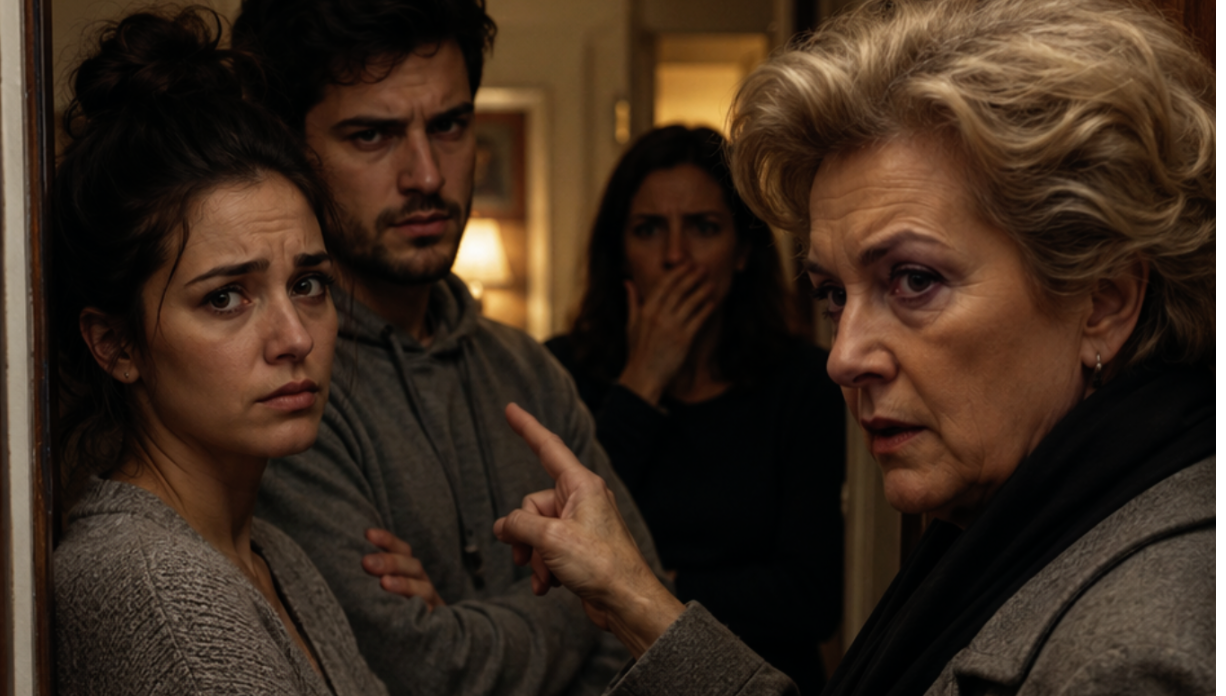
“Vacate the apartment voluntarily, otherwise the next conversation will be through the court,” Alina calmly warned her husband’s relatives.
Pavel raised his head so sharply it was as if he had heard not his wife, but a stranger. His mother, Valentina Sergeyevna, froze by the kitchen table with an open notebook in front of her, where she had already drawn some squares, arrows, and notes. His brother Sergei stopped scrolling through a furniture catalog on his phone. Sergei’s wife, Larisa, removed her hand from her mug and slowly looked at Alina.
Alina stood in the hallway, silently looking at the strangers’ belongings that had already taken over half the apartment.
Once, this hallway had been spacious. Not luxurious, not like something from a magazine, but comfortable: a narrow shoe cabinet, hooks for coats, a mirror, and a small rug near the entrance. Now, instead of the familiar order, there were bulky boxes with labels: “winter,” “Seryozha’s tools,” “Larisa kitchen,” “Mom’s things.” Against the wall stood Valentina Sergeyevna’s folding chair, because she had “nowhere to sit while changing shoes.” Beside it lay a bag of jars that no one had bothered to sort out for three weeks.
Alina walked past all of it in silence, but her fingers tightened around the handle of the folder with documents until they turned white.
Pavel’s relatives had moved in with them “for a couple of weeks” back at the end of autumn. At the time, it had sounded almost reasonable: Sergei, Larisa, and their seven-year-old son Artyom had sold an old share in a house outside the city and were temporarily looking for housing, while Valentina Sergeyevna had come to help them with the child. Pavel assured Alina that it would not be for long.
“Just be patient a little,” he had told Alina on the first evening, when his brother and his family brought in their first bags. “They didn’t come here from the street. They’ll stay with us while they find a place. You understand the situation.”
Back then, Alina did understand. She herself had grown up in a family where people did not refuse help. She felt uncomfortable that everything had been decided almost without her, but Pavel asked gently, guiltily, held her hand, and promised that it would all be over in two weeks.
The apartment was hers. A three-room apartment inherited from her aunt, Zoya Petrovna. More than three years had passed since her aunt’s death, all the documents had long been completed, and ownership had been officially registered. Pavel lived in that apartment as her husband, but he was not the owner. Alina had never thrown that in his face, because she believed that people in a marriage should not spend every day measuring their relationship by stamps and certificates.
But Pavel’s family mistook her silence not for delicacy, but for weakness.
At first, his relatives behaved almost shyly. Sergei apologized for every box, Larisa washed her own dishes, Artyom walked quietly around the apartment and even asked permission to turn on cartoons. Valentina Sergeyevna showered Alina with gratitude.
“Alinochka, you’ve helped us so much. We’ll be quick. Sergei just needs to finish the paperwork on the deal, Larisa will look at options, and we’ll move out. Don’t worry.”
Alina nodded. She gave them the far room, stayed in the bedroom with Pavel, and temporarily gave up the small study where she worked in the evenings for their suitcases. Back then, the temporary arrangement really did seem temporary.
After two weeks, Sergei said there were no suitable apartments.
After a month, Larisa declared that renting was expensive and pointless when they were “about to find their own place.”
After a month and a half, Valentina Sergeyevna stopped asking whether she could move pots around in the kitchen cabinet and simply rearranged everything however she found convenient.
Alina first became wary one morning when she could not find her folder with work papers. She searched for it for twenty minutes until Valentina Sergeyevna called from the kitchen:
“I put it in the cabinet. There was a mess on the table.”
“These are my documents,” Alina answered evenly. “Please don’t touch them.”
Her mother-in-law opened her eyes wide in surprise.
“I was just tidying up. You react so sharply right away.”
Later, Pavel pulled Alina aside.
“Mom just wanted to help.”
“Pavel, that isn’t help. Those are my things.”
“Well, tell her more calmly. She’s an elderly woman. She gets offended.”
Alina looked at her husband and noticed for the first time how skillfully he put her in the position of being guilty even when her boundaries were being violated.
Then additional cabinets appeared.
First, Sergei brought a metal shelving unit for his tools. He placed it in Alina’s former study and said:
“Not for long. It didn’t fit in the pantry.”
Alina wanted to object, but Pavel immediately interfered:
“Where is he supposed to put it? There’s a drill, a screwdriver, a box of small parts. He can’t put it all on the balcony.”
A week later, Larisa ordered a narrow wardrobe for Artyom’s clothes.
“We can’t keep everything in bags,” she explained. “A child needs to live normally.”
Alina stood in the middle of the room, watching the assembler screw in the shelves, and felt something inside her slowly move away from her former softness. She did not shout. She did not argue in front of the child. She simply told Pavel that evening:
“This won’t work. They’re settling in.”
“What are they supposed to do, live on the floor?” her husband replied tiredly. “Ali, don’t start. You’re exaggerating everything.”
But after two months, it no longer looked like an exaggeration.
New keys appeared in the apartment.
Alina found out by accident. She was coming back from the store, went up to her floor, and saw Larisa opening the door with a key she had not had before. A bright lemon-shaped keychain dangled from the ring.
“Where did you get the key?” Alina asked.
Larisa turned around and blinked.
“Pavel made it. So we wouldn’t bother you every time.”
Alina followed her inside, took off her shoes, placed the grocery bag on the kitchen counter, and called her husband.
“Pavel, come here, please.”
He came out of the bedroom with his phone in his hand.
“What happened?”
“You made keys for your relatives without my consent?”
Pavel grimaced.
“Oh, here we go again. Alina, they live here temporarily. It’s inconvenient for them to wait outside the door every time.”
“They are guests here.”
“Guests who have already been living with us for two months. Don’t cling to words.”
Alina slowly turned toward him. Her face became still; only a tiny vein twitched near her cheekbone.
“This is my apartment. Keys to my apartment are not handed out without my consent.”
Valentina Sergeyevna came out of the room.
“So that’s how it is,” she drawled. “That means we’re strangers here.”
“Yes,” Alina said. “In the legal sense, you are strangers in my apartment.”
Her mother-in-law threw up her hands.
“Pavel, did you hear that? Your wife called your mother a stranger.”
Pavel grimaced even more.
“Mom, don’t. Alina, you too. Let’s not make a scandal.”
And that phrase — “let’s not make a scandal” — became his main weapon. Every time Alina tried to talk about deadlines, belongings, keys, the kitchen, or noise, Pavel asked her not to create conflict. He did not say, “You’re right.” He did not say, “I’ll talk to my brother.” He only said:
“Be patient.”
“Don’t escalate.”
“Now isn’t the time.”
“They’re already stressed.”
“Let’s talk after the holidays.”
After the holidays, Sergei set himself up with a laptop at Alina’s work desk.
“I need to look through some documents,” he explained. “The lighting is good here.”
“This is my desk,” Alina said.
“I’ll only be an hour.”
He sat there until night, and in the morning he left crumbs, a charger, and a cup with dried coffee on the edge. Alina cleaned it up without a word, but inside her there was no longer the same desire to keep peace at any cost. She began writing down dates. When they moved in. Who received keys. What belongings had been brought. What conversations had taken place. Not for revenge. For clarity.
One day, she came home earlier than usual and heard a conversation from the kitchen.
“If we clear out the small room, Artyom will be better off there,” Larisa was saying. “He’s already big. He needs his own corner.”
“And where will Alina work?” Sergei asked.
“What kind of work does she do there in the evenings anyway? She can sit with a laptop in the bedroom.”
Valentina Sergeyevna answered confidently:
“Exactly. A study is a luxury when there’s a child in the apartment.”
Alina stopped at the kitchen entrance. Her fingers loosened by themselves, and the keys landed dully in her palm. She did not enter immediately. She listened until the end.
“We need to explain it to Pavel gently,” her mother-in-law continued. “He is the man. He’ll decide. Alina shouldn’t be the only one giving orders. The apartment is family property.”
“She got it by inheritance, I think,” Larisa said uncertainly.
“So what? They’re husband and wife. Pavel lives there, so he has a say. And if she is a normal wife, she should consider the family’s interests.”
Alina walked in.
The conversation broke off so sharply that the dripping water in the bathroom became audible.
“The interests of which family?” she asked.
Larisa quickly lowered her eyes. Sergei pretended to read a message. Valentina Sergeyevna straightened.
“Alina, you shouldn’t eavesdrop.”
“You shouldn’t discuss my apartment as if I’ve already been carried out the door.”
Her mother-in-law exhaled loudly.
“Again, your apartment. How long are you going to keep throwing that around? Pavel is your husband.”
“Pavel is my husband,” Alina said. “But the apartment is mine. And the study is mine. And I will also be the one deciding who lives where.”
Valentina Sergeyevna looked at her with open irritation.
“You’ve become very harsh.”
“I’ve become attentive.”
That evening, Pavel came home late. Alina waited for him not in the kitchen, but in the bedroom, so the others would not hear their conversation. On the bed lay Larisa’s set of keys — the one Alina had asked her to return. Larisa had given it back reluctantly, saying that living like that was “so inconvenient.” Alina did not argue. She simply placed the keys in front of her husband.
“Tomorrow you will collect the other duplicates from Sergei and your mother.”
Pavel froze by the wardrobe.
“Are you serious?”
“Yes.”
“Alina, you can’t do this. They’ll feel like they’re being kicked out.”
“They need to understand that this is not their home.”
“You’re speaking cruelly.”
“Cruel is making keys without the owner’s consent. Cruel is discussing room arrangements behind my back. Cruel is living for months in someone else’s apartment and pretending that the owner is obligated to tolerate you.”
Pavel sat on the edge of the bed and ran his hand over his face.
“They’re not strangers. That’s my brother. My mother.”
“To you, yes. To the apartment, no.”
He raised his eyes to her.
“Do you want me to choose between you and them?”
Alina gave a quiet, joyless smile.
“No, Pavel. You’ve already chosen. You just hoped I would stay silent.”
He said nothing.
The next day, no one returned the keys. Sergei “forgot,” Larisa “couldn’t find hers,” and Valentina Sergeyevna said she did not have a key, although Alina herself had seen it in her bag. Pavel spread his hands.
“Well, I’m not going to search them.”
That was when Alina called a lawyer she knew for the first time. Not for a dramatic threat, but to understand the proper course of action. The lawyer listened carefully and asked clarifying questions: Were the relatives registered in the apartment? Had Alina signed any agreement with them? Was there written consent for them to live there? Had they officially paid any utilities? Were the keys given with her permission?
The answers were simple: not registered, no agreement, no written consent, no payment documents from them, and the keys had been given without the owner’s consent.
“Start with a written demand to vacate the premises,” the lawyer said. “Hand it over for signature or send it by registered mail. If they don’t leave voluntarily, then you can go to court. At the same time, you have the right to change the locks if you fear access without your permission, but it is better not to take any arbitrary action with their belongings. Document everything.”
Alina wrote down every word.
She did not want war. But even less did she want to wake up one day and realize that her own home had finally turned into a dormitory where she had been assigned the role of an inconvenient owner interfering with other people’s plans.
The final straw was the discussion about renovation.
It happened on a Friday. Alina had been delayed at the notary’s office, where she was obtaining copies of documents for the apartment. She returned home closer to evening. Even from the stairwell, she heard animated voices. The apartment smelled of dust from cardboard boxes and new plastic: Sergei had dragged in tape measures, flooring samples, and several catalogs.
Everyone had gathered in the kitchen: Pavel, Sergei, Larisa, and Valentina Sergeyevna. Even Artyom was sitting nearby, drawing a room plan with markers on a sheet of paper.
“His bed will go here,” Larisa said, pointing to the small room. “And the wardrobe can go here. If we rehang the door, it will be more convenient.”
“There’s no need to touch the door,” Sergei said. “But we can add outlets.”
“And Larisa and I will fit well in the big room,” he continued. “We’ll leave Mom the sofa in the living room. She’s used to it.”
“And Pavel and Alina will stay in the bedroom,” Valentina Sergeyevna concluded. “There will be enough space for everyone. We just need to clear out the kitchen. Alinochka keeps too many things.”
Alina stood in the doorway and looked at their faces. No one became frightened right away. They did not sense danger in her silence. They had simply decided that she would once again be outraged, and Pavel would once again ask her not to escalate.
“What are you doing?” she asked.
Pavel turned first.
“Ali, we’re just discussing how to arrange things more comfortably while the guys are looking for housing.”
“They’re not looking anymore.”
Larisa sharply raised her head.
“Why do you say that?”
“Because people who are looking for housing do not plan renovations in someone else’s apartment.”
Sergei put down his phone.
“Alina, what renovation? Just small things. So everyone will be more comfortable.”
“Everyone — who is that?”
He frowned.
“Well, all of us.”
“I am not comfortable.”
Valentina Sergeyevna covered the notebook with her palm.
“You’re starting again. We’re not suggesting anything bad. The apartment is big. Why should rooms stand empty?”
Alina slowly walked to the table. On the sheet where Artyom had been drawing, a child’s handwriting had already written: “My room.” Not “guest room.” Not “temporary.” Mine.
Alina took the sheet with two fingers, looked at it, and placed it back. The child was not to blame. The adults were to blame — the adults who had been feeding him other people’s promises so confidently.
“Artyom, please go to the room,” she said softly. “The adults need to talk.”
Larisa immediately tensed.
“Don’t order my son around.”
“I’m not ordering him. I don’t want to discuss your adult decisions in front of a child.”
Sergei nodded to the boy.
“Go turn on some cartoons for now.”
When the door closed, Alina took off her coat, hung it on the hook, and returned to the table.
“I’m listening. Who decided to give my room to Artyom?”
Pavel spoke cautiously:
“No one decided. We were just thinking…”
“Without me?”
“You would have refused anyway.”
“Because I have the right to refuse.”
Valentina Sergeyevna slapped her palm against the notebook.
“Why do you keep going on about rights? Living people are cramped! A child is growing! Sergei and Larisa are not staying here because they’re living the good life.”
“They are staying here because it is convenient for them not to pay for housing and to live at someone else’s expense,” Alina said.
Larisa flared up. Bright spots appeared on her cheeks.
“What are you implying?”
“I’m not implying anything. I’m saying it directly. During all this time, you haven’t officially contributed a single kopeck for living here. You buy groceries selectively. I pay the utilities. The appliances are mine. The furniture is mine. The apartment is mine. And you are already dividing up the rooms.”
Sergei stood up.
“Listen, there’s no need to humiliate us.”
“I am not humiliating you. I am describing the situation.”
Pavel nervously tapped his fingers on the table.
“Alina, let’s not do this in front of everyone.”
“No, Pavel. Exactly in front of everyone. Because for some reason, decisions were being discussed in front of everyone too.”
Her mother-in-law slowly stood up. Her face changed: the familiar offended softness disappeared, replaced by a hard, almost proprietary confidence.
“Then let me say this. If you’ve decided to throw us out, first think about your husband. Pavel isn’t going anywhere from here. He lives here. And we are his family.”
Alina looked at her husband. He did not correct his mother. He did not say that the apartment belonged to Alina. He did not say that the decision was his wife’s. He simply sat there, hands clasped, waiting for the storm to somehow pass on its own.
At that moment, Alina understood completely: if she gave in again now, there would be no way back.
She left the kitchen.
“Where are you going?” Pavel asked sharply.
“To get the documents.”
In the bedroom, Alina opened the lower drawer of the dresser. Inside lay a blue folder. An extract from the Unified State Register. The certificate of inheritance. The documents registering her ownership rights. A copy of her aunt’s death certificate. Old papers from the inheritance process. Everything was arranged in plastic sleeves, neatly, without fuss.
She took the folder and paused for a second in front of the mirror. Her face was calm — too calm, even. Only her eyes had become darker, more attentive. No tears. No hysteria. Just the clarity of a person who was tired of explaining the obvious.
When Alina returned, the conversations in the kitchen immediately stopped.
Sergei sat back down. Larisa straightened. Valentina Sergeyevna visibly tensed, though she tried to force a smirk.
“Are you going to scare us with papers?”
Alina placed the folder on the table. She did not throw it, did not slam it down — she placed it, evenly, so the plastic sleeves slid softly across the surface.
For the first time in a long while, Pavel looked genuinely confused.
“Ali, why are you doing this?”
“To end the argument.”
She opened the folder and took out the extract.
“The owner of the apartment is me. The basis is inheritance. I legally entered into the inheritance six months after my aunt’s death. This property is not jointly acquired marital property. Neither you, Pavel, nor your mother, nor your brother, nor his wife have any rights to this apartment.”
Larisa frowned.
“We’re not claiming your apartment.”
Alina turned to her.
“You are. When you make keys without consent. When you install cabinets. When you decide which room goes to whom. When you discuss renovations. You simply call it by different names.”
Sergei exhaled sharply.
“We would move out if we had somewhere to go!”
“You are adults. That is your problem.”
“We have a child!”
“Which makes it even stranger that for several months you have not solved your housing problem and have shifted it onto me instead.”
Valentina Sergeyevna narrowed her eyes.
“And what if Pavel says he’s against it?”
Alina looked at her husband.
“Pavel can say whatever he thinks is necessary. But he cannot dispose of my apartment.”
Pavel finally stood up.
“Alina, stop. You’re ruining relationships right now.”
“No. Right now, I am closing the passage through which other people’s boxes, other people’s plans, and other people’s arrogance have been carried into my life for months.”
He turned pale.
“Are you really ready to throw my mother out?”
“Your mother lives here without my consent. As do the rest of them. I am not putting people out on the staircase at night. I am giving a deadline. But they will not continue living here.”
“What deadline?” Sergei asked dryly.
“Seven days.”
Larisa jumped up.
“It’s impossible to find housing in a week!”
“It is possible to find a temporary option — a hotel, a daily rental apartment, a room, relatives, friends. You are not on a deserted island.”
“And the belongings?” Valentina Sergeyevna asked. “There are so many things here!”
“Then you can start packing today.”
Her mother-in-law slowly walked around the table and stood opposite Alina.
“You will regret this.”
Alina did not step back. She only tilted her head slightly, studying the woman who had recently called her affectionate names and now looked at her like an obstacle.
“Regret what exactly?”
“Pavel will never forgive you for this.”
Alina shifted her gaze to her husband.
“Pavel will decide for himself what he wants to forgive. But I already have something I cannot forgive.”
The room became quiet. Even the sound of cartoons could not be heard from behind the door — Artyom, apparently, was listening too.
Alina took out another sheet.
“This is a written demand to vacate the apartment. I prepared two copies. One remains with you, and the second, signed as received, stays with me.”
Sergei looked at the paper distrustfully.
“You prepared this in advance?”
“Yes.”
“So you planned all this?”
“No. I prepared for a conversation that you yourselves made inevitable.”
Larisa sat back down, looking at her husband.
“Seryozh…”
Sergei rubbed his forehead.
“I’m not signing anything.”
“That is your right. I will send it by registered mail to your official registration address. And I will document the refusal.”
Valentina Sergeyevna smirked, but her voice became lower.
“Been reading up on lawyers?”
“I consulted one.”
Pavel stepped toward Alina.
“Why are you turning this into a legal matter? We could have handled this like human beings.”
Alina turned her whole body toward him.
“Handling it like human beings would have meant asking me before moving people in here. Handling it like human beings would have meant naming a specific deadline and keeping it. Handling it like human beings would have meant not secretly making keys. Handling it like human beings would have meant stopping your mother when she decided she had the right to allocate my rooms. You did none of that.”
Pavel opened his mouth, but found no answer.
Alina continued:
“And one more thing. Today, I am collecting all duplicate keys. Tomorrow morning, I am calling a locksmith and changing the lock. Not because I want a show, but because keys to my apartment were made without my consent.”
Sergei abruptly raised his head.
“Our belongings are here!”
“That is why the door will be opened for you to pack. But free access will no longer exist.”
Larisa turned even redder.
“Are you treating us like thieves?”
“No. I am protecting my home.”
Pavel said quietly:
“Alina, this is too much.”
She looked at him tiredly, but firmly.
“It became too much a long time ago. I simply admitted it out loud too late.”
The night passed heavily. No one slept properly. Sergei and Larisa whispered in the room. Valentina Sergeyevna went demonstratively to the kitchen several times, rattled cabinet doors, poured water, and went back. Pavel sat on the edge of the bed in the bedroom and tried to talk.
“Do you understand that now they’ll hate me?”
“They’re not angry at you. They’re angry that their convenience has ended.”
“This is my mother.”
“I know.”
“And my brother.”
“I know.”
“You could have given them another month.”
Alina slowly turned toward him.
“Pavel, they could have already figured out where to move in one month. In two months too. In three months too. But they didn’t, because you made it clear to them that they could pressure me and you would smooth it over.”
He was silent.
“Tell me honestly,” she continued. “Did you want them to stay?”
Pavel stared at the floor for a long time.
“I thought… it would be easier for everyone.”
“For whom exactly?”
He clenched his hands.
“Mom feels calmer nearby. It’s easier for Sergei. Artyom’s school is closer here. Larisa has gotten used to it. And we… well, we would have managed.”
Alina laughed quietly, but there was no amusement in the laugh.
“So it would be easier for everyone except me.”
“That’s not what I said.”
“That is exactly what you said. Just without the pretty packaging.”
In the morning, Alina called a locksmith. Pavel followed her around the apartment, asking her to postpone it at least for a day, but she no longer entered endless negotiations. The locksmith arrived after lunch. Valentina Sergeyevna made a scene by the front door.
“Don’t you dare change anything! My son lives here!”
The locksmith stopped and looked at Alina.
“Do you have documents?”
Alina showed her passport and the extract. The locksmith nodded.
“You are the owner?”
“Yes.”
“Then we’re changing it.”
Her mother-in-law turned to Pavel.
“Are you just going to stand there and watch?”
Pavel stood there. His face was gray, confused. He took one step, but Alina calmly said:
“Pavel, don’t interfere.”
And he did not.
When the old lock was removed, Valentina Sergeyevna’s chin trembled. Not from weakness — from anger. She understood that the usual levers had stopped working. Neither pressure through her son, nor offense, nor talk of duty produced results anymore.
That evening, Sergei brought two keys and placed them on the table.
“Here.”
“The rest?” Alina asked.
“There aren’t any others.”
Larisa looked away. Alina did not argue. After the lock was changed, the old keys no longer mattered.
The next day, the calls began.
Aunts, cousins, and some distant relative from the region called Pavel. They all said the same thing: Alina was acting cruelly, you cannot throw people out, a mother must be respected, a brother must be helped. At first, Pavel tried to justify himself, then he started going out to the stairwell to talk.
Alina did not eavesdrop. It was enough for her that he returned more and more irritated.
“Now everyone thinks I’m weak,” he said on the third day.
“And you wanted them to think I was weak?”
He turned sharply.
“What does that have to do with you?”
“It has everything to do with me. For several months, it was convenient for everyone to pretend that I was obligated to stay silent.”
The packing went badly. Larisa demonstratively folded things slowly. Sergei left “on business” and returned late. Valentina Sergeyevna did not pack at all. She sat in the living room with the expression of someone waiting for Alina to get tired and give in.
On the fifth day, Alina came home and saw two new large bags by the door.
“What is this?” she asked.
Larisa did not answer right away.
“My mother sent Artyom’s things.”
Alina slowly turned to Pavel.
“Are they moving out, or are they continuing to bring things in?”
Pavel opened his mouth, but Sergei answered first:
“We found an option, but we can only move in there in three weeks.”
“Then for those three weeks you will find somewhere else.”
“Are you mocking us?”
“No.”
“I have a child!”
“I have an apartment.”
Sergei stepped closer, but Pavel finally stood between them.
“Seryoga, don’t.”
“You shut up!” his brother snapped. “Because of you, we’re here like beggars! Are you even a man, or just an attachment to her documents?”
Pavel turned pale. Alina looked at him carefully. There it was. What had been said behind his back before was now spoken to his face.
“I said don’t,” Pavel repeated, this time more firmly.
Valentina Sergeyevna came out of the living room.
“Seryozha is right. Pavel, you should have settled this long ago. A wife should not talk to your mother and brother like that.”
Alina took her phone.
“If threats begin now, or attempts to hold onto the apartment by force, I will call the police. Not to evict you in five minutes, but to document the conflict and the unlawful occupation of my home.”
Larisa fearfully tugged Sergei by the sleeve.
“Enough. Let’s go.”
Sergei stepped back, but threw out:
“Fine. We’ll see how you live after this.”
Alina answered calmly:
“More peacefully than I am living now.”
On the seventh day, they did not move out.
In the morning, Alina stepped into the hallway and saw that most of the boxes were still in place. Larisa was cooking porridge for Artyom, Sergei was asleep, and Valentina Sergeyevna was talking on the phone and loudly complaining:
“She’s throwing us out, can you imagine? With a child. From the apartment where my son lives.”
Alina waited until her mother-in-law finished the call.
“The deadline expired today at ten in the morning.”
Valentina Sergeyevna looked at the clock.
“And?”
“The belongings should be packed.”
“We are not going anywhere today.”
“Then I will proceed further.”
Her mother-in-law raised her eyebrows.
“Proceed.”
Alina did not argue. She went into the bedroom, closed the door, and called the lawyer. Then she sent scans of the documents, photos of the belongings in the hallway, a copy of the written demand, a note about their refusal to sign, and messages with Pavel in which he acknowledged that his relatives were living there temporarily and without an agreement.
After that, she called the local police officer to document the conflict and the unlawful residence of strangers without the owner’s consent. Not with shouting, not with an attempt to throw belongings onto the landing, but calmly, like someone who no longer intended to solve a serious matter through kitchen persuasion.
When the doorbell rang, Valentina Sergeyevna first thought that one of the relatives had come to “support” them. She went to open the door herself, but the new lock no longer allowed her to feel like the mistress of the apartment. She did not have a key. Alina opened the door herself.
The local officer listened to both sides. Valentina Sergeyevna tried to speak loudly, interrupted, and pointed at Pavel.
“My son lives here! This is his family home!”
Alina presented the documents.
“I am the owner. These people are not registered here, there is no rental agreement, and I do not consent to their continued residence. They refused to accept the written demand to vacate the apartment. I ask that the situation be documented.”
The officer looked at Sergei.
“Where are you registered?”
Sergei named the address.
“Do you have temporary registration here?”
“No.”
“An agreement?”
“No.”
“The owner’s consent?”
Sergei looked at Alina and said nothing.
Larisa turned pale. Artyom stood by the room door, pressing a toy to his chest. Alina noticed and said softly:
“Please take Artyom away. A child doesn’t need to hear this.”
For the first time in all those months, Larisa did not snap back. She simply took her son by the shoulders and led him away.
Pavel stood by the window the entire time. When the local officer left, having given the necessary explanations and documented the complaint, the apartment became especially quiet.
Sergei spoke first:
“Are you satisfied?”
“No.”
“Then why?”
“So that you finally understand this is not an argument about someone’s mood. This is a question of property and boundaries.”
Valentina Sergeyevna sat down on a chair.
“Pavel, tell her.”
Pavel turned around. There was something new on his face: exhaustion, shame, confusion, and anger all at once. He looked at his mother, then his brother, then Alina.
“Mom, you really need to move out.”
His mother-in-law froze.
“What?”
“You need to move out,” he repeated. “Alina is right. We dragged this out.”
Sergei snorted.
“You finally started talking. Just in the wrong direction.”
Pavel clenched his jaw.
“Seryoga, I let you in for a couple of weeks. Not for life. You turned this into a takeover yourselves.”
“A takeover?” Valentina Sergeyevna rose so sharply that the chair creaked. “Is that what you call your own mother?”
“I’m calling things by their names.”
Alina looked at her husband and felt no relief. He had said the right words too late. But he had said them.
After that, the packing went faster. Not immediately, not without angry looks and slamming doors, but it began. Sergei found a short-term rental through acquaintances. Larisa silently packed the child’s things. Valentina Sergeyevna sat on a bag in the living room until the last moment, as if hoping that the very fact of her immobility would cancel the decision.
In the evening, when the moving truck was already waiting outside the building, Sergei approached Alina.
“You’ve really gone far. Calling the police on relatives.”
Alina looked at him directly.
“Relatives do not move into someone else’s apartment forever under the guise of temporary help.”
He wanted to answer, but Larisa quietly said:
“Seryozha, enough. Let’s go.”
Valentina Sergeyevna left last. At the door, she stopped and handed Pavel her bag.
“Walk your mother out.”
Pavel took the bag, but Alina said:
“The keys.”
Her mother-in-law turned sharply.
“What keys? You already changed the lock.”
“The old ones too. All the keys you had.”
“What do you need them for?”
“Because they are keys to my apartment. They may no longer fit, but they should not remain with you.”
Valentina Sergeyevna stared at her for several seconds. Then she reached into her bag, took out a key ring, and placed the keys on the small cabinet by the entrance with a sharp movement.
“Choke on your victory.”
Alina did not answer.
When the door closed behind them, for the first time in many months, the apartment was not filled with other people’s voices. There was no rustling of bags, no commands from Valentina Sergeyevna, no Sergei’s loud phone, no Larisa’s complaints. Only silence and traces of other people’s presence: dusty corners, a flattened rug, empty spaces where boxes had stood that very morning.
Pavel returned an hour later. He entered quietly, without his former habit of throwing a phrase from the hallway. He looked at Alina, then at the folder with documents still lying on the kitchen table.
“They settled in for a week,” he said. “Then they’ll keep looking.”
“Good.”
He sat across from her.
“Do you hate me?”
Alina tiredly ran her palm along the edge of the table.
“No.”
“Then what?”
She was silent for a long time. Then she said:
“I no longer trust you the way I did before. That is worse than hatred.”
Pavel lowered his eyes.
“I wanted to help my own.”
“And you should have avoided betraying your wife.”
He flinched at that word.
“I didn’t betray you.”
“Every time, you chose silence instead of the truth. That is also a choice.”
Pavel did not argue.
Alina put the documents back into the folder. There was no triumph inside her. The victory was heavy, ugly, scratched. But it was her apartment, her life, and her right not to become an extra person within her own walls.
She walked through the hallway where other people’s boxes had stood that morning. The space looked unusually free. Alina stopped by the front door and checked the new lock. Then she took the old key ring Valentina Sergeyevna had left on the small table and placed it in the top drawer.
Pavel stood behind her.
“What will happen to us now?” he asked quietly.
Alina did not turn around right away. She looked at the door, behind which not only someone else’s free life had ended, but also the long period of her own silence.
“Now, Pavel, for the first time, you will answer not to your mother and brother, but to me. And to yourself. And I will see whether you are capable of living beside me, instead of behind my back.”
He said nothing.
Alina returned to the kitchen, took the folder with documents, and once again mentally retraced the entire path from the first box in the hallway to this silence. At first, it had looked like temporary help for family. Then additional cabinets, boxes, and new keys appeared in the apartment. Her mother-in-law began behaving as if she had long considered the home shared property. Her husband ended every conversation by asking her not to create conflict. Alina more and more often felt like a stranger in her own apartment.
But the final straw was the discussion of renovation without her consent. Her husband’s relatives were already deciding which room would go to whom, as if the owner of the apartment no longer had any say here.
That evening, Alina calmly took out the folder with the housing documents. The conversations in the kitchen immediately went silent. Her mother-in-law visibly tensed. For the first time in a long while, her husband looked truly confused.
Alina slowly placed the documents on the table and said evenly:
“Vacate the apartment voluntarily, otherwise the next conversation will be through the court.”
A heavy silence hung in the room.
Because for the first time in all that time, her words did not sound like a request, but like a final decision.
And at that very moment, her husband’s relatives understood: their free life in someone else’s apartment was over for good.