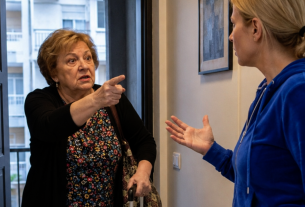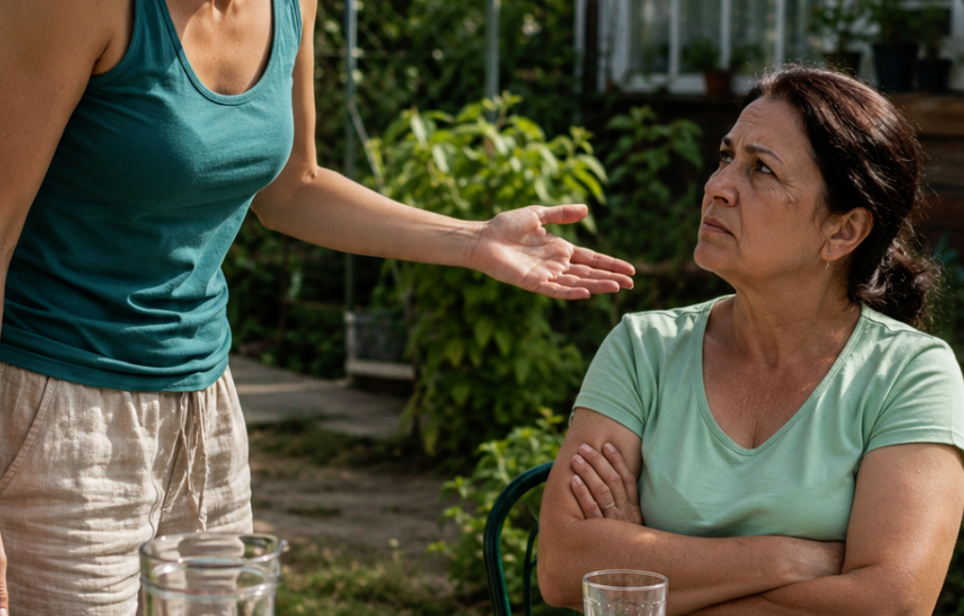
“Olya, I threw out those boxes with the papers. At least the veranda is tidy now,” her sister-in-law said casually, setting a bowl of shashlik on the table.
At first, Olga did not even understand what she had said. She slowly put her mug down on the table and looked toward the empty corner by the old cupboard. That very morning, boxes had been standing there — boxes filled with her grandmother’s photographs, letters, and notebooks.
“Where did you throw them out?” she asked quietly.
“Into the trash bin outside the gate. What was the point of keeping all that junk?”
Irina said it so lightly, as if she were talking about empty bags or a broken stool. Someone at the table laughed at a joke, forks clinked, children ran past the window with shrieks. But Olga stood in the middle of the veranda and heard only the dull pounding of her own heart. Something heavy and cold slowly began to grow in her chest, something that did not yet have a name.
The village house had come to her from her grandmother three years earlier. Back then, all her relatives had said the same thing: sell it.
“Olya, just look at this wreck,” Sergey grimaced as he walked around the crooked veranda. “The roof leaks, the stove doesn’t work. We’ll take the money and replace the car.”
But Olga suddenly dug in her heels. She did not even understand why. She would simply step over the threshold, see her grandmother’s apron hanging on a nail, the cup with the gold rim — and her throat would begin to sting.
“I’m not selling it, Seryozha. I spent every summer here as a child.”
She took on the house herself. She painted the walls light blue, searched online for how to restore an old stove, sorted through cupboards, washed every shelf. Along the paths, she planted phloxes and marigolds — just as it had been when her grandmother was alive. Their neighbor, Aunt Valya, would shake her head.
“Well done, girl. Others would have given up.”
Olga especially treasured what she had found in the attic and in the old cupboard: bundles of letters tied with string, photo albums, notebooks with her grandmother’s recipes — the ones where “a pinch of salt” was written in violet ink. She would sit for hours on the floor, sorting through the pictures and writing dates on them in pencil.
Sergey watched all this with a condescending smile.
“So, diving into the museum of the last century again?” he would laugh. “Olya, do you ever even reread those little papers? Why keep them?”
“It’s memory, Seryozha.”
“Memory is in your head, not in dusty boxes.”
Gradually, the house stopped being Olga’s quiet refuge and became Sergey’s place to relax. He began bringing friends, colleagues, relatives — shashlik, music, beer. Olga endured it. And his sister, Irina, acted more like the mistress of the house than Olga herself.
“Why do you tremble over all this old stuff?” she would snort, passing by the attic stairs. “You need to live, not sit in the past.”
Olga kept silent. For her husband’s sake.
Every visit from the relatives left the same thing behind: a mountain of dishes in the sink, cigarette butts in the flower beds, trampled paths, the smell of charcoal and someone else’s perfume soaked into the curtains. Olga would spend the next day washing, fixing, tying up crushed flowers, and convincing herself that these were small things.
“Seryozha, maybe next time you could at least warn me?” she asked once.
“Oh, come on. You’re not at work. What, you’re not happy to see family?”
It was not that she was unhappy to see them. She was simply tired.
That Saturday, everything happened again. Sergey drove up to the gate with a full car: Irina and her husband, two nephews, and another couple Olga had seen only once before in her life.
“Surprise!” her husband shouted, unloading bags of meat. “Olya, put the kettle on. We’re hungry.”
She smiled as best she could and went to chop vegetables. The men lit the grill, the children immediately rushed into the garden, someone turned on a speaker. Irina walked through the house with the step of an owner and looked into the veranda.
“My God, it’s like an old woman’s storage room in here,” came her voice. “Olya, when was the last time you even cleaned this place up?”
“Ira, please don’t touch anything,” Olga called from the kitchen. “I’ll do it myself later.”
“I’m just moving things so people can walk through!”
There came the sounds of things being moved, rustling, rearranged. Olga wanted to go and check, but at that moment the kettle boiled, her nephew came running in with a scraped knee, and her husband needed matches. Everything spun out of control.
By evening, everyone finally sat down at the long table on the veranda. Candles, salads, the smell of meat, noisy toasts. Olga poured compote and, for the first time all day, exhaled. She raised her eyes — and her gaze fell on the corner beside the old cupboard.
The empty corner.
Something inside her snapped, and a slow, unpleasant cold spread through her. She had not yet understood, but she already knew.
That was when Irina set down the bowl of shashlik.
“Where did you throw them out?” Olga repeated, louder now.
“Into the trash bin outside the gate, I told you. You should be thanking me. I spent half the day cleaning up there.”
Olga did not answer. She pushed her chair back so sharply that it struck the wall and quickly stepped down from the veranda into the yard. Behind her, someone laughed, someone asked, “What happened?” — but she no longer heard them.
By the container outside the gate stood her boxes. Open, crooked, soaked through after the afternoon rain. The cardboard came apart under her fingers. Photographs lay right in the mud — someone had apparently kicked the box, and the pictures had scattered like a fan. The letters had stuck together into a dense gray lump. The recipe notebooks lay in a puddle, their pages soaked with water and grease from someone’s discarded leftovers.
Olga crouched down. With trembling hands, she picked up a photograph of her grandfather in military uniform — the corner was torn off, his face covered in streaks. She tried to separate a bundle of letters, but the paper tore under her fingers.
A minute later, she heard footsteps behind her. Irina came up from behind.
“My God, what’s wrong with you? As if you found treasure. They’re just old papers, Olya. Who needs them?”
Olga did not turn around. Her lips were trembling.
Sergey came over. He stood there, looking down from above, then sighed — heavily, wearily, like an adult dealing with a capricious child.
“Olya, enough. Ira only wanted to help. They got thrown out, so they got thrown out. You can’t cling to the past like that. You’re a living person.”
She slowly raised her head. She looked at her husband — at the familiar face, at that irritated, slightly guilty expression — and suddenly saw him as if for the first time. From the outside. A stranger.
And she understood very calmly, almost casually: beside her was a person who would never understand why this mattered.
Never.
Silently, without hurrying, Olga gathered from the ground everything that could still be picked up. She stacked the photographs face up, so as not to wipe away what was left of the images. She took the letters one by one, like wounded birds. Sergey stood beside her, shifting from foot to foot, until he finally could not stand it anymore.
“Olya, come back to the table. You’ll sort it out later.”
She did not answer. She picked up the boxes and carried them back into the house. She placed them in that same corner by the cupboard, wiped her hands on a towel, and went out into the yard.
At the table, people were already laughing again. Someone raised a shot glass, Irina helped herself to salad, children shrieked by the swings. As if nothing had happened.
Olga stopped by the table and calmly looked around at all of them.
“I want all of you to leave now.”
The table fell silent. Irina was the first to scoff.
“Seriously? You’re kicking guests out over a box of trash?”
“Ira, you’re not exactly right either,” her husband muttered.
Olga did not shout or justify herself. She simply repeated, quietly and very evenly:
“People who consider someone else’s memory trash will no longer appear in this house. Gather your things.”
It became so quiet that the crackling coals in the grill could be heard. Sergey opened his mouth, looked at his wife — and understood that arguing was useless. Silently, he went to get the car keys.
They drove home in silence. Only when they reached their building did Sergey finally lose patience.
“Do you understand what you did? In front of my sister, in front of people. Over what, Olya? Some papers.”
“Not over papers.”
“Then over what?”
She did not answer. Not because she did not know — because explaining was already pointless.
Over the next few weeks, he sulked, then tried to make peace, then started all over again. When he learned about Olga’s decision, he made one more attempt to reconcile.
“Fine, do you want me to talk to Ira? Let her apologize. But why divorce? Break up a family over old photographs?”
“Seryozha,” she said, very tiredly. “In three years, you never once asked who was in those photographs. Not once.”
“So what? Is that a reason?”
“That is the answer.”
Suddenly, she saw everything at once: how for years he had smirked at her interests, how he had rolled his eyes when she talked about her grandmother, how he had called her repairs in the village “a whim,” and the flowers along the paths “fussing around.” How he had brought people into her house without asking. How he had never once stood on her side.
They divorced four months later. Calmly, almost businesslike, they divided the apartment and the car. Sergey did not even remember the village house — he had no use for it.
After the papers were signed, standing in the hallway, he shrugged.
“I still don’t understand, Olya. Over some boxes. It’s stupid.”
She only smiled — for the first time in a long while, without bitterness. He truly could not understand. And that no longer hurt her.
In autumn, she came back to the village house — alone. The veranda smelled of Antonovka apples from the crate by the door and fresh paint: she had finished painting the window frames in the summer.
Olga laid out the rescued photographs on the wide windowsill — dried and carefully smoothed between sheets of blotting paper. The one of her grandfather in military uniform had been almost restored; only the corner was missing. She placed the letters between the pages of old books, letting them lie there and straighten out. She copied the surviving recipes from her grandmother into a new thick notebook, trying to preserve even the “pinch of salt” in her grandmother’s handwriting — drawing it beside the words as best she could.
Part of the memory was gone forever. She understood that, and she no longer cried about it.
Aunt Valya, the neighbor, came in and set a jar of honey on the table.
“Alone now, Olyush?”
“Alone, Aunt Valya. And it’s all right.”
“It’s quiet here now.”
“Quiet,” Olga agreed.
And in that quiet, for the first time in many years, she suddenly felt it: the house had finally become hers.
Completely.
Down to the very last nail.