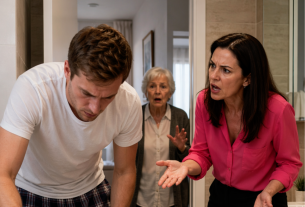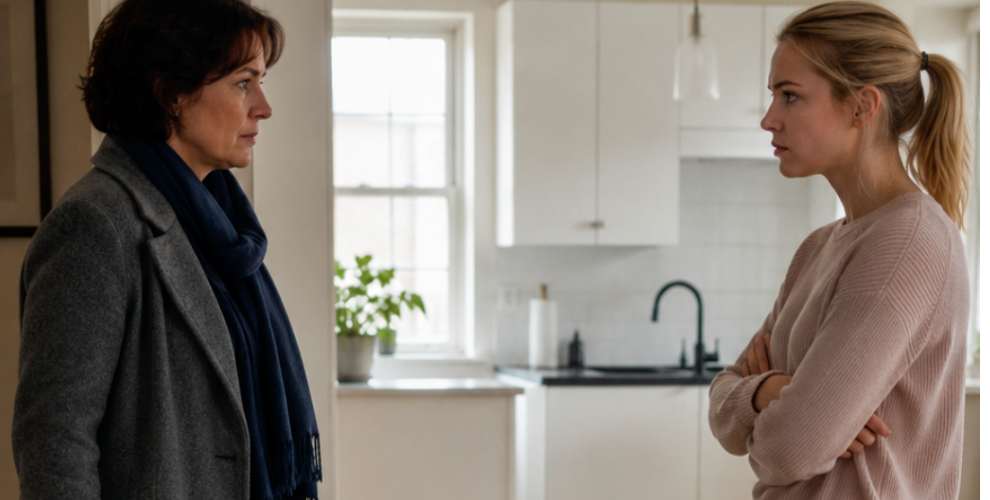
Galina Petrovna stood on the doorstep with two suitcases and a banana box. She was sure her son would take her in. She did not know the apartment was registered in her daughter-in-law’s name.
The doorbell rang at half past eight in the morning, when Rita had not even managed to finish her coffee. The mug stood on the windowsill, and steam rose from it in a thin thread toward the glass.
She was not expecting anyone. It was Tuesday, an ordinary morning, with wet April weather outside. Artyom had left for work at seven, and their daughter had been at kindergarten since eight.
Rita opened the door and saw her mother-in-law.
Galina Petrovna stood on the landing with two suitcases. One was large and brown, with a broken wheel. The other was smaller, the kind people take as carry-on luggage. Beside her, leaning against the wall, stood a banana box, wrapped crosswise with tape.
“Rita dear, take me in.”
She said it as if she had called in advance. As if they had arranged it. As if all of this were normal.
“Hello, Galina Petrovna. Does Artyom know?”
“Artyom knows. I called him yesterday.”
Rita stepped aside. She let her mother-in-law into the hallway and helped drag in one suitcase. Galina Petrovna carried the box herself, pressing it to her stomach with both hands as if it contained something fragile.
The entryway suddenly felt cramped. The smell of someone else’s perfume, sweetish, with a hint of lily of the valley, mixed with the smell of coffee from the kitchen. Rita stood in her socks on the cold floor and tried to understand what was happening.
“I brought borscht. In a jar. Put it in the fridge, or it’ll go sour.”
Galina Petrovna was already unbuttoning her coat. It was beige, with large buttons, probably bought fifteen years ago. Under it she wore a knitted cardigan the color of baked milk and a knee-length skirt.
“Galina Petrovna, how long are you staying?”
“For good.”
The word fell to the floor like a set of keys. Loudly and finally.
Rita called Artyom from the bathroom. She closed the door, turned on the water, and dialed his number.
“Did you know?”
“Know what exactly?”
“That your mother came. With suitcases. For good.”
He fell silent. She could hear the noise of the office on the other end: someone laughing, a printer running, a distant voice.
“She called yesterday. Said she’d had a fight with Aunt Valya. I thought she was just coming to talk.”
“Artyom. She has a banana box. There are dishes in it. I heard plates clinking.”
Another pause. Rita pressed the phone to her ear and looked at her reflection in the mirror above the sink. Dark circles under her eyes, her hair tied up carelessly, a crease across the bridge of her nose that appeared only when she was angry. Or afraid.
“I’ll talk to her this evening.”
“By evening she’ll already have her things laid out in the wardrobe. Artyom, we have a two-room apartment. One room is ours, the other is Polina’s.”
“Mom can’t live on the street.”
“And I can’t live with your mother.”
He sighed. Long, through his nose, the way he always did when he did not want to argue but had no intention of agreeing either.
“Rit, let’s not do this now. I have a meeting in five minutes.”
“Then when? After she rearranges the furniture?”
He hung up. Not rudely. Just quietly, as if he had pressed the button by accident.
Rita turned off the water. She stood there for another minute, watching the drops slowly slide down the tile. Then she went out.
Galina Petrovna was already sitting in the kitchen. Rita’s mug with unfinished coffee stood in front of her.
“It’s gone completely cold. I’ll make you fresh coffee.”
Without waiting for an answer, she stood up and reached for the cabinet above the stove. She opened it confidently, as if she had lived here for years.
The story with Aunt Valya was murky. Rita knew it in fragments, from phone conversations Artyom had had in front of her, but in a lowered voice.
Galina Petrovna had been living with her sister for the last four years, after selling her one-room apartment in Ryazan. She had sold it for one million eight hundred thousand, which was decent for prices back then. The money had gone somewhere. For treatment, she said. For dental work, for medical examinations. Artyom once let slip that his mother had given part of the money to some acquaintance “for a business.” Rita did not ask further. She understood that there was no point asking, because the money was already gone.
Aunt Valya lived in Podolsk, just outside Moscow, in a three-room apartment with her husband and adult son. Galina Petrovna occupied a small room, a former storage room that fit only a bed and a nightstand. For four years, she paid her way with groceries: she cooked, cleaned, and watched her grandnephew in the evenings.
Then something snapped. Rita did not know what. Maybe Aunt Valya got tired. Maybe her husband said, “Enough.” Maybe Galina Petrovna crossed some invisible line. A line that cannot be crossed in someone else’s home, but one you only notice when it is already too late.
The fact was simple: her mother-in-law was standing in their hallway, and she had nowhere to go.
They picked Polina up from kindergarten at four. Rita came home with her, holding her daughter’s hand, and from the doorway she heard the sound of a vacuum cleaner.
Galina Petrovna was vacuuming the child’s room.
Polina’s room. Pink curtains, a rug with unicorns, a shelf of books, a little bed against the wall. Her mother-in-law moved the vacuum methodically: corners, the middle, under the table, and did not immediately notice that they had come in.
“Oh, Polina! Grandma has arrived!”
Polina hid behind Rita’s leg. She had seen her grandmother three times in her life: at her parents’ wedding, which she did not remember; at New Year’s two years ago; and last summer, when they had stopped by Podolsk for an hour and a half. To a four-year-old girl, Galina Petrovna was almost a stranger.
“She’s shy, Galina Petrovna. She needs time.”
“It’s all right, she’ll get used to me. I tidied up a little in here. There was so much dust.”
Rita looked around the room. The toys stood neatly, not the way Polina had left them. The books had been rearranged by size. The blanket on the bed lay differently, tucked in at the corners.
Something tightened in Rita’s throat. She swallowed and said nothing.
“Come on, sweetheart, let’s go eat some porridge,” she said, bending down to Polina.
They went to the kitchen. On the table was already a plate of pancakes that Rita had not made.
Artyom came home at eight. He took off his shoes in the hallway, saw the suitcases, and Rita noticed how his shoulders rose slightly. For one second. Then they dropped again.
“Hi, Mom.”
“Artyom darling. Tired? I made cabbage soup.”
He looked at Rita. She was standing by the doorframe, leaning back against it, holding a towel that she kept automatically folding in half, unfolding, and folding again.
“Are we going to talk?” she asked quietly.
“Let me eat first.”
He went into the kitchen. Sat at the table. Galina Petrovna placed a bowl in front of him, and steam from the cabbage soup rose toward the lamp. An ordinary scene. A mother feeding her son. If Rita had been watching from the outside, she would not have noticed anything strange.
But she was not on the outside.
“Is it tasty?” her mother-in-law asked.
“Mm-hmm.”
“There are cutlets too. And compote.”
Rita put the kettle on. She opened the cabinet to get a mug and discovered that the mugs had been rearranged. Hers, the blue one with a crack on the handle, was no longer on the first shelf but on the second. On the first shelf stood Artyom’s mugs, the ones his colleagues had given him. And one more, unfamiliar. White, with red poppies.
Galina Petrovna had brought her own mug.
Rita closed the cabinet. Carefully, so she would not slam it.
The conversation happened in the bedroom, behind a closed door, after Polina had fallen asleep and Galina Petrovna had lain down on a folding cot in the child’s room.
She had brought the folding cot with her. The banana box had not contained plates. It contained the folding cot, bed linen, three towels, and a pillow in a pillowcase embroidered with daisies.
“She prepared for this,” Rita said. “Artyom, she didn’t come for a couple of days. She moved her life here.”
He was sitting on the edge of the bed, already in his house pants, without a T-shirt. He was turning his phone over in his hands. Rita saw the muscles in his jaw move and knew he was clenching his teeth.
“What do you suggest?”
“Rent her a room.”
“With what money?”
“With the money we’re saving.”
“For Polina’s school.”
“What else are we supposed to do?”
“I don’t know.”
Silence. Something creaked behind the wall, either the folding cot or the floorboard. Rita imagined her mother-in-law lying in the dark in Polina’s room, among unicorns and pink curtains, listening to them through the wall.
“Artyom. This is my apartment.”
She said it and immediately regretted it. Not because it was untrue. Because sometimes the truth sounds like a blow.
He raised his eyes.
“What?”
“The apartment is registered in my name. My parents helped with the down payment, and we pay the mortgage together, but I’m the one on the contract. You know that.”
“And what are you trying to say?”
“I’m trying to say that I make the decision.”
He stood up. Walked from the bed to the window and back. Three steps there, three steps back. The room was small.
“Rit, this is my mother.”
“I know.”
“She has nowhere to go.”
“I know.”
“She’s not to blame.”
“For what exactly?”
He stopped. Looked at her for a long time, as if he were seeing her for the first time.
“Do you want to throw her out?”
“I want us to find a solution. Together. Not have her arrive and confront me with a fact.”
He sat down again. Rubbed his face with his palms from bottom to top, and his voice came out muffled through his fingers.
“Give me a week. I’ll talk to her and look for options.”
“A week.”
“A week.”
Rita lay down. Turned toward the wall. The blanket smelled of their laundry detergent, familiar, orange-scented. But the apartment already smelled different. The lily-of-the-valley perfume had seeped everywhere, like water into cracks.
A week passed. Nothing changed.
Galina Petrovna made breakfasts. She wiped dust from shelves Rita had wiped the day before. She rearranged things: glasses by size, plates in stacks, spices in alphabetical order. Every morning Rita found some small change in the kitchen. One day the sponge was no longer by the sink but in a special soap dish that her mother-in-law had found somewhere. Another day the bags of grain were tied with rubber bands. Then a magnet appeared on the fridge that said, “Happiness lives here.”
Rita kept silent. Artyom kept silent. Polina got used to her.
“Grandma, why do you live here?” her daughter asked on the third day.
“Because Grandma has nowhere else to live, sunshine.”
Rita heard it from the hallway. She froze with her jacket in her hands. She wanted to go in and say something, but she could not find the words. Because it was true.
And the truth does not always help.
On the ninth day, Rita came home from work earlier than usual. She worked as an accountant at a construction company, and her schedule sometimes allowed her to leave at three. That Tuesday, she finished her report sooner and decided to pick Polina up herself, without her mother-in-law.
But Polina was not at kindergarten.
“Her grandmother picked her up,” the teacher said. “Half an hour ago.”
Rita called her mother-in-law. The ringing went on for a long time.
“Hello?”
“Galina Petrovna, did you pick up Polina?”
“Yes, we’re taking a walk. In the park nearby. I bought her ice cream.”
“You didn’t warn me.”
“Why should I? I’m her grandmother.”
Rita stood at the kindergarten gate, and the cold April wind blew into her face, smelling of wet earth. Her fingers, gripping the phone, turned white.
“Galina Petrovna. Polina is picked up from kindergarten by me or Artyom. We left your passport there for emergencies. That doesn’t mean you can pick her up whenever you want.”
“Rita dear, why are you acting like a stranger? I’m her grandmother. I have the right.”
Rita closed her eyes. Counted to five.
“Bring her home. Please.”
She hung up and stood by the gate for another minute. Her legs did not want to move. Not from tiredness. From something else, something sitting inside her and growing every day.
That evening, Rita took a folder out of the desk drawer. A blue one with a snap button. Inside were the documents: the purchase agreement, the ownership certificate, the mortgage contract. Everything was in her name.
She placed the folder on the kitchen table. She did not open it. She simply placed it there.
Artyom came home at nine. He saw the folder and sat across from her.
“What is this?”
“The apartment documents.”
“Why?”
“Because nine days have passed. You promised a week.”
He reached for the folder, but Rita placed her hand on it.
“I’m not threatening you. I want you to see it. This is my home. Mine, yours, and Polina’s. I pay for it every month. I chose these walls, this neighborhood, this view from the window. And I did not sign up for someone in my home to rearrange my things, pick up my child without asking, and put magnets on my refrigerator.”
“Magnets, seriously?”
“It’s not about the magnets. It’s about the fact that no one asked me. Neither she nor you.”
Artyom leaned back in his chair. The kitchen ceiling was low, the lamp cast yellowish light, and the shadows under his eyes seemed deeper.
“I called Aunt Valya.”
“And?”
“She said Mom left on her own. They didn’t throw her out. She had a fight with Uncle Sasha over the television. Over the remote, to be exact.”
“Over the remote?”
“Mom wanted to watch her series. Uncle Sasha switched it to football. She said that in someone else’s house, they wouldn’t even let her watch TV. She packed her things and left.”
Rita removed her hand from the folder. Rubbed her temples.
“So they didn’t kick her out.”
“No.”
“So she can go back.”
“Theoretically. But she doesn’t want to. She says she has humiliated herself enough.”
Silence. Somewhere beyond the wall, Galina Petrovna was watching television in the child’s room. Rita could hear the muffled voices of some talk show.
“Artyom. We need a decision. A real one.”
The decision did not come right away. It ripened like an abscess, painfully and inevitably.
The next morning, Rita woke up at six. Her mother-in-law was already awake. The kitchen light was on, and it smelled of pancakes. A neat stack stood on a plate, covered with honey.
“Good morning, Rita dear. Sit down while they’re hot.”
Rita sat down. Took a pancake and bit into it. The honey was linden honey, thick, with a slight bitterness. It was delicious. Truly delicious, in a way Rita herself never managed to make.
And that made everything even worse.
Because Galina Petrovna was not a bad person. She was not the evil mother-in-law from jokes. She knew how to cook, loved her granddaughter, kept the home clean. She simply did not understand boundaries. Or she understood them, but believed mothers should not have boundaries.
“Galina Petrovna, may I ask you something?”
“Of course.”
“Have you ever lived alone?”
Her mother-in-law stopped chewing. Put down her fork.
“Alone?”
“By yourself. In your own apartment. Without anyone else.”
“No. From my parents’ house, I went straight into marriage. Then I lived with Artyom’s father. Then he left, but Artyom was little, so what kind of alone was that? And then I moved in with Valya.”
She said it calmly, without self-pity. Stated it as a fact. Like the weather outside.
“And would you like to?”
Galina Petrovna looked at her for a long time. Her eyes were gray, like Artyom’s, but smaller, and the wrinkles around them formed little rays when she squinted.
“I don’t know, Rita dear. I’ve never tried.”
Rita finished her tea. Stood up. Cleared her cup and plate, washed them, and placed them on the drying rack.
“Thank you for the pancakes.”
Her mother-in-law nodded. But something in her gaze had changed. Rita could not explain what. Maybe a shadow. Maybe a question her mother-in-law had asked herself for the first time.
That evening, Rita opened her laptop and started searching. Rooms for rent in their neighborhood. Not the cheapest, not the most expensive. With a landlady or without. Furnished.
There were not many options, but there were some. One room was ten minutes away on foot, in the apartment of an elderly woman who was renting out the second bedroom after her husband’s death. Ten thousand a month, plus utilities.
Rita wrote down the number. She did not call. For now, she simply wrote it down.
Artyom came up behind her and saw the screen.
“What are you looking for?”
“Options.”
“For whom?”
“For your mother.”
He did not answer. He stood behind her for a moment, then went to the bathroom. Rita heard him turn on the water and splash around for a long time. That was his version of escape: when you do not know what to say, you go wash your hands.
But when he came out, he sat beside her.
“Show me.”
She showed him. He looked silently, scrolling through the listings. Once he snorted. Once he shook his head.
“This one, at Klavdia Ivanovna’s. It’s close to us.”
“I noticed that one too.”
“Ten thousand. Can we handle it?”
“If we don’t save for school for a couple of months. Then we’ll review things.”
“Mom won’t agree.”
“Artyom. Mom doesn’t get to decide.”
He rubbed his face again. A habit that had already left red marks on his forehead.
“I’ll tell her myself.”
“Good.”
“But you’ll be there.”
“I will.”
The conversation with Galina Petrovna took place on Saturday. Polina was taken to the playground by a neighbor, and the apartment became unusually quiet. Only the refrigerator hummed, and a crow cawed outside the window.
Her mother-in-law sat at the kitchen table in her baked-milk-colored cardigan. In front of her stood tea in the mug with poppies. Artyom sat across from her. Rita stood by the wall, leaning against the doorframe.
“Mom, we need to talk.”
“Talk.”
“You can’t live here.”
He said it evenly. Without harshness, without apologies. Just a fact. Rita saw his knuckles turn white as he gripped the edge of the table.
Galina Petrovna did not flinch. She did not gasp. She slowly lifted her mug, took a sip, and put it back down.
“Why?”
Artyom looked at Rita. She nodded slightly.
“Because the apartment is small. Because Polina needs her own room. And because Rita and I were not ready for you to come live here. You didn’t ask.”
“I called you.”
“You said you’d had a fight with Valya. You didn’t say you were packing your things.”
Galina Petrovna shifted her gaze to Rita.
“Did she put you up to this?”
“Mom.”
“No, I’m asking. Was this Rita’s decision?”
Rita stepped away from the wall. She came to the table and sat on the empty chair.
“Galina Petrovna. The apartment is registered in my name. My parents gave the money for the down payment. Artyom and I pay the mortgage together, but by law and by contract, this is my property. I’m not saying this to hurt you. I’m saying it so you understand: this is not a whim or a fancy. This is my home.”
Her mother-in-law blinked. Twice, quickly, as if from bright light.
“You have no heart.”
“I have boundaries.”
Galina Petrovna stood up. The chair slid back with a squeak across the linoleum.
“I gave birth to your husband and raised him. I did not sleep at night when he was sick. I raised him alone after his father left. And you’re talking to me about a contract?”
“Mom, sit down.”
“I will not sit down. You’re throwing me out. Just say it.”
“We’re not throwing you out,” Artyom said, lifting his hands, palms up, a gesture of peace, a gesture of surrender. “We found a room. Nearby, ten minutes on foot. You can come over every day if you want. But you need to live separately.”
“With what money?”
“We’ll pay.”
“I’m supposed to live with some strange old woman in someone else’s home?”
“With Klavdia Ivanovna. She’s alone, she’s sixty-eight. She needs company herself.”
Galina Petrovna stood by the table and looked at both of them. Her lips were pressed together, and Rita saw her chin trembling slightly. Not from the cold.
“I thought at least my son would not betray me.”
She turned and left the kitchen. A second later, the child’s room door slammed.
Artyom dropped his head onto the table. His forehead hit the tabletop, and he stayed like that, face down.
Rita placed her hand on the back of his head. His hair was warm, slightly damp. He did not move.
“You did the right thing.”
“It doesn’t feel like it.”
“I know.”
She removed her hand. Stood up. Poured him water and placed the glass beside him.
For two days, Galina Petrovna did not leave the child’s room. Polina slept with her parents. Her mother-in-law did not eat cabbage soup and did not make pancakes. From behind the door came only the sound of the television and sometimes a quiet cough.
On the third day, Rita knocked.
“Galina Petrovna. I brought tea.”
“I don’t need it.”
“It’s with honey. The linden kind you brought.”
A pause. Then the click of the lock.
The door opened. Her mother-in-law stood there in a robe, with swollen eyes. Polina’s bed was neatly made, and the unicorns on the rug stared at the ceiling.
“Thank you.”
Rita held out the mug. The very one with the poppies. Her mother-in-law took it with both hands.
“I called Klavdia Ivanovna yesterday,” Rita said. “She’s pleasant. She loves flowers. She has geraniums on her balcony. She sent me photos.”
“Geraniums.”
“And she has a cat. A red one, fat. I think his name is Kuzma.”
Nothing changed on Galina Petrovna’s face, but her fingers around the mug relaxed slightly.
“Valya had a cat too. Only gray.”
“Do you like cats?”
“I don’t know. I got used to Valya’s.”
Rita was silent for a moment. Then she said:
“We can go look at the room. Tomorrow, if you want.”
Her mother-in-law finished her tea. Put the mug on Polina’s little table, beside a box of pencils.
“Tomorrow.”
It was not agreement. And it was not refusal. It was something in between, something that contained exhaustion from her own stubbornness.
They went to Klavdia Ivanovna’s place as a group of three: Rita, Artyom, and Galina Petrovna. They left Polina with Rita’s mother.
Klavdia Ivanovna turned out to be short and thin, with a cropped haircut and glasses on a chain. She wore a checked apron. The apartment smelled of pies and soil, from those very balcony flowers.
The room was small but bright. A south-facing window, a radiator under the windowsill, wood-patterned linoleum on the floor. A bed, a wardrobe, a chair, a nightstand. Nothing else.
“I lived here with Grigory,” Klavdia Ivanovna said. “For forty years. Then alone. It’s quiet, you know. Too quiet.”
Galina Petrovna stood in the doorway and looked at the window. The light fell on her face, and her wrinkles seemed softer.
“Can I have a television?”
“Yes. I have one too. In the evenings, we can watch together if you want. Or each in her own room. Whatever is more convenient.”
Red-haired Kuzma came out of the hallway, rubbed against Galina Petrovna’s leg, and walked away.
“Cheeky thing,” her mother-in-law said.
“Like all men,” Klavdia Ivanovna replied.
And both of them smirked at the same time. In the same way, with one corner of the mouth, as if they knew the same joke.
Rita stood in the hallway and listened. Artyom was beside her, his back against the wall. He found her hand and squeezed it. Briefly, without words.
The move took two hours. The suitcase with the broken wheel, the smaller suitcase, the box with the folding cot, which was not needed: Klavdia Ivanovna’s room had a proper bed with an orthopedic mattress.
Galina Petrovna unpacked silently. Artyom carried bags. Rita stood by the door and thought that she did not feel relief. Or maybe she did, but it was mixed with something else. Guilt, perhaps. Or the understanding that victories are never clean.
“Bring Polina on weekends,” her mother-in-law said without turning around. She was laying towels in the wardrobe.
“Of course.”
“And I’ll make borscht. I’ll bring it in a jar, like before.”
“All right.”
Galina Petrovna turned around.
“Rita dear.”
“Yes?”
“You’re tough.”
Rita did not answer. She waited.
“But you’re right. Probably.”
Her mother-in-law turned back to the wardrobe. Rita went out into the hallway, where Artyom was smoking out the open window. The smoke drifted outside into the April air, which smelled of poplar buds.
“She said ‘probably.’”
“I heard.”
“That’s more than I expected.”
He put out the cigarette on the windowsill and tossed the butt into a bag he held in his other hand.
“Rit.”
“What?”
“Thank you.”
“For what?”
“For not letting me stay silent.”
She leaned against his shoulder. For one second. Then she straightened and went downstairs to the car.
That night, Rita went into Polina’s room. Her daughter was already asleep in her little bed, under the unicorn blanket that her mother-in-law had neatly tucked in for two weeks.
On the nightstand stood a glass of water, and there was a book lying open to the page where the princess runs away from the castle. Rita adjusted the blanket, put the book away, and turned off the night-light.
The room smelled of children’s shampoo and faintly of lily of the valley. The perfume would fade in a couple of days. Or in a week. Rita was in no hurry.
On the shelf, among Polina’s books, stood a small matryoshka doll. Galina Petrovna had left it behind. Perhaps she had forgotten it. Or perhaps she had not.
Rita did not move it.
She left the room, quietly closed the door, and went to the kitchen. She opened the cabinet. The mugs were back the way they used to be: her blue one with the cracked handle on the first shelf, Artyom’s on the second.
The place where the mug with poppies had stood was empty.
Rita closed the cabinet. She poured water into a glass, took a sip, and placed it on the windowsill, beside the spot where her morning coffee had stood two weeks earlier.
Outside, April was ending. The trees in the yard had already put out their first leaves, sticky and shiny. The streetlamp swayed in the wind, and its shadow moved across the kitchen ceiling like a pendulum.
Rita stood by the window and thought about nothing. For the first time in two weeks.
And on the refrigerator, the magnet was still hanging.
“Happiness lives here.”
Rita looked at it, reached out her hand, but stopped.
Let it stay.