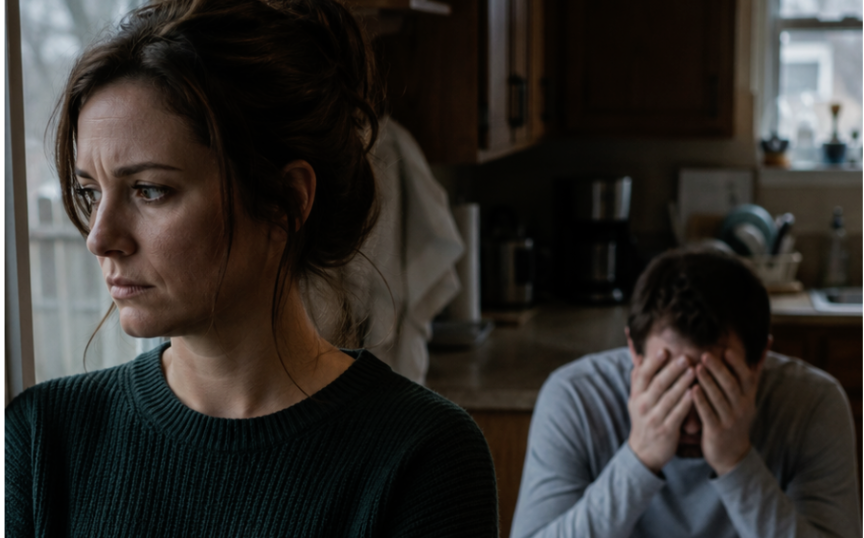
Olga did not immediately understand why her husband had started coming home from work in silence. Then she saw his correspondence with his sister. Seven days later, Viktor went to the bank, and everything fell into place.
Olga noticed it because of the spoon. Viktor had always stirred his tea counterclockwise, slowly, thoughtfully, looking out the window. But now he had begun dropping the spoon onto the saucer without finishing his tea. He would get up. Leave the room.
She did not ask. Not on the first day, not on the second. On the third evening, he came home later than usual, hung his jacket beside the hook instead of on it, and said:
“I need to think.”
“About what?”
“About everything.”
The jacket slid to the floor. Olga picked it up and hung it properly. Her fingers smelled of his cologne, the same one she had given him for his thirty-seventh birthday.
They were both thirty-eight. Twelve years together, nine of them married. Their daughter Polina was six. She attended a preschool preparation group and every evening drew the same picture: a house with a red roof, three little people, and a dog. They did not have a dog. Polina was drawing a dream.
Olga worked as an accountant at a construction company. Viktor, an engineer at a factory, had been staying late for the past six months. She was not jealous. There was no one to be jealous of. Viktor did not know how to lie: his ears turned red. His ears were their normal color. He was simply silent.
There are different kinds of silence. There is tired silence, when a person is worn out and has nothing left to give. There is offended silence, when words sit in the throat like a cork, letting neither air nor sound through. And then there is calculating silence. When a person is deciding something, and you are not included in that decision.
Olga felt the third kind.
Her sister-in-law’s name was Galina. She was forty-two, lived alone in a two-room apartment on Leningradsky Prospekt, worked as a realtor, and believed she understood people. Especially other people’s wives.
She and Olga had never quarreled. Galina smiled evenly, said the right words, brought cake to birthdays. But there was something in her gaze when she looked at her brother. Something possessive. As though Viktor belonged to her by right of seniority, while Olga merely had temporary use of him.
Olga had noticed it long ago. Even at the wedding, when Galina had made a toast: “To my brother, who has always known what he wants. I hope he knows now too.” The guests had laughed. Olga had not.
But she kept silent. Just as she kept silent later, when Galina called Viktor every Sunday and spoke with him for forty minutes. When she gave advice about repairs, though no one had asked her. When, on New Year’s Eve, she sat down beside her brother and nodded Olga toward the chair opposite them.
“You’re exaggerating,” Viktor would say. “That’s just how she is.”
“What kind of way?”
“Caring.”
Olga did not argue. She wiped the table after dinner and thought: caring. Fine. Let her be caring.
She saw the correspondence by accident. Polina was playing with her father’s phone, drawing her finger across the screen, and the messenger opened on its own. Olga wanted to take the phone away, but her eye caught on one line.
“Vitya, you have to make up your mind. She is dragging you down.”
Olga sat down on the edge of the sofa. Polina, beside her, kept moving her finger across the screen, absorbed in some game she had accidentally opened over the chat. Olga carefully took the phone and returned to the messages.
Galina wrote a lot. Long messages. With links to articles about “toxic relationships” and “financial independence after divorce.” Viktor replied briefly: “Mm-hmm,” “I’ll think about it,” “I don’t know, Galya.”
But there was one message that made Olga’s fingers turn icy.
“I found out about the separate account. If you transfer part of the money to yourself now, then after the divorce it will be only yours. I can help with the paperwork. I know people at the bank.”
Viktor replied four hours later. With one word: “Okay.”
Olga placed the phone on the sofa, screen down. Polina lifted her head.
“Mom, what’s wrong?”
“Nothing, sweetheart. Let’s go wash our hands before dinner.”
In the bathroom, she turned on the water and held her hands under the tap until her fingers reddened. The mirror fogged up. She ran her palm over the glass and saw her face: pale, with dark circles under her eyes, with a little wrinkle between her brows that had not been there a year ago.
That night she did not sleep. Viktor lay beside her, turned away, breathing evenly. Maybe he was asleep. Maybe he was not.
Olga went over their twelve years in her head. How they had met at a mutual acquaintance’s birthday party: she had spilled wine on his shirt, and he had laughed and said, “Now you owe me a wash.” How he had proposed in the park, going down on one knee right in a puddle because it had just rained and there was no dry spot left. How they had painted the walls of their new apartment together, and Olga had dropped the roller on his head, leaving him with a white stripe in his hair until evening.
And then Galina appeared. No, she had always been there. But before, she had kept her distance. After Polina’s birth, something changed. Galina started calling more often. Coming over without warning. Bringing things for the child that no one had asked for: expensive snowsuits, toys that took up half the room.
“I’m her aunt,” she would say when Olga tried to politely refuse. “I have the right to spoil her.”
And she looked at Olga as though Olga were the one who did not belong there.
In the morning, Olga took Polina to kindergarten and returned home. Viktor had already left for work. His mug stood on the kitchen table, empty, with a brown ring at the bottom. Beside it lay the notebook where he usually wrote his to-do lists.
She did not look inside. She washed the mug and put it in the drying rack. Wiped the table. Then she sat down and dialed her friend’s number.
“Lena, can you talk?”
“I can. What happened?”
“Do you remember telling me about the lawyer who helped your sister with the division of property?”
“I remember. Why do you need him?”
Olga was silent for a moment. Outside the window, a garbage truck drove by, and the glass rattled.
“Just in case.”
Lena dictated the number. Olga wrote it on a napkin, folded it in four, and put it in the pocket of her robe.
That evening, Viktor came home on time. He took off his shoes and placed them neatly. He hung his jacket on the hook. Sat down at the table.
“Borscht?” Olga asked.
“Sure.”
She poured him some. He ate in silence, looking down into his plate. Polina chattered about kindergarten: Arseny had taken her shovel again, and their teacher Nina Petrovna had said there would be drawing tomorrow.
“Dad, will you draw me a dog?”
“What kind of dog?”
“A big one. With spots. I want a dog.”
Viktor looked at his daughter. Something trembled in his face, some shadow, quick as a cloud outside the window.
“I’ll draw one,” he said quietly.
Olga collected the plates. She washed them with her back to him and heard him take out his phone. Heard him type a message. Heard the phone vibrate softly with a reply.
She did not turn around.
The next day, Olga called the lawyer. His name was Andrey Sergeevich, and his voice was even, businesslike, neither sympathetic nor indifferent.
“Tell me the situation.”
“My husband may be preparing for divorce. His sister is helping him. I saw their correspondence. It mentioned transferring money to a separate account.”
“Do you have joint savings?”
“Yes. In a joint account. We were saving for a bigger apartment. There’s about two million there.”
“Whose name is the account under?”
“His.”
“When was it opened?”
“Four years ago. We both contributed.”
“All right. Listen carefully.”
He explained. Calmly, point by point. That money accumulated during marriage was considered marital property. That transferring it to a personal account would not make it “only his.” That if it went to court, joint contributions could be proven through bank statements. That she needed to make copies of all documents: the marriage certificate, the child’s birth certificate, account statements.
“And most importantly,” he said. “Do not show that you know. Not yet.”
“Why?”
“Because while he has not filed any petition, you have time to prepare. But if he finds out you know, he may speed things up.”
Olga listened and felt something hardening inside her. Not pain. Not anger. Something cold and clear, like a winter morning.
“Thank you,” she said.
“Call if you have any questions.”
She hung up and looked at the clock. A quarter to twelve. In three hours she had to pick up Polina. In five hours Viktor would come home. In a week, if the correspondence was to be believed, he was going to the bank.
A week. Seven days.
Day one. Olga went to the bank herself. She ordered a statement for the joint account for the past four years. The girl at the counter looked at her with professional politeness.
“Printed or by email?”
“Both.”
The statement was eleven pages long. Olga sat in the café across from the bank and turned the pages. Every month, his salary and her salary, in neat lines. Sometimes his bonus. Sometimes her side work, when she did bookkeeping for an acquaintance’s small business. Everything transparent. Everything fifty-fifty.
The current amount was on the last page. Two million one hundred and eighty thousand. Twelve years, if counting from their first date. Nine, if counting from Mendelssohn’s march. Four, if counting from the first deposit.
She photographed every page and sent it to the lawyer.
Day two. Galina called. Not Viktor. Olga.
“Olya, hi. How are you?”
“Fine.”
“I was thinking, maybe I’ll stop by this weekend? I’ll bring Polinka some books. I found an excellent series about animals.”
“Come over.”
Galina’s voice was even, warm. Olga listened and remembered that correspondence. “She is dragging you down.” These were the words of the person now offering to bring books.
“Olya, how are things with you and Vitya?”
“What do you mean?”
“Well, is everything all right? He called me yesterday. He sounded tired.”
“Work.”
“Yes, yes, of course. All right, kisses. I’ll come Saturday.”
Olga hung up. Her hands were not trembling. Surprisingly. She had thought it would be difficult to speak with Galina, knowing what she knew. But her voice held itself steady, straight as a rail.
Day three. Olga took the folder of documents out of the bottom drawer of the wardrobe. Marriage certificate. Polina’s birth certificate. The rental agreement for the apartment they were renting. Documents for the car registered in Viktor’s name. She photographed everything. Sent everything to the lawyer. Put everything back exactly as it had been.
That evening Viktor watched football. Polina sat on his lap eating an apple. He placed the core on the armrest of the chair.
“Vitya, don’t put that on the upholstery,” Olga said.
“Sorry.”
He moved the apple core to the coffee table. Polina leaned against his shoulder and yawned.
“Dad, when will we buy a big apartment?”
“Soon.”
“And a dog?”
“We’ll see.”
Olga stood in the doorway and looked at them. At her daughter, falling asleep on her father’s lap. At her husband, watching the television and not seeing what was happening on the screen.
Day four. The lawyer called back.
“Olga, I looked over the statements. Everything confirms joint contributions. Your position is strong.”
“And what should I do?”
“Wait. If he transfers the money, it will be recorded. We will be able to challenge it in court. But I would recommend trying something else.”
“What?”
“Talk to your husband. Without his sister. Directly.”
Olga was silent. Outside, children were shouting in the courtyard. Someone was calling Petya, but Petya did not answer.
“Do you love your husband?” the lawyer asked. The question was unexpected in a business conversation.
“I don’t know. I knew a week ago.”
“Then talk to him. Divorce isn’t going anywhere. It can wait.”
She did not answer. She simply hung up and sat in the kitchen for a long time, looking at the magnets on the refrigerator. Polina had stuck them on crookedly, all over the place: a kitten, a watermelon, the Eiffel Tower from some set. The watermelon held a shopping list written in Viktor’s handwriting. “Milk. Bread. Butter. Apples for Polinka.”
He had written “Polinka.” Diminutively. Warmly.
Day five. Saturday. Galina arrived.
She came in with a bag of books and a box of pastries. Beige coat, low-heeled shoes, the smell of floral perfume, intrusive and heavy.
“Polinka, look what your aunt brought!”
Polina rushed to the books. Galina sat in the kitchen and accepted the tea Olga set before her.
“Thank you, Olya. You always brew tea so well.”
Olga sat opposite her. Viktor was in the room, doing something on the computer.
“Galya, I wanted to ask you something.”
“Yes?”
“Do you think I’m dragging Viktor down?”
Silence. Galina lifted her cup, brought it to her lips, but did not drink. Steam rose in a thin stream.
“Where did that come from?”
“It doesn’t matter where. What matters is whether it’s true.”
Galina set the cup down. Slowly, carefully, exactly on the saucer.
“Olya, I don’t know what you read or heard, but…”
“I read the correspondence. All of it. About the separate account too.”
Galina leaned back in her chair. Her eyes were gray, like Viktor’s. The same, yet different. There had always been softness in Viktor’s eyes. In Galina’s, calculation.
“You went through his phone?”
“Polina was playing. It opened accidentally.”
“Accidentally. Of course.”
“Galya. I’m not going to quarrel with you. I want to understand. Why?”
Galina was silent for a moment. She ran her finger along the edge of the saucer. Her nail was coated with matte polish, pale pink and perfect.
“Because I see what you don’t.”
“And what do you see?”
“That he is unhappy. That he lives by inertia. That the two of you stopped noticing each other long ago and pretend it’s normal.”
Olga did not answer right away. She stood up and went to the window. In the courtyard, a boy was riding his scooter in circles, again and again, the same path.
“And did you ask him? Directly? Whether he is unhappy?”
“Men don’t say things like that directly.”
“No. You are the one who doesn’t speak directly. You speak indirectly. With links to articles. With advice about bank accounts.”
Galina stood up.
“I want what’s best for him.”
“Better than me.”
“I didn’t say that.”
“You wrote, ‘She is dragging you down.’ That isn’t about what’s best. That is about me being bad. About him being better off without me.”
The door creaked in the hallway. Viktor stood in the doorway in sweatpants and a T-shirt, barefoot.
“What is going on?”
They both fell silent. Polina peeked out of the room with a book in her hands.
“Dad, there’s a dog here. Look, with spots.”
Galina left twenty minutes later. The pastries remained on the table. Olga put them in the refrigerator, though she had no desire to eat them.
Viktor sat in the kitchen. His hands lay on the table, large, with roughened knuckles. He repaired things at work, and his right index finger was covered with a bandage.
“You read the messages,” he said. He did not ask. He stated it.
“Yes.”
“And what do you think?”
Olga sat opposite him. Between them stood two cups. His, full. Hers, empty.
“I think you didn’t say a single word to me. That your sister is deciding things for both of us. That you wrote ‘okay’ to a suggestion to hide our money.”
“I wasn’t going to hide it.”
“Then what were you going to do?”
He rubbed the bridge of his nose. A gesture she knew: he did it when he could not find the right words. He rubbed and rubbed until the skin turned red.
“Galya said I needed to think about myself. That I live for others. For you, for Polina, for the factory. And nothing for myself.”
“And you agreed?”
“I don’t know, Olya. I’m really tired. But I don’t know of what. Work, life, myself. Galya says it’s because of you. Maybe she’s right.”
“Or maybe she isn’t.”
“Maybe she isn’t.”
Silence. The clock on the wall ticked. The refrigerator hummed. In the room, Polina was talking to herself, reading the book aloud syllable by syllable.
“Do you love me?” Olga asked. Her voice did not tremble. She was surprised by that.
Viktor raised his eyes. Brown, with reddish specks near the pupils. She remembered studying those specks during the first month of their acquaintance, when they sat in a café and he told her about turbines.
“I don’t remember when I stopped thinking about it,” he said. “Not because I don’t love you. Because everything became familiar. Like walls.”
“Walls can be repainted.”
He gave a small laugh. Not cheerful, but alive. For the first time in two weeks.
“They can.”
Day six. Sunday. They spent it together. Not because everything had been resolved. Not because they had made peace. Simply because they were both home, and Polina wanted to go for a walk.
They went to the park. Polina ran ahead in her red snowsuit, her hat slipping down over her eyes. Viktor walked beside Olga. Silently, but not like before. It was a different silence. Not calculating. Confused.
“I called Galya this morning,” he said.
“And?”
“I told her I would figure things out myself.”
“Was she offended?”
“She said I was making a mistake.”
“And you?”
“I said it was my mistake. If it is a mistake.”
Polina ran up and grabbed his hand.
“Dad, there’s a squirrel! Come on!”
He looked at Olga. She nodded. They went after the squirrel, which had long since disappeared into the branches.
That evening, after Polina fell asleep, they sat in the kitchen. Viktor took out his notebook. The very one with his to-do lists.
“I want to show you something.”
He opened the notebook to the last filled page. Olga saw columns of numbers. Amounts, dates, notes. “Mortgage, down payment.” “Insurance.” “Repairs, approximate.” “School, preparation, uniform.”
“What is this?”
“It’s a plan. I was calculating whether we had enough for a down payment. If we take a mortgage for twenty years, the payment will be thirty-eight thousand. With my salary we can manage. With yours, even more so.”
“Wait. You were calculating a mortgage? For us?”
“For us. Who else?”
Olga looked at the numbers and did not understand. A week ago she had read “okay” in his correspondence with Galina. About a separate account. About documents at the bank.
“And Galya… She was talking about a separate account. You wrote ‘okay’ to her.”
“I wrote ‘okay’ so she would leave me alone. I wasn’t going to transfer anything. I was going to do… this.”
He pointed at the notebook. At the line “mortgage, down payment.”
Olga read it again. Then again. And again. The numbers blurred because her eyes had become wet, and she blinked rapidly, but she did not wipe her face.
“You could have told me.”
“I wanted to calculate everything first. To understand whether it was realistic. So I wouldn’t promise for nothing.”
“And the silence? Two weeks?”
“It wasn’t only because of the apartment. Galya really was… pressuring me. Every day. Writing, calling. Saying that I was living wrong. That you were using me. That Polina would grow up anyway. That I needed to think about myself.”
He fell silent. Rubbed the bridge of his nose.
“And I started thinking: what if she’s right? What if I really am living by inertia? What if I only think everything is fine?”
“And what did you decide?”
“That I am fine. It’s hard, and it’s cramped in this apartment, and there isn’t enough money, and there’s pressure at work. But I am fine. With you. With Polina. With this borscht.”
He nodded toward the pot on the stove.
“With the borscht?”
“You cook it every Thursday. Every Thursday I know I’ll come home and there will be borscht. That isn’t a habit. It’s an anchor.”
Olga lowered her eyes. The napkin on the table was crumpled. She smoothed it out without thinking.
“An anchor.”
“Yes.”
Day seven. Monday. Viktor took the day off.
He took the folder out of the wardrobe drawer. The same one from which Olga had photographed the documents. He added to it the notebook with calculations and a printout he had apparently made at work: a list of apartments in new buildings in the south of the city.
“I’m going to the bank,” he said.
“Why?”
“To submit a mortgage application. We need documents: passports, the marriage certificate, income certificates. I already got mine. We need yours.”
“I have it. Since last week.”
He looked at her. She looked at him. And they both laughed. Nervously, quietly, like people who had spent a week living inside parallel anxieties and only now realized they had been moving in the same direction.
“You were preparing too,” he said.
“I was preparing for something else.”
“For what?”
“For divorce.”
He stopped laughing. Sat down on the edge of the bed. The notebook fell out of the folder and opened on the page with calculations.
“You thought I would leave.”
“I read your messages with Galya. What was I supposed to think?”
“That I’m an idiot.”
“You are an idiot.”
“I know.”
He held out his hand. She did not take it at once. She stood there, looking at his fingers with the bandaged index finger, at his knuckles, at the thin line of a vein on his wrist.
Then she took it.
At the bank, they sat side by side. The manager, a young man with thin-framed glasses, arranged their documents into piles.
“Marriage certificate. Passports of both spouses. Income certificates. Account statement. Application.”
Viktor signed. Olga signed. Their hands moved in turn, as though rehearsed.
“A mortgage loan for twenty years,” the manager said. “Down payment from the savings in your joint account. Is that correct?”
“That’s correct,” Viktor said.
“That’s correct,” Olga repeated.
At the bank exit, he stopped. Took out his phone.
“What are you doing?” she asked.
“Writing to Galya.”
Olga tensed. Her fingers tightened around the handle of her bag.
“What are you writing?”
“We applied for a mortgage. Together. Don’t call for now.”
He pressed send and put the phone in his pocket.
“Let’s go. We have two hours before we pick up Polina. We can stop somewhere.”
“Where?”
“I don’t know. Just walk.”
They walked. Past the pharmacy. Through the courtyard. Along the sidewalk, which was covered in cracks and patches, as if it had been repaired a hundred times and cracked again a hundred times.
Olga walked and felt the asphalt through the soles of her shoes. Every crack. Every patch. The city sounded around them: cars, pigeons, someone’s laughter from an open window.
She did not take his hand. He did not take hers either. They simply walked side by side, and the distance between them was exactly as it needed to be: not too close, not too far.
That evening, Polina was drawing. A house with a red roof. Three little people. A dog.
“Mom, when will there be space for a dog in the new apartment?”
“When we move.”
“And when will we move?”
“In a year, maybe. Or a little longer.”
“That’s a long time.”
“Yes. But we’ll wait.”
Polina nodded and added a fifth spot to the dog. Then she thought for a moment and drew another dog beside it, smaller.
“That’s a puppy,” she explained. “So the big one won’t be lonely.”
Olga placed the drawing on the refrigerator. The watermelon magnet held it by the upper edge. The shopping list written by Viktor shifted, but did not fall.
The kitchen smelled of borscht. Thursday.
Galina called three days later. Not Viktor. Olga.
“Are you pleased with yourself?” Her voice was icy.
“Galya, I’m not going to discuss this.”
“You kept him. Tied him down with a mortgage. Twenty years of bondage.”
“It isn’t bondage. It’s a choice. His choice.”
“He doesn’t understand what he’s doing.”
“He’s thirty-eight. He’s an adult.”
“He is my brother.”
“He is my husband.”
Silence on the line. Long, dense. Olga could hear Galina breathing.
“You will regret it,” Galina said.
“Maybe. But that will also be my choice.”
She pressed end. The phone lay on the table, screen down. A habit that had appeared a week ago and apparently would remain.
A month later, the mortgage was approved. Viktor brought home a folder with the contract and placed it on the table between the salt shaker and the breadbox.
“Here,” he said.
Olga opened it. Address, floor, square meters. Dry numbers that, for some reason, made her nose sting.
“Three rooms,” she said.
“One for Polina. One for us. And one left over.”
“For what?”
“I don’t know. For life.”
He smiled. She noticed he had not smiled like that in a long time: with one corner of his mouth, as if he did not quite dare to smile fully.
Polina ran into the kitchen with a drawing.
“Mom, Dad, look! A new house!”
The drawing showed a house. With a red roof. Four little people.
“And who is the fourth?” Viktor asked.
“That’s Aunt Galya. She’ll come visit.”
Olga and Viktor looked at each other. He shrugged. So did she.
“She will,” Olga said. “If she wants to.”
The salt shaker stood in the middle of the table. Olga automatically moved it closer to the edge, then put it back. Then left it there.
No one noticed.
The drawing hung on the refrigerator. Four little people, a house, two dogs. The watermelon magnet held it firmly, pressing down the very top, where Polina had drawn clouds. The clouds were purple. She loved purple.
The shopping list written in Viktor’s hand still hung beside it. Only now, there was one more line on it.
“Milk. Bread. Butter. Apples for Polinka. Look at dog breeds.”