Zoya took off her glasses and wiped them with a tissue. The numbers in the report stubbornly refused to add up—somewhere, there was an error of three kopecks. At a logistics company, even such tiny discrepancies could cost someone their bonus, so she decided to work overtime.
“Zoyochka, it’s time to go home!” her colleague Marina said as she packed her bag. “It’s nearly eight o’clock.”
“Just five more minutes,” Zoya replied without looking up. “I’ll find this mistake, and then I’m done.”
Marina shrugged and left. Zoya remained in the nearly empty office. Outside the windows, darkness was falling and the streetlights were coming on. She loved these quiet moments—no one distracted her, and she could concentrate on her work.
At last, she found the error. Zoya corrected the file, printed the report, and carefully filed it in a folder. Her boss would be pleased tomorrow. She turned off her computer, tidied her desk, and headed for the exit.
She traveled home by bus—a forty-minute journey with one transfer. Zoya read a book and thought about the fact that tomorrow was Saturday. She could sleep in, go shopping, and cook something delicious. Simple pleasures that did not require a lot of money.
As she climbed to the third floor, Zoya heard her husband’s voice behind the door. Leonid was talking on the phone, and he sounded excited.
“Sergey, that’s nothing—it’s a tiny amount!” he laughed. “We’ll find the hundred and fifteen thousand. The important thing is not to miss this opportunity.”
Zoya froze with the keys in her hand. One hundred and fifteen thousand rubles could pay for groceries for several months. Or nearly a year’s worth of utility bills. She took a deep breath and opened the door.
“Hello, sweetheart!” Leonid hugged his wife and kissed her on the cheek. “How was work?”
“Fine.” Zoya hung up her jacket. “What about you? Who were you talking to?”
“Oh, that was Sergey,” Leonid said, walking into the kitchen. “An interesting opportunity has come up.”
Zoya followed him. Whenever Leonid was planning something, he became restless—opening cupboards, moving things around, and avoiding direct eye contact.
“What kind of opportunity?” she asked, sitting down at the table.
“Sergey is opening a phone repair shop,” Leonid said, taking a beer from the refrigerator. “He says it’s very profitable. You invest a little, and within a month you’re already receiving income.”
Zoya nodded and waited for him to continue. Conversations like this happened regularly—one friend would suggest a “profitable investment,” then another.
“And how much do you need to invest?” Zoya asked patiently.
“Only a hundred and fifteen thousand,” Leonid said as he opened the can. “I already told him I’d give him the money. We’re meeting tomorrow.”
“Lenya, we don’t have that much money left on the card,” Zoya said, remaining calm. “How are we supposed to live if you give it all away? Besides, even that won’t be enough!”
“Zoyochka, don’t be like that!” Leonid began pacing around the kitchen. “Money should be working, not lying around uselessly. I’ll borrow the rest from someone I know. We’ll pay it back quickly. Don’t worry.”
Zoya looked at her husband and remembered what he had been like two years earlier. Cheerful, carefree, and unpredictable. Back then, she had found it attractive. Now, it simply seemed irresponsible.
“Lenya, do you remember how Vitya promised to return twenty thousand within two weeks?” Zoya stood up and walked over to the window. “Four months have passed.”
“Vitya was an exception,” Leonid said, waving his hand dismissively. “Sergey is reliable. We’ve been friends since childhood.”
“Friendship and business are two different things,” Zoya replied, turning toward her husband. “We need to save for an apartment, not hand out money left and right.”
A flash of irritation appeared in Leonid’s eyes. For a moment, Zoya felt uneasy.
“Why save money when we can earn more?” he said. “We’re young. We still have plenty of time. An opportunity like this might never come again.”
Zoya leaned against the windowsill. She had two hundred and eighty thousand rubles in a separate bank account. She had been saving the money for a year and a half, putting away ten to fifteen thousand every month. It was an emergency fund that her husband knew nothing about.
“We don’t have any spare money,” she repeated. “Let’s plan our budget first.”
Leonid snorted and left the kitchen. Zoya heard him turn on the television. After conversations like this, her husband usually sulked for several hours. Then he forgot all about it.
This time, however, things were different. Leonid did not forget. On the contrary, he began paying closer attention to the family’s spending—and to his wife’s behavior.
A few days later, he came home from work in an unusually cheerful mood. Zoya was frying meat patties when her husband entered the kitchen carrying flowers.
“These are for you, beautiful!” Leonid said, handing her a bouquet of tulips. “Just because.”
Zoya was surprised. Leonid had not given her flowers in more than a year. She thanked him and placed the bouquet in water.
“You know, why don’t we go somewhere this weekend?” her husband continued. “Kolomna, for example. They say the Kremlin there is beautiful.”
“And how will we pay for it?” Zoya asked cautiously. “Tickets, a hotel, food…”
“We’ll find the money,” Leonid replied carelessly. “We could take out a loan or borrow from someone.”
Zoya became suspicious. Leonid usually did not like spending money on the family. Yet now, he was suddenly being so generous.
“And in general,” he continued, “it’s time for us to improve our lives. We could replace the furniture and buy new appliances. Maybe even get a car on credit.”
“Lenya, where are all these plans coming from?” Zoya turned off the stove and faced her husband. “You know our budget is already stretched to the limit.”
Leonid stopped and looked closely at his wife. Something cunning appeared in his eyes.
“Maybe there is money,” he said slowly. “Maybe you’re just not telling me everything.”
Zoya’s heart began beating faster. Her husband could not possibly know about her savings. Bank notifications came only to her phone, and the account had been opened before their marriage.
“What are you talking about?” she asked as calmly as possible.
“I’m just thinking,” Leonid said with a shrug. “You work in accounting. You probably know how to handle money.”
Zoya did not answer. She finished preparing dinner, and they ate in silence. Leonid did not press the matter, but she could see that her husband suspected something.
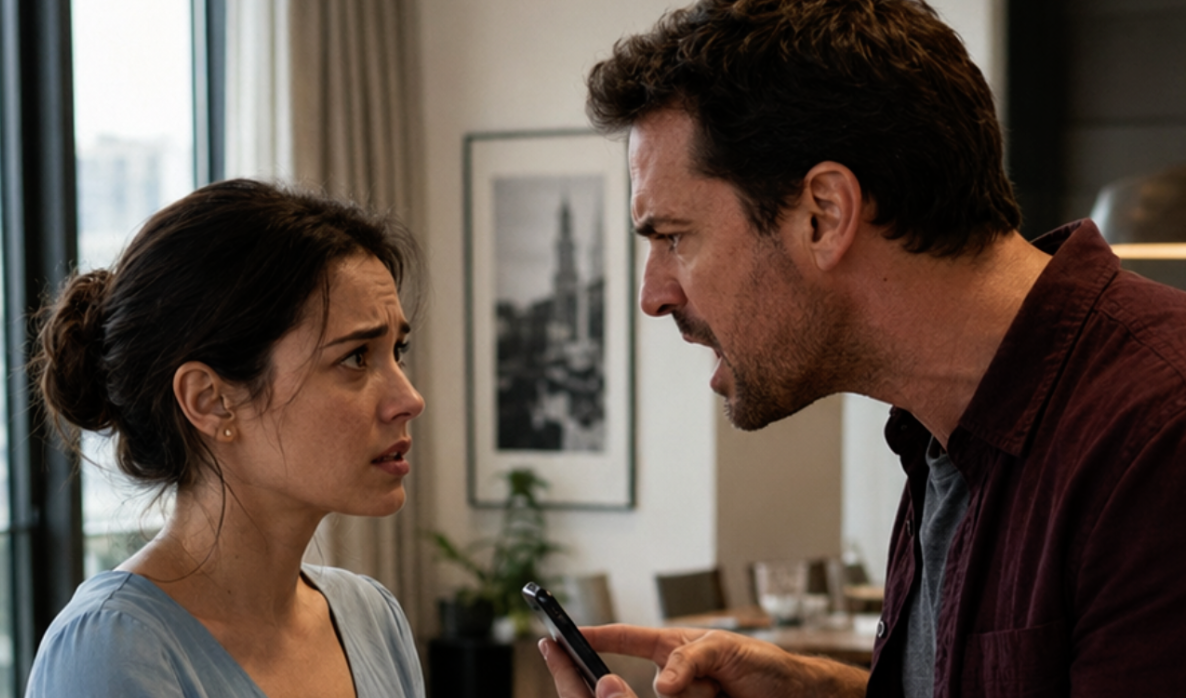
The next day, Zoya stayed late at work. When she arrived home, she dropped her bag in the hallway and went to take a shower. When she came out, her husband was sitting on the sofa with her phone in his hands.
“Zoya, you received a message,” he said. “I heard the notification and decided to check it. I thought it might be something important.”
Zoya walked over to him. A bank notification was displayed on the screen:
“Account balance: 283,450 rubles.”
Leonid slowly said:
“Two hundred and eighty thousand. Interesting.”
Zoya took the phone from him and placed it on the table. Fear tightened everything inside her, but outwardly, she remained composed.
“Yes, those are my savings,” she said simply.
“Yours?” Leonid stood up from the sofa. “So I’ve been foolishly worrying about every kopeck?”
“That money is for an emergency,” Zoya explained. “I saved it in case something unexpected happened.”
“A year and a half!” Leonid began pacing around the room. “You kept this secret throughout our entire year and a half of marriage! I denied myself everything and tried to save money, while you had a whole pile of cash sitting there!”
“Lenya, it isn’t a pile of cash,” Zoya said patiently. “It’s an emergency fund. I put aside a little every month.”
“You’re part of this family!” Leonid exclaimed. “That money isn’t yours—it’s ours!”
Zoya looked directly into her husband’s eyes. Something inside her broke.
“Ours?” she asked quietly. “When was the last time you contributed any money to our shared budget?”
“What do you mean?” Leonid stopped. “I work! I receive a salary!”
“And you spend it on yourself,” Zoya replied calmly. “New sneakers, jeans, and meetings with your friends. Who pays for the apartment and the groceries?”
Leonid’s face turned red. He clenched his fists.
“I contribute too!” he shouted. “I buy you presents and take you to cafés!”
“When was that?” Zoya stood up from the sofa. “Six months ago? A year ago?”
Leonid turned toward the window. His shoulders tensed.
“You don’t appreciate me,” he said through clenched teeth. “You treat me like a stranger.”
“Do you remember when you were unemployed for two months?” Zoya’s voice became firmer. “Who paid for everything then?”
“I was looking for a respectable position!” Leonid spun around. “I didn’t want to grab the first job that came along!”
“You were looking for your dream job,” Zoya said sharply. “Meanwhile, I worked without days off so we wouldn’t end up on the street.”
Leonid stepped toward his wife. Genuine anger burned in his eyes.
“So I’m a burden to you?” he hissed. “I’m a freeloader?”
“I didn’t say that.” Zoya folded her arms across her chest. “But since you’re thinking it yourself…”
“You know what?” Leonid rushed toward the door. “Live with your precious money! Keep counting every kopeck! Just don’t expect any gratitude from me!”
The door slammed shut. Zoya was left alone. For the first time in a year and a half, the apartment was quiet.
And peaceful.
Leonid did not return in the morning. Zoya got up, ate breakfast, and began packing her belongings. She did not cry or panic. She simply and methodically placed everything she needed into bags.
Three days later, she found a one-room apartment in a neighboring district. It was bright, clean, and newly renovated. The landlady asked for a security deposit and one month’s rent in advance.
“Forty thousand,” she said, handing Zoya the rental agreement.
“No problem,” Zoya replied with a nod, taking out an envelope of money.
After the landlady left, Zoya sat on the windowsill and looked around the empty room. She had two hundred and forty thousand rubles left in her account. For the first time, the money no longer felt like a reserve.
It felt like an opportunity.
A week later, she took a vacation and flew to St. Petersburg. She posted no photographs on social media and told none of her colleagues. She simply boarded a plane and left to figure out what she truly wanted.
Zoya wandered through the halls of the Hermitage. She drank coffee in the museum café. She read a book on a bench in the Summer Garden. Tourists and couples in love walked nearby. There were many families with children.
Zoya looked at them and understood.
For a year and a half, she had not been living her own life. She had been adapting herself to someone else’s desires and demands.
But it was time to put an end to that.
After returning from her vacation, she filed for divorce. Everything proceeded quickly and peacefully. By the time the papers were submitted, there were eighteen thousand rubles in their joint account. The court divided the money equally.
“Nine thousand?” Leonid protested during the hearing. “Seriously?”
“That is everything that was in our joint account,” Zoya replied calmly.
“What about the rest of the money?” her former husband persisted. “Where are your savings?”
Zoya silently stood up and headed toward the exit. She no longer wanted to explain anything.
Now she lived alone. There was no shouting, no one trying to control her money, and no person who believed he had the right to decide how to spend what he had not earned.
Most importantly, no one could claim the results of her work and careful planning anymore.
A notebook containing her plans lay on the table—a trip to Sochi, English classes, and perhaps even a journey to Europe the following year.
For the first time in a long while, the future belonged entirely to her.
And that gave her genuine peace.