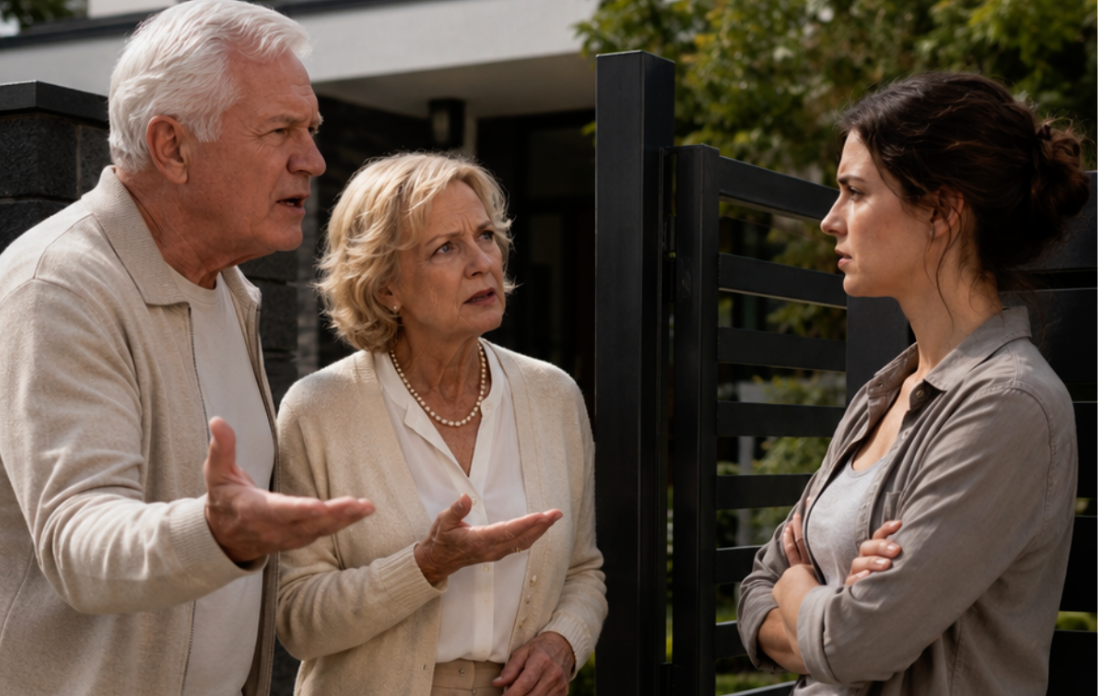
Lyuda stood in the doorway of her own two-bedroom apartment, unable to believe what she had just heard. Her father-in-law, Nikolai Petrovich, and her mother-in-law, Valentina Vasilyevna, were standing on the threshold with suitcases in their hands, looking as though they intended to move in immediately.
“What do you mean, ‘vacate it’?” Lyuda asked quietly.
“Exactly what it sounds like,” Valentina Vasilyevna replied, adjusting the bag on her shoulder. “Living in the city is more convenient for us. The doctors are closer, and so are the shops. You’re young. You’ll fit perfectly well in the house.”
It had all begun a year earlier, immediately after Lyuda and Stanislav’s modest civil wedding. They had planned to live alone for a while and get used to married life, but a month later, Stanislav’s parents arrived.
Temporarily, they said—just until the house on the plot of land was finished.
“We’re one family now!” Valentina Vasilyevna had announced cheerfully as she arranged her own pots and pans in the kitchen. “There’s no reason to feel awkward around each other.”
Stanislav had received the plot before the marriage. His father had given it to him for his twenty-fifth birthday. It was about eight hundred square meters in the suburbs, with utility connections nearby. It was a good place to build a house.
The young couple had no other construction options, and Stanislav’s parents promised to help with both money and labor.
“We have experience,” Nikolai Petrovich said. “I built my own house thirty years ago. I know everything there is to know.”
Lyuda agreed.
She worked as a veterinarian at a private clinic and earned a steady salary of around ninety thousand rubles a month. Stanislav worked as an electrician, but his jobs were irregular. During a good month, he might earn fifty thousand. At other times, he would sit without work for weeks. His parents received pensions of eighteen thousand rubles each.
From the very beginning, most of the expenses fell on Lyuda’s shoulders.
Materials for the foundation cost seventy thousand rubles. The bricks cost one hundred and twenty thousand. The roofing materials cost ninety thousand. Then there were the windows, doors, interior finishing, and everything else.
The numbers added up to a substantial amount.
“Don’t worry. We’ll pay you back later,” Nikolai Petrovich promised whenever Lyuda took out another bundle of cash. “Once we save some money from our pensions.”
Stanislav always agreed with his father.
He spent more time at the construction site, helping the workers, than he did looking for new jobs. He said someone had to supervise them to make sure they did not cut corners.
Meanwhile, Lyuda was torn between her job and the construction project.
She worked shifts at the clinic, responded to emergency calls involving sick animals at night, and spent her weekends traveling to the plot. She checked the progress, bought whatever materials were missing, and resolved problems with the workers.
Gradually, Stanislav’s parents stopped merely helping and began giving orders.
Valentina Vasilyevna chose the bathroom tiles without asking Lyuda’s opinion. Nikolai Petrovich decided where the heating boiler would be installed. The wallpaper for the bedrooms, the chandeliers for the living room, and the kitchen cabinets were all selected by Stanislav’s parents.
“We have better taste,” his mother explained. “We’re experienced. We understand life.”
Lyuda remained silent and kept paying.
She saved every ruble and worked without days off so that the house could be completed faster and they could finally leave the cramped apartment. Living with four people in two rooms was becoming unbearable, especially when Valentina Vasilyevna began frying her cutlets early in the morning and Nikolai Petrovich turned the television up to full volume.
“We’ll be finished soon,” Stanislav reassured her. “Just be patient a little longer.”
By spring, the house was complete.
It had two floors, four bedrooms, a spacious kitchen, and two bathrooms. The entire project had cost more than a million rubles—almost everything Lyuda had earned during the year.
During the same period, Stanislav had earned no more than two hundred thousand rubles, and his parents had not contributed a single kopek.
“Now we can celebrate the housewarming!” Valentina Vasilyevna exclaimed happily as she wandered through the rooms.
“When are we moving?” Lyuda asked her husband.
“Well, I’ve been thinking…” Stanislav hesitated. “Maybe we should let my parents live here first. Let them settle in and get used to the place. We can stay in the apartment for now.”
“For how long?”
“Well… a month or two.”
One month turned into three.
Stanislav’s parents began settling into the new house. They brought in furniture and made minor improvements. Meanwhile, everyone continued living together in Lyuda’s apartment.
“I need to move into the house,” Lyuda said in June. “I’m tired of living in such cramped conditions.”
“I understand,” Stanislav replied with a nod. “But my parents haven’t completely settled in yet. Let’s wait until autumn.”
“Until what point in autumn? The house is ready. It’s time for us to live separately.”
“Sveta, don’t rush things. Older people take longer to adjust.”
Then, a week later, Stanislav’s parents arrived at the apartment with suitcases and announced their plans.
“Living in the city is more convenient for us,” Valentina Vasilyevna repeated. “The clinic is nearby, and there are buses. What would we do in that house? It’s terribly boring there.”
“But we built the house for ourselves,” Lyuda said in confusion.
“We built it for the family,” Nikolai Petrovich corrected her. “And the family means all of us together. We like it here. We’re used to the city. You can settle down in the house and start a household.”
Lyuda looked at her husband.
Stanislav stood by the window in silence.
“Stas, say something.”
“What is there to say?” her husband replied with a shrug. “It really is more convenient for elderly people to live in the city. Maybe we can stay in the house for a while. It’s not a disaster.”
“Not a disaster?” Lyuda could not believe her ears. “I worked myself to exhaustion for a year and spent all my money, and now I’m supposed to vacate my own apartment?”
“Not exactly vacate it. Just make room. Temporarily.”
“How long is ‘temporarily’?”
“We’ll see how circumstances develop,” Nikolai Petrovich interrupted. “Life will tell us.”
Valentina Vasilyevna was already hanging her dresses in the bedroom wardrobe.
“This will be our guest room,” her mother-in-law announced. “You two can stay in the smaller bedroom. There’s enough space.”
“What guests?” Lyuda stared at her. “This is my apartment!”
“Of course it’s yours, dear. No one is arguing about that. We’re simply all going to live here together now. Like a family.”
“I never agreed to all of us living together.”
“What is there to agree about?” Nikolai Petrovich asked as he placed his suitcase in the hallway. “The house is ready—thank you for that. You’re turning into a good daughter-in-law. Now you need to give us the apartment as well. Elders must be respected.”
Lyuda watched her in-laws settle into her apartment and could find no words.
Stanislav went into the kitchen and began noisily moving dishes around.
“Stas!” Lyuda called.
Her husband returned to the room but avoided looking her in the eye.
“What?” he muttered irritably.
“Explain to your parents that this is unacceptable.”
“What exactly is unacceptable? They want to live in the city. That’s normal. We’ll be fine in the house.”
“You’ll be fine? Did anyone ask me?”
“I’m asking you now. What’s so terrible about living in a spacious house?”
Lyuda slowly walked over to the desk and took a folder of documents out of a drawer.
It contained receipts for construction materials, invoices for the workers, and contracts with suppliers.
Everything was in her name.
“Do you know how much I spent?” Lyuda asked quietly.
“Well… a lot,” Stanislav replied uncertainly.
“One million one hundred thousand rubles. Exactly. That was my entire salary for more than a year.”
“So what?”
“So if your parents want to live in the city, they can buy an apartment with their own money.”
“They’re pensioners!”
“And? I’m not obligated to provide them with housing.”
“But we’re a family…”
“No, Stas. A family is when everyone contributes to shared expenses. When one side only pays and the other side only makes demands, that isn’t a family.”
Valentina Vasilyevna appeared in the doorway.
“Lyudochka, dear, don’t get so worked up. We’re not staying forever. We’ll live here for a year or two, and then we’ll see.”
“See what?”
“Who knows? Maybe you’ll have children, and they’ll have more room in the house. Or perhaps we’ll find a summer cottage for ourselves and move there.”
“Or perhaps you could pack your things right now and go back to your house.”
Her mother-in-law threw up her hands.
“How harsh you’ve become! Stanislav, talk to your wife. Explain to her that she needs to show respect for her elders.”
Stanislav shifted awkwardly from one foot to the other.
“Sveta, honestly. We can’t throw my parents out onto the street.”
“Not onto the street. Into the house I built for them.”
“The house we built.”
“Show me your receipts, Stas. Show me documents proving that you spent even a single ruble.”
Her husband’s face turned red.
“I worked at the construction site.”
“Were you paid for that work?”
“No, but…”
“Then it wasn’t work. It was help. And I have already paid for that help by building the house.”
Nikolai Petrovich coughed loudly in the hallway.
“Perhaps we should have some tea. This conversation is becoming unpleasant.”
“Come on, Grandpa, let’s have tea,” Valentina Vasilyevna agreed. “The young people can calm down.”
Lyuda remained alone in the room.
She sat on the sofa and spread the documents out in front of her.
One million one hundred thousand rubles of her money had gone into the house where her in-laws were now living. At the same time, her husband’s parents intended to take over her apartment under the pretext of caring for the older generation.
Through the wall, she could hear Valentina Vasilyevna laughing and Nikolai Petrovich saying:
“These rooms are nice and spacious. We’re going to like it here.”
Lyuda closed her eyes.
She understood that if she did not stop them now, she would be left with nothing.
The next morning, the first thing she did was take out the folder of documents.
The land truly belonged to Stanislav. The deed of gift from his father had been completed before Lyuda and Stanislav had even met.
However, under the investment agreement, the house itself had been registered with Lyuda as the developer. All the receipts, invoices, and bank statements were in her name.
“Kolya, where are your documents showing how much you spent on the house?” Lyuda asked her father-in-law over breakfast.
“What documents?” Nikolai Petrovich asked, confused.
“Receipts, transfers, written acknowledgments—anything proving that you invested money in the construction.”
“Why would we need documents?” Valentina Vasilyevna asked in surprise. “We’re a family.”
“Family is good. Documents are better.”
Through an acquaintance from the veterinary clinic, Lyuda found a competent lawyer.
Boris Vladimirovich listened to her story and reviewed the paperwork.
“You have every chance of having the building legally recognized as your property,” the lawyer said. “The money was invested exclusively by you. None of the other parties has a single document proving any expenditure.”
“What about the land?”
“The land will remain your husband’s property, but the house is yours. Under the law, you can demand either compensation for the value of the building or legal ownership of the house.”
“How long will it take?”
“With evidence this strong, approximately three months through the courts.”
Meanwhile, the atmosphere at home was becoming increasingly tense.
Valentina Vasilyevna openly treated the apartment as though it already belonged to her.
“There are only two of you, while the three of us are rather cramped,” her mother-in-law remarked over dinner. “Besides, living in the city is more convenient for elderly people. The clinics and shops are nearby.”
Lyuda discreetly turned on the voice recorder on her phone and recorded the entire conversation.
“And where are we supposed to live?” she asked.
“You can settle in the house. It’s spacious, and the air is clean.”
“I see.”
Two weeks later, Lyuda made her decision.
She contacted the local police officer, Dmitry Anatolyevich, and explained the situation. The apartment belonged to her. Everyone staying there was officially registered at other addresses, and she had never consented to their residence in her home.
“So this amounts to an unlawful takeover?” the officer clarified.
“That’s what it looks like.”
Dmitry Anatolyevich arrived at the agreed time.
Lyuda’s in-laws were sitting in front of the television, drinking tea.
“Do you have the ownership documents for the apartment?” the officer asked Lyuda.
She showed him the property certificate.
“And at what address are you officially registered?” he asked Nikolai Petrovich.
“At the country property,” her father-in-law grumbled.
“Then I must ask you to vacate these premises. Living here without the owner’s consent is a violation.”
“How can this be?” Valentina Vasilyevna exclaimed. “We’re relatives!”
“Being related does not give you the right to occupy someone else’s home,” Dmitry Anatolyevich explained. “You have one hour to pack your belongings.”
Valentina Vasilyevna cried. Nikolai Petrovich tried to argue and appealed to their family relationship.
But the documents spoke for themselves.
An hour later, Lyuda’s in-laws were loading their belongings into a taxi.
“You ungrateful woman!” her mother-in-law shouted as she left. “After everything we’ve done for you!”
“What exactly have you done?” Lyuda asked calmly.
“We gave you our son! We accepted you into the family!”
“Thank you for that. Now go and live in the house I built for you.”
Stanislav returned that evening.
When he saw the empty apartment, he frowned.
“Where are my parents?”
“They went to the house.”
“What do you mean, they went to the house? We agreed they would stay with us for a while.”
“We did not agree on anything. Agreements are made between equal parties. In this situation, one side only pays while the other only makes demands.”
“Sveta, you can’t treat elderly people like that.”
“How should I treat them? Explain it to me.”
Stanislav went into the kitchen and switched on the kettle. He returned looking confused.
“Did you call the police?”
“Yes.”
“Why?”
“To restore my rights over my own apartment.”
“But they didn’t do anything wrong.”
“Nothing? Your mother was already planning to live here permanently. And you think that’s normal?”
“Well… perhaps temporarily…”
“Stas, I’m giving you a choice. Either you are with me, in which case you defend my interests, or you are with your parents, in which case you can live wherever it is more convenient for you.”
“Why should I have to choose?”
“Because you can’t keep sitting in the middle. Your parents don’t respect me, and they refuse to recognize my rights. Meanwhile, you remain silent.”
“I’m not silent…”
“You are. And every time, you choose their side.”
Stanislav went into the bedroom, took out a bag, and began packing his belongings.
“What are you doing?”
“I’m going to stay with my parents until this situation settles down.”
“It won’t settle down, Stas. It’s going to get worse.”
“We’ll see.”
Her husband packed the things he needed and left.
He did not even say goodbye.
A week later, Lyuda filed for divorce at the civil registry office.
Because they both consented, had no children, and had no jointly owned property, the process took one month.
Lyuda had bought the apartment before the marriage, so it remained hers. The house had been built with her money, so it belonged to her as well.
All that remained of the marriage was a stamp in her passport, and even that would soon disappear.
Stanislav signed the papers without saying a word.
They met at the registry office for the final time and then walked away in opposite directions.
“Perhaps we should think about this again,” he suggested at the entrance.
“I’ve already thought about it.”
“My parents won’t live forever…”
“So?”
“Afterward, we could live normally.”
“Stas, during this entire year, you never supported me. Not once did you take my side. What kind of normal life are you talking about?”
Her former husband shrugged and walked away.
They never had to meet again.
Stanislav’s sister, Nadya, did call Lyuda, however.
She screamed over the phone that Lyuda had thrown their parents out onto the street and left two elderly people without a roof over their heads.
“What street?” Lyuda asked in surprise. “They’re living in a beautiful house.”
“A house they don’t legally own!”
“Why should they own it? It was built with my money.”
“But the land belongs to Stas!”
“So what? The land still belongs to Stas. The house belongs to me.”
“How can the house belong to you?”
“Very easily. There are no documents proving that his parents invested even a single kopek in the construction. I, on the other hand, have receipts proving all my expenses.”
“You’re cruel!”
“I’m fair.”
Nadya never called again.
The apartment suddenly felt unusually spacious.
There was silence in the mornings and order in the kitchen. No one changed the television channel without asking.
For the first time in a year, Lyuda felt at home in her own apartment.
Through the courts, she registered the house in her name as property that had been built exclusively with her money.
Boris Vladimirovich had been right. With evidence that strong, the court issued its decision quickly. Lyuda had personally covered all construction costs, and there was no evidence that anyone else had contributed financially.
Nikolai Petrovich and Valentina Vasilyevna appealed the ruling.
They claimed that they had contributed building materials and labor, but they could not produce any documentary evidence.
The appellate court upheld the original judgment.
Lyuda now owned two homes: a two-bedroom apartment in the city and a country house.
She could live peacefully in either one without worrying about anyone else’s claims or listening to accusations that she was ungrateful.
Her former in-laws remained in the house without ownership rights but were granted the right to live there for the rest of their lives. Lyuda included that condition in the settlement agreement.
They should have been grateful that she had not evicted them completely.
As for Lyuda, a new life lay ahead of her—a life without unwanted opinions, without compromises made at her own expense, and without people who believed she was obligated to provide them with a comfortable existence.