Veronica had always believed that paint was more honest than people. Color never betrayed you, never lied to your face, never smiled while hiding a knife behind its back. As she ran her brush across the brick wall of what would soon become a restaurant dining room, she thought that the world, generally speaking, could be repainted—as long as you had enough patience.
A thin leather cord hung around her wrist, and attached to it was a small brass key, darkened with age. She had been wearing it for more than a year, yet no one knew what it opened. Whenever anyone asked, she merely smiled from the corner of her mouth.
“You’re fiddling with that little key again,” Oksana remarked, appearing with two cups of coffee. “Come on, tell me. What treasure does it unlock?”
“All in good time,” Veronica replied. “I’m like a fine wine—I open up slowly.”
“Oh, come on. I’m going to burst from curiosity.”
“Bursting is bad for you,” she snorted. “You’ll wear yourself out trying to stitch yourself back together.”
Oksana laughed and settled onto an overturned bucket. Veronica dipped her brush into ocher paint and thought that friends were people to whom you didn’t have to explain the mystery—they would still wait patiently for the ending.
Gleb would never have waited. In six months, Gleb had not managed to wait for anything at all.
“How’s yours doing?” Oksana asked, as though reading her thoughts. “Has he found anything?”
“He’s looking,” Veronica answered evenly. “Very diligently. From the couch.”
“Veronica…”
“I’m serious. Looking for a job is a spiritual practice for him. He sits there meditating on the ceiling.”
Oksana gave a small laugh, but the concern remained in her eyes. Veronica turned back to the wall and carefully painted a yellow highlight.
“I still believe he’ll manage it,” she added quietly. “A person isn’t made of stone. People change.”
“They change,” her friend echoed. “The question is, in which direction?”
The apartment smelled of someone else’s laziness. Gleb lay sprawled across the couch with one leg crossed over the other, scrolling through something on his phone. An empty bottle stood on the table beside a plate holding a dried-out sandwich.
“Hi,” Veronica said as she removed her shoes. “Any progress?”
“Nothing,” he grumbled. “Everyone out there is a crook. The salaries are pathetic, and the bosses are tyrants. Who needs me there, anyway?”
“Have you tried making yourself useful to anyone?”
“Again?” He finally looked at her. “You walk in and immediately start nagging me. For your information, I’ve been thinking all day.”
“About what, may I ask?”
“About life!” He sat up and spread his arms. “About how people underestimate me. You smear paint over your little walls and feel satisfied, but I have standards.”
“You have standards, and I pay for them,” Veronica said calmly. “An interesting economic system.”
“There we go again. Money, money, money.” His face twisted. “You’ve become so materialistic. You used to be normal.”
“I used to keep quiet.” She hung up her jacket.
He muttered something and returned to his phone. Veronica went into the kitchen, put the kettle on, and leaned against the counter. One stubborn thought kept pounding inside her: just a little longer, just a little more faith, and he would come to his senses.
“Gleb,” she called. “Let’s talk like adults. No resentment. This can’t be easy for you either.”
“I’m fine,” came his voice from the other room.
“Well, I’m not. I’m carrying both of us, and I’m not made of iron.”
“Then stop carrying us,” he replied lazily. “Who’s forcing you?”
She closed her eyes and exhaled slowly.
“By the way…” Gleb appeared in the doorway, suddenly affectionate. “What’s that little key you wear around your wrist? It’s always dangling there.”
“Why do you care?” She raised an eyebrow.
“I’m curious. Is it for a safe?” He chuckled. “Are you hiding millions from me?”
“I’m hiding a dream,” she said with a smile. “You can’t see it from the couch.”
He twirled a finger beside his temple and returned to the living room. Veronica closed her hand around the key and thought that her dream was the one thing she would never give to anyone.
Not in exchange for any apology.
Trouble arrived in an ordinary way, as all real trouble does.
Veronica was setting up a baby monitor in her workshop. She intended to use it to see when delivery people arrived while she was working at the far end of the room. The camera itself was at home in the living room, and suddenly the screen flickered to life.
Gleb was sitting at the table. Across from him sat his mother, Zinaida, as straight and rigid as a fence post. The sound was quiet but understandable, and Veronica instinctively turned up the volume.
“You have to understand,” Zinaida was saying, tapping one fingernail against the table. “She doesn’t need that car. She’s an artist! She can carry her little paintbrushes on the tram. But Artyom needs real money for his wedding.”
“She has the keys,” Gleb replied. “And she’s hidden the documents somewhere.”
“Find them. Are you her husband or a doormat? Look for the documents in the desk and have a spare key made. We’ll sell the car quietly and tell her it was stolen.”
“What if she finds out?”
“What is there for her to find out?” His mother waved a dismissive hand. “She’s an outsider, that lousy dauber. She’ll stay for a while and then move out. We need to help our own family, not feed freeloaders.”
The cloth slipped from Veronica’s fingers and fell to the floor. She stared at the screen and did not immediately realize that she had stopped breathing.
An outsider.
A freeloader.
These were the “family” for whom she had kept the entire household afloat for six months with nothing but her paintbrushes.
“And the worst part is, she walks around smiling,” Zinaida continued with a kind of self-satisfied laziness. “Trusting fool. Always wearing that little key around her wrist, making such a fuss over it. Maybe that’s where she’s hidden her savings. Find out.”
“To hell with the key,” Gleb said dismissively. “The car is more important.”
Veronica switched off the screen.
The workshop became completely silent.
She picked up the cloth, folded it neatly into quarters, and placed it on the table—as though, through that simple gesture, she were putting not the room but her entire life in order.
That evening, she did not make a scene. She waited until Gleb had finished eating the dinner she had prepared for him, then sat across from him.
“Gleb. Tell me about my car.”
“What is there to tell?” His body tensed. “It’s parked outside.”
“For now,” she said with a nod. “What plans do you have for it? Were you thinking of taking it somewhere far away?”
“What are you talking about?” He tried to smirk, but the expression came out crooked. “Have the paint fumes gone to your head?”
“I heard your conversation,” Veronica said calmly. “All of it. From ‘freeloader’ to ‘savings hidden in the key.’”
Gleb’s face turned blotchy.
“You were eavesdropping?” he roared. “Spying on me in my own home?”
“In my home,” she corrected him. “The one I pay for. Terminology matters.”
“You…” He choked on his words, spittle flying from his mouth. “You’re nobody! You’re only being kept here out of pity! You call yourself an artist, smear your pathetic pictures around, and think you’re some kind of queen!”
“So that’s how we’re speaking now.” She tilted her head slightly. “This afternoon I was a trusting fool. I’m clearly rising in your estimation.”
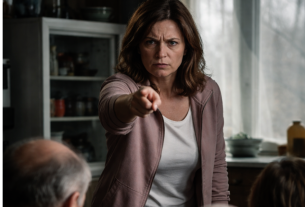
“Shut up!” He leaned across the table, pointing a finger at her. “The car is nothing! I’m your husband—I have rights! But you hoard every penny, you greedy little miser!”
“A miser?” Veronica laughed softly. “Gleb, I’m feeding a grown man who wants to steal my car to pay for someone else’s wedding. If that makes me greedy, then you must be the model of generosity.”
He opened his mouth, ready to unleash another wave of shouting, but at that moment the front door slammed.
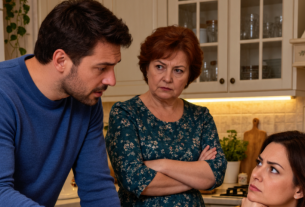
Artyom, Gleb’s younger brother, entered carrying a bag of fruit and wearing an apologetic smile. He froze in the doorway, taking in the overturned glass, his pale-faced brother, and the perfectly calm Veronica.
“I’ve come at a bad time,” he said slowly. “What’s happening?”
“A family council,” Veronica replied. “We’re deciding whose money should pay for your wedding.”
“What do you mean?” Artyom frowned. “I didn’t ask anyone for anything.”
“No one asked you,” she said. “Your brother and your mother decided to sell my car behind my back and give the money to you and Yulia as a wedding gift. Surprise.”
Artyom looked at Gleb.
Gleb avoided his eyes and muttered, “Don’t listen to her. She twists everything.”
“Gleb.” Artyom’s voice became quiet and firm. “Is it true?”
“What difference does it make?” Gleb exploded. “She doesn’t need the car! I’m doing it for you, you idiot, and now you’re interrogating me?”
“For me,” Artyom repeated. “You were going to steal from your wife and call it a gift to your brother.”
“Not steal—take! Take what belongs to us! Are we a family or not?”
“What belongs to you is what you paid for,” Artyom said. “And you haven’t paid for anything in six months.”
He placed the bag on the table.
“You’re a thief, Gleb.”
The words were spoken without shouting or emotion—just two short sentences. Yet Gleb seemed to collapse in on himself, as though someone had let all the air out of him.
“You… What are you saying?” he hissed. “Calling your own brother a thief.”
“I won’t accept a single ruble from that car,” Artyom said sharply. “And I’ll tell Yulia everything. We’d rather get married in sweatpants at a cafeteria than pay for a wedding with stolen money.”
“You self-righteous fool,” Gleb spat. “You’re just like her.”
“Thank you,” Veronica said calmly. “That’s the best compliment I’ve received all evening.”
She stood, crossed the room, and removed the car keys from the hook on the wall. She slipped them into her pocket, then took the vehicle documents from a drawer and placed them in her bag.
“What are you doing?” Gleb asked suspiciously.
“Putting things in order,” she said. “Both the terminology and the property. Artyom, would you like a ride? As it happens, I still have a car. For now.”
Gleb lunged toward the doorway and spread his arms.
“You’re not going anywhere! We haven’t finished talking!”
“We have finished,” Veronica replied gently. “You called me ‘nobody,’ a ‘freeloader,’ and a ‘miser.’ That was very comprehensive. Let me pass.”
“Or what?” He bared his teeth.
“Or I’ll start telling the truth loudly.” She smiled. “Your neighbors are right behind that wall. I’m sure they’d be interested in hearing about the plan to report my car as ‘stolen.’ And I still have the recording of your conversation with your mother.”
He stepped aside.
Veronica calmly walked out, and Artyom followed her after casting one brief look at his brother.
The next day, she did not delay. That morning, she called her father, Andrei Petrovich, and told him everything in a steady voice, without embellishment.
“I’m leaving Gleb,” she concluded. “I’m going to find somewhere else to live today. I don’t need help. I just wanted you to know.”
“Daughter,” he said after a pause, “I’m proud that you didn’t crawl to me asking for permission. You simply informed me of your decision. That’s my girl.”
“I take after you, Dad.”
“Do you need money?”
“No,” she answered firmly. “I’ll manage on my own. Talent is faith in yourself and in your own strength. I have enough of that faith for two people.”
“Then get moving,” he said with a chuckle. “And don’t lose that little key of yours. I remember how you’re always carrying it around.”
“I won’t lose it.” She smiled. “I’m going to need it very soon.”
After that, everything happened quickly, as though the world had merely been waiting for her to stop enduring.
Oksana arrived with two empty suitcases and took Veronica home with her. That same evening, Veronica sat down in front of a canvas and painted until dawn—a face divided in two, one half warm and the other hollow, with cold eyes.
“Two-Faced,” she said the next morning, stepping back to examine it. “The perfect title. Cheaper than a photograph and more honest than a mirror.”
A week later, Mark, a gallery owner whom she had once met at an art fair, stopped by the workshop. He stood in front of Two-Faced for a long time before turning toward her.
“I’ll take it,” he said. “And don’t try to bargain with me. I’ll pay more than whatever price you name. Where have you been hiding this?”
“In my husband,” Veronica replied. “A wealth of material. Shame he wasn’t built to last.”
Mark laughed.
The next day, he called with more news. A hotel chain was looking for an artist to paint murals in its lobbies, and he had recommended her.
“It’s a huge commission,” he said. “Enough work for the next six months. Can you handle it?”
“I can,” she answered without hesitation. “I’ve carried worse. I’m used to it.”
The money came quickly.
Veronica sold her car to Mark—he had wanted one like it for some time—added the savings no one had known about, and went to the art district. At the end of one row stood a small studio pavilion with a glass wall, a place she had noticed long ago.
“It’s yours,” the seller said, handing her the documents. “Congratulations.”
Veronica removed the brass key from its cord—the same key she had worn for more than a year. She inserted it into the lock of the back door, and it turned smoothly.
“It fits,” she whispered to herself. “A year ago, I asked the owner to make me a duplicate in advance. So that every day, I would remember what I was enduring everything for.”
That was the answer to her quiet mystery.
It was not a key to hidden savings or a safe. It was the key to a door that did not yet belong to her.
She had worn it as a promise to herself.
And she had kept that promise.
Gleb appeared two weeks later with a bouquet of flowers, a clean shirt, and a carefully rehearsed expression.
“Veronica,” he began sweetly. “I was wrong. The devil made me do it. Can’t we forget everything?”
“Hello, devil,” she replied without coming out from behind the pavilion’s glass wall. “How is your mother? Did she pay for those flowers, or did you use my money again?”
“Don’t be sarcastic.” He grimaced. “I came to make peace. A wife is supposed to forgive.”
“And a husband is supposed to work.” She shrugged. “Looks like we’re both failing the job description. Go away, Gleb.”
“Where am I supposed to go?” he shouted, raising his voice. “You ruined my life! Look at you, walking around here after buying yourself a little studio! Where did you get the money?”
“Honestly,” she replied calmly. “I understand that’s an unfamiliar concept.”
He hurled the bouquet onto the doorstep and walked away, cursing under his breath.
The following evening, he returned drunk. He pounded on the glass and promised to “tell her everything he thought of her.” Veronica calmly photographed him with her phone, held the photograph up for him to see through the glass, and called the district security office.
“Leave on your own,” she said through the partially opened door. “Or someone will escort you. You have more choices than ever before.”
He staggered away, shaking his fist at her.
The next day, her mother-in-law arrived—rigid-backed, tight-lipped, and wearing the expression of injured virtue.
“Well, hello,” Zinaida said through clenched teeth. “Are you satisfied? You destroyed the family.”
“Hello.” Veronica nodded. “The family was destroyed by the person who planned to steal my car. I simply chose not to finance it.”
“You shameless woman!” Zinaida raised her voice. “Selfish! You probably have men coming over here. That’s why you ran away! I’ll tell everyone what kind of woman you are!”
“Go ahead.” Veronica smiled. “Just make sure you have the right address first, or you might get lost in your own lies.”
“You…” Her mother-in-law gasped. “You’ll regret abandoning us! Where could you possibly go without us?”
“I’ve already gone somewhere.” Veronica spread her arms, indicating the bright studio around her. “And strangely enough, I can breathe.”
Politely but firmly, she guided her visitor outside and closed the door. Then she took out her phone and calmly blocked two numbers—Gleb’s and his mother’s.
Life took care of the rest without Veronica’s involvement.
According to Artyom, Gleb was caught shoplifting and thrown out of the store. Zinaida eventually grew tired of her drunken son and kicked him out of her house. Afterward, she became offended at the entire world. Artyom stopped speaking to his brother altogether.
“Veronica,” Artyom said over the phone, “Yulia and I are getting married on Saturday. Nothing fancy—just a small family ceremony. Will you come? You’ve turned out to be closer to us than any of our relatives.”
“I’ll come,” she replied, warmth entering her voice. “And I’ll bring a gift.”
“Yulia is crying with happiness,” he said with a laugh. “She says you’re like the older sister we never had.”
“Older sister has a nice sound to it.” Veronica smiled. “I accept the position.”
Late that evening, light glowed inside her studio.
A sunny meadow was taking shape on a large canvas—tall grass, cornflowers, daisies, and warm air in which summer itself seemed to tremble. The paint flowed easily and effortlessly, as though the colors were celebrating with her.
The brass key once again hung from her wrist—not as a promise now, but as a reward.
Veronica took a step back, looked at the meadow, and laughed softly.
She was happy.
And she had earned that happiness herself, down to the final glimmer of light on the canvas.