Nadezhda Pavlovna could not tolerate dust. Tomorrow there would be a restaurant, a banquet for thirty people, a hired host and florists, but today her four-room apartment had to be perfectly spotless. Anna, playing the role of the ideal daughter-in-law, obediently wiped down the living room while her mother-in-law coordinated the delivery of delicacies over the phone from the kitchen.
The living room was the pride of the apartment. And its main attraction was the “chronicle wall” — an enormous space above the sofa densely covered with photographs in expensive decorative frames. A family tree captured in glossy prints. Eight years of Anna’s marriage to Pavel were displayed there for everyone to see.
Anna ran a damp cloth over the glass of a large photograph from her sister-in-law Vika’s wedding. She brushed away a speck of dust from her smiling husband’s face. Then her eyes moved to the right. She looked at the neighboring photo — a picture from last year’s picnic on the Gulf of Finland. Then at a New Year’s photograph.
Her hand holding the cloth froze.
Anna stepped back to take in the entire wall. Twenty-four photographs. Large ones, medium-sized ones, small ones. Her husband Pavel was there. Her sister-in-law Vika was there with her children. Her father-in-law was there. Even their Maine Coon cat, Marquis, was there.
But Anna was not in a single one.
She blinked, thinking it had to be some kind of optical illusion. But facts were stubborn things. In the wedding photo, only half of the groom was visible beside Pavel, along with someone’s hand holding a champagne glass. Anna’s hand. In the picture from the gulf, there were pine trees, a smoking barbecue grill, her mother-in-law in a straw hat, while the right side of the image ended unnaturally, cutting off half of the picnic blanket. In the New Year’s photo from two years earlier, all that remained of Anna was a small piece of the hem of her emerald-green dress.
Anna pulled her phone from the pocket of her jeans, opened the gallery, and quickly began scrolling backward through the years. She found the original wedding picture. There they were, all standing together.
Her mother-in-law’s voice from that day echoed in her head:
“Anya, darling, stand at the edge. Your dress is too colorful — it’ll draw all the attention, and this is Vika’s celebration!”
Then there was the picnic by the gulf. Anna was standing on the right, with her arm around Pavel.
Another memory of her mother-in-law’s voice:
“Anya, take one little step to the side. You’re tall, you’re blocking the composition. That’s it, good girl!”
New Year’s Eve.
“Anya, move closer to the Christmas tree. The shadow is falling badly here!”
And suddenly Anna understood: they had always positioned her at the edge.
Then Nadezhda Pavlovna simply used a photo editor — or scissors — to cut away the “unnecessary” part of the picture.
Her daughter-in-law.
It was not an accident.
It was a system.
And that system had its own rigid, ironclad logic, something Anna already knew about from other relatives. Thirty years earlier, when young, naive Nadya had first entered this family, her husband’s parents had treated her in exactly the same way. Her in-laws openly told her that she was merely an attachment to their son, a temporary presence. In every old Soviet photograph from that period, Nadya had been pushed into the background in the same way and then cropped out when the pictures were printed. They had drilled into her head that she was nobody.
And now, after finally attaining the status of family matriarch, Nadezhda Pavlovna had not broken that toxic cycle.
She had not become wiser.
Once she gained power, she began mirroring the behavior of those who had once hurt her, methodically taking out her old trauma on her own daughter-in-law.
Anna dropped the cloth onto the coffee table, silently put on her coat in the hallway, and left the apartment, ignoring her mother-in-law calling after her from the kitchen.
That evening, Anna and Pavel’s bedroom smelled of hot metal and fabric softener. Pavel was ironing his perfect white shirt for the next day’s banquet. Anna sat on the edge of the bed.
“Pasha, look at this,” she said, holding out her phone.
On the screen was a collage: on the left, the original photograph from the picnic; on the right, the version hanging in his mother’s living room.
Pavel glanced at the screen without taking his attention away from the shirt collar.
“So what? It’s a normal photo.”
“I’m not in it. Just like I’m not in the other twenty-three photographs in your mother’s apartment. Your mother has been cutting me out for years. I’m always made to stand at the edge so it’s easier for her to use the scissors.”
Pavel slammed the iron onto its stand and exhaled irritably.
“Oh, for God’s sake, Anya, are you starting again? My mother has a huge anniversary tomorrow. She’s turning sixty, her blood pressure has been acting up, and you’ve come here to get on my nerves over some pieces of paper?”
“They’re not just pieces of paper, Pasha. It’s erasing someone’s existence. She asks me to stand at the edge, and then she cuts me out. Twenty-four times in a row.”
“She just doesn’t know how to use her phone!” her husband snapped, yanking at the shirt. “Her fingers shake when she tries to tap the screen! She presses the wrong things and the pictures get cropped! Why are you making such a huge problem out of nothing?”
“So by accident, exactly I was cropped out twenty-four times in a row?” Anna asked quietly, articulating every word. “And when she uses actual scissors on printed photographs, her fingers also accidentally shake in exactly the right way to cut around me?”
“Oh, spare me the hysterics!” Pavel leaned over her, bracing both hands on the ironing board. Red blotches spread across his face. “A ton of relatives are coming tomorrow. Don’t you dare ruin my mother’s celebration because of your complexes. Stop imagining problems where there aren’t any. You simply have too much free time.”
“Fine,” Anna replied evenly.
But a plan had already formed in her mind.
The next day, thirty guests sat around long tables at the restaurant. Nadezhda Pavlovna occupied the place of honor at the head of the table, accepting envelopes, bouquets, and compliments while theatrically pressing her hands to her chest.
Anna sat beside her husband.
Her back was perfectly straight.
Her face wore a polite, unreadable expression.
“And now, dear guests,” the host’s voice boomed into the microphone, “a surprise prepared by the birthday woman herself! Nadezhda Pavlovna personally spent nights putting together this wonderful film about the greatest achievement of her life — her strong, close-knit family! Everyone, look at the screen!”
The lights in the hall slowly dimmed.
The enormous projector screen lit up.
Sentimental instrumental music began to play.
Photographs started flashing across the screen.
There they were picking apples at the country house.
There was Pavel receiving his diploma for his second university degree.
There was Vika leaving the maternity hospital.
There was the entire family on vacation in Turkey in 2022.
There was last year’s anniversary celebration for Anna’s father-in-law.
One photograph followed another.
Two minutes passed.
Five.
Eight.
Anna stared at the screen without blinking.
During the entire ten-minute film, containing around a hundred photographs, she did not appear even once.
Not even in the background.
Not even from behind.
Not even as a fragment of a dress.
She did not exist.
She was a ghost who had spent eight years walking beside these people, paying for part of those vacations, helping prepare salads at those country-house gatherings, and choosing the shirts her husband proudly wore in those photographs.
The film ended with a beautiful inscription:
“Family is everything.”
The lights came back on.
The guests burst into applause.
Vika dabbed at her eyes with a napkin.
Anna’s father-in-law nodded approvingly.
Anna turned toward her mother-in-law.
Nadezhda Pavlovna sat there with a serene expression, graciously accepting everyone’s admiration.
“Nadezhda Pavlovna, the film is truly a masterpiece,” Anna said.
The guests at the nearest tables quieted down, listening.
Her mother-in-law nodded graciously.
“Thank you, Anya. I worked so hard on it…”
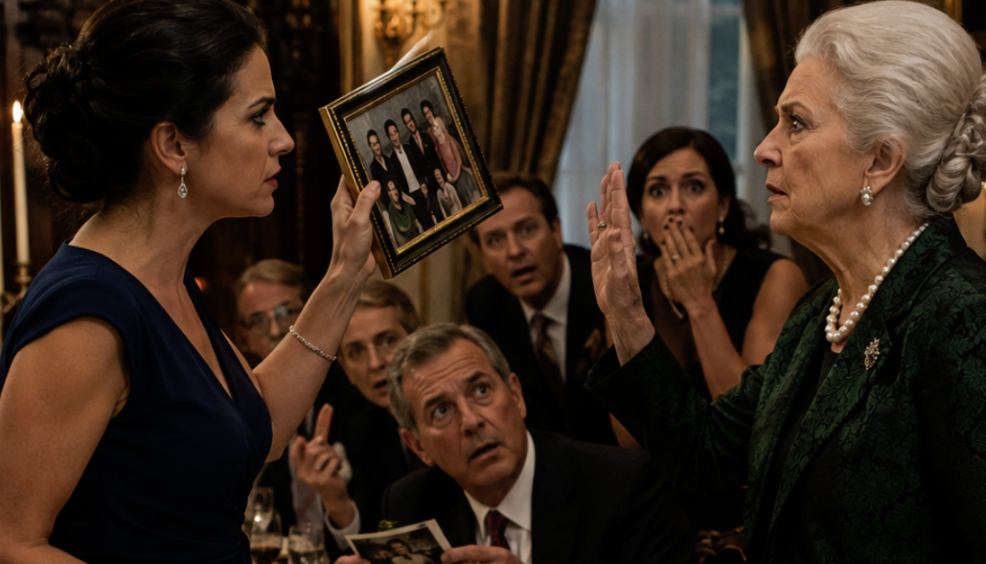
“There’s just one thing I didn’t understand,” Anna continued, and the temperature around the table seemed to drop rapidly. “I’ve been married to your son for eight years. We live together, go on vacations together, celebrate holidays together. But in a ten-minute film, there isn’t a single photograph of me. I don’t exist in it.”
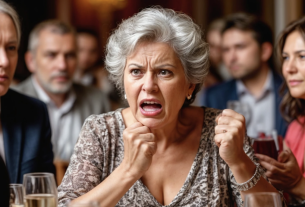
Nadezhda Pavlovna threw up her hands theatrically, putting on an expression of sincere confusion.
“Oh, Anya… What are you talking about? It’s the program, you see? The screen format is square! And you’re always standing at the edge, so the smart technology automatically crops you out. Technology! What can you do? I’m not a programmer. I don’t understand these things.”
“So I’m always at the edge because you tell me to stand there?” Anna clarified, staring directly at her mother-in-law. “And then the smart technology picks up the scissors by itself?”
Under the table, Pavel’s fingers clamped around Anna’s arm like steel.
Pain shot all the way to her shoulder.
“Anya. Shut your mouth,” he hissed into her ear, barely moving his lips so the other guests would not notice. “People are watching. Don’t you dare ruin my mother’s celebration because of your sick fantasies. Smile and sit quietly.”
Anna looked down at her husband’s hand gripping her arm like a vise.
Then she looked at her mother-in-law, who had already turned toward the woman beside her, confident that she would face no consequences.
Then at Vika, who was hiding a smirk behind her wineglass.
Everything suddenly became clear.
This was never really about the photographs.
The photographs were merely a symptom of the disease infecting this family.
Anna had always been “at the edge.”
At the edge when they discussed where she and her husband would go on vacation — because Pavel made that decision with his mother.
At the edge when their household budget was discussed — because major purchases were always approved by a family council where Anna had no real vote.
She could remember countless examples.
With a sharp movement, Anna pulled her arm from her husband’s grip.
Caught off guard, Pavel jerked and nearly knocked over his wineglass.
Conversation at the table stopped completely.
Dozens of eyes turned toward her.
“You know, Nadezhda Pavlovna, you are absolutely right,” Anna said, her voice loud, clear, and frighteningly calm. “For all these eight years, I really have been standing exclusively at the edge.”
She paused.
The room became so quiet that the sound of a waiter accidentally tapping a fork against a tray could be heard from the far wall.
Pavel went pale and sank back into his chair.
“But apparently you’ve forgotten that being ‘at the edge’ comes with one enormous, undeniable advantage,” Anna continued, looking directly into her mother-in-law’s shifting eyes. “When you’re standing at the edge, it’s very easy to take one small step to the side.”
She paused again.
“And leave the frame forever. So that you’ll never have to strain yourself editing me out again.”
Anna picked up her handbag from the table.
Calmly, she opened it.
She took out a thick white envelope — the anniversary gift she and her husband had prepared together.
It was, it should be said, an extremely generous gift.
In front of the stunned guests, Anna opened the envelope.
She removed exactly half of the large banknotes — the money she herself had earned and saved.
Then she took a few bills and placed them on the tablecloth directly in front of Pavel, whose face had turned crimson with shame and shock.
“This is for my steak and salad,” she told her husband loudly, putting the rest of the money back into her handbag. “Goodbye.”
She turned and walked toward the exit.
Nobody said a word.
Nobody tried to stop her.
Pavel remained sitting there, paralyzed by public humiliation, staring at the money lying beside his plate.
The restaurant door closed softly behind Anna, separating her from that family once and for all.
Several hours later, Pavel burst into their apartment like a hurricane.
He intended to demand an apology for “humiliating his mother in front of her management” and ruining the celebration.
He had rehearsed his angry speech the entire way home.
But there was no one there to yell at.
The apartment greeted him with ringing emptiness.
Anna’s shoes were gone from the hallway.
Her bottles and toiletries had disappeared from the bathroom.
He threw open the wardrobe doors in the bedroom.
Half of the shelves where Anna’s clothes had once been were now perfectly bare.
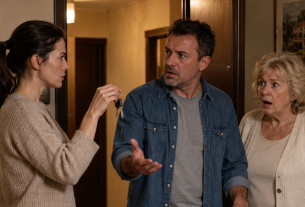
On the ironing board lay her set of apartment keys.
And a thin gold wedding ring.
Anna had not stayed to argue.
She had simply cropped her own life with brilliant precision, cutting both of them out of it.
With no possibility of restoration.
We often tend to close our eyes to small things. We tolerate strange everyday behavior, dismiss obvious disrespect as “age,” “not knowing how to use technology,” or “just an unfortunate coincidence.” We convince ourselves that we should be wiser and stay silent in order to preserve appearances and maintain the illusion of peace.
But the truth is that in family systems, small things are rarely accidental.
Where they place you in a family photograph can be a remarkably accurate reflection of your position in that family’s hierarchy.
It is a marker of how much they value you.
And if, year after year, they methodically push you toward the edge, forcing you to make yourself smaller and hide behind other people’s backs, then one day you simply have to step away from that edge.
For your own sake.