Valya stood by the window, watching the rain blur the April courtyard. Behind her, from the room, came the sound of coughing—dry, racking, endless. She closed her eyes and counted to ten. Then to twenty.
Zinaida Pavlovna had taken to her bed in March. A neighbor had brought her from the village in his old Gazelle van—wrapped in a blanket, pale, her cheeks sunken. Valya’s mother-in-law had still been managing then, bustling around, warming broth, making up the bed. But two weeks later, she too became bedridden.
Valya remembered that evening down to the smallest detail. She had just come home after picking Dashka up from kindergarten, and Andrei was waiting for her at the entrance to their two-room apartment—calm, detached, a phone in his hand.
“My mother called,” he said. “She says she’s really bad. Grandma’s bedridden too.”
“So what are you suggesting?” Valya asked as she took off her daughter’s little jacket.
“Well, you’re a woman. You know better how to deal with sick people.”
Valya slowly hung the jacket on the hook and looked at her husband. He did not even notice her stare. He was scrolling through something on his phone, idly rocking one slipper with his foot.
“Andrei, there are two women there who can’t even get out of bed. Your mother and your grandmother.”
“I understand. But what am I supposed to do? I’m not a nurse.”
“So that makes me a nurse?”
“Val, you’re better at this sort of thing. Your hands are different, you’re gentler. I’d only make things worse.”
She stood there waiting for him to say something else. To offer to help. At least to look her in the eyes. But Andrei had already gone into the kitchen, and a moment later she heard the refrigerator door open.
Dashka tugged at her trouser leg.
“Mommy, I’m hungry.”
“In a minute, sweetheart. In a minute.”
Valya crouched down, wrapped her arms around her daughter, and held her tightly—perhaps too tightly. She was twenty-seven. Dashka was three. And ahead of her loomed something she desperately wanted to run away from, except there was nowhere to run.
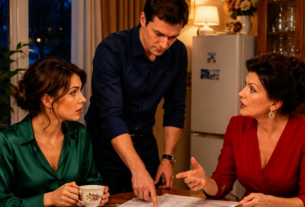
The next day she went to see her mother-in-law. Nina Sergeevna was lying in the bedroom, while Zinaida Pavlovna was on a fold-out sofa in the adjoining room. The apartment smelled of medicine and something sour. Valya opened a window, washed the dishes, then sat beside her mother-in-law.
“Nina Sergeevna, we need to talk.”
“I know,” the woman replied quietly. “I know what you want to say. That it’s hard for you.”
“It isn’t just hard. I have a little daughter. I need to earn money. I can’t split myself between three households.”
“I understand, Valya. I really do.”
“Then tell me honestly—what do you suggest? How are we going to solve this? Because Andrei won’t solve anything. You know your son.”
Her mother-in-law turned toward the wall. She remained silent for a while, then nodded—slowly and heavily, like someone who had known the truth for a long time but did not want to say it aloud.
Zinaida Pavlovna turned out to be stronger than she looked. Not physically, but in spirit. When Valya came and sat beside her, the old woman looked at her with clear, intelligent eyes. Her hands trembled, but her voice was firm.
“I heard you talking to Nina,” Zinaida Pavlovna said. “The walls are thin.”
“I’m sorry if I sounded harsh.”
“There’s nothing to apologize for. You’re right. My Andryusha won’t do anything. He was the same as a child—he’d turn away and wait for someone else to solve everything for him. Ninka spoiled him, and I failed to stop it.”
Valya said nothing. Not because she had nothing to say, but because she respected this woman and her right to speak such bitter truths.
“I’ll tell you what, Valya. I’m eighty-one years old. I can’t live alone anymore. I have a house in the village. It’s a good, solid house. I’m prepared to sign it over to you as a gift. But on one condition.”
“What condition?”
“I live with you for the rest of my life. And you take care of me. That’s my only condition. My lifetime right to live there will be written into the documents so everything is fair.”
Valya looked down at her hands. Then at the old woman. Then back at her hands.
“Zinaida Pavlovna, the house in the village is fine. But I can’t live in the village. Dashka needs kindergarten, then school. I need work. Moving to the village isn’t a solution.”
“What do you suggest?”
“Sell your house. And have Nina Sergeevna sell her apartment too. With that money, we can buy a four-room apartment here in the city. There’ll be enough space for everyone—you’ll have your room, Nina Sergeevna will have hers, and Dashka and I will have two rooms. I’ll be nearby. I’ll take care of you.”
Zinaida Pavlovna was silent for a long time. Then she gave a faint smile—not maliciously, but with a kind of bitter admiration.
“You’ve got a good head on your shoulders, Valya. That’s good. But Ninka will have to agree.”
“I know.”
“And Andryusha will be against it. He’s considered Ninka’s apartment his own for years.”
“That’s exactly why I’m asking you to talk to her. Not me. You’re her mother. She’ll listen to you.”
Zinaida Pavlovna leaned back against the pillow and stared at the ceiling. Her lips moved—perhaps she was praying, perhaps counting. At last she turned to Valya.
“Call her in.”
Nina came in, supporting herself against the wall. She sat in the armchair opposite them, wrapped in a blanket. Her face was gray and her eyes exhausted. Zinaida Pavlovna spoke quietly.
“Nina, did you hear what Valya suggested?”
“I did. Mom, but Andryusha… He’s always considered the apartment his. If I sell it, he’ll never forgive me.”
“And he’ll forgive Valya for emptying your bedpan? She’s young. She has a life to live. Meanwhile, you and I are lying here like two logs, waiting for someone to take pity on us.”
“But I need to discuss it with my son…”
Valya raised her hand, gently but firmly.
“Nina Sergeevna, I’ll tell you exactly what will happen. Andrei will be against it. He’ll say, ‘Don’t touch the apartment. That’s my inheritance.’ But he won’t come here to help. He won’t change the sheets. He won’t get out of bed at night when you feel ill. He’ll say no and go back to watching television.”
“You can’t talk about my son like that.”
“I can. Because I’ve lived with him for four years. And not once—do you hear me?—not once has he asked how I’m coping. Not once.”
The silence was so deep they could hear the old refrigerator creaking behind the wall. Nina Sergeevna stared at her hands. Zinaida Pavlovna looked at her daughter.
“Nina,” the old woman said, “Valya isn’t a stranger. She isn’t just Andryusha’s wife. She’s the mother of my great-granddaughter. She’s the only person who came here and asked, ‘How are we going to solve this?’ She didn’t ask, ‘Why should this be my problem?’ She asked, ‘How?’ Do you understand the difference?”
Nina covered her face with her hands. Her shoulders began to tremble. Valya did not try to comfort her. She simply waited.
“All right,” Nina finally said in a muffled voice. “All right. We’ll do it. Just don’t tell Andrei the details yet. He won’t understand.”
“He doesn’t need to understand everything,” Zinaida Pavlovna replied sharply. “He should have come here himself. But he didn’t.”
The village house sold within three weeks. A buyer was found quickly for the sturdy log house on its good plot of land. Nina Sergeevna’s apartment took a little longer, but by the middle of summer everything was settled.
Valya herself found the four-room apartment on the third floor of a building in a good neighborhood. She had traveled across half the city looking at places with Dashka in her arms.
The ownership papers were drawn up in Valya’s name. Zinaida Pavlovna’s share was transferred through a notarized deed of gift, completely legally. The grandmother’s lifetime right of residence was written into the documents separately. Nina transferred her share in the same way, fully understanding what she was doing—the proceeds from her apartment had gone toward the purchase, and she too received the right to live there for the rest of her life.
Andrei never bothered to look into any of it.
He was simply told that his mother and grandmother were moving, that Valya would be living nearby and taking care of them, and that everything had been settled.
He nodded without even asking for the address of the new apartment.
Valya moved their belongings, arranged the furniture, and hung the curtains. Zinaida Pavlovna got the quiet room overlooking the courtyard. Nina Sergeevna’s room was next door so Valya could quickly reach either woman. Dashka was given a bright room with yellow wallpaper, while Valya herself took the smallest room near the kitchen.
The months dragged on.
Valya got up at six every morning. She prepared breakfast for four. She fed Grandma, who could no longer eat by herself. She gave her mother-in-law her pills according to schedule. She dressed Dashka and took her to kindergarten, then rushed to the other side of the city for work.
She came home.
Cooked again.
Did the laundry.
Cleaned.
Talked to them—because the two women needed more than physical care. They needed another human voice nearby.
Meanwhile, Andrei discovered freedom.
The two-room apartment he had bought before their marriage became his fortress.
Silence.
No children crying.
No smell of medicine.
No responsibilities.
At first Valya called him once a week. Then once every two weeks.
Then she stopped.
He did not call either.
Dashka asked about her father less and less often.
Then Valya found out.
She had not eavesdropped or spied on him. A friend told her, calmly and sympathetically, choosing her words carefully.
“Val, I didn’t want to interfere. But I saw them in a café. He was sitting with a woman. They weren’t just talking.”
“What does she look like?”
“Does that matter?”
“No. It doesn’t. Thank you for telling me.”
Valya ended the call and sat motionless for a while. From behind the wall Zinaida Pavlovna called for her, quietly and pleadingly.
Valya got up and went to her.
“Grandma, do you want some water?”
“Sit down. What happened? Your face looks different.”
“Andrei is cheating on me.”
Zinaida Pavlovna did not look surprised. She did not even flinch. She simply clenched her jaw until the muscles stood out along her cheekbones.
“Fool,” she said quietly. “What a fool. What are you going to do?”
“If it’s true, I’m getting a divorce.”
“Good.”
“You’re not going to ask me to wait? To think about it? To give him another chance?”
“No. I’ve done enough begging in my life. A chance should be given to someone who has at least once come asking for one.”
Valya gave her some water and adjusted her pillow. Then she went into the kitchen, sat at the table, and began filling out the divorce papers.
But fate added another burden.
Two weeks after Valya filed for divorce, Nina Sergeevna died.
Quietly.
At night.
In her sleep.
Valya discovered her in the morning when she went in to give her medication and immediately understood.
Zinaida Pavlovna outlived her daughter.
She did not cry. She simply lay facing the wall in silence for three days. On the fourth day she called Valya.
“I’m still here. Don’t leave me.”
“I’m here, Grandma. I’m not going anywhere.”
Andrei came to the funeral. He stood silently in a black coat, handsome and detached. He did not approach Valya.
After the cemetery, he left immediately.
The divorce went through.
Valya did not bargain, shout, or make scenes. Andrei kept his two-room apartment because he had bought it before the marriage. The four-room apartment belonged to Valya under the deed of gift, something Andrei knew nothing about.
Dashka remained with her mother.
Everything was clear, legal, and final.
Two months passed after the divorce.
Valya was walking home from kindergarten holding Dashka’s hand. The little girl chattered nonstop—about a cat she had seen outside their building and about a boy named Timosha who kept pulling everyone’s braids.
“Mommy, Timosha says his daddy is as big as a wardrobe. What is my daddy like?”
“You have a daddy too, sweetheart. He just lives separately.”
“Why?”
“Because sometimes grown-ups decide that’s best.”
Valya opened the apartment door and froze on the threshold.
There were boxes in the hallway.
A pair of men’s shoes—out of place, yet familiar—stood beside the door.
From the kitchen came the sound of a kettle boiling.
Andrei walked out of the kitchen with a mug in his hand.
Calm.
Confident.
Like the owner of the place.
“Hi,” he said, taking a sip of tea. “I’ve moved in.”
Valya slowly lowered her bag to the floor. She took off Dashka’s jacket and stroked her daughter’s hair.
“Dash, go to your room and put on some cartoons. Mommy will be there soon.”
The girl ran off.
Valya straightened and looked at her ex-husband.
“What are you doing here, Andrei?”
“I just told you. I moved in. I sold my apartment and bought a car. A good one, by the way. I’ve wanted it for years.”
“You sold your apartment?”
“Yeah. So what? It was mine. I had every right. At least now I have a decent car instead of that old wreck.”
“And where exactly do you plan on living?”
“Here, obviously. This apartment was bought with the money from Mom’s apartment and Grandma’s house. I’m the only son. The only heir. This apartment is mine.”
He said it so casually, with such confidence, that for a second Valya wondered whether she was losing her mind.
Perhaps she had misheard him.
Perhaps this was some kind of bad dream.
“Andrei, have you completely lost your mind?”
“Not at all. Mom would have wanted her apartment to stay in the family. Grandma’s house even more so. And you, sorry to say, are nobody here. We’re divorced. You have no rights to this apartment.”
He spoke evenly.
Almost gently.
Like a man who had calculated everything and was completely convinced that he was right.
Valya stood opposite him and felt something dark and hot rising from somewhere deep inside, beneath her ribs.
Not hurt.
Not pain.
Anger.
Pure, concentrated, ice-cold anger.
“The apartment is mine,” Andrei repeated, lifting his mug as though making a toast. “And don’t think I owe you anything.”
Valya gave a short laugh.
Dry.
One sharp breath.
Then she raised a hand and twirled a finger beside her temple.
“Are you serious?”
“Absolutely.”
“Wait. Just wait one minute. Don’t go anywhere.”
She walked past him into her room.
Opened the wardrobe.
Took out the documents.
Returned to the kitchen and laid the papers on the table.
“Read them.”
“What is this?”
“Read them, Andrei.”
He picked up the papers.
Valya watched his face—watched the confidence slowly disappear, his eyes widen, his jaw begin to move even though no words came out.
“This is… a deed of gift?”
“Yes. A deed of gift from Zinaida Pavlovna. In my name. It was drawn up more than a year ago and notarized. The apartment is registered to me. I’m the owner. The sole owner. Completely.”
“But… that was money from Mom’s apartment. Mom’s money.”
“Your mother also transferred the proceeds from the sale of her apartment toward the purchase of this home through a deed of gift. She agreed to it. Grandma agreed to it. Everything was signed in their presence and in front of a notary. If you want, check it yourself.”
“No one told me.”
“Did you ever ask? Did you come here even once? Did you ever ask how your grandmother was living? How your mother was feeling? You didn’t even know what floor this apartment was on until you decided to barge in here.”
Andrei stood in the middle of the kitchen holding the papers in silence.
His mug of tea was growing cold on the table.
From behind the wall came Dashka’s laughter. Something funny had happened in her cartoon.
“This isn’t fair,” he finally said. “You all decided everything behind my back.”
“Not fair?”
Valya stepped closer.
“Not fair is when your wife takes care of your grandmother and your mother while you’re seeing another woman. Not fair is when you don’t even come to visit your sick mother. Not fair is when you never once ask your own daughter how she’s doing in kindergarten. That is what’s unfair, Andrei.”
“I’ll challenge it.”
“Challenge whatever you like. The documents are clean. Grandma is alive and will confirm every word. She’s eighty-one years old, and her memory is sharper than yours.”
From the back room came Zinaida Pavlovna’s voice—weak but unmistakably clear.
“Valya, who’s here?”
“Andrei, Grandma. Your grandson. He just stopped by for a little while.”
A pause followed.
Then came a voice filled with such bitterness that it seemed as though the walls themselves absorbed it like moisture.
“Tell him to leave. I have nothing to say to him.”
Andrei stood in the hallway watching as Valya picked up his boxes one by one and carried them onto the landing.
She did not hurry.
She did not throw his belongings.
She did not shout.
She simply picked up each box and carried it outside.
Steadily.
Methodically.
Calmly.
“You can’t do this,” he said. “I have nowhere to go.”
“You have a car, Andrei. That fancy one you wanted so badly. Live in it.”
“Valya, let’s talk about this like normal people.”
“We are talking normally. I’m removing a strange man’s belongings from my apartment. What’s abnormal about that?”
“I’m the father of your daughter.”
Valya stopped.
Set the box on the floor.
Turned toward him.
“You’re the father of my daughter? Really? When was the last time you saw her? When did you last call her? When did you last bring her so much as a carton of juice?”
“I was busy.”
“Doing what? What were you so busy doing, Andrei? Selling your apartment? Buying a car? Going on dates? Seeing your mistress?”
He remained silent.
Valya picked up the box, carried it onto the landing, and came back for another.
“Do you know what the most bitter part is?” she said without looking at him. “It isn’t that you cheated on me. It isn’t that you abandoned your mother and grandmother. It isn’t even that you decided everyone owed you something. The most bitter part is that you genuinely believe you’re right. You’re standing here thinking, ‘They betrayed me.’ Not, ‘I betrayed them.’ But, ‘They betrayed me.’ That’s the frightening part.”
“Grandma wasn’t in her right mind when she signed those papers.”
A thump came from the room.
Zinaida Pavlovna had struck the bedside table with her palm.
“I am completely in my right mind, you brat! I spoon-fed you when you were a year old. I gave away my house because Valya was the only person who reached out a hand to me. And you—my own grandson—never called me once. Not once! Get out. I’m ashamed that you’re mine.”
Her voice broke off.
Valya quickly went into the room, gave the old woman some water, calmed her down, and returned to the hallway.
Andrei had already pulled on his shoes.
His face was gray—not with shame, no, but with anger.
With helplessness.
With the realization that there was no way out, and that the apartment he had considered his own actually belonged to someone else.
“You planned all of this,” he hissed. “From the very beginning.”
“No, Andrei. I didn’t plan anything. I simply solved problems. One after another. Like I always do. And you—as always—stood on the sidelines waiting for everything to somehow sort itself out.”
“I’m not going to let this go.”
“You will. Because you don’t have a single argument. Not one document. Not one witness on your side. Your grandmother is on my side. The notary is on my side. The documents are on my side. All you have is resentment and a pile of somebody else’s boxes on the landing.”
He opened the door.
Then turned around.
“You’ll regret this.”
“No,” Valya said. “I won’t. I’ve already done all the regretting and grieving I’m ever going to do. Through two years of sleepless nights. Every time I carried your mother into the bathroom. Every pill I gave your grandmother. Every evening Dashka asked where her daddy was and I didn’t know what to tell her.”
She paused.
Then added quietly, almost in a whisper:
“Leave, Andrei. And close the door behind you.”
The door shut.
Valya stood in the hallway listening to his footsteps fade away.
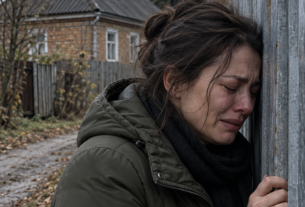
Then she pressed her forehead against the wall and exhaled—a long breath ending in a sob she had been holding inside for the entire hour.
Dashka came out of her room.
“Mommy, did Daddy leave?”
“He left, sweetheart.”
“Will he come back?”
Valya crouched down, lifted her daughter into her arms, and held her close.
“No, sunshine. He won’t come back. But we’re all right. You and I are all right.”
From the back room came Zinaida Pavlovna’s voice—hoarse, cracked, but alive.
“Valya, how about some tea? I’d like some tea. With jam. Ninka made cherry jam last year. Is there any left?”
“There is, Grandma. I’ll bring it now.”
Valya set her daughter back on the floor, adjusted her hair, and went into the kitchen.
The kettle was still sitting on the stove—the same one Andrei had boiled for himself.
The water was still warm.
Valya took out two cups.
One for Grandma.
The other for herself.
She opened the jar of jam.
Cherry jam.
Nina Sergeevna’s.
The last jar.
Outside the window, evening slowly descended over the city, like someone who had finally made it home.
Dashka sat on the hallway floor, drawing with felt-tip pens directly on the cardboard from one of Andrei’s boxes.
A sun.
A house.
And three figures—one big, one small, and one very small, bent over, holding a stick in her hand.
Mommy.
Daughter.
Grandma.
There was no fourth figure.