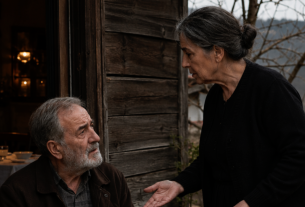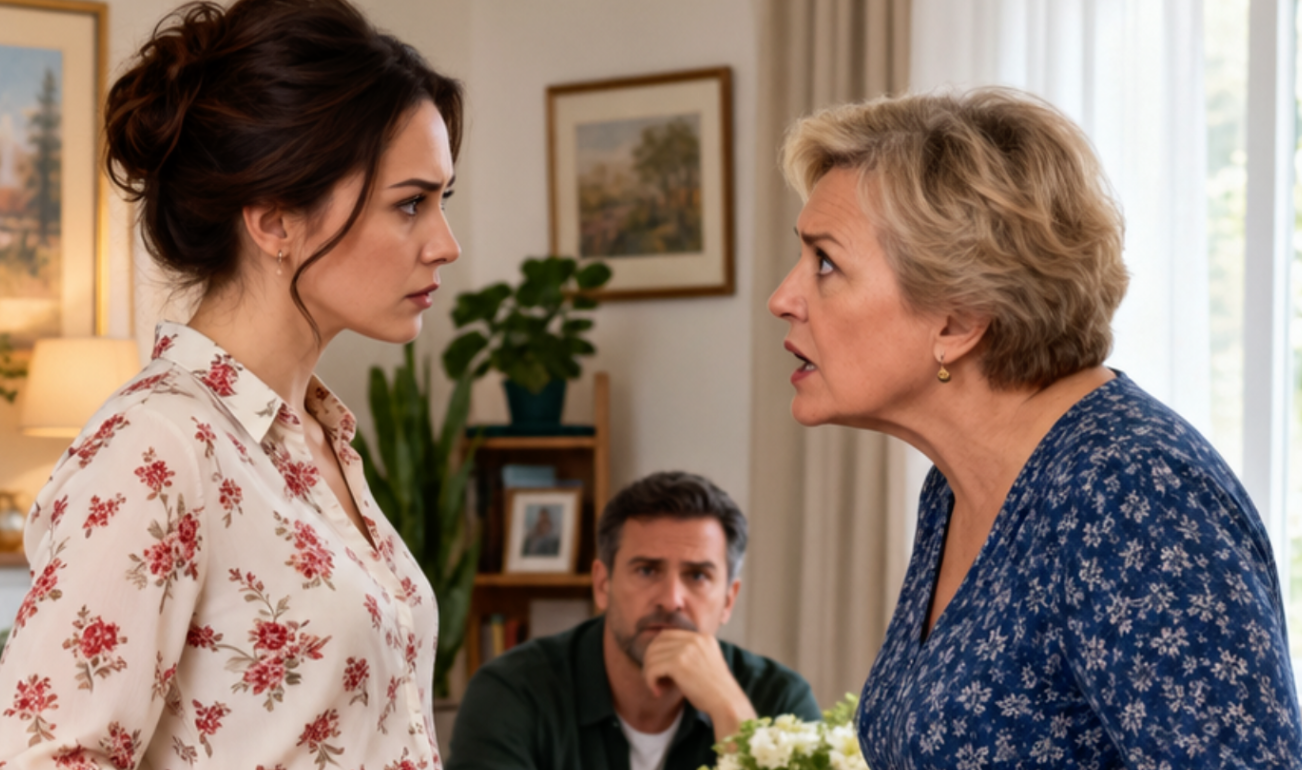
“You Should Be Grateful That We Put Up With You!” My Mother-in-Law Said at the Table. I Got Up and Walked Out — Forever
“Just look at her!” Antonina Semyonovna set her cup down so sharply that tea splashed onto the tablecloth, and no one at the table even moved to wipe it up. “Sitting there like a guest! This isn’t a restaurant, you know.”
Olya raised her eyes. Slowly, without rushing. She had learned long ago not to react too quickly, because a quick reaction only added fuel to the fire.
There were three people sitting around the round table in the living room: her mother-in-law, her husband Dima, and Olya herself. It was Sunday. A September morning, with a gray sky outside the window and the smell of damp, decaying leaves drifting in through the slightly open vent.
Antonina Semyonovna had arrived at ten, without warning, as usual, and immediately gone into the kitchen to inspect everything. Naturally, she found something wrong. What exactly no longer mattered. She could invent reasons for criticism out of thin air.
“Mom, that’s enough,” Dima said, reaching for a cookie.
That was it. “That’s enough.”
His signature way of defending his wife.
Olya looked at her husband. At his large, calm hands, at the way he methodically broke the cookie in half and put it into his mouth, as though nothing were happening around him, as though his mother had not just steamrolled over his wife.
They had been married for four years.
In those four years, Olya had managed to understand several things.
First: Dima loved her in his own way — sincerely, but completely helplessly.
Second: to him, his mother was like a force of nature. You did not argue with her; you simply waited for the storm to pass.
Third: you could spend a very long time waiting.
Antonina Semyonovna was a large, loud woman who was fundamentally convinced that she was always right. Judging by old photographs, she had even been beautiful in her youth, with a kind of heavy, forceful beauty.
Now she was sixty-two, and she wore those years like armor: with dignity and constant readiness for battle.
Her own apartment was permanently cluttered — piles of magazines, bags stuffed with more bags, dishes left unwashed with inexplicable persistence — yet she criticized other people’s housekeeping with the enthusiasm of an expert.
Olya’s apartment.
Olya’s and Dima’s, officially.
Antonina Semyonovna, however, did not concern herself with official technicalities. She had long ago divided up everyone’s territory according to her own rules.
“I’m just saying,” she continued, stirring her tea, “that some people don’t appreciate what they have. That’s all. You were accepted into this family. We put up with you. The least you could do is make an effort.”
Put up with you.
Olya felt those words settle somewhere beneath her ribs.
It didn’t hurt.
No, not anymore.
It was simply heavy.
Continued in the comments.
“Just look at her!” Antonina Semyonovna set her cup down so sharply that tea splashed onto the tablecloth, and no one at the table even moved to wipe it up. “Sitting there like a guest! This isn’t a restaurant, you know.”
Olya looked up. Slowly, without rushing—she had learned long ago not to react too quickly, because a quick reaction only added fuel to the fire.
There were three people sitting around the round table in the living room: her mother-in-law, her husband Dima, and Olya herself. Sunday. A September morning, with a gray sky outside and the smell of damp, decaying leaves drifting in through the slightly open window. Antonina Semyonovna had arrived at ten, without warning, as usual, and immediately gone into the kitchen to inspect everything. Naturally, she had found something wrong. What exactly no longer mattered. She could manufacture reasons for criticism out of thin air.
“Mom, that’s enough,” Dima said, reaching for a cookie.
That was it. “That’s enough.” His trademark way of defending his wife.
Olya looked at her husband. At his large, calm hands, at the way he methodically broke the cookie in half and put it into his mouth as though nothing were happening, as though his mother had not just steamrolled over his wife.
They had been married for four years. In those four years, Olya had managed to understand several things. First: Dima loved her in his own way—sincerely and completely helplessly. Second: to him, his mother was a force of nature, something you didn’t argue with but simply waited out. Third: waiting things out could take a very long time.
Antonina Semyonovna was a large, loud woman who was fundamentally convinced that she was always right. Judging by old photographs, she had even been beautiful when she was younger—a heavy, forceful kind of beauty. Now she was sixty-two and wore those years like armor: with dignity and constant readiness for battle. Her own apartment was permanently cluttered—piles of magazines, bags stuffed with other bags, dishes left unwashed with inexplicable persistence—but she criticized other people’s housekeeping with the enthusiasm of an expert.
More Details
Family Relationships svg
Family Psychology svg
Choose Kitchenware svg
Olya’s apartment. Olya and Dima’s, officially speaking. Antonina Semyonovna, however, did not concern herself with official technicalities. She had long ago divided up the territories according to her own rules.
“I’m only saying,” she continued, stirring her tea, “that some people don’t appreciate what they have. That’s all. You were accepted into this family, they put up with you—so at least make an effort.”
Put up with you.
Olya felt those words settle somewhere beneath her ribs—not painfully, no. They didn’t hurt anymore. They were simply heavy.
“I’d like to put up with some coffee,” she said evenly, stood up, and went into the kitchen.
Behind her, Antonina Semyonovna started saying something to Dima in a stage whisper—the kind of whisper perfectly audible from the next room. Something about Olya’s attitude, her arrogance, about “surely you can see it yourself.” Dima replied quietly and peacefully, trying not to offend his mother while technically avoiding betraying his wife.
Olya placed the cezve on the stove and watched the foam rise.
She remembered how it had all started. Her mother-in-law’s first visits—even before the wedding—had seemed like nothing more than personality. Fine, she was a harsh woman. Fine, she was used to giving orders. Olya had thought they would eventually get used to each other. People always adjusted to one another if they wanted to.
Antonina Semyonovna had not wanted to.
After the coffee, her mother-in-law began preparing to leave. That was a ritual of its own, one that took about forty minutes: first the handbag, then the wallet inside the handbag, then something forgotten in the room, followed by a conversation in the entryway that stretched on like chewing gum.
Dima walked her to the elevator.
Through the door, Olya could hear their voices—soft and affectionate, as though somewhere there existed another Dima, one who knew how to be caring and attentive, just not with her.
When he came back, she was standing by the window.
She looked at the poplar trees in the courtyard—already yellow, tired, dropping their leaves without the slightest regret.
“Don’t pay attention to her,” Dima said. “You know what she’s like.”
“I do.”
“She doesn’t mean any harm.”
Olya turned around.
She looked at him carefully, without anger.
“Dima. She said that people put up with me. At my own table, in my own home. That isn’t ‘not meaning any harm.’ That’s a position.”
He grimaced. Not because he disagreed—he had a habit of grimacing precisely when he agreed but didn’t want to admit it.
“What do you want me to do?”
“I want,” she said slowly, “for you to tell her ‘no’ at least once.”
Silence.
He looked away.
“I’ll talk to her,” he finally said.
Olya nodded.
She had heard that phrase probably a hundred times. “I’ll talk to her” meant, “Everything will stay exactly the same, but I’ll tell you what you want to hear.”
That evening, she went out alone.
She simply put on her jacket and left, without explaining anything, because there was no one worth explaining it to. Dima buried himself in his phone, and from his expression it was obvious that he had already moved on: conflict over, wife would calm down, life continued.
She walked through the quiet streets of the residential district. September smelled of damp earth and cold air. The streetlights had not yet come on, although dusk was already falling. Dog owners wandered around the courtyards, and somewhere a building door slammed shut.
An ordinary evening.
An ordinary city.
An ordinary life.
Only inside her, something was slowly, almost silently changing shape.
Olya reached a small park two blocks from home. There was a bench there—she loved that bench, although she had never told anyone.
She sat watching pigeons waddle along the path, a child dragging his mother toward a puddle, an old man holding a newspaper he clearly wasn’t reading because he was simply lost in thought.
There was something quiet and honest about the scene.
No one here was pretending.
No one was baby-talking or manipulating anyone.
They were simply living.
She took out her phone.
There was a name in her contacts—Nina. A friend she had not seen in almost six months.
Olya stared at the name for a long time.
Then she put the phone away.
Not today.
Today she needed to sit with this feeling—new, strange, a little frightening.
As though she had only just noticed a crack in a wall she had walked past for years.
The crack had always been there.
She simply hadn’t looked at it before.
“They put up with you.”
She remembered Antonina Semyonovna’s face—self-satisfied, wearing that particular kind of smile that wasn’t really a smile at all, but a demonstration of superiority.
And Dima beside her, chewing his cookie.
Calm.
Familiar.
A pigeon came almost right up to her, looked at her sideways with one yellow eye, then wandered away.
“I think so too,” Olya murmured to it.
She stood up. Adjusted her jacket.
And went home—for now still home, for now still out of habit.
But something inside her had already begun counting the days.
Three Weeks Passed
Antonina Semyonovna started appearing more often now—as though she sensed something, like a cat before a storm.
She would come on Saturdays carrying a bag of groceries no one had asked for, arrange them in the refrigerator the way she wanted, move things around on the shelves.
Not out of malice.
Worse.
With the confidence of an owner.
During those moments, Dima usually disappeared.
Not physically—he simply retreated into himself, into his phone, into some internal bunker where neither his mother nor his wife existed and where he never had to make a choice.
Olya watched.
Stayed silent.
Collected everything.
She herself had changed during those three weeks—she could feel it.
She argued less.
Explained less.
Something inside her had stopped wasting energy trying to get through to them and started using that energy for something else.
She had not yet put into words what that something was.
She simply noticed that in the mornings, while getting ready for work, she looked at herself in the mirror a little longer than before.
She worked at a small architectural firm—drawing plans, coordinating projects, visiting construction sites. The work was alive, full of character.
There, people called her by her name.
There, her opinion sometimes carried weight.
There, she was Olya—not “Dima’s wife” and not “the daughter-in-law.”
There was a colleague at the office named Anton.
They had worked together for about a year and a half, no longer, but somehow they had quickly understood each other. Neither of them liked unnecessary words. Both could sit beside each other in silence without discomfort.
He was divorced, lived alone, and occasionally complained in an amusing way about his neighbor, who played the trumpet in the evenings.
Olya had never thought of Anton as anything other than a colleague.
Until one day he said to her:
“Lately you look like you’re solving an equation. All the time.”
She was surprised.
“Is it that obvious?”
“To me, yes.”
They were standing beside the coffee machine in an empty hallway. Behind the glass partition, someone was drawing something. The phone at reception kept beeping unanswered.
“Everything’s fine,” she said automatically.
“Yeah,” he replied.
He took his coffee and walked away.
No pressure.
No advice.
He simply left her alone.
And for some reason, that one “yeah” affected her more deeply than if he had started questioning her.
The turning point came on Thursday.
An ordinary Thursday. Nothing remarkable about it.
Olya returned from a construction site—freezing cold, a folder of drawings under one arm, dreaming of a hot shower.
She opened the door and heard voices.
Two voices.
Dima’s and another one—a woman’s voice she didn’t recognize.
She stopped in the hallway.
The smell of coffee and something sweet drifted from the kitchen.
The voices were quiet, almost domestic.
Dima laughed—the kind of laugh Olya heard from him less and less often.
She walked into the kitchen.
A young woman, about twenty-five, was sitting at the table. Blonde, wearing jeans and a sweater. A mug stood in front of her.
Dima sat across from her—relaxed, animated, entirely unlike the man he usually was.
He saw Olya, and something shifted in his face.
Not guilt.
More like the confusion of someone caught by surprise.
“This is Zhenya,” he said. “The daughter of Mom’s friend. She came to the city and has nowhere to stay for a couple of days. I thought…”
“You thought,” Olya repeated.
It wasn’t a question.
She merely repeated his words.
Zhenya looked at her calmly and a little guiltily—like someone who understood she had walked into somebody else’s story but no longer knew how to get out of it.
Olya didn’t envy her.
“I can leave,” Zhenya said. “Really, I didn’t want to cause…”
“Stay,” Olya said. “This isn’t your fault.”
She placed her folder on the cabinet, removed her jacket, and hung it very carefully on the hook.
Then she went into the bedroom, closed the door, and sat on the bed.
He didn’t ask.
That was the main thing.
Not the girl.
Not the “couple of days.”
He hadn’t asked.
He had brought someone into her home, into her space, without even calling her first.
Just like his mother came over without warning.
Just like she rearranged jars in the refrigerator.
They were the same breed—Olya suddenly saw it with absolute clarity, like an architect who had finally understood which wall in a building was load-bearing and which was merely decorative.
Dima came in five minutes later.
“Olya, don’t turn this into…”
“I’m not turning it into anything,” she said. “I’m sitting here.”
“She really had nowhere to go. Mom asked me.”
“Of course she did.”
He sat beside her.
After a moment, he said in the tone he always used when he wanted to sound conciliatory:
“You understand that I couldn’t refuse.”
Olya looked at him.
“I understand,” she said quietly. “That’s the problem.”
He couldn’t think of anything to say.
He went back to the kitchen—to Zhenya, to the coffee, to something easy and uncomplicated.
Olya heard the conversation resume—cautious at first, then slowly becoming light again.
She stood up.
Walked over to the window.
Outside, September had already turned completely dark. Streetlights were glowing, and people were walking along the sidewalk carrying umbrellas—the rain had begun unnoticed while she was driving back from the site.
Her phone lay on the windowsill.
She picked it up and wrote to Nina—the same friend whose number she had not called three weeks earlier while sitting on the park bench.
“Are you busy? Can we meet tomorrow?”
The reply came almost instantly.
“Finally. I’ve been waiting. Coffee at ten?”
Olya stared at those words—“I’ve been waiting”—and felt something inside her, something that had been clenched tightly for a long time, slowly begin to loosen.
She didn’t yet know that Nina knew something important.
Something Olya had no idea about.
Something that would change not only the way she saw her marriage, but the entire picture.
For now, she didn’t know.
She simply wrote:
“Ten. I’ll be there.”
And for the first time in a long while, she smiled.
The coffee shop had some Italian-sounding name—Olya always forgot exactly what it was.
Inside, it smelled of cinnamon and fresh pastries. The windows were fogged from the rain.
Nina was already sitting at a corner table—small, energetic, with short hair and the look of someone who always had something to say.
They hugged.
Ordered coffee.
Then sat through those first few seconds of silence that two people need in order to find each other again after a long separation.
“You’ve lost weight,” Nina said.
“So have you.”
“I did it on purpose. You didn’t.”
Olya smiled.
It felt like old times.
“Okay, tell me everything,” Nina said, wrapping both hands around her cup.
Olya talked for a long time.
Not complaining—simply presenting facts, the way she was accustomed to doing at work: date, event, consequence.
Antonina Semyonovna.
The visits.
“They put up with you.”
Dima and his cookie.
Zhenya in the kitchen.
Nina listened without interrupting.
Only once did her eyebrows draw together slightly.
When Olya stopped talking, Nina put down her cup.
“Olya. I need to tell you something. And I don’t know how to say it gently, so I’m going to say it directly.”
“Go ahead.”
“I saw Dima. In July. On Sadovaya Street. He wasn’t alone.”
Olya didn’t answer.
She simply looked at her.
“A woman. Not Zhenya, someone else. They were walking—you know how people walk when they’ve been used to walking together for a long time. Not holding hands, but… together. Like that.”
Silence.
Someone at the next table laughed loudly.
Behind the counter, the barista was talking on the phone.
“You didn’t call me,” Olya finally said.
“I didn’t know how. I thought maybe I was mistaken. Maybe she was a colleague. But then… Olya, later I found out by accident, through Larka. Dima studied at university with her husband. She says he’s been seeing someone for… a long time.”
“How long is a long time?”
“She says about a year and a half.”
A year and a half.
Olya automatically calculated it—an architect’s habit of converting everything into units of measurement.
A year and a half ago, they had still gone to the seaside together.
A year and a half ago, she had thought they simply needed to communicate more.
“You’re angry that I didn’t tell you right away,” Nina said.
It wasn’t a question.
“No,” Olya replied.
And it was true.
For some reason, there was no anger at all.
There was something else—something like the feeling you get when you’ve been searching for a lost object for a long time and then discover that it had been lying in plain sight the whole time.
Not happiness.
Just clarity.
“What are you going to do?”
Olya looked out the window.
Streams of rain ran down the glass.
Outside, a woman in a red coat was struggling with her umbrella in the wind—comically and stubbornly.
“I don’t know yet,” Olya said. “But I know what I’m not going to do.”
“What?”
“I’m not going to wait for him to make the decision himself. I’ve spent too long waiting for him to decide anything.”
Nina nodded slowly.
“You need a lawyer.”
“Yes.”
“I have someone. A good woman, straightforward. Write down her number.”
Olya took out her phone.
Saved the number.
Put it away.
They stayed a little longer, talking about other things now—small things, Nina’s cat, an exhibition they had both wanted to see the previous year.
Olya drank her coffee and felt something rearranging itself inside her—quietly, without drama, like water finding a new level.
She returned home at half past midnight.
Dima was in the living room watching something on his laptop.
Zhenya, judging by the closed door to the guest room, was already asleep.
“Have a nice time?” he asked without looking away from the screen.
“Yes,” Olya said.
She went to the kitchen and drank some water.
She looked at the refrigerator.
Their photo from the seaside was attached to it with a magnet.
A year and a half ago.
In the picture, she was laughing.
He was looking somewhere off to the side.
She had never noticed that before.
Now she did.
In the morning, while Dima was still asleep, she called the number Nina had given her.
“Hello?” answered a composed female voice.
“Hello. I need a consultation. About division of property.”
“When would be convenient for you?”
“The sooner, the better.”
She spoke quietly, standing by the kitchen window.
Outside, the rain had stopped, and the groundskeeper below was methodically raking wet leaves into a pile.
The poplars were almost bare now—disheveled, honest, without any pretense.
At work that day, Anton asked her about one of the drawings—he needed to confirm a reference point.
They stood beside the table while she explained and he listened.
Then he looked at her—briefly, attentively—and said:
“You’re different today.”
“Different how?”
He thought for a moment.
“Like you finally know where you’re going.”
Olya said nothing.
She simply picked up a pencil and made a mark on the drawing—precise, confident, without unnecessary lines.
There was something right about that gesture.
She still didn’t know exactly how everything would unfold—the apartment, the paperwork, the conversation with Dima that still had to happen and that she was no longer afraid of.
She didn’t know exactly when she would tell Antonina Semyonovna what the woman had deserved to hear for a long time.
She didn’t even know what would happen to Zhenya or to the woman from Sadovaya Street.
But she knew one thing, solidly and firmly, like a load-bearing wall.
She would no longer wait.
Four Months Passed
January arrived dry and biting cold.
Olya walked along the embankment with her hands in her pockets and her scarf pulled up to her nose. Frozen snow crunched beneath her boots.
In weather like this, the city became strangely honest: no leaves, no softness, only architecture and sky.
The divorce had been finalized in November.
There had been no scandal—she hadn’t wanted one, and her lawyer had advised her against any unnecessary arguments.
The apartment remained Olya’s—it had been purchased before the marriage, so that part was straightforward.
Dima took the car and the silence, which both of them considered a fair division.
Antonina Semyonovna called once.
She spoke loudly, with that forceful confidence Olya knew by heart.
Olya listened.
Then said evenly:
“Antonina Semyonovna, this conversation is over.”
And hung up.
She never called again.
Nina helped rearrange the furniture the first weekend after Dima moved his belongings out.
They pushed the sofa around, dropped something, laughed at inappropriate moments.
Later they drank wine sitting directly on the floor because the table had not yet been put back in place.
“How are you?” Nina asked.
“I’m okay,” Olya replied.
And for the first time in a long while, it was true.
Nothing changed at work—except that breathing felt a little easier.
One day Anton suggested they have coffee not in the hallway, but at the café across the street.
She agreed.
They sat there for an hour, talking about architecture and the sea, and neither of them was in a hurry to leave.
Nothing more than that.
Not yet.
But that was enough.
Olya stopped beside the embankment railing.
The river below was dark, almost black, edged with a white border of ice along the shore.
Far in the distance, a tugboat moved along the water—slowly, stubbornly, against the current.
She watched it for a long time.
Then she adjusted her scarf and kept walking.