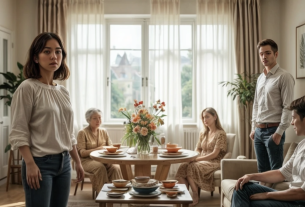
The new key was golden, with sharp teeth, and still smelled faintly of metal shavings. Marina placed it on the small cabinet in the hallway beside two sports bags and a checkered shopping bag that Sergei’s winter coat had refused to fit into. She had to fold the coat separately and tie it with the belt from an old bathrobe.
The kitchen clock showed half past one. The train was leaving at 5:40 p.m.
She sat down on the low stool by the door where she usually put on her shoes and suddenly realized she had no idea what to do with her hands. For thirty years they had always had something to do: hold a saucepan, an iron, someone else’s estimates, her son’s shirts. Now they simply rested on her knees as though they belonged to someone else.
Sergei was supposed to return from Denis’s place after lunch.
His key no longer fit the new lock.
Marina Alexeyevna was fifty-five years old. She had worked as a cost-estimating engineer for twenty-eight years—first at a design institute, and now at a construction company. She calculated how much it would cost to renovate an apartment, replace a roof, or insulate a building façade. Her numbers always balanced down to the last kopek. Her colleagues joked that Alexeyevna could glance at a wall once and tell you exactly how many bags of plaster it would take.
She had never been able to calculate her own life that way.
Sergei’s father left when the boy was four. He left quietly, without a scandal: he took the tape recorder, the winter tires from the Zhiguli, and left behind an unpaid electricity bill.
From then on, Marina lived alone and carried everything alone.
After work, she cleaned the stairwells in the neighboring apartment building so she could buy her son a winter coat. She took her vacation three days at a time: to paint the balcony, stay home with Sergei when he was sick, or finish digging potatoes at her mother’s country house.
The last time she had been to the sea was when her son was three. He had gotten badly sunburned in Kyrylivka, and for the rest of the week she rubbed kefir onto his shoulders.
She had worn the same pair of boots for six seasons. Twice she had glued the soles back on herself in the kitchen, pressing them down beneath a heavy dictionary.
But Sergei had private tutors for mathematics and English.
He got into the Polytechnic University to study computer science.
He wore a proper suit to graduation instead of cheap trousers from the market.
After receiving his degree, her son worked at an IT company for four months. Then he said the workplace was “toxic” and that “nobody appreciated initiative.”
After that came freelancing, then “his own project,” then something else Marina never quite understood, and for the past two years he had been “running a channel”: spending his evenings and nights playing video games with headphones and a microphone, narrating every move for a few dozen viewers.
Sergei woke up around noon.
Every evening, Marina found plates with dried ketchup waiting for her in the sink.
Her bank card, which was linked to his phone, was regularly charged for pizza, sushi, and various “gaming subscriptions.”
“Mom, these are investments in content,” he explained. “You don’t understand. That’s how everyone starts these days.”
She truly did not understand.
But she kept quiet.
Because he was her Sergei.
Because he was still trying to find himself.
Because, after all, she had no one else.
That Thursday at the end of September, it had been pouring since morning.
Marina got off the minibus carrying five kilograms of potatoes in one hand and a bag of vegetables in the other.
The elevator was broken.
She climbed to the fourth floor with two rest stops because the knee that had been aching for nearly three years was particularly painful that evening.
The kitchen greeted her with a mountain of dirty dishes and an open pizza box on the windowsill.
She placed the bags on the floor, caught her breath, and knocked on her son’s door.
He was sitting with his back to her, wearing headphones and loudly arguing with someone she could not see.
“Sergei,” she said, touching his shoulder. “Please help me. There’s another bag downstairs with the neighbor, and the trash needs to be taken out.”
He violently pulled off his headphones.
“Mom! Can’t you see what I’m doing?! I’m live! You’re bothering me! You always barge in at the worst possible moment!”
Someone’s laughter came through the headphones hanging around his neck.
Marina stood in the doorway.
The handles of the shopping bag she still had not put down dug into her fingers.
“I’m bothering you?” she asked quietly.
“Yes! Can you leave me alone for once?”
He put the headphones back on and turned toward the monitor.
Marina closed the door.
She went downstairs to the neighbor for the other bag by herself.
She took out the trash by herself.
She washed all the dishes by herself.
Then she sat in the kitchen and stared at her hands for a long time.
They were red from cold water, the skin cracked over the knuckles.
The hands of a fifty-five-year-old woman who, apparently, was a nuisance.
That evening, for the first time in many years, she did not cook dinner.
And for the first time, nobody noticed.
On Saturday, Sergei came into the kitchen at half past eleven, yawning and scratching the back of his head.
Marina was sitting at the table with a cup of coffee that had already gone cold.
“Sergei, sit down. We need to talk.”
“Mom, if this is about Thursday, I’m sorry. I was emotional. It was an important match.”
“This isn’t about Thursday. You’re thirty years old. I want you to find a job. Any job. I’m giving you one month.”
He laughed and reached for a plate of cottage-cheese pancakes.
“Any job? You’re suggesting that someone with a Polytechnic degree should go to a warehouse and carry boxes?”
“Even a warehouse. After graduating from university, I washed stairwells so you could go to school wearing a new coat.”
“Oh, Mom, here we go again…” He rolled his eyes. “People will appreciate me eventually, you’ll see. My channel is about to take off. Everything’s finally set up properly. I’ll even buy you a trip to a sanatorium one day. Then you’ll be thanking me.”
He kissed the top of her head, took the last pancake, and returned to his room.
A month passed.
During that time, Sergei updated his résumé on a job website once and complained twice that “employers won’t hire people without experience, but you can’t get experience without a job.”
Meanwhile, Marina’s bank card showed three pizzas, two burger deliveries, and a new gaming headset.
One evening Marina took a sheet of squared paper, a pencil, and did what she knew best.
She prepared an estimate.
Utilities—her son’s share.
Groceries.
His mobile phone and internet.
Food deliveries.
Clothes.
“Investments in content.”
The total came to eleven thousand four hundred hryvnias per month.
She multiplied it by twelve.
Then by seven, because that was how many years had passed since he graduated.
She stared at the number at the bottom of the page for a long time.
With that money, she could have properly renovated this very apartment, where the kitchen wallpaper had been there since the year 2000.
She could have gone to the sea every summer.
She could have bought herself boots that did not need to be glued back together.
But something else struck her even more.
There was not a single line in the estimate labeled “for Marina.”
The following week, her colleague Tatyana returned from the Carpathians and spent her lunch break scrolling through photographs on her phone: fog over fir trees, a wooden guesthouse, a waterfall, coffee on a terrace.
“Marina, when was the last time you actually took a vacation? A real one?”
“Me? I was at the country house in August.”
“No. I mean a vacation. Not working in the vegetable garden.”
Marina thought about it.
She could not remember.
That same evening, Tatyana sent her a link to a guesthouse in Yaremche.
Massage treatments.
Walks.
Twelve days.
Marina scrolled through the page until two in the morning.
The next day she went to her boss and submitted a vacation request.
A proper vacation.
Not three days at a time.
She bought a ticket for the overnight train through an app, checking the date three times.
She paid for the stay with money she had been saving for five years “just in case.”
She decided the “just in case” had finally arrived.
Then she called a locksmith.
“Changing a lock?” asked the man on the phone, who introduced himself as Vitaly. “Did you lose your keys?”
“You could say that,” Marina replied.
On Friday, Sergei said he was going to Denis’s birthday party and would stay there overnight.
Vitaly arrived at ten on Saturday morning. In forty minutes, he installed a new lock, gave Marina three keys, and left without asking a single question.
She was grateful to him for that.
She spent the rest of the day packing her son’s belongings.
She did it carefully, the way she did everything in life.
She ironed his shirts. She could not possibly give them to him wrinkled.
She paired up his socks.
She wound the laptop charger neatly and put it in the side pocket so he would not have to look for it.
She wrapped the laptop in a sweater.
She put a bag of sandwiches into each travel bag.
“Throw your son out and iron his shirts first,” she thought as she zipped one of the bags closed. “Who else would do something like that?”
She also prepared an envelope.
Inside were three thousand hryvnias, the same squared sheet of paper with the estimate, and another piece of paper.
On it, in her neat engineer’s handwriting, she had written down three job openings with telephone numbers: a building-materials warehouse near the metro, a delivery service, and a service center that repaired laptops and electronics and was looking for a technician.
She had personally called the service center on Wednesday.
They told her that someone with a relevant degree would gladly be accepted for a trial day.
And on Sunday, at half past one, she sat on the little stool beside the door and looked at the new key.
The doorbell rang at 2:05 p.m.
First there was prolonged scratching inside the lock, then a muttered curse, and finally someone pressed the bell.
Marina opened the door.
She was wearing a new mustard-colored coat she had bought two days earlier.
It was the first thing she had tried on in years for a reason other than simply checking whether the size fit.
“Mom, something’s wrong with the lock. My key won’t…” Sergei stopped when he saw the bags.
“Oh. What’s this?”
“Your things.”
“I don’t understand.”
“I changed the lock. Here are your things, and here’s an envelope. There’s some money for the first few days and three job openings. The service center is expecting you Monday at nine.”
Sergei laughed.
Then he stopped laughing.
“Are you serious right now? You’re throwing your own son out onto the street?”
“Not onto the street. I called Denis. He has a spare couch. He said you can stay with him for a week or two.”
“You called Denis?! Mom, are you… Do you even understand how this looks?”
“I do,” Marina said calmly. “It looks like a thirty-year-old man is going to live independently for the first time in his life. There’s nothing terrible about that, son. Everyone has to start sometime.”
He stared at her as though he were seeing her for the first time.
Then his gaze moved to her coat and to the small wheeled suitcase behind her.
“And where are you going all dressed up like that?”
“On vacation. To the Carpathians. For twelve days.”
“What vacation? You never go anywhere!”
“That’s exactly what I thought.”
He fell silent.
His lower lip trembled exactly the way it had when he was seven and had scraped his knee falling off a bicycle.
And Marina felt everything inside her rush toward him at once.
To hug him.
To take the bags back.
To say, “Come on, I’m joking. Come inside. I made cutlets.”
She tightened her grip on the suitcase handle.
“Sergei, you said I was bothering you. I thought about that for a long time. And you know what? You were right. I was bothering you. For thirty years, I kept you from becoming an adult. I’m not going to do that anymore.”
“What if I can’t find a job?”
“You will. You’re smart. You tell me that yourself every day.”
He remained silent for a long time.
Then, without another word, he picked up the bags, slung the shopping bag over his shoulder, and started walking down the stairs.
The elevator was broken again.
Marina closed the door, leaned her back against it, and cried for about ten minutes.
Silently.
Covering her mouth with her hand so the neighbors would not hear.
Then she washed her face with cold water, put on some lipstick—something she had not done in she could not remember how long—and called a taxi to the railway station.
She had a lower berth in the train compartment.
Across from her sat a gray-haired woman of about seventy wearing a fluffy beret.
She immediately introduced herself as Nina Vasilyevna and offered Marina homemade poppy-seed cookies.
“Traveling alone? Going on vacation?” Nina Vasilyevna looked at her over the top of her glasses. “Good for you. Until I was sixty-five, I lived entirely for them. For the children, the grandchildren. Jars, preserves, packages of food. Then my doctor said, ‘Nina Vasilyevna, either you start living for yourself, or there’s nothing more I can do for you.’ So now I travel.”
The conductor brought tea in glasses with metal holders.
The teaspoon quietly jingled in rhythm with the wheels.
Outside the window, dark fields drifted past, along with isolated lights at railway crossings and sleepy stations illuminated by yellow lamps.
Marina took out her phone.
There were already fourteen missed calls from Sergei and a message:
“Mom, this isn’t funny.”
She switched off the phone, placed it at the bottom of her bag, and for the first time in many years fell asleep without setting an alarm.
Yaremche greeted her with fog slowly sliding down the mountains and the smell of smoke and wet fir trees.
The guesthouse looked exactly like the photographs: wooden, slightly creaky, with windows facing the forest.
On the first morning, she slept until nine and then lay there for a long time, unable to understand where she was or why she did not have to hurry anywhere.
She went for massages.
She drank mineral water.
She walked to the Probiy Waterfall and stood there until her fingers went numb with cold.
She bought herself face cream.
For the first time, she did not choose the cheapest one, but the one the specialist recommended.
At the market she bought woolen socks and laughed for a long time when the saleswoman started trying to persuade her to buy another pair “for her husband.”
She turned her phone on once a day, in the evening.
On the first day, there were only angry messages.
On the second day, there were none.
On the third day, a message arrived:
“Mom, where’s the laptop charger? I can’t find it.”
She did not reply because the charger was in the side pocket, exactly where she had put it.
On the fifth day:
“Went to the trial day at the service center. They told me to come back. Grandpa Grigory, the senior guy there, says my hands grow from the right place. Not sure if that’s a compliment or not.”
Marina read the message three times.
Then she sat on the terrace for a long time with a cup of mint tea, smiling into the darkness.
On the eighth day another message arrived:
“Mom, how much water do you use for buckwheat? Denis and I burned ours, and now the whole kitchen stinks.”
It was the first message she answered.
“One glass of buckwheat to two glasses of water. Low heat. And don’t walk away from the stove.”
A minute later another message appeared:
“Thanks. How are you doing there?”
She thought for a moment and typed:
“Good. For the first time in a long time—good.”
The train arrived in Kyiv at seven in the morning.
The platform was cold and windy and smelled of wet asphalt and coffee from a vending machine.
She did not notice Sergei immediately.
He was standing near a column in a dark-blue work jacket with the service center’s logo on the chest.
In his hand were three yellow chrysanthemums wrapped in newspaper.
“Hi, Mom.”
He took her suitcase.
On his own.
Without being asked.
“I found a room,” he told her as they walked toward the exit. “In Troieshchyna. I’m splitting it with one of the guys from work. Payday’s in a week, but they already gave me an advance. Grandpa Grigory says that in a month he’ll let me start repairing motherboards. Can you imagine? Turns out I actually know how to do that.”
She did not interrupt him.
She simply listened to him talk about his work and realized that she had not heard that tone in his voice for at least ten years.
Beside the taxi, he stopped, shifted awkwardly from one foot to the other, and said without looking her in the eyes:
“Mom… I’m sorry about that Thursday. And about everything else too.”
Marina straightened the collar of his jacket.
Just as she used to before he went to school.
“Come over for vareniki on Sunday. Three o’clock. But this time, you’re making them.”
“With potatoes?”
“With potatoes. The same kind I carried up to the fourth floor by myself that day.”
He laughed.
For the first time during their entire conversation, he truly laughed.
Then he hugged her.
The key to the new lock lay inside her handbag.
One key.
She had hidden the other two in a kitchen drawer.
Marina was in no hurry to give them to anyone.
And the chrysanthemums remained on her windowsill for nearly three weeks.
Longer than any flowers she could remember.