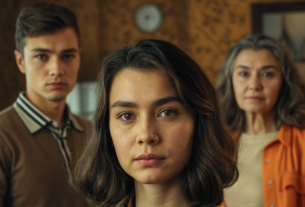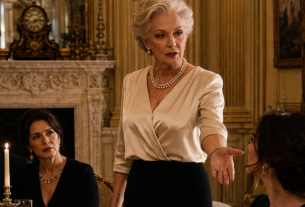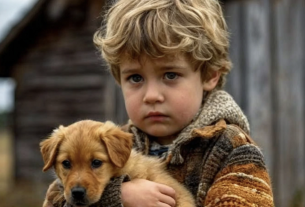
Polina was sitting on the floor, building a cardboard house with a balcony. Ksenia handed her strips of tape and held the walls so the structure wouldn’t collapse. The room was quiet, as usual: the crystal behind the glass cabinet glimmered, and the mahogany wardrobe stood motionless, like a monument.
«Mom, can I cut out a window here?» her daughter whispered. «You can. And you don’t have to whisper, we’re not in the library.» «But Grandma says loud voices give her a headache.» «Your head can hurt from lots of things. Sometimes even from the silence.»
Polina cut out the window and gently blew through it. Ksenia watched her daughter and thought that a six-year-old shouldn’t have to tiptoe around the house. For five years, they’d lived in these rooms, where nothing was their choice—from the faded rose curtains to the practical, ‘non-marking’ bathroom mat.
The phone rang just as the cardboard roof was finally in place. Ksenia picked up and heard Irina Alekseevna’s voice, a little too calm for an ordinary chat.
«Ksyusha, are you sitting down?» «I’m kneeling with scissors. Does that count?» «It counts. Your father and I have decided to sell the three-room apartment and split the money. Some of it is for you. It’s small, but you’ll have your own place.»
Ksenia sat right down on the floor next to the cardboard house. Words wouldn’t form a sentence; the letters scattered, like the legs of a chair spreading apart.
«Mom, are you serious?» «Serious as it gets. Your father did the math three times and once out loud.» «I don’t even know what to say.» «Just say ‘thank you’ and get yourself a decent bathroom mat.»
Polina came over and noticed her mother’s cheeks were wet. She got scared, tugged at her sleeve, and looked up into her face from below.
«Are you crying?» «I am.» «Did someone hurt you?» «Quite the opposite, sunshine. Sometimes, tears come from joy. A rare kind—almost extinct.»
Egor came home in the evening, took off his jacket, and immediately sensed something had happened. Ksenia was standing in the hall with her phone in hand, smiling in a way she hadn’t in a long time.
«Did you win the lottery?» «Better than that. My parents are giving us money for an apartment. Our own. With our own rules about noise and everything.» «Wait… I thought they always said someday, later.» «‘Later’ just arrived. It has a way of showing up unexpectedly.»
He hugged her, lifted her up, and spun her around, and Polina squealed with delight—and no one hushed her. Then Egor set his wife down, walked over to the coat rack, and his expression darkened.
«Finding the money was easier than telling my mom.» «We’re not committing a crime, Egor. We’re just moving out, not fleeing to another country through swamps.» «You know how she is. She treats any ‘no’ like a stab in the back.» «Then we’ll just have to explain it’s not a knife—it’s a key. To another door.»
He smirked, but his eyes were still worried. Ksenia looked at her husband and realized he was bracing himself, just like before a leap from a great height.
«We’ll tell her on Saturday, at the dacha,» he decided. «With my father there. He’s calmer.» «Perfect. With witnesses, there’s less chance the talk turns into a one-actor show.» «Ksyusha, don’t get worked up in advance.» «I’m not getting worked up. I’m warming up.»
We were up at six on Saturday. Ksenia baked her famous fish pie—the one Lyudmila Viktorovna always calls the only edible dish her daughter-in-law makes. Yegor was frantically searching the apartment for some papers, while Polina was on the hunt for her doll with the bright red braids.
“Did you find it?” Yegor shouted from the other room. “Found it! She’s coming with us and she’ll sleep on grandma’s windowsill!”
“Let her sleep there. The windowsill is the only place that’s clear of clutter.”
As we drove, our daughter stayed silent for a long time, until she suddenly asked a question that made Ksenia’s fingers tighten around her bag strap.
“Mom, is grandma going to kick us out?”
“Why would she do that?”
“Yesterday, she told grandpa that we’re a burden to her. I wasn’t eavesdropping—just walking by.”
Yegor glanced at his daughter in the mirror, then at his wife. Ksenia turned around, reached back, and held her little girl’s hand—warm and sticky from a piece of candy.
“No one’s kicking us out, Polina. We’re leaving on our own. That’s a big difference.”
“But where are we going?”
“Somewhere you can stomp around. Even in bunny slippers.”
The lilac by the gate was blooming so much its branches were draped over the fence. Lyudmila Viktorovna came out to meet them, apron on, gave her granddaughter a quick once-over, and wasted no time finding something to pick on.
“Her dress is wrinkled. Only people who don’t care let a child ride around in a wrinkled dress.”
“Hello,” Ksenia replied. “The dress got bored on the way—it started wrinkling itself.”
“Always with the jokes, huh.”
“And always with a pie. It’s my version of a white flag.”
Anatoly Pavlovich returned from the garden, nodded, took Yegor’s bags and went inside. They all sat down to the table just after noon. Lyudmila Viktorovna picked up the salad bowl and shook it like it was evidence.
“The greens are chopped way too big. Who cuts them like that?”
“Someone who believes in the freedom of dill.”
“And there’s too much oil. Tolya has a sensitive stomach.”
“Tolya has an iron stomach! He eats cucumbers straight from the garden, dirt and all,” Anatoly Pavlovich chimed in.
Polina reached for the bread, her elbow knocked the glass, and juice spilled across the plastic tablecloth, making a big yellow puddle. She froze. Lyudmila Viktorovna pushed her plate away, as if half a glass hadn’t just spilled, but her entire life had crashed to the floor.
“See? That’s what you call upbringing.”
“It’s just a spilled glass, not bad manners,” Ksenia said, already wiping it up. “Glasses get knocked over by everyone—even the perfectly brought-up.”
“In our family, children always sat straight at the table!”
“In our family, children are alive at the table. Sometimes that gets loud.”
Polina burst into tears. Yegor took a deep breath, set down his fork, and finally said what they had come to announce.
“Mom, we have some news. Ksenia’s parents are helping us with an apartment. We’ll be moving in a month.”
Lyudmila Viktorovna’s cup clattered onto its saucer. She straightened up, her face suddenly as sharp as the corner of a cupboard.
“They gave you an apartment? I don’t believe it. That money would’ve been better spent on the child’s education, not on walls!”
“Polina is six,” Ksenia replied calmly. “She’s got twelve years and a baby tooth before college. But we need a home now.”
“So you made all these decisions behind my back! In secret! I’ve fed you, given you drinks, put a roof over your head…”
“Your walls gave us that roof, and we’re grateful for it. But a roof isn’t the same as handcuffs.”
Yegor turned pale, and Anatoly Pavlovich looked away out the window. Lyudmila Viktorovna stood up, bracing both hands on the table.
«You! You turned him against me! He used to be normal, obedient, and now he’s like a stranger!»
«An obedient son and a grown man are two different roles. Egor moved from one to the other. Actually, I misspoke, it’s the other way around, from the first to the second. I really meant it in his favor.»
«Don’t you dare joke around in my house!»
«I’m not joking. I’m translating. You’re shouting in a language no one understands, so I have to choose my words carefully.»
His mother began breathing heavily, grabbed the back of a chair, and looked at her son as if he were already standing at the door with his suitcase.
«Egor! Tell her! Tell her you’re not going anywhere!»
«Mom, we are going.»
«Oh, so that’s how it is! So your mother means nothing now? Who raised you, who stayed up all those nights for you?!»
«You did,» Ksenia answered. «And that’s a huge achievement. But no one repays that by living with you forever.»
Polina was sobbing, clutching her doll to her chest. Egor got up, took his daughter in his arms, carried her outside to the yard, and sat her down on the bench by the lilacs.
«Dad, is grandma mad at me?»
«Not at you.»
«Then who?»
«She’s upset that we’re growing up. It happens sometimes.»
Anatoly Pavlovich followed them out, wiped his hands on a towel, and sat down next to them. He sat in silence for a while, then finally spoke softly, looking out at the vegetable beds.
«You’re doing the right thing. A family needs its own nest, not just a corner in someone else’s house.»
«Mom doesn’t agree.»
«Your mother’s been keeping her own rules for thirty years. And for her, there’s always just one answer: ‘I know best.’»
Back in the house, the shouting continued. Ksenia was stacking dishes in the sink—her hands needed something to do—and she heard every word through the opened window.
«She’s ruined my whole life!» Egor’s mother was saying loudly into the phone. «Zoya, can you believe it, they just ran away! Like thieves! Her parents probably paid them off just to take my son from me!»
«Really, Lyud, you don’t say,» came a voice from the other side of the fence. «I gave them everything, and what do I get? A stab in the back!»
Ksenia wiped her hands and stepped outside. Lyudmila Viktorovna was standing by the fence, speaking loudly enough for the neighbor—and the whole street—to hear.
«Lyudmila Viktorovna,» Ksenia said evenly, «if you want to share our story with the whole village, I can wait. I can even provide some extra details to make it more entertaining.»
«Are you eavesdropping?!»
«I’m just hearing you. There’s a difference… Sorry, I mean it’s not the same thing. You’re speaking so the whole town can hear, and nobody here’s deaf.»
«And I should be! Let them know who I let into my house!»
Neighbor Zoya quickly retreated to her own bushes. Ksenia walked down two steps and stopped.
«You let your son’s wife and his child into your home. For five years, we followed your rules: no noise, no moving things, no hanging anything up—because there’d be a hole in the wall. I never said a rude word to you once.»
«You were always silent and just bottled it up!»
«I wasn’t bottling anything up. I respected you. And now we’re leaving, and that’s the most respectful thing we can do: stop getting in each other’s way.»
«You’ll be back! Just wait until you run out of money!»
«If we do come back, it’ll be as guests, and we’ll bring a pie. But judging by your tone, you’d rather we showed up begging for forgiveness. But that’s not on my menu.»
Her mother-in-law took a step toward her, then stopped and waved her hand as if shooing away a wasp.
«Get out! Right now! And take your things—I don’t want to see you again!»
«Alright. But just so you know: you’re not forcing us out. We were already leaving, you just happened to slam the door loudly.»
We packed up in twenty minutes. Polina spun her doll in her hands, then left it sitting on the windowsill—the very same one where she had promised to let it sleep. Ksenia thought about reminding her, but her daughter was already running to the car, and none of us wanted to go back inside.
On the way, Irina Alexeyevna called. Ksenia put the call on speaker and listened to her calm, slightly teasing voice.
«So, how did it go?»
«Like an earthquake on schedule. Everything lined up perfectly.»
«Ksyusha, time heals all wounds. And grandkids are always loved, even if you fight with their parents.»
«Let them love her. Loving from a distance works too.»
A month later, we were washing windows in a nearly empty one-bedroom apartment. There were no rugs, no crystal, and instead of a mahogany wardrobe, just a rack made of metal pipes. Polina ran up and down the hallway, stomping so hard that the fridge shook.
«Mom! I’m loud!» she yelled. «Loud! And nobody yells at me!»
«And nobody yells at you. Just have mercy on the neighbors after ten, they have ears too.»
Egor hung a shelf, stepped back, admired his work, and looked at his wife. He hadn’t stood so tall in a long time.
«Ksyusha, I keep thinking… maybe we should’ve been softer?»
«We were soft for five years. Our daughter used to whisper because of it.»
«I dreamed about her last night. My mother. She just stood there, silent.»
«Let her be in your dreams. But we live in reality.»
That evening, the three of us chopped vegetables, argued about how much salt we needed, and lit candles that Irina Alexeyevna had brought. Polina clutched a match in both hands and puffed with seriousness.
«Mom, are we going to get my doll back?»
«We will. When grandma invites us.»
«What if she doesn’t?»
«Then we’ll buy a new one and name her the same. Names never run out, sunshine.»
In a month, Lyudmila Viktorovna hadn’t called once. Egor dialed her three times, listened to the long beeps, then put his phone back in his pocket, saying nothing.
In the city apartment with its crystal decorations, it was quiet. Anatoly Pavlovich watched TV with the volume low, while Lyudmila Viktorovna had been sitting motionless in her armchair for two hours.
«Tolia, do you realize the house is dead?»
«The house is still standing. It just has fewer people in it now.»
«It’s her! Her parents tempted her with money, and he agreed—just like a doormat!»
«He agreed as a husband. That’s a role, too, you know.»
She pressed her lips together and turned away. On the windowsill in their granddaughter’s room lay the doll with red braids, and no one dared to move it.
«Call them,» said Anatoly Pavlovich.
«So I can be humiliated?»
«So you can see your granddaughter. Polina is six. In another year, she might not even remember your name.»
Lyudmila Viktorovna stood up, walked over to the windowsill, and straightened the doll’s braids. Her fingers trembled, but she still didn’t pick up the phone.
«Let them come on their own,» she said to the empty room. «I’m the mother. I know how to wait.»
«You do,» her husband agreed. «But they’re not coming anymore. They’ve already arrived—just now, to their own place.»