For the second time this morning, Alina walked across the room with the picture frame in her hands, holding it up to the wall above the dresser. Inside the frame, her grandma, wearing a knitted sweater, had her arm around a skinny girl with a braid—that was Alina herself at about nine years old. That frame had spent the last five years traveling between the cupboard and the dresser, like a cat being shooed from its favorite spot.
«Just hang it already,» Gleb said, without looking up from his folded newspaper. «Why are you carrying it around like a relic in a procession?»
«You only have one nail, and it’s holding up the calendar with the pike on it,» Alina replied. «I’m not a barbarian, I’m not going to oust the pike.»
«We’ll buy a second nail.»
«You’ve been saying that for five years. The pike has become a dynasty.»
He laughed, and she laughed too, because it was such a light, clear Saturday, and they were planning to walk all the way to Otradnoye and back. On days like these, Alina easily forgave their little apartment for everything: its strangely sand-colored wallpaper, and the fact that not a single thing in here was truly hers.
«I have a whole gallery in the hallway on Chekhov,» she said, setting the frame on the dresser. «Grandma would have approved.»
«Your grandma had a good sense of humor.»
«When we finished the renovations there, she stood in the doorway and said, ‘Alinka, you’re going to live in beauty, and beauty requires that you don’t trample it.’»
«That’s a beautiful phrase.»
«She was a master with words. She used to say about the neighbor upstairs: ‘Decent man, but he walks like a piece of furniture.’»
Gleb put down the newspaper, and from that gesture alone, Alina knew: it was about to turn into a serious conversation. He had that look people get when they’re about to bring up something that seems trivial, but really isn’t.
«Listen, I wanted to ask you. Eva graduates from university in June.»
«I know. We gave her that vase last year, and she said it was ‘cool.’»
«She and Stas are being kicked out of the dorm. First of the month. They can’t afford to rent, you know that.»
«I understand.»
«And you’ve got that empty apartment on Chekhov. Just sitting there. You’re paying for heat, for electricity, but there’s no point.»
Alina sat down in the armchair and pressed her hands together. She didn’t like decisions being made behind her back—especially when everything had already been calculated without her.
«Let me have a day to think about it.»
«What’s there to think about?» Gleb threw up his hands. «A month, two at most. Just until Eva finishes her thesis defense.»
«A month, two at most,» Alina repeated. «That’s like ‘just five minutes’ at the dentist.»
«You’re such a cynic.»
«Fine, I agree,» she said almost immediately, because it felt awkward to haggle over a girl with suitcases. «But let’s discuss the conditions.»
«What conditions, it’s just between us,» Gleb waved off.
That was the first phrase that deserved to be written down.
Two weeks later, Alina went to the apartment on Chekhov to get her grandma’s photo album. She stood on the landing, pressing the button for a good three minutes, because the music behind the door was so loud the railings were shaking.
A guy she didn’t know opened the door, wearing just socks and holding a sandwich.
«Who are you looking for?»
«I’m here for the album,» Alina said. «And you, it seems, need a plate.»
«Who are you, anyway?»
«I’m the house spirit,» she replied as she walked in. «Been managing this place since ‘38.»
There were about six people in the room. A pile of jackets was stacked on the couch, and the parquet floor—the very one she and her grandmother had spent two weekends sanding—was now marked with dark tracks from shoe soles. Stas emerged from the corner, looking as pleased as someone who had finally figured out where they belong.
«Oh, Alina! Come on in, we’re having a bit of a spontaneous get-together.»
«Spontaneous is exactly what you’re doing to the parquet,» she replied. «That floor is older than the three of us put together.»
«It’s fine, really. Nothing will happen to it.»
«Stas, listen. My grandmother and I have scrubbed that floor on our knees with rags. I’m more attached to it than I am to some people.»
«Come on, relax,» Stas grinned from ear to ear. «We’re not homeless, you know. We’re careful.»
«Careful are the ones who take off their shoes. You’ve left marks like a quad bike ran through here.»
Eva emerged from the kitchen, spotted Alina, and instantly put on a show of being glad to see her.
«Oh, we weren’t expecting you.»
«Yeah, I noticed—judging by the mountain of jackets.»
«Our classmates just dropped by to celebrate passing our exam.»
«Passing what, the city itself?»
She took her album, asked for the music to be turned off, and stepped out. On the landing, the music came back on again exactly eight seconds later—Alina counted.
That evening, Gleb listened to her, nodded, and put on the face of someone who was clearly uninterested.
«Kids will be kids. We were just like that once ourselves.»
«Were we like this in someone else’s apartment? I don’t remember that.»
«Don’t get worked up. Let them stay until spring, and we’ll sort it out then.»
«Spring is eight months away, Gleb. We agreed on two months.»
«So what, you’re going to throw them out on the street?»
«I’m not throwing anyone out. I let them in, in case you forgot how things happened.»
«So be a good person till the end.»
«I will,» said Alina. «But with paperwork. A person with paperwork has a memory.»
«What paperwork? They’re family!»
«A rental agreement. Ends on April thirtieth. No registration. No renovations without the owner’s approval. Three signatures, two pages, and no hard feelings.»
«You’re acting like you’re renting to total strangers!»
«I’m renting to people who just spent eight minutes trying to convince me my parquet would be just fine.»
Gleb pressed his lips together and signed. Eva signed quickly, without reading, and even drew a little smiley next to her name. Stas scribbled his signature and said, «Cool, just like the grown-ups.»
All winter, Alina tried hard not to think about the apartment on Chekhov Street. It worked about as well as trying not to think about a toothache.
In February, Inga told her straight out—just two minutes before her break was over.
«Alina, don’t get upset. But do you realize how all this looks from the outside?»
«Like an act of kindness?»
«Like a scheme. Your husband lives in his own place. Your place is occupied by his daughter. You’re living at your husband’s, but the real owner is her.»
«Inga, you’re telling me the exact thing I tell myself in the elevator.»
«See? The elevator’s smarter than you.»
«Elevators are pretty smart—they at least know where they’re going.»
That evening, Larisa Petrovna called and finished her off with her signature wisdom:
«Alina, listen to your mother. That’s how things get taken away without anyone noticing. A year or two goes by—and suddenly it’s ‘we live here, and who are you?’»
«Mom, they’re only there temporarily.»
«Temporary is what happens on a train. There’s no such thing as temporary when it comes to apartments.»
Alina showed up unexpectedly in March, turned her key—and it actually worked, which already felt like luck. In the hallway, she found a bucket, a paint roller, and two packs of tiny floral wallpaper. The walls in the room were stripped down to concrete, with gouges in places, and the molding by the cornice was chipped in three spots.
Eva was up on a stepladder, pressing a strip of wallpaper with her palm. The paper was bubbling, the pattern didn’t line up, and the seam was spreading apart awkwardly.
“Eva.”
“Oh, hello! We decided it was time for a refresh.”
“You decided to refresh my wall. It’s like repainting someone else’s car just because you feel like it.”
“The old wallpaper was horrible, really gloomy,” said Stas, stepping out with a knife in his hand. “We were trying to make it nicer for ourselves.”
“There it is,” said Alina. “That word. ‘For ourselves.’ Thank you, Stas, you’re being very insightful today.”
“I mean for comfort.”
“Who broke the molding?”
“It broke by itself,” said Eva. “It was old.”
“It’s been there since 1938. It can be old. But you’re twenty-three, and you can read the contract you signed—with a smiley face.”
“Dad said you wouldn’t mind.”
“Dad isn’t the owner. Dad’s just a commentator.”
In April, the rental ended. Alina called and heard a calm, almost bored voice.
“We’re not moving out yet,” Eva said. “Dad knows about it.”
“Eva, April thirtieth was yesterday.”
“So what? I need somewhere to live, too.”
“You do. But not at my expense, and not on top of my molding.”
“You’re really counting everything, aren’t you.”
“I am counting. It’s a handy skill, you should try it sometime.”
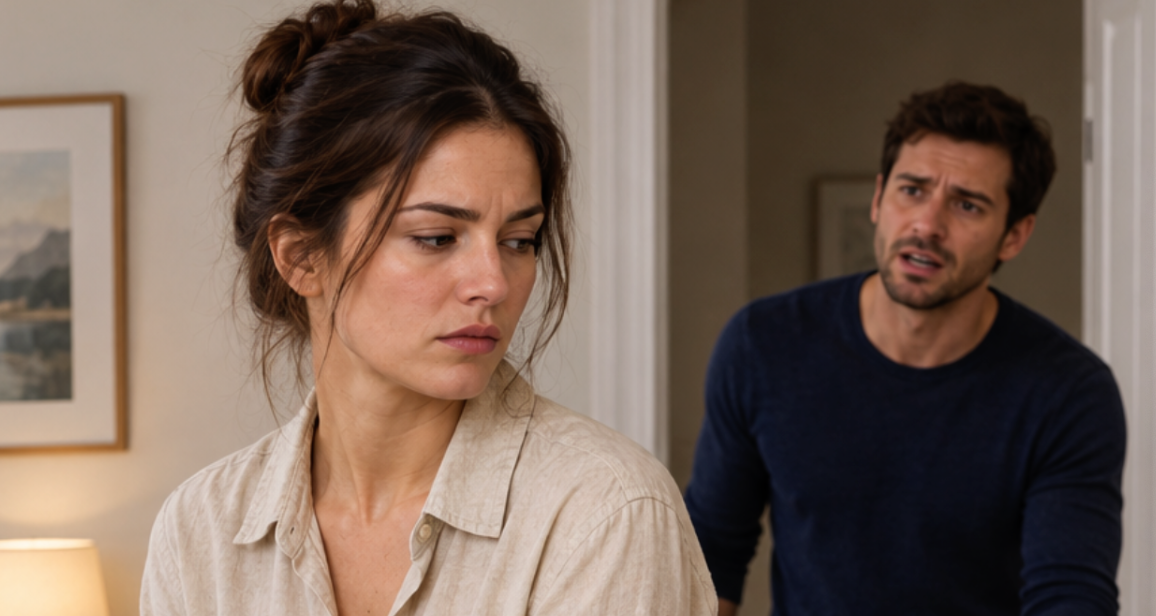
At home, Gleb met her right in the corridor, his voice shaking with anger.
“Did you call Eva and interrogate her?”
“I called Eva and reminded her of the date.”
“You’re a stingy woman, angry at the whole world! You really begrudge a corner to a child!”
“The ‘child’ is twenty-three, with damaged molding and bubbly wallpaper.”
“Wallpaper! You’re ready to throw a girl out because of wallpaper!”
“I’m ready to get my apartment back. The word ‘throw out’—belongs in another genre.”
“Do you realize she’s my daughter?!”
“I do. And this is my apartment. See how convenient that is: everyone has their own, no confusion.”
“You don’t value me at all!” Gleb raised his voice to that edge where people start saying things they’ll regret later. “I’ve supported you for five years in my apartment!”
“So you do know how to count ‘yours’? Just selectively, I see.”
“Don’t twist my words!”
“I’m not twisting, I’m setting things straight. All year, you explained to me that there are no boundaries among family. And now it turns out ‘family’ means you and Eva, and I’m just some hallway roommate.”
A week later, Alina went to Chekhov Street, put her key in the lock and felt it wouldn’t turn. The lock had been changed. She called: the apartment was silent, the kind of quiet you get when someone stands behind the door holding their breath. Eva’s phone was off, Stas didn’t answer, and Gleb picked up and said it was “not a good time right now.”
So Alina went to see Nikita, the guy in their office who would analyze any contract down to the last comma.
“Do you have the contract?” he asked.
“Yes. Signed, with a smiley face.”
“The smiley doesn’t matter. Lease is up, ownership is yours, and the place is in worse condition. We’ll draft a notice for eviction and compensation.”
“Will it take long?”
“Not really. There’s not much to argue here.”
“Then let’s write it up.”
She didn’t say a word to her husband. Three weeks later, a summons arrived, and Gleb stormed into the room with it in his hand, his face red and his voice hoarse.
«Did you file it?! Against my daughter?!»
«Against the tenants who changed the locks in my apartment.»
«Withdraw the documents! Right now!»
«No.»
«Do you hear what I’m saying?! Withdraw them!»
«I hear you just fine. You’re standing two steps away, yelling for the whole building to hear. No.»
«You’ve set all of us up!»
«Gleb, ‘setting someone up’ means they didn’t know. Everyone knew everything, including the dates. You just thought I’d complain a little and then let it go.»
«You should have! That’s how families do it!»
«Doing it the family way would have meant returning the keys. Instead, you changed the lock and went into hiding like fish in the mud.»
He grabbed her by the shoulder, then quickly let go.
«Take your hand off me,» Alina said calmly. «And remember this: I don’t wait for years. I don’t wait at all. I talk things out, and if that doesn’t work—I take action.»
She packed her bag in twenty minutes, left him his two-room apartment, his pike hanging on the wall, and his daughter on Chekhov Street, and left for her mother’s.
«That’s right,» said Larisa Petrovna as she cleared a shelf for her in the closet. «Just don’t turn back halfway.»
«I’m not turning back.»
«And don’t feel sorry for him. He’ll take care of pitying himself for the both of you, so you can finally relax.»
The case was handled quickly. The contract, the ownership documents, the expired term, the inspection report—there was nothing to argue about, and Nikita spoke only six sentences the entire time.
On the day of eviction, Gleb was hauling boxes to the car. Eva sat on the curb, Stas shuffled a stepladder from one hand to the other. None of them looked at Alina, and for once, this was the easiest schedule she’d had all year.
The apartment greeted her with bare concrete, stains on the ceiling, and a dripping faucet. Alina walked through the rooms, touched the chipped moldings, and said out loud to the empty space:
«Well, Grandma. Second time in the same river.»
The repairs took a month. The moldings were restored from molds, the parquet was sanded, and the faucet was replaced on the very first day. Alina put her books and photo frames on the shelves—all the ones that had lived in a closet for five years.
Meanwhile, in Bibirevo, a very different conversation was happening, and for the first time, Eva heard her father’s voice rise so high.
«Do you even get how much I have to pay?!» Gleb shouted. «It’s like a small car! A whole car because of your flowers!»
«Dad, I was just trying to do the right thing! I just didn’t get to finish the renovation!»
«Didn’t get to!» he seized on that like a lifeline. «Exactly! She’s the one who set us up! Let us in, and then slammed the door on us!»
«Yeah, that’s how she is,» Eva quickly agreed. «I really tried, but she counted every scratch.»
They spent the whole evening saying this to each other, because it was easier to blame Alina: Alina was far away, but his daughter was in the kitchen and wasn’t going anywhere. Gleb knew perfectly well who chipped the molding and changed the lock, but admitting it would mean being stuck in that apartment with someone to blame—and he much preferred being there with someone who was upset.
In the evening, Alina got a message on her phone: «Let’s try again. Just the two of us, no kids or apartments.»
She read it twice, deleted it, and washed her hands.
Then she took out the photos from the drawer—ones of her and Gleb by the sea, by the Christmas tree, at someone else’s wedding—and dropped them, a tidy stack, straight into the trash, no drama.
On the windowsill were three pots of violets and another with some sprawling plant she hadn’t figured out the name of yet. The gray cat with a mischievous face crawled out from under the chair—since her neighbor Zoya was hospitalized, and it seemed she’d be gone a long while, the cat had moved in with Alina, litter box, list of quirks and all.
“Well, Musya,” Alina said, settling into her grandmother’s chair. “No more floral wallpaper for us. But at least it’s ours now.”
The cat climbed onto her lap, kneading the blanket like a little landlady. From the hallway wall, a woman in a knitted sweater hugged a girl with a braid—the photo already hung on a new nail, hammered in on the very first day, with no more ‘we’ll get to it later’.