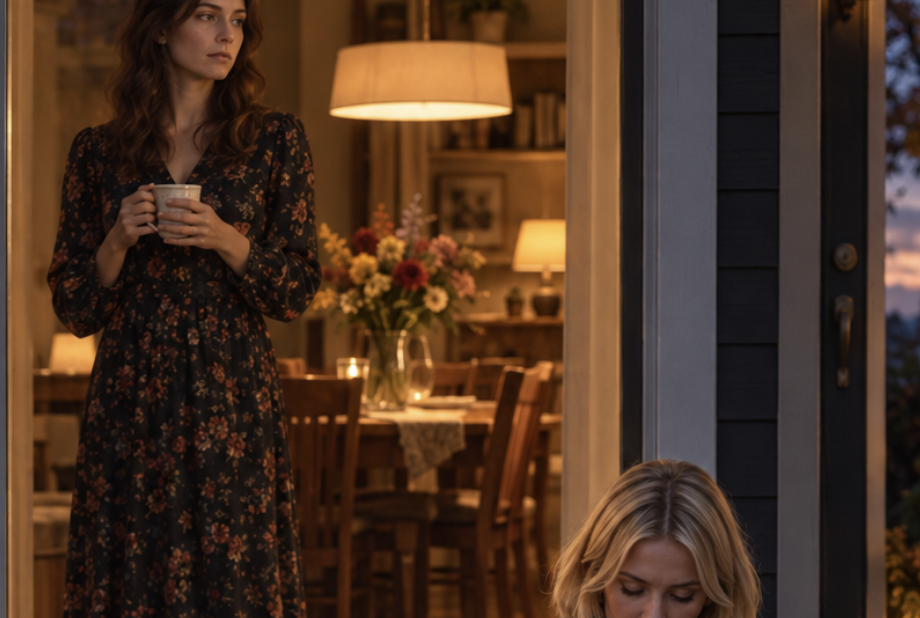
Darina recognized the little red box right away. Just last night, she had spent half an hour gazing at it through the kitchen window and still couldn’t bring herself to walk out onto the porch.
Now, the box sat on the second step, amidst the damp maple leaves. Overnight, frost had formed on the railings, and the porch light above the door was still on, even though daylight had broken—Pavlo had forgotten to turn it off again. Darina stood in her slippers, holding a bag of trash, unable to make herself bend down.
As if that box could somehow bite her.
* * *
Darina decided to celebrate her thirty-fifth birthday properly. Not at a café, where waiters rush to clear your plates, but at home, in the house on the edge of town she and Pavlo had spent six years finishing and finally completed. She spent two evenings baking Napoleon cake, roasted a duck with Antonovka apples, and borrowed six chairs from the neighbor. Pavlo and Matviy brought home a gold glittery ball from the store, and her son tied it himself to the vase of chrysanthemums because “it looks prettier that way.”
Guests started arriving from six. Her friend Khrystyna and husband gave her a beauty salon certificate, her coworkers chipped in for a set of pans Darina had been mentioning for a while. Her colleague Inna brought so many roses that they had to go in a bucket—there wasn’t a vase big enough.
Liza turned up at half past eight.
Darina heard the creak of the gate and, even before the doorbell sounded, knew it was her. Only her younger sister would fumble so long with the latch. Liza stood on the doorstep in the same beige coat she’d worn three winters ago, her hair damp from the drizzle. No bouquet. No gift bag. Not even a card.
“Happy birthday, Daryna.” She hugged her sister and rested her hands on her shoulders for a moment. “Sorry I’m late. I didn’t make it in time.”
“Come in. The duck’s already cold.”
Darina saw Khrystyna glance at Liza’s empty hands, then at her, and quickly change the subject. She noticed how Inna gave a polite smile. That polite smile stung more than any words could.
Liza never took off her coat, saying she was cold. At the table, she barely ate anything. She sat for about an hour, listened to Pavlo tell his story about the six-kilo carp for the third time, glanced at her phone several times. And the whole evening, she kept her right hand buried in her pocket, as if holding on to something.
* * *
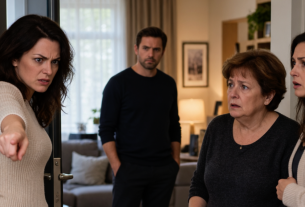
Once the last guests had left through the gate, Pavlo took Matviy to bed, and the sisters were alone in the kitchen. Darina put the plates in the sink, a little louder than necessary.
“You could have at least brought a chocolate bar,” she said without turning around. “I felt awkward in front of Khrystyna. She asked if everything’s okay with you, and I was just standing there, not knowing what to say.”
“I came to wish you a happy birthday,” Liza replied quietly. “Isn’t that enough?”
“It’s never enough for you, Liza.” Darina finally turned around. “When you moved two years ago, you called me at six in the morning and Pavlo drove your boxes. When you needed a room, I called half the city for you. But when I just want my sister to be around, you’ve got a shift, errands, or ‘sorry, I can’t make it’.”
Liza turned pale. The hand in her pocket clenched even tighter.
“You have no idea what my life is like right now.”
«Then tell me!» Darina tossed the towel onto the table. «You never say anything to me. I have to learn about you from other people!»
«Because I don’t want your pity,» Liza’s voice shook. «And I don’t want to hear ‘I told you so’ again. You’ve been saying that to me since I was twelve.»
She turned around and left. The front door slammed, and the glass on the veranda rattled.
«Maybe you should go out to her?» Pavlo stood in the kitchen doorway, wearing a t-shirt and holding Matviy’s teddy bear. «It’s cold outside.»
«She came on her own, she can leave on her own,» Darina shot back.
But she still walked over to the window.
Liza was sitting on the porch steps under the streetlamp, knees drawn up. A small red box rested on her lap, and both her hands gently covered it as if for warmth. Maple leaves kept falling on her shoulders, but she didn’t brush them off.
Darina turned off the kitchen light so Liza wouldn’t notice she was being watched. She stood in the darkness. Once, she even grabbed the door handle.
But she didn’t open it. The younger one had to be the first to come back, the younger one had to apologize. That’s what Darina told herself. When she peeked out again, the steps were empty.
* * *
Now, in the morning, she finally bent down.
The box was light, a little damp from frost. Inside, on a scrap of dark blue velvet, lay a silver bracelet—delicate, with small links and a clasp shaped like a leaf.
Darina sat right down on the cold step.
Their mom used to wear this bracelet every Sunday and on holidays. The clasp was stiff, and Mom could never fasten it herself—she’d reach out her arm to Dad, and he’d grumble that his fingers weren’t made for such tiny things, but he’d fasten it anyway. Little Darina would sit on the couch, watching it all like it was a small miracle.
Mom had been gone for nine years. She left behind towels embroidered in her youth, a recipe notebook, and an emptiness that nothing seemed to heal. And the bracelet had disappeared. It later turned out Aunt Vera, Mom’s sister, had taken it as a keepsake. Darina argued with her about it over the phone and hadn’t called since.
Under the bracelet was a page torn from a notebook. Liza’s handwriting—round, still like in school.
«Darinka. You once said that after Mom, you had nothing left but her recipe book. I remember how you cried in the kitchen then. Aunt Vera didn’t want to give the bracelet back just like that, so since spring I’ve been bringing her money in bits. On Thursday, I finally got it. I had it cleaned at the jewelry shop in the market, they tightened the clasp, too. Sorry there are no flowers. I only had enough for Mom’s bracelet.»
Darina read the note. Then read it again. And again.
«Since spring.» She remembered April, when Liza skipped the barbecue for the first time, saying she had a shift. In May, her sister didn’t make it to Matviy’s preschool graduation. In August, she offhandedly mentioned she’d moved out of her rented apartment because of «noisy neighbors.» Darina felt hurt back then that she hadn’t been asked to help with the move.
The page trembled in her fingers, and only now did she notice there was something on the back, written in smaller, uneven letters, as if scribbled on a knee.
«The print shop where I worked closed back in March. I didn’t tell you because you would’ve immediately started trying to help: looking for a job for me, offering me money, inviting me to live with you. But for once, I wanted to handle things myself. I gave up my apartment and now live in a friend’s room, did odd jobs at a café, washed dishes. Now I’ve finally found a decent job in another region, and they provide housing. The bus leaves Sunday at 8:10. I wanted to tell you yesterday, after everyone had left. It didn’t work out. Please don’t be mad. I love you.»
Darina glanced at her phone. Seven thirty-eight.
* * *
It was about a twenty-minute walk to the bus station. She got there in twelve: still wearing her green sweater from home, Pavel’s jacket thrown over it, and sneakers with no socks. She clutched the bracelet in her fist.
The blue bus was already at the terminal, the driver checking tickets by the front door. Liza was at the end of the line, a plaid bag slung over her shoulder, still in the same beige coat.
«Liza!»
Her sister turned around. In that instant, her face flashed with everything at once: surprise, fear that another fight was about to start, and something old and childlike that made Darina’s chest ache.
«What are you doing here? Did you run here in your slippers or what?»
«I’m in sneakers,» Darina caught her breath. «Why didn’t you say anything? Six months, Liza. For six months you’ve been washing dishes in a café while I was mad at you for not coming to our picnics.»
«Because I know how it would’ve gone,» Liza adjusted her bag strap. «You would’ve told Pavel, Pavel would tell his friend, and his friend would’ve hired me out of pity. And then for years, I’d keep hearing ‘if it weren’t for us’. I didn’t want to always be the little sister who needs saving.»
«And I didn’t want to be the sister you don’t even tell when you’re in trouble.»
They stood in silence. The driver glanced at his watch.
«I’m sorry about yesterday,» Darina said. The words came with difficulty, as though she was pulling them up from a deep well. «For the chocolate. For seeing you through the window and not coming out. I stood by the door, Liza. I held the handle. And didn’t come out because I was waiting for you to apologize first.»
Liza smiled slightly, just at the corner of her mouth.
«And I was sitting there thinking: any moment now she’ll come out and I’ll hand it over. But you never came. So I just left it by the door before I could change my mind.»
«Ladies, time to board!» the driver called.
Darina unclenched her fist and handed her sister the bracelet.
«Fasten it for me. I don’t know how, just like Mom.»
Liza put her bag down on the asphalt and took her sister’s hand. The little leaf-shaped clasp was stubborn, Liza bit her lip just like Dad used to, and finally, it clicked into place.
«There, it’s done.»
«Come for New Year’s,» Darina said quickly. «And no gifts, you hear? Just come. That’s all I want.»
«Yesterday you said otherwise.»
«Yesterday I said a lot of things. Forget it.»
Liza laughed, for the first time in these two days, hugged her tightly, really hugged her, and jumped on the bus. She took a seat by the window, pressed her palm to the glass. Darina placed her hand on the opposite side, and the bracelet chimed softly against the window.
* * *
She walked home slowly. Leaves rustled beneath her feet, smoke drifted from neighbors’ chimneys: people were already lighting their stoves. Pavel was waiting on the porch with two mugs of tea, asking no questions. He just handed her one.
Darina sat down on the same step where her sister had sat yesterday. Yesterday, only a door separated them. It would have taken just a second to open it. But overcoming her own pride took a whole night, a note on the back, and a twelve-minute brisk walk to the bus station.
The little leaf-shaped clasp was holding firmly. And if it ever came undone, Darina now knew exactly who to call.