For twenty years, a small squared sheet of paper hung on the fridge in Mom’s kitchen, held in place by a seahorse magnet. At the top, in Mom’s neat handwriting, was a single word: «Oleni.»
Below was a list that never seemed to end. Some things got crossed out, others were added in tiny letters along the side, as if Mom was embarrassed to ask again. «Receipts for gas and electricity.» «The bathroom faucet is dripping.» «Buy buckwheat, sugar, and flour at the market—it’s cheaper there.» «Wash the windows before the frost comes.» «Call Stasik, have him pick up the jars of pickles.»
Olena had long stopped reading this paper as a list of requests. It was more like a weather forecast: it simply existed, something you had to live with.
On Thursday evening, Mom called and said simply:
«Everyone’s coming to my place on Sunday. Stas and Yulia too. We need to talk.»
«Is something wrong, Mom?»
«Nothing’s wrong. Just get here early, Olia. I can’t make enough dumplings for everyone on my own.»
* * *
That October was damp and chilly. The heat in the building hadn’t been turned on yet, so Margarita Pavlivna walked around the apartment in a quilted vest over her robe. On the kitchen windowsill sat a bucket of apples from the dacha—the same ones Yulia had promised to take back in September.
Olena arrived at ten. She unpacked a bag of cabbage, put a pot on the stove, rolled up her sleeves. Mom sat across from her, rolling out dough—slowly and carefully, just like she used to.
«Stas will be late again,» she said, not looking up. «He has work.»
«He always has work,» Olena replied, immediately regretting it.
Mom looked up, holding her gaze for a long moment.
«Don’t start. You’re the eldest.»
Olena silently started on the cabbage. She’d heard those three words so many times, she could have said them in Mom’s voice, with the same tone, and the same faint sigh at the end.
The first time was when she’d just turned five. Grandma had knitted her red mittens with a white snowflake on each—the prettiest in the whole yard. But little Stas lost his on the ice rink. Mom simply took Olena’s off her hands and put them on him.
«You’re the eldest. You won’t be cold in the old ones.»
Olena didn’t cry then. She already understood—eldest children don’t cry.
After that, everything happened one after another, like beads on the same string. A coat from a cousin, while Yulia got a brand new puffy jacket. Summers spent in the city because there was only enough money for one to go to camp, so Stas went. Evenings checking younger siblings’ homework while Mom worked double shifts, because someone had to make sure the work got done.
Their father passed away when Olena was seventeen. That summer, she’d planned to apply to study literature—she dreamed of teaching, even wrote poems in a green notebook. But one evening Mom sat beside her on the bed and said softly, like she was talking to an adult:
«Olia, you understand, right? Two little ones. I can’t do it alone.»
So Olena started working at the post office—sorting letters and parcels. She promised herself she’d go to school part-time later. Next year. Maybe the year after.
Five years later, Stas applied for university—on a paid basis, since he didn’t score high enough for a scholarship. By then, Olena had already been setting aside money for her own distance learning. The envelope waited between the pages of a thick dictionary in her wardrobe.
«You’re the eldest,» Mom said. «You’ll have plenty of time. For a boy, everything depends on this.»
The envelope went to Stas. And after that, every year, every semester, a bit from every paycheck—just so her brother could finish school.
When Yulia was getting married, Olena was thirty-three. She’d been saving for eight years for a down payment on a small apartment, even a one-bedroom on the outskirts. Yulia came running to her, glowing, phone in hand, her dress photos ready to show off.
«Olia, you know—once in a lifetime! Mom says you’ll help.»
Olena helped. The restaurant, the dress, the photographer—everything she had.
Twelve years passed. When Stas got married, mom gave him grandma’s two-room apartment. Yulia got the dacha with apple trees and raspberries, «because kids need fresh air.» Olena rented a one-bedroom that looked out over garages and every Wednesday and Sunday she’d take the bus across town to Mom’s—bringing receipts, groceries, and a mental list marked «Olena’s.»
* * *
Stas showed up at three, just as the dumplings were steaming on the table. He kissed Mom on the cheek, nodded at his sisters, and sat down, putting his phone face-up on the table. Yulia arrived with a supermarket cake—the kind in a clear plastic box.
«Oh, Mom, you made so much food again,» she chirped. «Olia, you helped, right? You’re our treasure.»
Margarita Pavlivna took the special china out of the cabinet—the set with the gold rim, only brought out for New Year’s and birthdays. Olena noticed and felt something tighten inside.
After the dumplings, Mom wiped her hands with a towel, went to the other room, and came back holding a blue plastic folder.
«Well, kids,» she said, sitting down. «I’m not young anymore. I want to sort this out while I still have the strength, so there won’t be any arguments later.»
Stas set his phone aside. Yulia straightened up.
«I’m going to sign this apartment over to Yulia,» Mom placed her hand on the folder. «She has two kids, it’s cramped in those two rooms. Stas, you already got yours, you both know that. This is the fair way.»
«Mom, why so sudden?» Yulia blushed, but her eyes lit up.
«Makes sense,» Stas shrugged, reaching for another dumpling.
Olena put down her fork. The chime against the gold-rimmed plate rang loud in the silence.
«Mom,» she said quietly. «What about me?»
Margarita Pavlivna looked at her with genuine surprise, as if her daughter had just asked whether it was snowing outside.
«Why would you need it, Olia? You’ve always managed on your own. You’re strong. You’re the eldest.»
Yulia dropped her gaze to her plate. Stas froze with a dumpling on his fork.
Olena was silent for a long time. Then she stood up, walked to the fridge, and carefully removed a sheet of paper from under the seahorse magnet.
* * *
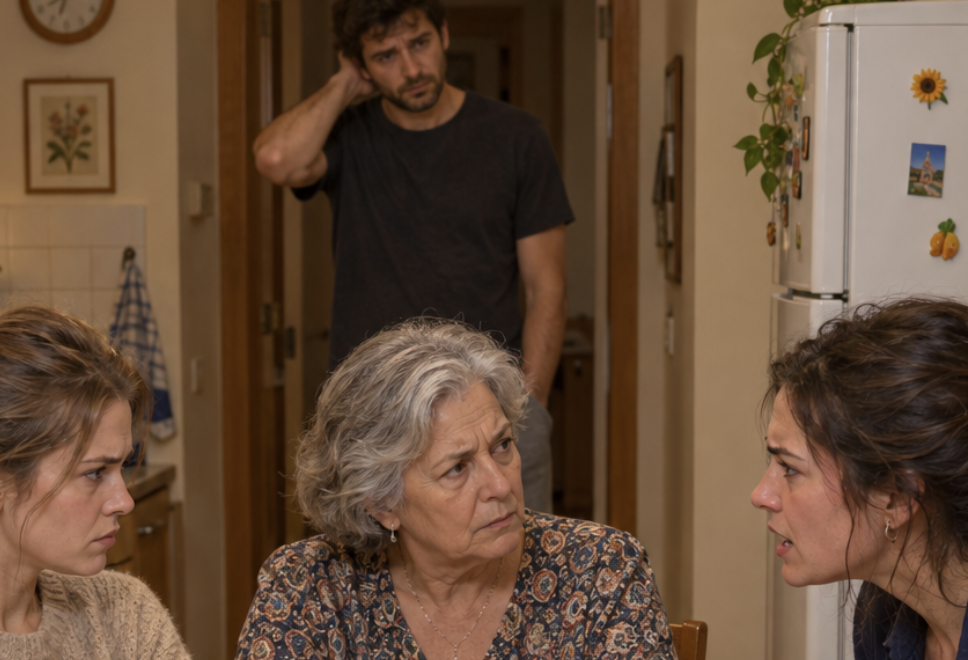
She came back to the table and placed the paper in the center, between Stas and Yulia.
«Mom, you’re asking why I need it. I don’t. Sign it over to Yulia, that’s fine by me. I’m not talking about the apartment.»
She spoke evenly without raising her voice, which only made everyone more uncomfortable.
«I was five when you first said, ‘You’re the eldest.’ Remember the gloves? No? But I do. I’ve been the eldest for forty years, Mom. I’m even older than you now—it’s me who calls to ask if you’ve eaten, if you remembered to turn off the gas, if you’re warm at night.»
“Olya…” Mom began.
“Please, let me finish. Just this once.”
Mom fell silent.
“Stas, I’ve paid your contract for all four years. Out of my job, and side gigs. Mom always told you it was from Dad’s pension—I know. I asked her to say that, so you wouldn’t feel awkward.”
Stas slowly put down his fork.
“Yulia, your wedding was my apartment. The one I never actually had. I don’t regret it, honestly. You were so happy.”
Yulia covered her mouth with her hand.
“I’m not asking you for anything. No apartment, no country house, no money back. I just have one request.”
She tapped her finger on the sheet of paper.
“Everything mom needs is here. Receipts—by the twentieth. I’ve already bought the gasket for the tap, it’s in the drawer by the sink. Windows—before the frost. It’s all yours now. Along with the apartment and the country house. From today, I’m just a daughter. Not the eldest. Just mom’s daughter.”
“Olya, you know I have work,” Stas said, flustered. “I can’t every Wednesday…”
“I know, Stas. I work too. For twenty-eight years.”
“I didn’t think you were upset,” Yulia whispered.
“I’m not upset. I’m just tired of being silent for the first time.”
Olena walked around the table, leaned over, and kissed her mom on the crown of her head—right where her hair had gone completely gray.
“I love you, Mom. And I’ll come visit. But as a guest. Like Yulia. Like Stas. With a cake, not a rag.”
She put on her coat in the hallway, quietly closed the door, and went down the stairs. It was drizzling outside. Olena walked to the bus stop, sat on a bench under the shelter, and for the first time in many years, she cried. Not out of hurt, but from how much easier it was to breathe.
* * *
Mom didn’t call for two weeks. Olena didn’t call either, though her hand reached for the phone every Wednesday at six.
On the evening of the third week, Stas called.
“Listen… I paid Mom’s utilities today,” he said, and paused. “There’s some weird number on the gas bill, I spent half an hour figuring it out. Did you do this every month?”
“Every month.”
“And I fixed the tap. Myself. Found the gasket in the drawer.”
“Good job.”
He was silent again, then asked in a completely different tone:
“Olya, why did you never tell me about the contract?”
“Because you never asked.”
Stas breathed on the phone for a long time. Then he said ‘sorry’—short, awkward, the way men do when they’re not used to apologizing. And Olena realized this was harder for him than fixing the tap.
Yulia arrived on her own, without calling first, on Saturday morning. She stood at the entrance of Olena’s one-bedroom apartment, looking around the narrow hallway, the three-hook coat rack, the window facing the garages.
“I’ve never been to your place,” she said, confused. “Can you believe that? Not once.”
They drank tea in the tiny kitchen, which barely fit the two of them. Yulia turned her cup in her hands and finally said:
“I told Mom I won’t take the apartment for myself. Let it be for the three of us. Or for you.”
“Yulia, you don’t have to. I told you, I don’t…”
“Maybe you don’t,” her sister interrupted. “But I do. So that I can look you in the eye.”
* * *
Mom called at the start of December, on the day the first snow fell—wet, heavy snow that melted as soon as it touched the asphalt.
“Olya,” her voice was soft and strangely unfamiliar. “Come on Sunday. You don’t need to do anything. Just come.”
Olena arrived with a cake. Not one from a store—she baked the honey cake herself, just like her grandmother once taught her.
The apartment was filled with the scent of cinnamon and baked apples. Mom greeted her at the door in a festive blouse, and Olena suddenly noticed how small she had become.
“Take your coat off, come in,” Margaryta Pavlivna bustled. “Sit down. Today I’m doing everything myself.”
Olena walked into the kitchen and paused.
On the fridge, beneath the same little seahorse magnet, hung a new checked sheet of paper. At the top, in her mother’s neat handwriting, it read: “For Olena.” And underneath—just one line:
“Apple pie. With cinnamon, just the way she loved it as a child.”
Olena stood there staring at that line, her vision blurring with emotion.
“I forgot you were little once, too,” her mom said from behind her, her voice trembling. “You had to grow up so fast, I didn’t even notice when it happened. Forgive me, my daughter.”
Olena turned and hugged her tightly—in a way she probably hadn’t since childhood.
That evening, they sat together in the kitchen for a long time, eating warm apple pie and reminiscing about Dad, red mittens, and an old notebook with a green cover. Mom asked her to read some poems, if she still had them. Olena promised to look.
And the sheet stayed right there on the fridge. With that single line, which nobody was in a hurry to cross out.