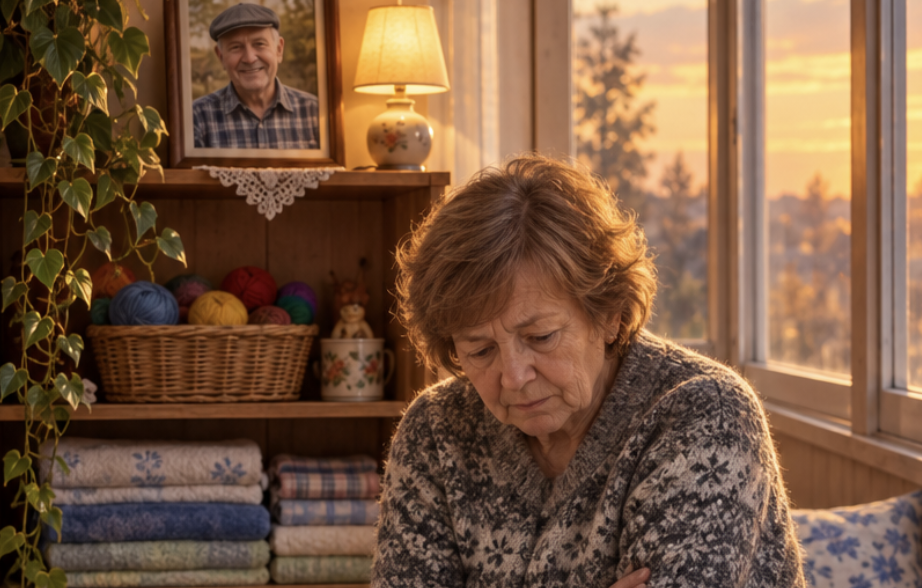
From her ninth-floor balcony, Maria Serhiivna could see forty-two glowing kitchen windows. She counted them during her first sleepless week in this new place, and every evening since, she checked if they were all still shining. It felt as if those windows belonged to her, too. As if someone out there was waiting for her gaze.
Her own kitchen was just two doors away. The scent of fried potatoes drifted in, forks clinked, Danilo chatted about school, and Oleg burst out with that short laugh she’d known since his first year at school. She heard every word. But stepping out there without a reason? She didn’t dare.
The balcony was enclosed and narrow, like a train compartment. Against the wall stood a folding bed covered with a mattress printed with blue cornflowers. In the corner, there was a shelf Oleg had once nailed up for her jars of preserves. Now, her things had taken it over: a green desk lamp she’d brought from the village, a blue saucepan with a lid—where she kept her threads and crochet hooks—and a photo of Petro in a wooden frame. In the picture, Petro squinted in the sun, holding a giant zucchini. He was so proud of it.
October had come in foggy. Every morning, the windows dripped with condensation, and Maria Serhiivna wiped them down with a rag so she could see the trees in the yard. Oleg had set up a heater, just like he promised. But she felt embarrassed to run it all night—it used up electricity, and Ira already sighed every month over the bills.
* * *
Petro passed away last spring. Quietly, without warning, as if he’d just stepped out to the yard for a minute and was taking too long to come back.
The house in the village immediately felt too big. Three rooms, the stove Petro would patch up each autumn, a well with a crane, the old apple tree by the gate—all of it now belonged to her alone, and she had no idea what to do with it. In the evenings, she turned on the radio, just so there’d be some voice in the house.
Oleg arrived at the start of summer. He wandered through the yard, peeked into the shed, and sat on the porch for a while.
“Mom, why stay here alone?” he said, eyeing the peeling fence. “Winter will come—who’s going to chop your firewood? Who’ll clear the snow?”
“I’ve managed so far…”
“That was when Dad was here. Come move in with us. There’s a room for you, and Danilo would love to have you around. You’ll be with your grandson instead of the chickens.”
“But what about the house?”
“We’ll sell it. Someone’s already asked—Kozachenko’s family wants it for their son. They’re offering good money.”
She stayed silent for a long time. She looked at the apple tree she and Petro planted when Oleg was a baby. Then she finally said:
“I’ll think about it.”
She thought about it for two weeks. Then, she made the call herself.
The Kozachenkos paid as promised. Maria Serhiivna brought the money to the city in a shopping bag wrapped in a towel. She placed it on the table in front of her son.
“You said you still owe money for the car.”
“Mom, no, that’s your money.”
“What do I need it for, son? Where would I keep it, under the mattress?” She waved her hand. “Take it. Pay off your debt, and you’ll breathe easier.”
Oleg accepted. He hugged her and kissed the crown of her head, just like she used to do to him.
“I’ll pay back every penny, Mom. I promise.”
“No need to pay it back. We’re family.”
* * *
The first few months, as she would later tell herself, were happy ones. They gave her the kids’ room, and Danilo happily moved to the living room sofa: the TV was there, so he could secretly watch cartoons until eleven. Maria Sergeyevna picked her grandson up from school, cooked enough borscht to last several days, made potato dumplings with fried onions just like Petro loved. Ira thanked her. She’d even brag to her friends on the phone: «My mother-in-law is a gem, now at least I’m not coming home to an empty fridge anymore.»
Maria Sergeyevna realized something was wrong because of the borscht. One evening she made a whole pot, and the next day saw it dumped in the trash bin. Ira didn’t even try to hide it.
«Maria Sergeyevna, we don’t eat such fatty food,» she said in a steady voice. «I’ve told you before. Please don’t cook for us, I’ll handle it myself.»
She hadn’t actually said that before. But Maria Sergeyevna decided not to argue.
Then the hints started. At first, they were gentle, almost casual.
«Danilo is already ten, he needs his own space. The poor kid does his homework in the kitchen, squeezed between the pots.»
«Oleh, did you see? He got another C in math. There’s nowhere to sit, nowhere to focus.»
Ira didn’t say these words to her. She said them to Oleh—in the kitchen, in the hallway, behind the bedroom door. But always loud enough for Maria Sergeyevna to hear.
Oleh stayed silent. He came home late from work, ate dinner while staring at his phone, and visited his mother before bed less and less often.
* * *
He brought the folding bed on Saturday evening, when Ira and Danilo had gone to her mother’s. He fussed around on the balcony for a long time: moving jars out, cleaning the floor, setting up a heater. Maria Sergeyevna stood at her room’s doorway, not understanding what he was doing. Then she realized.
«Mom, look,» he said, spreading his arms like he was showing her a new apartment. «It’s warm here. Double-glazed glass, I checked. I put a heater in too. And it’ll be quieter for you—no one will disturb you, Danilo won’t wake you up in the morning…»
She stayed silent.
«It’s just temporary,» he added more quietly. «Just until Danilo grows up a bit. You understand, right?»
He was looking down at the floor, at her slippers. They were checkered, blue—he had bought them at the market in the very first week. «So your feet don’t get cold, Mom.»
Maria Sergeyevna didn’t say a word. She went into the room that was no longer hers, took her striped pillow, a saucepan full of thread, and a photo of Petro. She carried them onto the balcony. Then she returned for her lamp. She hung her coat on a nail by the door. That was all she had left here, it turned out.
* * *
The hardest part wasn’t sleeping on the folding cot. She got used to that quickly: in the village, she’d had to sleep on the stove or on a bench when guests arrived. What was hardest was the kitchen.
She started trying to guess when the kitchen would be empty. At six in the morning, when everyone was still asleep. At two in the afternoon, when Ira was at work and Danilo at after-school care. She’d make tea, holding the lid of the kettle so it wouldn’t rattle. She’d wash her cup right away and put it back, leaving no trace. If Ira came in, Maria Sergeyevna would say «excuse me» and leave, even though she hadn’t done anything wrong.
One day she stood for a long time in the hallway with an empty cup, because from the kitchen she heard:
«…So what, am I not allowed to have a peaceful dinner in my own apartment? Oleg, I can’t even remember the last time the three of us sat down together.»
The three of us. Maria Serhiivna quietly slipped back out onto the balcony that evening and drank water from the bottle she kept under her folding bed.
On Sunday, Hanna called—her neighbor from the village. They had been neighbors for forty years, living just across the fence.
«So how are you doing, Marusia? How are the kids? Are you lonely?»
Maria Serhiivna gazed at the fogged-up window, at the forty-two foreign kitchens, at her own checkered slippers.
«I’m fine, Hanna. It’s warm at their place. My grandson’s smart, he’s in the fourth grade.»
«That’s good,» Hanna sighed in that neighborly way. «Oh, and the new folks here pruned your apple tree so it wouldn’t shade their garden.»
After that conversation, she sat on the edge of the folding bed for a long time, hugging herself. She didn’t cry. She just couldn’t figure out exactly when she had become something like luggage in her own family—no one really knew where she belonged.
* * *
That morning, they had breakfast early because Oleg had a meeting. Maria Serhiivna was already awake but lay still, waiting to come out until they left. The balcony door was cracked open just a finger’s width, because the heater made things stuffy.
Danylo was absentmindedly poking at his oatmeal with his spoon. Then out of nowhere, he asked, not really talking to anyone in particular:
«Dad, when you get old, will you need to move onto the balcony too?»
Oleg didn’t understand right away.
«What?»
«Well, like Grandma. By then I’ll be grown up, and I’ll have my own apartment. Should I put a couch for you out on the balcony? Or would a folding bed be better?»
He asked it completely innocently, the same way someone would ask whether to bring gym clothes for PE tomorrow.
The kitchen got so quiet that Maria Serhiivna could hear the tick of the clock above the fridge. Ira put her spoon on the table. She didn’t drop it—she set it down carefully, as if afraid to make too much noise.
«Eat,» Oleg said. His voice sounded strange, distant. «Eat, or you’ll be late.»
Nobody said another word during breakfast.
* * *
That evening, Oleg came out onto the balcony. Alone, no dinner, no phone. He stood and looked out the window. Then he sat down at the edge of the folding bed, which creaked under his weight.
«Forty-two,» Maria Serhiivna said.
«What?»
«Kitchens. I counted them. Over there, in the building across the way, on the sixth floor, there’s a woman who bakes something every evening. And over there, there’s a boy Danilo’s age doing homework, and his grandfather helps him. I know all of them already, but they don’t know me.»
Oleg was silent for a long time. Then he picked up a photograph of his father from the shelf and turned it in his hands.
«Why didn’t you say anything, Mom?»
«What was I supposed to say, son? You saw it for yourself.»
«I didn’t see,» he set the frame back in its place. «I didn’t want to see. It was easier that way.»
She didn’t reply. She just straightened his shirt collar, like she used to twenty years ago when he went on his first date. Her hand reached out on its own.
«I’ll pay you back,» he said without looking up. «All of it. You can buy yourself whatever you want…»
«It’s not about the money, Olezhenka,» she said softly. «I gave you that money myself and I don’t regret it. I just mean I’m scared to go out for tea in your apartment.»
That night she couldn’t sleep for hours. She kept wondering if she did the right thing giving everything she had, down to the last penny. Hanna would have said, «You’re a fool, Marusya, who gives everything away to their children while they’re still alive?» Maybe that’s true. But she wasn’t just handing over money. She was giving her son what she could, because in seventy-three years, she never learned another way. The pain did not come from being left with nothing. The real ache was that, along with the house, it felt like she had handed over the right to feel at home.
* * *
Oleh took the folding cot off the balcony two days later. By Saturday, he brought home a narrow bed from the furniture store and set it up in Danylo’s room, right next to the wardrobe. That was Danylo’s decision.
«I’m not cramped,» he told his parents in a tone that made it clear there was no point in arguing. «My desk is by the window, and grandma’s bed is by the wardrobe. And she can tell me stories about grandpa. And about the squash patch.»
This time Ira didn’t object. All evening, she moved quietly around the apartment, and when it was time for dinner, she herself set out a fourth plate on the table.
«Maria Serhiivna,» she said, without looking at her mother-in-law. «Come on, sit down. It’ll get cold.»
It wasn’t quite an apology. But her voice no longer sounded distant.
Maria Serhiivna sat down. In front of her was a steaming plate of buckwheat with gravy; Danylo was chatting about a test at school, Oleh passed her bread. The green lamp now rested on Danylo’s desk beside his textbooks. Just an ordinary dinner, an ordinary family—one of forty-two outside those windows.
Now—forty-three.