The stack of papers landed on the oilcloth before Mark even had a chance to take off his jacket.
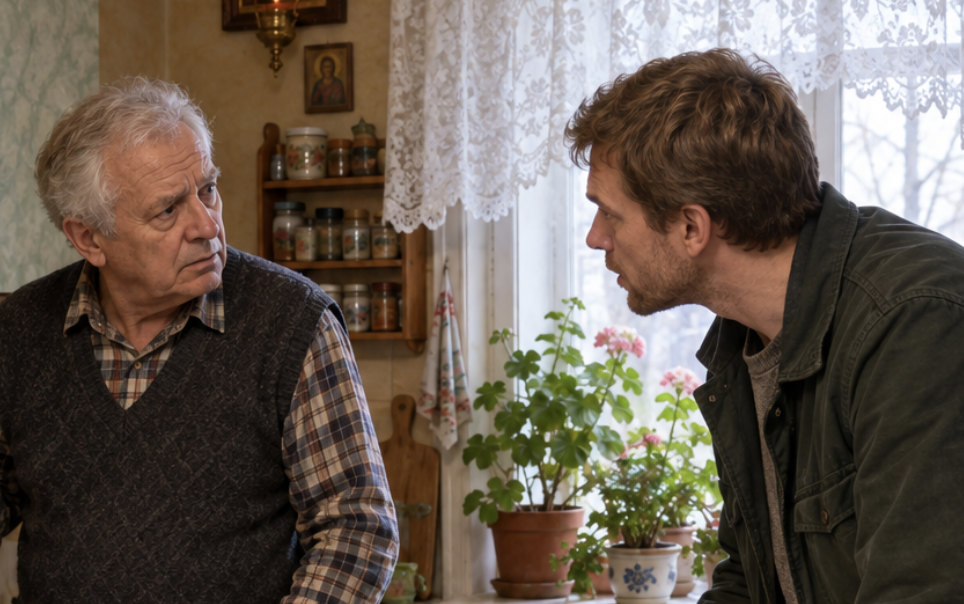
Ihor Stepanovych was just putting the kettle on. He’d heard the car brake to a stop at the gates, then the car door slam, then his grandson, without calling out, flick the latch on the gate himself. That’s how Mark used to come in when he was little: he always knew where the latch was, because his granddad had shown him once. Ihor Stepanovych even felt a pang of happiness at that familiar click.
Then his grandson walked into the kitchen, set his bag on a stool, pulled out a transparent folder, and spread it right between the sugar bowl and the plate of jam. Granddad had made that jam yesterday. He knew Mark was coming.
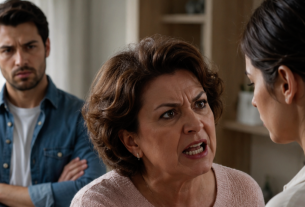
«Grandpa, please don’t get upset and just hear me out,» Mark began. «You’re already seventy-eight! Why do you need such a big house? Sign it over to me.»
Ihor Stepanovych just stood there, the kettle still in his hand. Then he finally set it on the stove and turned the handle. The gas flared up in a blue ring.
«Well, hello, Mark,» he said quietly.
«Yeah, yeah, hi,» his grandson replied with a wave, as if it was a minor thing to address later. «Grandpa, think about it. You’re here alone in a four-room house. You have to keep it heated, you have to clean it. The roof over the veranda is leaking again—I saw it from the car. And Christina and I have been living in rented places for two years. The landlady is raising the rent again after New Year, another two thousand. We’ll never have a place of our own at this rate. It’s just not fair, don’t you see?»
* * *
A year and a half. Ihor Stepanovych hadn’t meant to count, but the time counted itself.
The spring before last, Mark and Christina had gotten married in the city. Quietly, no guests. «Nobody does big weddings anymore, Grandpa; it’s a waste of money.» Still, Grandpa got himself ready: shined his shoes, took out the white shirt that Grandma Vira had ironed for his last big birthday, and caught the morning bus to the regional center.
He sat in a café next to the newlyweds, holding a tiny cup of coffee he didn’t even like, listening to them talk about work, prices, and some trip to the sea. He hadn’t given them his gift. He wanted to do it at home, the proper way. He hoped Mark would come, they’d sit at the table, do things like a real family.
Mark never came. He called on New Year’s and on Grandpa’s birthday, once sent a photo from the seaside: he and Christina tanned, wearing matching hats. Every time he promised: «Grandpa, we’ll definitely visit, just as soon as things calm down.» Ihor Stepanovych never complained. But every Saturday he’d open the window in the little room at the end of the corridor, the one the whole family still called Mark’s, and let in fresh air—even though nobody had slept there in a long time.
Grandma Vira passed away five years ago. Since then, the quiet in the house had only lessened because Grandpa learned how to fill it. The radio on the windowsill playing from the very morning. The chickens meeting him by the shed with their disgruntled clucks. The garden, the walnut tree by the well—which each autumn he had to hurry to harvest before the magpies got to it. He didn’t complain. He just waited.
* * *
Now he sat across from his grandson, put on his glasses, and picked up the papers. He read slowly, tracing each line with his finger, just like he used to read fairy tales to Mark. It was the deed of gift. His last name, Mark’s last name, the address, the cadastral number of the plot. At the bottom, someone had carefully made a little checkmark in pencil: sign here.
«I’ve already spoken to the notary,» Mark said, a bit faster than usual. «We can get everything done on Monday. I’ll drive you there myself and bring you back, it’ll only take about half an hour.»
«But where will I live, grandson?» asked Ihor Stepanovych, his eyes still fixed on the paper.
It seemed like Mark was expecting this question. He even looked a bit more relaxed, as if he’d finally reached the part of the conversation he had practiced on the way there.
«At a retirement home, of course! I’ve checked everything, Grandpa, there are good private ones. Clean, they serve meals three times a day, take care of everyone. There’s company your age so you’ll have people to chat with. You can play dominoes there, and there’s a big TV in the lounge. What more could you need? Here, you’re all alone. Christina and I will come visit you.»
«We’ll come visit you.»
Ihor Stepanovych took off his glasses and placed them on top of the deed. The kettle on the stove began to whistle softly, but no one got up.
Grandpa looked at his grandson for a long moment. At his new jacket with zippers on the sleeves. At the phone on the table, lighting up over and over again. At his hands, which Mark couldn’t seem to settle—now in his pocket, now fidgeting with his car keys. Once, those hands had held a hammer when Grandpa taught him to nail boards to the fence. The nails would bend, eight-year-old Mark almost cried from frustration, but Grandpa only laughed: «Don’t worry, son. Nails need a little convincing, too.»
Then Ihor Stepanovych got up, turned off the stove, and went to the sideboard. He pulled out the bottom drawer, the one where Grandma once kept her thread and buttons in a candy tin. From it, he took an envelope, a bit yellowed and held together with a rubber band. On the envelope, in big pencil letters: «FOR MARK. FOR THE WEDDING.»
«I wanted to give you something for your wedding,» Grandpa said, placing the envelope at the edge of the table. «But maybe now it’s not worth it anymore…»
* * *
Mark took the envelope as if he expected money inside. He slid his nail under the flap and pulled out the folded sheets. His face turned pale.
He recognized the first sheet immediately, since one just like it was under Grandpa’s glasses right now. Deed of gift. The house, the land, the same cadastral number. Recipient—Mark Olehivych. Prepared by the notary in the district center. The date was set for a week before his wedding.
Beneath the deed was a sheet of graph paper, torn from a school notebook. Grandpa’s handwriting, neat and careful, with little loops on the letters «d» and «v.» Mark read, and the lines swam before his eyes:
«Mark. The house is yours. I built it for your grandma, for your mother, and now for you. I only ask one thing: please don’t sell it. Move in here with Christina, there’s room for everyone. I’ll move to the summer kitchen—it’s warm and comfortable there, the stove is good. I don’t need anything else. I just want to hear someone walking in the house in the mornings.»
There was another faint jingle in the envelope. Mark tipped it over, and a front door key fell onto his palm. Hanging from it was a faded red string with a wooden fish-shaped keychain—crooked, with awkwardly carved scales. Mark had made it himself, years ago, with a penknife when he was about ten, the first time his grandfather took him to the pond.
«You… you never told me anything,» he barely managed to say.
«You never asked,» Igor Stepanovich replied simply.
He sat back in his chair, folded his hands on the table, and looked at his grandson—not with anger, but with a quiet, well-worn tiredness. That was the hardest part: not the anger, just that soft, settled fatigue.
«I wanted to give you the house—and myself—with it, Mark. But you came to take it without me.»
Mark would remember those words many times after. At work, in the car, in the middle of the night when he couldn’t sleep. They weren’t loudly painful, like an insult. They were just there, like a pebble in your shoe that you keep walking on and can’t shake out.
* * *
That day, he sat in silence for a long time. Then he slowly put his papers back into the clear folder, and pushed the folder to the very bottom of his bag, under his sweater. He placed his grandfather’s envelope on the table, carefully, with both hands, as if it were something very fragile.
«Grandpa,» he said and cleared his throat. «How are you anyway? How are you feeling? How did you get through the winter here alone?»
Igor Stepanovich smiled slightly. For the first time in a year and a half, his grandson asked about him.
«Better now,» he answered and turned the gas back on under the kettle. «The tea’s gone cold. Will you have some with jam?»
They drank tea until dusk. Grandpa told stories about the neighbor who bought himself a walk-behind tractor and now plowed everyone’s gardens on the street, about the chickens who suddenly stopped laying eggs in October, about the walnut tree that this year had so many nuts the branches were cracking. Mark listened, glancing now and then at the kitchen door jamb. On the white paint, pencil marks with dates were still there: ‘Mark, 4 years.’ ‘Mark, 7 years.’ ‘Mark, 11.’ The last one—’Mark, 15.’ Higher up, no marks had been added since.
Igor Stepanovich put the envelope back in the drawer.
«Let it sit there,» he said. «It’s not going anywhere.»
* * *
The next Saturday, a car pulled up at the gate again. This time, two people got out. Khrystyna carried grocery bags, Mark had a borrowed ladder and a toolbox. By noon he had patched the roof over the veranda. It wasn’t perfectly straight, but at least it no longer leaked. Grandpa stood below, passing up nails and offering advice, and when one nail bent, they both burst out laughing, remembering the same thing.
After that, they came every week. In November, they picked the last of the walnuts. In December, Khrystyna painted the windows in Mark’s old room and hung new curtains, light ones with a little floral print. On New Year’s, for the first time in many years, there were three people in the house and not enough space for all the plates on the table.
In spring, they moved in. Igor Stepanovich really did start packing his things for the summer kitchen, but Mark took the cardboard box out of his hands and carried it back.
«Grandpa, your room is yours. Don’t be silly.»
One evening, Grandpa pulled out the envelope again and handed it to his grandson. Mark shook his head:
«Later, Grandpa. Some other time. We’re happy here as it is.»
Then, in the summer, Khrystyna told them they were expecting a baby. That very evening, Mark picked up a pencil, sat down next to the kitchen doorway, and drew a short line low down—lower than where his own was marked at four years old. He didn’t write anything next to it. He just looked at his grandpa and winked.
Now every morning Ihor Stepanovych wakes up to the sounds of someone moving around the house. The floorboard creaks in the hallway, the kettle whistles, and Khrystyna softly hums something in the kitchen. He lies there for another minute, eyes open, just listening. Exactly the way he once dreamed it would be.