Artem was trying for the third time to get his silk tie in order, standing in front of the narrow hallway mirror. His fingers were visibly shaking with irritation and nerves. The reflection showed a man who wanted to hide from the world even before stepping out of his own apartment. The tie refused to form a proper, tight European knot. Frustrated, Artem tugged at the collar of his starched white shirt, his Adam’s apple bobbing anxiously in his neck.
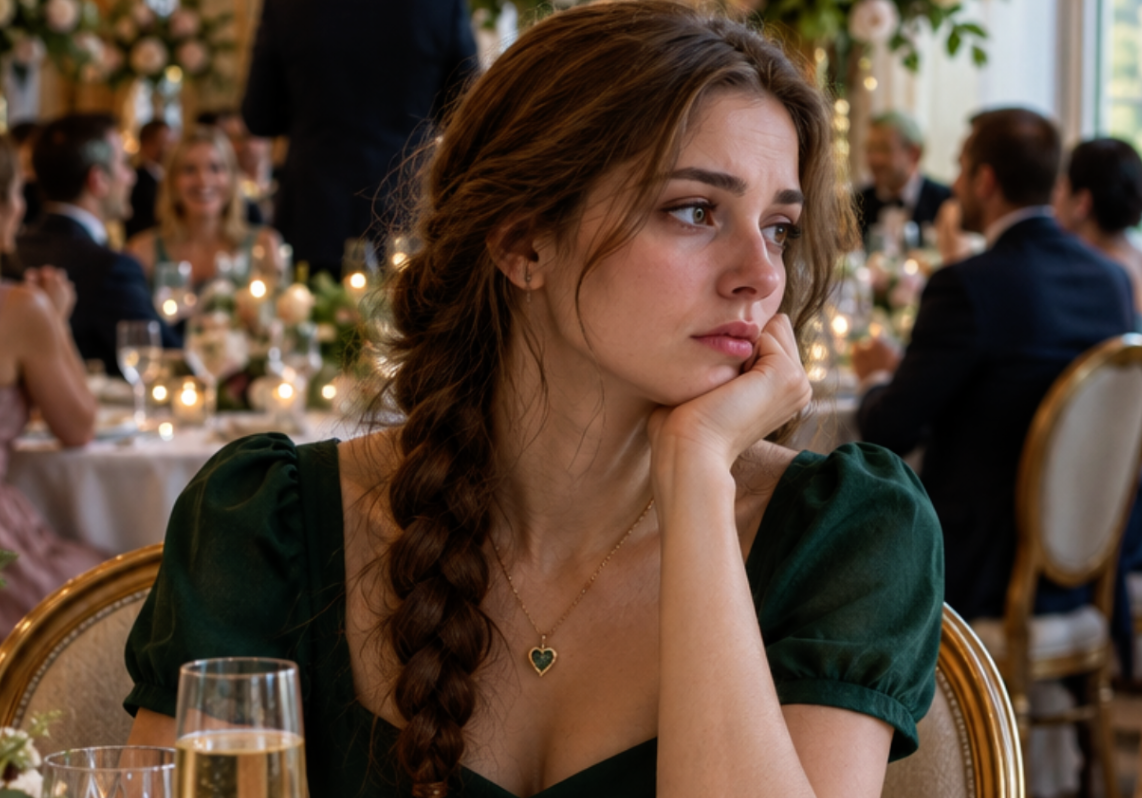
Close by, Nastya sat calmly on a small pouf near the front door. She had just turned thirty-one. She wore a simple dark green dress made of thick cotton, which she had sewn herself last autumn using old patterns. There were no deep necklines, sparkling jewelry, or bright makeup. Her face was fresh, sprinkled with a few light freckles, and a thick chestnut braid lay over her shoulder. Resting in her lap was a small wooden box, which she gently held with her slender fingers and neatly trimmed nails.
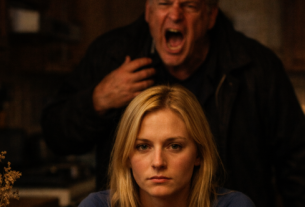
Artem suddenly spun toward his wife, his lips curling in annoyance:
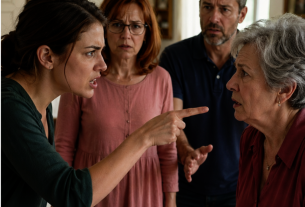
“Are you really going to go like that, Nastya? We’re heading to the factory’s anniversary! All the management will be there, the top engineers with their wives from the capital, even the deputy minister promised to attend. And you look like… like a music teacher from some remote village in the taiga! You could’ve at least put on some lipstick. And stop dressing like you just stepped out of the countryside.”
Nastya looked up at her husband with calm gray eyes. There was no outrage or desire to argue in their depths. Only a deep-seated weariness and quiet indifference toward his constant criticisms.
“My dress is clean, pressed, and perfectly decent. In respectable company, Artem, it’s not necessary to show off your whole body. As for makeup… Why should I become someone else? I am who I am, and that’s exactly how I plan to show up. If you’re embarrassed to be with me, I can stay home. I’ll bake cranberry pies and wait for you to come back.”
Artem let out an irritated sigh and adjusted the lapel of his dark blue jacket.
“Stay home? Don’t even think about it! The shop manager specifically warned: all lead technologists must attend with their spouses. The general director will personally meet every employee’s family, and he’s the one who approves the promotion lists for main management. If I show up alone, they’ll think I’m antisocial or hiding something. But if you come with me, everyone will start whispering that Kovalev married a milkmaid! So please, just keep quiet this time. Don’t embarrass me with your country sayings. Just stand next to me, smile, and nod when you need to.”
Nastya didn’t answer. She simply hugged the wooden box closer, stood up from the pouf, and was the first to leave the apartment onto the landing.
They spent eight years together. Artyom was born and raised in a regional center, always seeing himself as someone with urban habits and great potential. Working at the factory, he saw a real chance to move up in life. He devoted himself to learning the technical manuals, tried hard to please the bosses, picked up trendy phrases, and lived in constant fear that somebody might call him a country bumpkin.
He once brought Nastya from a tiny taiga village, lost somewhere near a northern river. Back then, Artyom was truly captivated by her pure voice, open gaze, and the wonderful warmth of her hands. But things started to change after he was offered the position of senior technologist and given a new company apartment. Slowly, his attitude toward his wife shifted. What he used to see as her naturalness and simplicity now felt like an unpleasant mark he couldn’t erase.
He felt ashamed that Nastya cooked borscht in clay pots instead of ordering trendy Japanese dishes. It irritated him that she greeted the janitors in the yard and could stop for a chat with them. Even the scent of mint and thyme on her hands after chores bothered him. In his mind, his wife should smell of expensive French perfume from a high-end mall, not of herbs grown in a country garden.
The banquet hall in the local community center buzzed with real festive excitement. Crystal chandeliers sparkled from the ceiling, pouring golden light onto the polished parquet floor. Glasses gleamed on the long tables, while waiters in pristine white shirts carried around a variety of appetizers. The wives of the factory management showed off their fancy outfits, flaunted gold jewelry, and competed with each other in the elegance of their evening hairstyles.
The moment they entered the room, Artyom felt all eyes turn their way. The planning department head, a well-groomed man in an expensive grey suit, glanced at Nastya’s dress with a condescending smile. His wife, whose hair was teased and dyed into a towering hairstyle, giggled quietly into her glass and whispered something to her neighbor. Artyom caught a mention of a “simple rural club.”
His face flushed instantly, and it felt like even his ears were burning with shame.
“Wait here,” he muttered through clenched teeth without even looking at Nastya. “I need to talk to the technical department people. There are some work issues to discuss. Just don’t go anywhere.”
He strode quickly to the other side of the hall, grabbed a glass of mineral water from a tray, and joined a group of young engineers. He pretended to be completely absorbed in a conversation about upgrading the casting furnaces, but his gaze kept drifting back to the far corner where his wife stood.
Nastya stood by the tall window. She didn’t try to hide or shy away from the curious looks of the elegantly dressed women, nor did she slouch or seem embarrassed by their mocking glances. For a while, she admired the whimsical frost patterns on the glass, then calmly took a seat on an empty chair at the end of the banquet tables, her hands resting gently on her knees.
Her back remained straight, every movement measured and confident. There was something regal about her, like a woodland princess who had somehow wandered into a bustling fair. Although Nastya clearly didn’t fit into the atmosphere of this hall, her calmness radiated so much inner dignity that the women at the nearby table gradually stopped whispering. They couldn’t find a single thing in her demeanor to mock anymore.
At exactly eight o’clock, the music stopped. Conversations faded away, and the room filled with a sense of anticipation.
Through the central doors stepped the company’s general director—Valery Pavlovich Voronov. He was a tall, solid man nearing sixty, with short silver hair at his temples and a piercing gaze that spoke of someone used to harsh conditions and serious challenges. In the past, he had worked as a polar geologist.
Voronov had managed the plant for over twenty years. His tough personality kept employees on their toes, but his authority was undeniable. Under his leadership, the company not only survived difficult times but also became one of the most important enterprises in the entire north.
Next to the director walked his son Denis, a sturdy young man of about thirty. Denis had only recently returned to his hometown after graduating from a technical university in the capital.
Valery Pavlovich made his way to the center of the hall and took the microphone. His speech was brief but meaningful. He spoke about the people who had worked honestly at the plant for years, about the families who had built legacies there, about loyalty to their northern homeland, and about responsibility to future generations.
When he finished, the hall burst into loud applause. Artyom clapped especially hard, trying to inch closer to the second row so the director would definitely notice his enthusiasm.
Once the official speech was over, Valery Pavlovich handed the microphone to the host and began making his way slowly along the tables. He personally greeted the company’s veterans, shook hands with foremen, and exchanged a few words with longtime employees.
Artyom instantly straightened up, almost as if on command. His heart was pounding so loudly he felt it in his throat. The general director was approaching their section. First, he greeted the head of the planning department, then exchanged a nod with the chief engineer.
Now it was time for the technologists!
Artyom quickly put on his friendliest face, got ready to talk, and was just starting to say his greeting:
“Valery Pavlovich, good evening! I’m from the technical…
But the director didn’t even turn his head in his direction.
Suddenly, the general director’s attention was drawn to a woman sitting by the window. It was as if he saw someone completely unexpected. Valeriy Pavlovich stopped sharply in mid-step, as if he’d hit an invisible wall. His gray eyebrows lifted, his eyes widened, and his usually stern, unreadable face transformed. It was as though a wave of intense surprise had swept over him.
«Dad, what’s wrong?» Denis quietly asked as he followed his father.
Voronov didn’t answer. He didn’t even notice how the employees around him froze with their glasses raised. The general director quickly made his way right across the hall to the far window, where Nastya was.
Artyom felt a chill inside. Worrying thoughts rushed through his mind: «God, what has she done?! She must be sitting wrong, looking inappropriate… Now we’ll both be kicked out of here in disgrace! And there goes my whole career!»
Nastya noticed the approaching director. She got up from her chair calmly, smoothed the folds of her green dress, and stepped toward him.
Valeriy Pavlovich stopped very close, just two steps away from her. He was breathing heavily, taking in every detail of her face, her fair braid, and her slender fingers, clearly used to real, hard work.
The room became so tense and silent that even the faint hum of the transformer behind the stage could be heard. Hundreds of people simultaneously turned their heads toward the window. Now all eyes were on the two of them.
«Nastya?..» the director finally said in a hoarse, suddenly trembling voice. «Anastasia Vasilievna… Berezina?»
Nastya smiled slightly, just with the corners of her lips.
«Good evening, Valeriy Pavlovich. But my last name is different now. I’m Kovalyova.»
Voronov slowly shifted his gaze to his son, who stood nearby.
«Denis… Come here. Come to me, now.»
The young man took a few steps forward and looked intently at Nastya’s calm face. In the next instant, it was as if all his strength had left him: he turned pale, and his hand instinctively tugged at his shirt collar.
«Is it really… you?.. The very girl who was on the boat?»
And then something happened that left the entire factory management literally breathless, and Artyom felt his well-shined shoes become impossible to stand in.
Valeriy Pavlovich Voronov, the general director whom even high-ranking officials approached with reverent fear, slowly straightened and let his arms fall to his sides. Then he gave a deep, genuine bow to Nastya, bending almost to the floor.
When the director rose, there were real tears in the eyes of this stern leader, so used to making tough decisions and never showing weakness. He reached out and gently took Nastya’s slender fingers in his large, rough hands.
— It’s already been ten whole years, Nastya… For ten years, my mother and I have been visiting churches, lighting candles, and asking God to help us find you. We searched all along the upper river, asked everyone we could, but it was as if you vanished without a trace. If it weren’t for you, Denis wouldn’t be standing beside me today. I probably would’ve ended up in the cemetery by now, instead of building and growing the factory.
A surprised gasp rippled through the room. Some women covered their mouths with their hands, and the head of the planning department froze with his mouth open, not daring to even move.
— Valery Pavlovich, please… There’s no need for this. Everyone is looking at us, — Nastya said quietly, a bit embarrassed by the sudden attention. — Any reasonable person would have done the same. You just can’t walk past someone who’s in trouble.
— Not everyone would! — the director replied firmly, turning to face everyone gathered. His voice was so powerful, it seemed to reach the farthest corners of the hall. — Not everyone at seventeen would dare jump into an icy river in the autumn freeze-up! Ten years ago, my son and I were heading upriver in a motorboat toward the rapids. Trouble struck: the boat capsized and smashed against the rocks. The current threw me onto a sandy spit, and I lost consciousness. Denis got pulled under by a sunken tree. His clothes got stuck on a branch, and he was almost three meters underwater. The water was freezing, only four degrees, with chunks of ice floating everywhere! When I came to, I couldn’t even stand — my leg was broken. I was absolutely helpless to save my son.
Voronov placed a heavy hand on Denis’s shoulder and continued his story:
— At that very time, Nastya was returning from haymaking in her old flat-bottomed boat. She saw us and didn’t hesitate for a second! She immediately dove into the icy water. She had to dive three times before she managed to find a knife and, underwater, cut away the canvas jacket that Denis was tangled in. She pulled him out, already blue and barely alive. Then she dragged him to the shore herself, started resuscitating him, and used her hands to clear the sand from his mouth. She made a fire out of wet driftwood and kept us both warm all night with her own body. Only in the morning, when the rescuers arrived by helicopter, did we get help. And just as they were about to take us to the hospital, Nastya quietly got into her boat and went back to her village. All we ever learned was her first name — Nastya.
The director once again looked at the now-silent guests. His face turned serious, and his eyes took on a new firmness.
— That’s who I call a true person of our northern land! It’s not shiny appearances, empty words, or important positions that make a person valuable. Real wealth is a kind heart, courage, and a soul ready to help others!
Denis walked up to Nastya, knelt before her, and gently pressed her hand to his forehead.
— You gave me the chance to live, Nastya. Every day I begin with a prayer of thanks for you.
Nastya shyly took the young man by the shoulders and helped him to his feet.
«Denis, get up. There’s no need to kneel in front of everyone. You’re alive and well, and for that alone we should thank God. You grew up to be a worthy man, just like your father. That’s all I could ever wish for.»
Then she took a small wooden box out of her pocket—the one she’d been carrying with her all this time.
«I found out your factory is celebrating today, so I didn’t want to come empty-handed. My late father loved woodworking. I kept this box as a memory of him. Inside, I put herbs from our forest: thyme, blackcurrant leaves, and wild rosemary. Please take it, Valery Pavlovich. After work, you can brew some fragrant tea and relax for a bit.»
Voronov accepted the small gift with both hands, as if it were not just a simple wooden box but a most precious state award. He pressed the box to his chest and took in the rich, earthy aroma that came from it.
«Thank you, my dear. In all my life, I’ve never received a gift more precious than this.»
Suddenly, the director fell silent, as if he had just remembered something important. He looked around at the crowd and turned to Nastya again:
«Wait, Nastya… How did you end up here today? Who did you come to the celebration with?»
Nastya slowly turned toward the opposite wall. Her calm gray eyes landed on Artyom.
The man stood motionless, pale as chalk. All his urban self-importance, his perfectly tailored suit, his polished shoes, and his carefully crafted confidence suddenly seemed meaningless. It felt like hundreds of people in the room turned to look at him at once. But now, instead of their old curiosity about his career, he saw only silent judgment—judgment for a man who couldn’t see the true treasure in his own family.
Words he’d recently tossed at his wife in front of the mirror flashed through Artyom’s mind: «Milkmaid,» «don’t embarrass me,» «stand next to me and just nod.» He felt as if a ring of ice was tightening around his throat from shame. He couldn’t speak or even take a deep breath.
«This is my husband, Artyom,» Nastya said quietly. «He works as the senior technologist in the foundry.»
Valery Pavlovich slowly shifted his gaze to the man. He looked him over carefully from head to toe, as if trying to understand not just how he appeared, but who he was deep inside. The director’s face showed neither irritation nor open dislike. Only deep disappointment and a kind of sorrowful wisdom.
«So, you’re a technician…» Voronov said quietly, but everyone around heard him. «I’ve read your reports, Kovalyov. You read blueprints well, and you’re a competent engineer. But remember one thing for the rest of your life, kid: maybe you know your way around machinery, but when it comes to people and life itself, you understand nothing. If fate has given you a chance to live beside a woman like her and you still haven’t realized what happiness that is, then as a man, you have a lot left to learn. Treasure her. Cherish every day she spends by your side. Because one day you might lose her, and then you won’t be able to put your life back together from the pieces.»
After saying this, the director turned toward the musicians and gave a loud command:
«Orchestra, start the waltz! And bring me the finest berry juice you have. Tonight, I want to raise a glass to a truly remarkable woman!»
Music filled the hall once again. People quickly gathered around Nastya. Elderly craftsmen approached to shake her hand and personally thank her for something she’d done a decade ago. Women who had just moments before eyed her dress with mockery now looked at her with genuine admiration, eager to talk. Denis barely left Nastya’s side, asking her questions about her life, her hometown, and what she was doing now.
Meanwhile, Artyom was left alone by the cold wall. None of his colleagues tried to continue any conversation with him. Earlier discussions about production metrics, new technologies, and modernization now seemed empty and completely insignificant to him.
From across the room, he watched his wife as if truly seeing her for the first time today.
Wearing a simple dark green cotton dress, her usual fair braid, and a clear gray gaze, Nastya seemed truly radiant. Her inner dignity was so natural that all the surrounding luxury—the expensive outfits, gold, sparkling jewelry, and crystal chandeliers—seemed like cheap holiday decorations next to her.
It was exactly that kind of glitter Artyom had been chasing for so long. He wanted to appear more important than he really was, and nearly destroyed the most precious thing he had through his actions. He almost stomped out the pure spring right at his side with his own boots.
The couple left the banquet closer to midnight.
They decided to walk through the quiet, snow-covered streets of the district center. The cold had eased a bit. Large, fluffy flakes slowly drifted down from the dark sky, settling on Nastya’s woolen scarf and on Artyom’s shoulders.
They didn’t exchange a single word the entire walk home.
When they finally reached their apartment, a heavy silence greeted them. On the small bedside table by the mirror still lay Artyom’s forgotten comb.
He didn’t even take off his coat. Slowly, he walked up to Nastya, lowered his head, and then, suddenly, dropped to his knees right in front of her in the hallway.
Pressing his face against the hem of her dark green dress, he began to cry silently. These were the first truly bitter tears he had shed in his entire adult life, a life that had already spanned two decades. With those tears, it felt as though all the years of pretending, the pointless chase for someone else’s approval, and the petty fear of others’ opinions—which had long poisoned his soul—were finally leaving him.
«Nastya… Nastenka, please forgive me… How blind and foolish I’ve been…» he said hoarsely, his fists clutching the thick fabric of her dress. «If you can, forgive me… It’s only today… only now that I finally understand what kind of person has been next to me all this time…»
For a while, Nastya just watched him in silence. The snowflakes that had landed on her shoulders during their walk slowly melted and turned into clear droplets of water.
She sighed quietly, bent down to her husband, and placed her hands on his trembling head. Her hands carried the scent of wild mint from the woods. Gently, she ran her fingers through Artyom’s short hair and tried to lift him from the floor.
«Get up, Tyoma. There’s no need to kneel in front of me. People kneel before God, but we’re just regular folks, each with our own mistakes. Take off your coat, you’re freezing. I’ll put the kettle on now. I’ve still got some cranberries saved… Let’s sit down and have some tea.»
She took off her coat, adjusted her long braid in a familiar gesture, and headed toward the kitchen.
Artyom remained standing in the hallway, watching his wife with eyes full of regret and belated realization. He knew that everything would change from tomorrow. Ahead of him was a new life, one in which he would never again feel ashamed that his wife’s scent was of wild thyme from the forest, not expensive city perfumes.