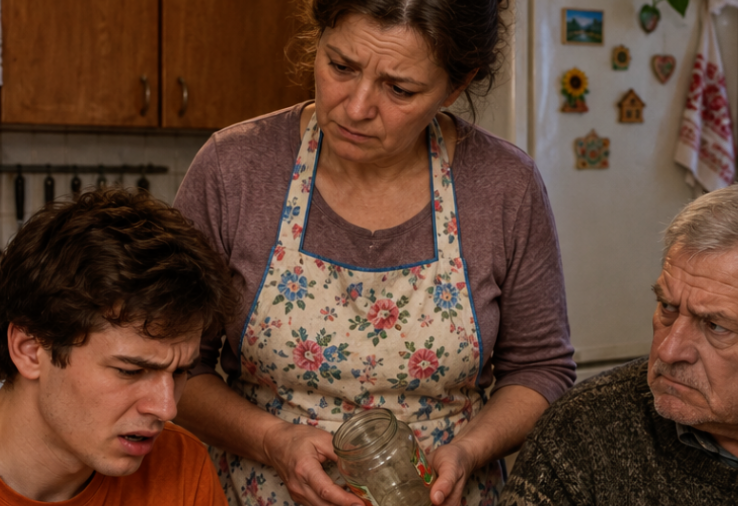
The bowl of borscht sat in front of Stas just long enough for him to give it a proper look.
«Mom, again without sour cream? I’ve told you before—borscht without sour cream is just beet soup.»
Svitlana stood up silently, opened the fridge, and placed a jar on the table with only about two spoonfuls left at the bottom. She hadn’t managed to buy a new one today. She left the atelier at seven, and still had two clients’ coats at home to repair the lining on by Friday.
Ostap Mykhailovych, who had arrived the previous evening with a bag of potatoes and a liter jar of honey from the beekeeper next door, was sitting across from his grandson, slowly slicing bread. Thin, even slices, one after another. Svitlana had watched her father slice bread like that ever since she was a child, and to this day, she did it the same way.
«The borscht is delicious,» he said to his daughter. «Just like your mother used to make.»
«It’s fine,» Stas shrugged. «You could have planned it out, though. Bought the sour cream in advance. I’ve told Mom a hundred times—she should make a list on her phone and write down what’s running out. It’s the 21st century, after all.»
Grandpa raised his eyes to his grandson. He looked at him for a long time, carefully, as if seeing him for the first time. And didn’t say a word.
* * *
Stas was twenty-seven. Svitlana had raised him alone since he was three, and over the years she’d learned how to stretch one salary into one and a half. During the day she worked at the atelier, and in the evenings she took work home: hemming, shortening, replacing zippers.
On the first day of school, Stas always had new sneakers. As for herself, for the eighth autumn in a row she pulled the same gray coat out of the closet and would always say it was «still going strong.»
Stas finished college, worked for a while at a phone shop, then as a courier, and afterward, as he put it, «searched for himself.» Now he sometimes set up TVs and routers for neighbors, worked a few shifts a month at a warehouse, and spent the rest of his time in his room at the computer.
But he always had an opinion about everything. Mom’s cutlets were too dry. The new curtains were a waste of money. And his friend Denys’s parents, by the way, gave their son a car, «because normal parents support their kids until they get on their feet.»
Ostap Mykhailovych had been staying with his daughter for three days, and in that time he’d seen enough. He saw Svitlana rushing out to catch the bus at 8:30 in the morning while Stas was still asleep. He saw her serve dinner in the evening, and his grandson, not looking up from his phone, ask if there was «something else.» At night, lying on a fold-out couch in the small room, he could hear the sewing machine whirring in the kitchen until almost 1 a.m.
On the kitchen windowsill was a notebook wrapped in a page from last year’s calendar. Svitlana recorded every expense in it, in neat tiny handwriting, one under another. She had learned this habit from her father. He used to keep records of everything, too.
* * *
On Thursday morning, there was a plain envelope by Stas’s cup. In Grandpa’s handwriting, it said: «For three days.»
«What’s this?» Stas yawned.
«Money. Two thousand hryvnias. For three people for three days.»
«What do you mean?»
«I mean it,» Ostap Mykhailovych said, sliding the envelope closer to his grandson. «From today until Sunday, you’re the boss in this apartment. Groceries, breakfasts, lunches, dinners, keeping the place tidy, little expenses—it’s all on you. Even your mom’s bus fare comes from here. The two of us will relax and see how planning should be done. You know what to do.»
«Dad, but why are you doing this…» Svitlana began.
«Svitlana,» Grandpa barely lifted his hand. «You were the one who asked me not to fix or redo anything for once during a visit. So I’m not fixing anything. I’m taking a break.»
Stas laughed and took the envelope.
«No problem. Two thousand for three days? Grandpa, you have no idea how much Mom spends on random things. I’ll even save you some money.»
«That’s great. Whatever you save, you keep. Just one condition: put every receipt in the envelope. Every single one.»
Stas stuffed the envelope into the back pocket of his jeans and went back to sleep. He only got ready to go to the store after lunch.
* * *
At the supermarket, he grabbed a cart and walked among the aisles with the confidence of someone finally showing how it’s properly done. Dinner had to be a real meal, so he put a pork neck in the cart. He didn’t take his mom’s instant coffee seriously, so he picked up a bag of whole beans instead. Next came holey cheese, olives, a carton of juice, frozen pizza for lunch—because, as he said, “I’m not standing by the stove twice a day”—and two packs of chips for the TV series.
At the register, the total flashed up: one thousand one hundred forty.
«Is that right?» Stas asked.
The cashier, whose badge read «Larysa,» didn’t even look up.
«The pork neck is two hundred ninety per kilo, young man. I don’t set the prices.»
A line had already formed behind him. A man in a work jacket sighed meaningfully. Blushing, Stas put back the chips and olives, bringing the total down to one thousand twenty. He left the store in a light October drizzle and only realized at the corner that he’d forgotten to buy bread. They were also almost out of dish soap at home. He had to go back.
The pork neck was burnt on the outside and raw inside, so he cut it up and finished cooking it in a second pan. At first he forgot to salt the potatoes, then ended up salting them twice. Juice spilled all over the floor, making it sticky, so every step his slippers made a quiet smacking sound. A mountain of dishes grew: two pans, a pot, a bowl, the cutting board, pizza plates.
Svitlana came home at seven forty. She glanced at the kitchen and without even fully taking off her coat, instinctively reached for the apron on the hook.
«Sit down,» her father said quietly. «Tonight, you’re a guest.»
She sat down. Stas set a plate in front of her. They ate in silence.
«You can eat it,» Ostap Mykhailovych finally said.
«Thank you, son,» Svitlana smiled.
And suddenly Stas felt something awkward. His mom was thanking him for dinner—one he, himself, would have brushed off as «so-so» if she had made it.
He finished washing the dishes at eleven. That evening, he never even touched his computer—he fell asleep as soon as he hit the bed.
* * *
The second day started with Mom needing money for the bus. Fifty hryvnias for the round trip. Stas handed it over with a face like it was his last money—and felt embarrassed by his own reaction.
Then everything started snowballing. The milk ran out—and Grandpa only drinks his tea with milk. There was nothing left from yesterday’s pork neck, so lunch was just macaroni with cheese. Next, Stas decided to do some laundry and realized he was out of detergent too—and a new one costs a hundred and eighty-nine. Then there was vacuuming, cleaning the tub, mopping the floor, and he had to mop twice because yesterday’s juice stain was persistent. At five, Grandpa asked him to buy some kefir and a loaf of bread.
continued in the comments
That evening, Stas sat at the kitchen table, restaurant receipts spread out in front of him, with the calculator on his phone glowing. There were only two hundred and thirty hryvnias left in the envelope.
“This is impossible,” he said finally, his voice filled with real irritation. “You can’t actually live normally on this amount of money. Someone definitely didn’t do the math.”
Ostap Mykhailovych was standing in the doorway, leaning his shoulder against the doorframe.
“Your mother has been living like this for years,” he replied calmly. “Except she also works from eight to seven. There are other people’s coats to take care of until half past twelve. And then there’s her son, explaining to her that she doesn’t know how to manage money.”
Stas opened his mouth to say something. Then closed it. He had nothing to say.
* * *
Later, Grandpa called him to the balcony. It was October-cold outside, the street light shone through the wet chestnut leaves, somewhere below the front door slammed. Ostap Mykhailovych zipped his jacket all the way up and was silent for a long time.
“When your mother was six,” he began at last, “I used to work at the factory in two shifts. In the summers, I’d also go help people mix mortar if they were building a house. One winter she needed boots. The old ones didn’t fit her anymore, and we had little money. So for a month, I walked to work to avoid paying for the bus. Forty minutes there, forty back. But she got the boots. Red ones, lined with fur inside. She would have even slept in them if her mother had let her.”
He smiled with just the corner of his mouth.
“I’m not telling you this so you’ll feel sorry for your grandpa. I want you to understand something. A man, Stas, can be poor. There can be years when you have nothing—everyone goes through that. There’s nothing shameful in that. The real shame is when a healthy, grown man lives off his mother’s money and still critiques her for how she manages her life. I was ashamed for you yesterday. When you talked about that sour cream.”
“I didn’t mean any harm, Grandpa,” Stas said quietly.
“I know you didn’t. That’s why I’m telling you this, instead of keeping quiet.”
They stood there a bit longer. Then Grandpa patted his grandson on the shoulder and went back to the room, leaving Stas on the balcony. He stayed there until he got cold, thinking about the red fur-lined boots he’d never seen.
* * *
On Sunday, he woke up before everyone else. Put the kettle on, sat by the window, and, not even knowing why, opened his mom’s notebook.
Bread — 28. Milk — 46. Utilities. Minibus fare. For Stas’s headphones — 600. For Stas’s birthday — 1500. For Stas’s sneakers. For Stas. For Stas. For Stas. He flipped page after page but never found a single line that began with ‘for myself.’
When Svitlana walked into the kitchen, her son was already peeling potatoes.
“Mom,” he said without turning around, “show me how you make your sauté. I want it to taste just like yours.”
She stood there for a minute, then quietly picked up another cutting board and sat down beside him. She chopped onions finely, grated the carrots, and used just a bit of oil. They were making soup from a chicken kit that Stas had bought for eighty hryvnias, and suddenly Svetlana realized that the last time they cooked together was when their son was around twelve.
For dinner, there were pancakes made with kefir. That evening, Stas placed an envelope on the table in front of Grandpa. Inside were the receipts, forty-seven hryvnias in change, and on the envelope itself, beneath Grandpa’s handwriting that said «For three days,» another line appeared in a different script: «47 UAH left. Bought sour cream.»
Ostap Mykhailovych read it, grunted, and tucked the envelope into the inside pocket of his jacket.
«I’ll keep this as a memory.»
On Monday, he took the first bus out.
* * *
A week later, Stas came home late in the evening, dressed in a new blue shirt with a logo on the pocket. He had found the service center for phone and laptop repairs himself, passed the interview, and completed two days of trial work. Now, every morning he left at half past seven, taking the same bus as his mom.
He received his first salary at the end of November. Svetlana didn’t hear it from him directly. One evening, while reaching for her notebook on the windowsill, she found a new envelope next to it. On it was written: «For home. From Stas.»
She held it in her hands for a long time. Then she called her father.
«Dad, he brought money. On his own. I didn’t ask him for anything.»
«And what about you?»
«I’m just sitting here, not sure whether to laugh or cry.»
There was silence on the line for a moment.
«Buy some sour cream,» Ostap Mykhailovych finally said, and Svetlana could hear the smile in his voice. «And invite him to dinner.»
That evening, Stas washed his own plate, and when his mom reached for the kettle, he said, «Sit down, I’ll do it.» He spoke quietly. Lately, he always spoke quietly to her.
And that night, the sewing machine in the kitchen stayed silent.