Petro had never stood by the door to eavesdrop. That evening, he just walked in from outside to grab his gloves—the air had already started to freeze, and the leaves under the walnut tree were still uncollected. He froze halfway down the corridor, one arm in the sleeve of his jacket.
From the kitchen, Maria’s voice drifted out. She was talking on the phone, as always on speaker, because, she said, it kept her hands free. Something was bubbling on the stove, and the whole house smelled of fried onions.
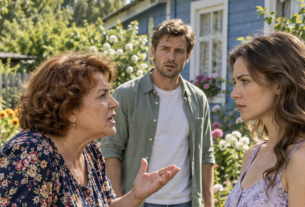
«Mom, let me buy you a getaway for your birthday,» Irynka pleaded. «A week in the mountains, fresh air, a pool. And no one will tell you the borscht is too salty.»
«Oh, what sort of getaway, dear?» A spoon clinked against the edge of the pot. «I won’t go alone, and you’ll never get your father out of the house. He hasn’t managed to visit his sister in the next district in twenty years. All he wants is the TV and dinner on the table at seven.»
Petro smiled wryly. Well, it was true. He reached for the rack where the gloves were when Irynka suddenly spoke in a completely different, quieter voice:
«Mom… do you still love him?»
The kitchen went so quiet, Petro could hear the click of the refrigerator relay.
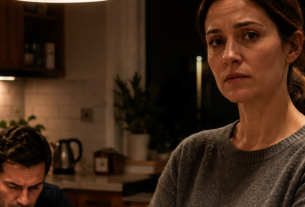
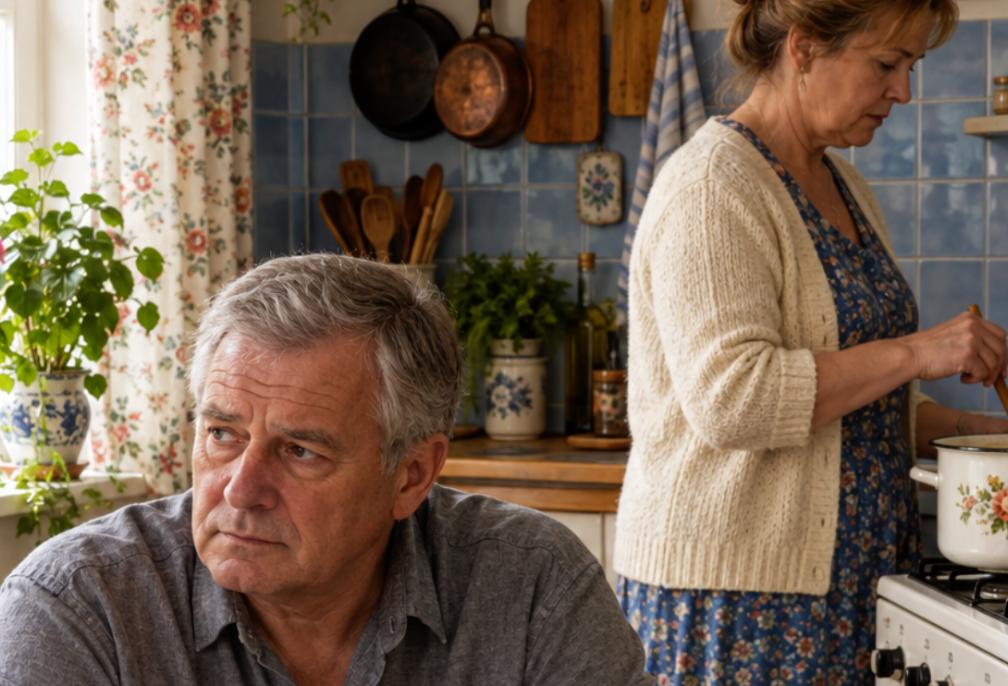
«I don’t know, honey,» Maria finally said. «There was a time I loved him so much I couldn’t breathe without him. And now… we live like neighbors. He does his thing, I do mine. We sit down for dinner, and there’s nothing to talk about. He stares at his plate, I stare at mine. So we just sit in silence.»
«Mom…»
«It’s alright, Irynka. I’m used to it. Better tell me how things are at work.»
Petro slipped quietly back onto the porch, feeling like a stranger in his own home. He never did pick up his gloves.
* * *
He sat down on the bench beneath the window—the same one he’d built years ago from oak planks. Maria once scolded him for making it too big, nearly half the yard. But every summer after that, she’d plant marigolds beside it.
Thirty-five years. He’d never once wondered if something was wrong. His shirts were always ironed and neatly arranged in the closet, collar to collar. Borscht every Sunday. A warm scarf appeared on the hook near the door whenever the radio predicted frosts. Maria always remembered his godfather’s birthday, when to pay the electricity, and which pocket held his glasses.
But what did he remember?
Petro tried to recall the last time he’d brought her flowers. Not for International Women’s Day, when everyone brings them, but just because. He thought hard. He remembered white, shaggy chrysanthemums from the market. Irynka was still in school back then. So, about twenty years ago. Maybe more.
«Like neighbors,» he repeated to himself. That word made it suddenly feel colder than the October wind blowing leaves across the yard.
That evening, he turned off the TV right after the news himself. Maria looked at him in surprise, but said nothing. He wanted to ask her something—anything—but the words just slipped away. He sat there, rolling a crust of bread between his fingers.
«The potato pancakes are delicious,» he finally managed to say.
«I make them every Saturday, Petro,» Maria replied softly.
And she looked at him closely, as if he were a stranger.
* * *
On Thursday, Maria went to the store for flour and yeast. She was planning to bake cabbage pies because Irynka was coming home on Sunday. She called out as she left: “I’ll be back in half an hour.” Petro nodded without looking up from his newspaper.
A year had passed. Then another half-year. Petro called his wife once, then again. The phone rang and rang, but no one picked up.
He threw on his jacket and stepped outside the gate. He looked one way down the street, then the other. A light drizzle was falling, and wet leaves clung to the asphalt. He walked to the bus stop, stood there for a bit, then returned. He called again. Still just ringing.
A strange thing: in thirty-five years, he had never waited for Maria. It was always her waiting for him—after work, after fishing, after spending time at the garage with friends. But now he stood by the gate, shivering, not knowing what to do with himself.
The phone rang just as he set off for the store the second time.
«Petro, please don’t worry,» his neighbor Raisa’s voice trembled. «Maria became unwell near the store. She sat down on the steps and turned completely pale… They took her to the district hospital. My Andrii is getting the car ready now, he’ll drive you there.»
Later, Petro couldn’t remember the ride at all. Just the sound of the windshield wipers scraping the glass, and Maria’s scarf in his hands. For some reason, he had grabbed it from the hook as he ran out—maybe thinking she’d be cold there.
* * *
Maria was lying by the window in her hospital room. Under the hospital blanket, she looked so small, as if someone had taken half her strength in just a few hours. Pale, with her hair down. Petro couldn’t remember the last time he’d seen her like that—she always wore it up in a tight bun.
He paused in the doorway. There was so much he wanted to say that he didn’t know where to begin. That he was at fault. That she’d been waiting for just one kind word from him, year after year, while he’d come home, eat dinner, and switch on the TV.
«Why did you come rushing over?» Maria asked softly. «What about the cabbage? I left it cooking on the stove…»
And Petro, who no one had ever seen at a loss, sat down on the edge of the bed and burst out laughing. And for some reason, his laughter came out wet.
«Forget about the cabbage, Marusia. The cabbage doesn’t matter…»
He took her hand—thin, with rough fingers and the wedding ring she never took off, not even when working in the garden. He held it and didn’t let go until the doctor on duty came in.
The doctor, young but with tired eyes, said they hadn’t found anything serious. Just exhaustion. She’d just been shouldering too much, for too long.
«She needs to rest,» he told Petro out in the hallway. «Real rest. Not in the garden or the kitchen. She needs someone to look after her, for a change, instead of her looking after everyone else.»
Petro nodded. Those words stuck with him more than anything else.
* * *
That evening, he called his daughter. Himself. For the first time in a year, probably. Usually, Irynka would call her mother, and she’d hand the phone over: «Here, your father wants to say something.» He’d say «hi», ask about the weather, then hand the phone back.
«Dad? Is something wrong with mom?» Irynka asked right away, worried.
«Everything’s okay. We’ll bring her home tomorrow. Tell me… you mentioned a getaway. Where did you want to send her?»
There was a long silence on the line.
«Did you overhear?»
«I heard,» Petro said. «Don’t buy anything. I’ll do it myself. Just help me pick, because I’m lost in this internet stuff.»
They talked for almost an hour. Petro jotted everything down in his notebook—the same one he’d used to keep track of how many sacks of potatoes they’d harvested. He wrote the sanatorium’s name, prices, directions, and what to pack. Irynka went quiet a few times, and he knew she was crying. But he pretended not to notice.
* * *
A week passed. Maria was slowly getting back to her household chores, even though Petro kept trying to chase her away from the stove and made soup himself. The soup turned out so thick you could almost stand a spoon in it, but Maria still ate it and complimented him.
On Sunday morning, he placed a white envelope right onto the table, over the floral oilcloth.
«What’s this?» Maria wiped her hands on her apron.
«Take a look.»
She opened the envelope and pulled out two vouchers and train tickets. She read them. Then read them again. Her glasses slipped to the tip of her nose.
«Petro… A sanatorium? In the Carpathians? For two weeks?»
«Let’s go relax. Just the two of us.»
«You?» she almost sat down. «You never want to go anywhere! I can’t even drag you to your own sister’s!»
Petro pulled up a stool and sat across from her. He stared at her hands, resting on the envelope—hands rough from work, fingers showing fine wrinkles. So familiar, and yet he realized he’d never really seen them.
«You know, Marusya, do you know what scared me most when they took you away?» he said. «Not that there’d be no one to cook borshch. Not that my shirts wouldn’t get ironed. But that I might never hear you on the phone with Irynka in the morning again. The way you put the kettle on. The way you call me to the table.»
He fell silent.
«I used to think you’d always be here. Like light in the house. When it’s on, nobody looks at a bulb. But when it goes out…»
Maria wiped her eyes with the corner of her apron, quietly.
«I heard that phone call of yours, too,» he added softly. «About the neighbors.»
She blushed and looked away.
«Petro, I didn’t mean anything bad…»
«I know. You were honest. I just don’t want to be your neighbor. Maybe it’s late, but that’s not what I want.»
Maria was silent for a long time. Then she looked at him, with that same sly squint he remembered from their youth, from dances at the village club.
«And are you going to walk with me there? Or will you just find a TV in the lounge and spend two weeks in front of it?»
«I’ll walk with you. Every day, if you want. I’d even climb all the way up the mountain if you asked me.»
«No need to climb the mountain,» she smiled. «Or I’ll have to carry you back down.»
«Just be patient with me a little longer,» Petro pleaded. «I have to learn how to talk all over again. I was silent for so many years, it won’t happen right away.»
And they both laughed. Together, the way they hadn’t in a very long time. Maria laughed, covering her mouth with her hand, while Petro looked at her and thought that for that laughter, he’d give up all his news and football.
That evening, he didn’t turn on the TV. The remote stayed on the shelf by the wedding photo until they left for the trip—the same photo where they both looked young and, for some reason, very serious.
On the train, when the hills blanketed with rusty autumn woods stretched outside the window, Maria rested her head on his shoulder. And for the first time in many years, they had something to talk about.