“Zhanna, please, don’t get upset right away, okay? Mom is coming over soon, and she has a small favor to ask of us.”
Zhanna stopped fastening her earring and glanced at her husband through the hallway mirror.
“What do you mean, ‘don’t get upset’? I don’t even know what this is about yet.”
“That’s exactly why I’m telling you ahead of time. Just listen, that’s all.”
“Kirill, whenever you start off talking like this, it usually ends up that someone’s already made a decision for me.”
“Nobody’s made any decisions.”
He replied a little too quickly, and Zhanna immediately felt suspicious. Their Saturday plan was to have a peaceful breakfast, go pick up a new lamp for the living room, and finally get around to unpacking the boxes on the top shelf of the closet. Family visits weren’t part of those plans.
Ten minutes later, the doorbell rang.
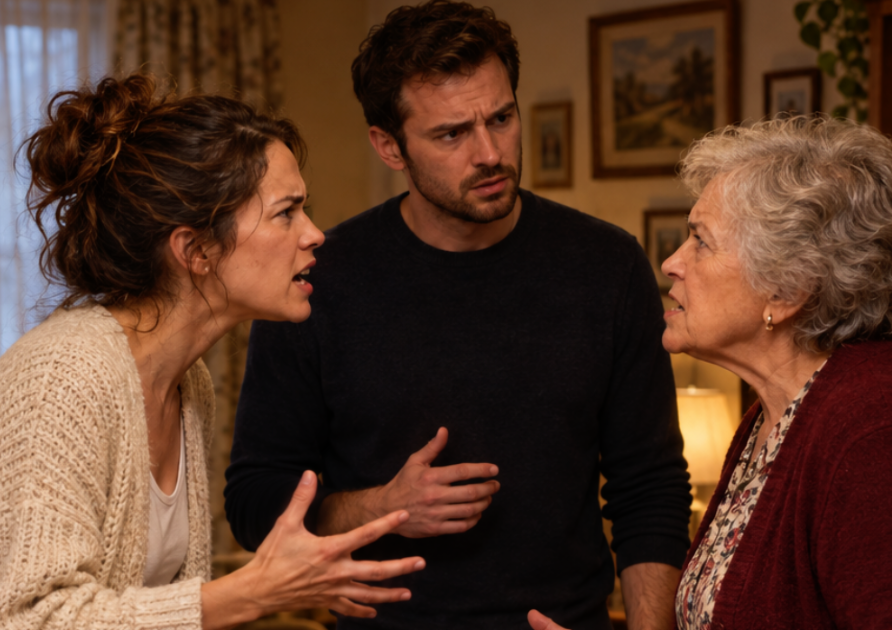
Anna Sergeyevna walked in with confidence, as if she really had been expected. She took off her coat, sat down on the bench, and placed a bulging folder next to her. Zhanna noticed the folder right away, but chose not to ask about it.
“Well, kids,” her mother-in-law began, “this is something simple. Temporary, even. Not much to discuss, really.”
“Then why did you come here?” Zhanna asked.
Kirill shot his wife an annoyed look.
“Zhanna, can’t you just be nice?”
“I am asking nicely.”
Anna Sergeyevna opened the folder.
“Sveta needs to get registered in the city. Both she and Artyom. Just for a year at least. Of course, three years would be better, but we’ll see. You have a spacious apartment, excellent address, a good school nearby. It would all be very convenient for the child.”
Zhanna didn’t immediately realize that her mother-in-law was referring to their apartment. More precisely, to her apartment.
“Wait a minute. Where is this registration supposed to happen?”
“Here, at your place.”
“At my place?”
“Yes, of course. Kirill said there wouldn’t be any problems.”
Zhanna slowly turned to her husband.
“What did you say?”
Kirill ran his hand over the back of his head.
“I said we would discuss it.”
“No,” Anna Sergeyevna cut in immediately. “You said: ‘Mom, Zhanna will sign, it’s not a big deal.’ I double-checked because Sveta needs to submit her documents soon.”
“Mom, why do you have to put it that way?”
“How else? I’m just saying what happened.”
Zhanna was silent for a few moments. This apartment hadn’t come from her parents, nor was it inherited, nor a gift. She bought it at thirty-one, before she ever met Kirill, after several years of difficult penny-pinching. First, she bought a tiny one-bedroom on the outskirts, sold it for a small profit, then spent three more years saving, took out a loan for the rest, and almost two years without a real vacation. By the time she and Kirill got married, the loan was paid off.
Kirill moved in with her. No one ever made an issue of it. Zhanna never said ‘my house’ during arguments, never reminded anyone who the owner was, and never expected her husband to thank her for the privilege of using the bathroom and fridge. They just lived together.
But now it turned out someone had misunderstood that quiet arrangement—and taken it a little too far.
“Why exactly am I supposed to register your daughter and her child in my apartment? Just because it’s convenient for you? No! And don’t give me that ‘it’s just a stamp’ story! If you want to help, register her at your own place and stop making decisions about my home!”
Anna Sergeyevna was so taken aback, she actually leaned back in surprise.
Now that’s how you talk! I came here to speak to you as one person to another.
Talking like a human being means asking first. Not showing up with completed paperwork after your son has already promised everything on my behalf.
No one is taking your apartment away from you!
I never said anyone was taking it.
Then what’s the issue?
The issue is that I don’t agree with this.
Is it just because you want to be difficult?
It’s because it’s my apartment and it’s my decision.
Finally, Kirill stepped in:
Zhanna, you’re making this into a matter of principle on purpose. Svetka doesn’t want to claim the apartment. She just needs to be registered so Artyom can go to a decent school and she can sort out her documents here.
Then let her register at your mother’s place.
And why, exactly, should I register your daughter and grandchild in my own apartment? Just because it’s convenient for you? No! And don’t try to tell me tha
Anna Sergeyevna immediately grimaced.
My apartment is in a different district. And it’s small.
But you do have space for registration there.
I do, but why should a child have to go to a school halfway across the city when yours is just seven minutes away?
Because he’s your grandson, your daughter, and it’s your responsibility to help. How did I suddenly become a required participant in all this?
You’re Kirill’s wife. That makes this family.
Family doesn’t give you the right to distribute my property among relatives.
There you go again with ‘my property’! snapped Kirill. We’ve been living together for how many years now? Five. Am I a stranger here now?
Are you arguing about your right to live here or about registering your sister?
I want you to stop acting like we’re asking you to give away the apartment.
And I want you to stop promising my agreement without asking me first.
This was the most unpleasant part of the conversation. It wasn’t even Anna Sergeyevna’s request that bothered Zhanna. Svetlana really was in a tough spot: recently divorced, temporarily staying with a friend in the suburbs, planning to look for a job in the city. Artyom was nine, and switching to a new school was complicated. Zhanna could have listened to the request. Maybe she’d have still said no, but at least they would have had a calm conversation.
But now, there was no calm request left. There was only a done deal, where her signature was somehow seen as the final technicality.
For another twenty minutes, Anna Sergeyevna kept explaining that registration ‘obliges you to nothing,’ that the child needs help, that Zhanna is being too suspicious, and that ‘normal people don’t cling to square meters like this.’
Zhanna’s responses grew increasingly brief.
No.
But at least think about it.
No.
What did Sveta ever do to hurt you?
Nothing. That’s why I’m not discussing her. I’m discussing your request.
This isn’t even a request anymore, it’s like some kind of test of your humanity!
Then I failed the test. That’s all there is to it.
When Anna Sergeyevna stood up, her face was red with anger.
You’re greedy, Zhanna. And heartless. The apartment is huge, you live there just the two of you, and you can’t even help your own family.
Artyom isn’t my family.
Exactly! That sentence sums you up perfectly!
Well, he’s family for you. So one more time: register them at your own place.
I’ve told Kirill everything. Let him deal with you.
Just let him remember: he’ll have to deal not with the apartment, but with me.
After his mother left, Kirill stayed quiet for a long time. Then he began picking up random things from the bench, even though there was hardly anything there.
“Why did you treat her like that?”
Zhanna actually laughed.
“Are you serious right now?”
“You could have refused more politely.”
“I did refuse politely in the first three minutes. Then your mom spent another twenty-five minutes telling me why my ‘no’ was wrong.”
“You kept bringing up the apartment.”
“Because we were talking about the apartment.”
“We’re husband and wife, you know.”
“And what does that mean?”
“That there shouldn’t be this kind of division: ‘mine’ and ‘yours.’”
Zhanna looked at him intently.
“Great. So tomorrow I’ll call your mom and tell her we’ve decided to sell her dacha. Sveta needs the money more.”
“What does my mom’s dacha have to do with this?”
“And why did you immediately call it ‘your mom’s’?”
Kirill realized where she was going with this and turned away, annoyed.
“Don’t twist things.”
“I’m not twisting anything. It’s easy to decide what happens to someone else’s property, as long as that ‘someone else’ is me.”
That evening, they hardly spoke.
The next day, Kirill brought up the topic again at dinner.
“I talked to my mom. She definitely said too much yesterday.”
“Alright.”
“But Sveta really is struggling.”
Zhanna put down her fork.
“Kirill, no.”
“You didn’t even let me finish.”
“Because my answer hasn’t changed.”
“Can we at least do it for half a year?”
“No.”
“Artyom has nothing to do with this at all.”
“I know.”
“Then why should he have to suffer?”
“And why does his problem have to be solved through my apartment?”
“Because we can help!”
“You can. You have a salary, a car, free time, connections. Go ahead and help.”
Kirill felt hurt.
“So now we’re not ‘we’ anymore?”
“When it comes to promises you made without me—no, we’re not.”
From that evening on, the topic started coming up almost every day. Sometimes gently. Sometimes with irritation.
Kirill would bring new arguments.
The school is good.
It’s inconvenient for Sveta to travel.
The boy needs a stable address.
Mom isn’t sleeping well because of all this.
His sister is upset and thinks Zhanna hates her.
Zhanna would always reply the same way:
“I do not give my consent.”
A week later he tried approaching it from another angle.
“Do you realize that now Sveta probably thinks I have no say in our family at all?”
“Are you more worried about what Sveta thinks, or the fact that you really can’t make decisions about my apartment without me?”
“Here we go again.”
“Yes. Again.”
“I’ve lived here for five years and contributed.”
“To utilities and groceries?”
“Not just that!”
“We built the closet together in the bedroom. You bought the TV. I’m not denying that. But it doesn’t mean the apartment became yours.”
“I’m not asking for a share!”
“Then why does it bother you so much that I decide who gets registered here?”
He didn’t answer.
Zhanna gradually realized that for Kirill, it really wasn’t just about his sister. What actually upset him was simply being refused. While the apartment was just a place for their shared life, everything was fine. But as soon as it was needed to help his family, the fact that Zhanna was the official owner suddenly started to bother and even offend her husband.
He started saying she was ‘clinging to the walls.’
“You should cling to your family,” he said one evening.
— So being family means I always have to agree with your mom?
— Family sometimes means making compromises.
— And why should I be the one to compromise?
— Because it’s really not that big of a deal for you.
— Then why don’t you give in? Register your sister at your place.
— I don’t have an apartment.
— Exactly.
After that, Kirill went to his room and barely spoke to her until almost midnight.
Anna Sergeyevna wasn’t backing down either. She stopped calling Zhanna, but kept calling Kirill persistently. Sometimes he’d step out to the balcony to talk, other times he wouldn’t, and Zhanna would catch bits of the conversation.
— Mom, I’m talking to her.
— No, not yet.
— I told you, stop pushing.
— So what should I do then?
After these phone calls, he always seemed irritated.
One day Zhanna asked:
— Is she still demanding you “put me in my place”?
Kirill shot her a sharp look.
— Have you been eavesdropping?
— No. Your phone’s just loud.
— Mom’s just emotional.
— And you?
— What about me?
— Do you agree that I need to be put in my place?
— Don’t start.
— I’m not starting anything. I’m just asking.
— No, I don’t agree.
But he didn’t sound very sure about it.
On the ninth day, Svetlana called Zhanna herself. She hadn’t reached out to her before, and Zhanna had even hoped her sister-in-law understood the awkwardness of the situation better than their mother or brother.
— Hey Zhanna. Is this a good time to talk?
— Yes, I can talk.
— I don’t want to argue, honestly. I just need to understand why you’re so opposed to this.
Zhanna closed her work laptop and leaned back in her chair.
— Svet, it’s not about you. I’m upset that Kirill promised I’d be okay with it, and then your mom just showed up already expecting I’d agreed.
— He said you both discussed everything.
— No. That’s what he told you. He never talked to me about any of this.
There was silence on the other end.
— I didn’t know.
— Well, now you do.
— But if we just set that part aside… would you still say no?
— I still wouldn’t agree.
— Why not?
— Because I don’t want to register two more people at my apartment.
— But we’re not planning to live there.
— Maybe not today. But that could change tomorrow. I just don’t want to deal with any of that.
Svetlana felt hurt:
— So you think I’m some kind of scammer?
— I never said that.
— But that’s how it sounds.
— No. What I mean is I’m not obligated to handle someone else’s problems just because I happen to have the right address.
— Someone else’s? I’m your husband’s sister.
— Yes, but that doesn’t mean the apartment stops being mine.
— Mom’s right. You’re hanging onto that place like it’s all you’ve got.
— That’s because I earned it myself.
— And Kirill means nothing?
— Why do we always end up here? Kirill is my husband. But he can’t just give my permission away to his relatives.
Svetlana sighed in frustration.
— Okay. I get it. It’s just sad things turned out this way.
— I’m sad too. Especially because if you’d just asked properly from the start, there wouldn’t have been all this drama.
— But the answer still would’ve been ‘no’.
— Yes.
After the conversation, Zhanna sat in the kitchen for another ten minutes, staring at the black TV screen. She felt uncomfortable knowing that now the whole family saw her as the one who ‘didn’t help.’ No one discussed why Anna Sergeyevna didn’t want to register her daughter at her place, or why Svetlana wasn’t looking for other options, or why Kirill promised someone else’s signature. The only thing being discussed was that Zhanna had an apartment, and by family logic, she was supposed to offer it up to others.
That evening, Kirill came home already knowing about the conversation.
«Sveta cried after talking to you.»
«She didn’t cry when she was with me.»
«She started crying afterwards.»
«And what am I supposed to do with that information?»
«Sometimes you could be a bit softer.»
«Kirill, you’ve been trying to make me feel guilty for a week because your sister didn’t get something I never promised her.»
«She’s not a stranger.»
«And I’m not a free registration service.»
«There you go again, turning everything into red tape.»
«No. You’re the ones who did that. You picked my apartment simply because it was convenient, and now you’re trying to convince me I owe it to everyone.»
«I just want us to have normal family relations.»
«Then start by not telling your relatives that I’ll just say yes.»
He went to change his clothes, and half an hour later, he returned, looking calmer.
«I honestly thought you wouldn’t be against it.»
«Why?»
«Because you always used to help before.»
«So, letting your mom borrow my car for a day and registering two people at my place—that’s the same to you?»
«No.»
«Then why didn’t you ask me first?»
He shrugged.
«I don’t know. It just seemed like a small thing.»
For the first time in days, Zhanna saw him actually stop to think, not about convincing her, but about his own behavior. But it only lasted a moment.
Two days later, Anna Sergeyevna called him again in the evening. This time, Kirill accidentally turned on the speakerphone while putting his phone on the charger.
«Are you even talking to her?» Zhanna immediately heard her mother-in-law’s voice. «Or did she say ‘no’ and you just gave up?»
Kirill quickly switched off speakerphone, but it was too late.
«Mom, I’ll call you back.»
«No, you won’t call back—just tell me now! Are you the man of the house or just a tenant?»
Kirill ended the call.
Zhanna stood by the table and looked at him.
«So that’s where all your talk lately about being a ‘nobody’ here is coming from.»
«Don’t start.»
«Is that what she tells you every day?»
«She’s just worried about Sveta.»
«No. She’s telling you that if you can’t control my apartment, then you’re not a real man.»
«Zhanna…»
«And then you bring that attitude home.»
«I don’t bring anything home.»
«Yesterday you asked why you don’t get to decide things in our family. For five years before this, it never bothered you.»
Kirill sat on a high kitchen stool.
«It bothers me that at any moment you can say, ‘It’s my apartment.'»
«I only say that when you try to decide who will be registered there or live there.»
«Still, it bothers me.»
«Then this isn’t really about the apartment. It’s about what your mom has been telling you and you trying to prove you have power here.»
He suddenly stood up.
«Don’t pick me apart like this.»
“I don’t even want to understand anymore. I’m just tired of someone else’s request turning into a test of your masculinity and my being a real wife.”
After that, he really said nothing about the registration for two days. Zhanna even thought that talking to his mother hit him harder than his wife refusing. But it turned out he was just looking for another way.
Nearly three weeks went by. Things were calmer at home on the surface. For a few days, Kirill didn’t mention the registration at all. Zhanna started to think the whole issue had finally fizzled out.
On Saturday, they went grocery shopping. On the way home, Kirill got a message, read it, and quickly put his phone away.
“Sveta?” asked Zhanna.
“Yes.”
“What does she want?”
“Nothing.”
“Then why do you look like that?”
“Like what?”
“Like someone who’s about to explain something unpleasant.”
“Zhanna, let’s talk at home.”
“No. Tell me now.”
He was silent for a moment.
“I offered her another option.”
Zhanna already knew in advance it wouldn’t be anything good.
“What kind?”
“She could stay with us for a while. With Artyom.”
Zhanna turned her head.
“What?”
“Just temporarily. The room’s empty anyway.”
There really was a small second bedroom in the apartment, which Zhanna used as her office and a guest room. It was the one Kirill had always called ‘free,’ though it had her desk, books, and a fold-out couch.
“You offered your sister to move into my place?”
“Our place.”
“Don’t start playing word games.”
“I thought if you two spent some time together, you’d see that Sveta isn’t a bother. Then we could calmly talk about the registration again.”
Zhanna stared at her husband for several seconds until he finally looked away.
“So, your plan is to move them in so I ‘get used to’ it and then start pushing the registration issue again?”
“I never said ‘push.’”
“So what did you tell Sveta?”
“That I’d talk to you.”
“Did you learn nothing from last time?”
“I didn’t promise her you’d agree.”
“But you did offer my home as a temporary place to stay.”
“You’re saying ‘my home’ again!”
“Yes, Kirill. Mine. That’s especially important right now.”
“You’re just being stubborn.”
“No. Let me make this perfectly clear. If your sister shows up at this door with her child and her things, the first one out of here will be you. Not her. You. Because that means for the second time you decided to just present me with a fait accompli.”
Kirill actually gave a little smirk.
“You’d kick me out over my sister?”
“Because of you.”
“Don’t be ridiculous.”
“I’m not joking.”
He tried to argue for a few more minutes, but Zhanna didn’t raise her voice again.
“Call her right now and tell her moving in is not an option.”
“I’ll handle it myself.”
“Fine. But if she comes, you pack your bags along with her.”
That evening, Kirill really did call his sister. The conversation was unpleasant. Zhanna wasn’t eavesdropping, but she still heard him say several times:
“No, Sveta, it’s not going to work.”
Then:
“Because it just won’t.”
And finally:
“Let Mom call me herself, then.”
Anna Sergeyevna called him five minutes later.
This time Kirill stepped out onto the balcony and shut the door.
After the call, he came back inside looking gloomy.
“Well?” Zhanna asked.
“Nothing.”
“Put me in my place, did she?”
“Very funny.”
“I’m not laughing.”
— Mom thinks you’re turning me against the family.
— And what do you think?
Kirill sat down across from her.
— I think this all could have been avoided if we offered help from the start.
Zhanna nodded.
— So you still don’t get it.
— What am I supposed to get? That the apartment is yours? I already know that.
— No. That you can’t promise something on behalf of another adult. Even if that’s your wife.
He didn’t reply.
After that threat, talks about moving really stopped. Kirill no longer said his sister could stay with them “for a couple weeks.” He didn’t suggest going to sign papers again. Even the word “registration” almost disappeared from the house.
But the problem didn’t go away completely.
Anna Sergeevna kept calling her son for a long time after. Sometimes twice a day. She found another place for Sveta through a distant relative, but it didn’t make her any less offended. To her, Zhanna would always be the woman who “wouldn’t help her husband’s own nephew, even with a three-bedroom apartment.”
Svetlana was cold with Zhanna, too. At family gatherings, she would greet her, answer questions, and then quickly move on to talk to someone else. Zhanna didn’t try to fix their relationship. She didn’t feel guilty and didn’t want to keep explaining her refusal.
At first, Kirill kept trying to bring up the old topic through little hints.
— By the way, it takes Svetka an hour and twenty minutes to get to work now.
— Got it.
— Artyom didn’t get into the school they wanted after all.
— Things happen.
— Don’t you feel bad at all?
— I do feel bad. But it doesn’t change my decision.
After a while, he stopped.
Zhanna changed too. She used to treat Kirill’s family matters almost automatically as their shared responsibilities—help his mom with a delivery, pick up Sveta from the shop, lend her car for a day, pay for a group gift—no problem. But after the apartment situation, she started asking what exactly was needed from her and why it was considered her job.
Kirill didn’t like this.
— Now you check on every little thing, — he said once.
— Yes.
— Just because of one situation?
— Because in that one situation, you made decisions for me twice.
He wanted to argue but didn’t.
The worst part for Kirill wasn’t even that Zhanna didn’t register Sveta. What bothered him more was that, after all this, “family” stopped working on her as a catch-all argument.
When Anna Sergeevna asked for help, Kirill would now first decide whether he could handle it himself.
If Sveta needed something, he no longer said, “We’ll help.” He said, “I’ll see.”
Zhanna didn’t forbid him from helping his relatives. She didn’t control his money or demand he stop talking to them. She just wouldn’t let herself or her belongings be included in other people’s plans automatically anymore.
A couple of weeks after the moving story, Kirill, for the first time, refused his mother’s request about Zhanna himself. She called one evening during dinner, once again asking why he “let his wife boss him around.”
— Mom, enough, — he said. — We’re done with this.
Zhanna looked up from her plate but didn’t say anything.
“You didn’t put an end to anything!” Anna Sergeyevna’s voice rang out loud and clear, no speakerphone needed. “You just gave up.”
“It’s not my apartment.”
He said it very curtly, clearly forcing the words out.
“You’re the husband! You’ve been living there for five years!”
“So what?”
“So, you should have a say in things.”
“I do have a say. But I don’t have the right to sign for Zhanna.”
Zhanna kept eating, although she had no appetite left. She didn’t want to get involved or turn this rare moment into a dramatic scene.
Anna Sergeyevna wasn’t giving up.
“So, did you just abandon Sveta completely?”
“Sveta already found her registration. What else?”
“She had to rely on connections, swallow her pride, and beg!”
“Mom, she’s a grown woman.”
“Of course. And your wife is the most mature and independent of us all.”
“I’ll call you back later.”
“Don’t bother calling me back!”
Kirill ended the call.
He sat silently for a few moments.
“Thank you,” Zhanna said.
“For what?”
“For finally not promising her a new way to persuade me.”
“I never promised that before, either.”
Zhanna looked at him.
“Kirill.”
“Alright. I did promise.”
He admitted this in a flat, casual tone, with no particular regret. Oddly enough, Zhanna found herself believing him more than she ever had all his previous explanations.
But things didn’t return to normal after that. Before the argument, they could talk almost automatically about plans: who to help, what to buy for their parents, where to spend the holidays. Now, every time, Zhanna waited for clarification—who had already promised what without her. Kirill noticed and grew irritated.
“So now before every conversation, I have to prove I haven’t decided anything for you?”
“For now, yes.”
“And for how long?”
“I don’t know.”
“How convenient.”
“It’s not convenient for me either. But you’re the one who created this.”
He felt hurt, sometimes walked into another room, or argued that she was holding onto a single mistake for too long. Zhanna never discussed how long. For her, making sure it didn’t happen again was more important.
One day, Svetlana went to visit their mother, and Anna Sergeyevna organized a family lunch. Kirill went alone. Zhanna had declined from the invitation stage.
“Mom said she won’t bring up the apartment.”
“Alright.”
“Then why aren’t you coming?”
“Because I don’t want to spend three hours just waiting for someone to finally bring it up.”
“That’s how you’re going to distance yourself from my family altogether.”
“Maybe so.”
“Are you okay with that?”
“I wasn’t okay when your mom showed up with prepared papers for me to sign. Then I wasn’t okay with you pressuring me for three weeks. Then I found out you suggested your sister move in. After all that, I think I’m entitled to skip a family lunch.”
Kirill went alone.
He came back in the evening looking gloomy. Zhanna didn’t ask for details, but he told her himself:
“Mom thinks you’re deliberately trying to ruin the relationship.”
“Noted.”
“Sveta said she’ll never ask us for anything again.”
“That actually makes things easier.”
“Why would you say that?”
“What am I supposed to do, persuade her to keep asking us for more?”
Kirill tossed his keys onto the dresser, frustrated.
“Sometimes it’s impossible to talk to you.”
“And sometimes, we just don’t need to talk about things that are already finished.”
After that, he really did stop bringing home every one of his mom’s complaints. Maybe not because he completely agreed with his wife—he just realized that being the go-between for his mother and Zhanna only made things worse for himself.
A few months later, Anna Sergeyevna brought up the apartment again. This time it wasn’t about registration. She told her son it would be smart to eventually give him at least a small share, “so a person in a marriage can feel secure.”
Kirill didn’t mention any of this at home.
Zhanna found out by accident, overhearing him talking with his mother in the kitchen while he thought his wife was in the shower.
“Mom, no. Don’t even start. After what happened last time, I’m not going to discuss it.”
Zhanna stopped in the hallway, but she didn’t want to listen any further.
In a way, he finally understood. Maybe not in the way she had hoped, not right away, and not without some resentment. But he grasped at least the practical side: if he tried to do something with her apartment again, he could really find himself out on the street.
Anna Sergeyevna didn’t accept this.
She kept insisting her son was “living on borrowed rights,” even though she’d never used those words in the five years before that blow-up. Now, it was convenient for her to see the apartment as proof that her daughter-in-law supposedly kept Kirill dependent.
And Kirill was caught between two very simple facts.
His mother wanted him to “put his wife in her place.”
His wife had already made it very clear what his place would be if he tried to bring anyone else to live with them without her consent.
So he just stopped bringing up the topic out loud.
And really, that’s probably what irritated Anna Sergeyevna the most: not Zhanna’s refusal, but the fact that her son finally stopped promising her something that was never his to give…