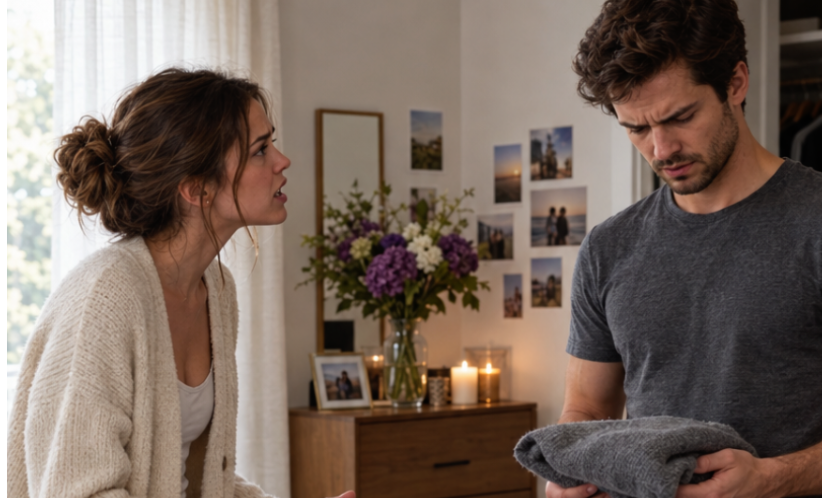
«Are you seriously planning to send me to the work party in this shirt?» Pavel held the white shirt in front of him as if Lyudmila had handed him a rag instead of something she had spent nearly an hour steaming that morning. «Look here. There’s a crease. And here, too. I asked you to do it properly.»
«I did it properly, Pasha. That’s the third time you’ve taken it off the hanger and looked for something to complain about. If you want it to be perfect under a magnifying glass, you can iron it yourself.»
«Of course. Straight to ‘iron it yourself.’ Can’t a husband just ask his wife for a little help for once?»
«For once?» Lyudmila placed the iron on its stand and turned to her husband. «I’ve been standing at this board since half past six because you first decided you’d wear the gray shirt, then the blue one, and now back to the white. I ironed the gray one. And the blue. Now you don’t like the white. I’ve got a work call in forty minutes, in case you forgot.»
«What does your call have to do with this? I’m going to a work party! The bosses and partners will be there. I can’t look like I just slept in my clothes.»
Pavel ran his fingers along the sleeve and pursed his lips with displeasure. Lyudmila knew that look. First he’d act like he’d found a simple flaw, then would explain he wasn’t saying anything offensive. If she got upset anyway, that’s when Vika would inevitably come up.
This had been happening for years. Vika could come up in conversation over anything. Over burnt potatoes, because “Vika never turned dinner into charcoal.” Over dust on the top shelf, because “at Vika’s place you could check with a white glove.” If Lyudmila didn’t feel like visiting his mom after a long week, it was because “Vika respected elders and never acted too busy.” And now, it was the shirt’s turn.
«You know, Vika never over-dried things,» Pavel commented casually. «That’s why her shirts took ten minutes to iron, not an hour with results like this.»
Lyudmila just stared at him for several seconds.
«Here we go. It’s started.»
«What’s started?»
«The Vika stuff. I was waiting for it.»
«I was just giving an example. Why do you always get so worked up about it?»
«Because you always use her as your example for everything!»
«Maybe because I actually have something to compare it to?» Pavel smirked and looked at the cuff again. «We’ve been married eight years, Lyuda. Eight years. You’d think you’d have learned how to iron a shirt properly by now.»
He really shouldn’t have said that. Before that, Lyudmila might have just dropped the iron, left the room, and let him deal with his clothes. But Pavel loved to dig right where it already hurt, then wonder why she wasn’t smiling.
«Well, I’m not going to be like your ex! Stop bringing her up all the time! Oh look at him! The shirt isn’t ironed the way you wanted! Maybe I’ll just burn the shirt along with your precious photos of Vika!» Lyudmila yelled.
«Are you completely crazy?!» Pavel yanked the shirt away from her. «What photos? Are you bringing up that nonsense again?»
— Nonsense? You still have your old album with photos of the two of you! You told me yourself not to touch it because it’s a ‘part of your life.’ So go live with your ‘part of life’! She irons better, cooks better, and probably even talks better than I do!
— Oh my God, I wasn’t even talking about her, I was talking about the shirt!
— But you just mentioned her yourself!
— Because she could do normal things without making a big production out of it!
Ludmila snatched the shirt from his hands and threw it right in Pavel’s face. The fabric gently hit his cheek and slipped onto his shoulder. It didn’t hurt, but the look on her husband’s face was like he’d just been publicly humiliated.
— What are you doing?
— What? Did a new crease appear? Sorry!
— Liuda, don’t get me angry.
— I’m making you angry? Wonderful. Then pack your things yourself.
On the ironing board were his dark trousers, a spare shirt, and a light sweater that Pavel planned to bring in the car in case it got chilly. Ludmila scooped everything up in her arms.
— Don’t even think about it, — he warned.
— Why? Would Vika have folded everything nicely?
— Put the stuff back where it belongs.
— You’ll put it back yourself.
— I’m not planning to be like your ex! And stop constantly comparing me to her! Look at him! I didn’t iron your shirt the way she did.
She walked into the hallway, opened the door, and tossed the clothes out onto the landing. The building was old and the stairwell had needed repairs for ages. On the concrete floor near the stairs, there were gray marks left from morning cleaning, someone had already left a trash bag by the chute, and a damp advertising paper lay on the windowsill, soaked from the open window. The white spare shirt landed sleeve-first right on the dirty floor.
— Are you out of your mind?! — Pavel ran after her. — Those pants cost twelve thousand! Do you get that?!
— I understand perfectly. Go pick them up and bring them in.
— You did this on purpose!
— Yes. Can you believe it? On purpose.
Pavel started picking up his clothes, swearing so loudly that a door lock clicked on the floor above. Clearly, one of the neighbors wanted to see what was happening, but in the end didn’t come out.
— The sweater is covered in dust! Now I have to wash the shirt! Are you even sane?
— Are you sane? Eight years living with a woman, and for eight years you keep telling her your ex was better — is that normal?
— I’m not saying she was better!
— You just list the ways she was better. But yeah, sure, no difference.
— I act this way because there’s no other way to deal with you! At least in the early years you tried. And now? You’re just lazy!
Ludmila even burst out laughing, outraged.
Ludmila was thirty-seven, Pavel forty. They both worked. Pavel was a sales manager at a company that sold equipment to small manufacturing businesses. He made good money, especially in successful months, but his income depended a lot on bonuses. Ludmila worked as an accountant at a logistics firm, earning less but steadily. Four years ago, they bought this two-room apartment with a mortgage. They saved for the down payment together: some came from Ludmila’s parents, some from Pavel’s old savings. They split the monthly payment too, although Pavel liked telling friends that he ‘got the family an apartment.’
Somehow, all the household chores gradually ended up on Lyudmila’s shoulders. Not because Pavel ever sat her down and said, “Now it’s your duty.” It just started with her cooking more often, since she’d get home earlier. Then she did the laundry. Then she began keeping track of when the detergent ran out, where spare towels were kept, what to buy before his parents visited, and which shirt he wanted to wear to each meeting. Pavel grew used to it. And the more familiar her help became, the more invisible it was for him—while any imperfection stood out instantly.
Things with Vika were even more ridiculous. Pavel had been married to her before Lyudmila. Their first marriage lasted almost five years before they split up. According to Pavel’s old stories, it was a rough breakup: Vika packed her things and left after another fight. In the early years of his new marriage, Pavel hardly mentioned her, and if he did, it wasn’t fondly. But slowly, his memory of his ex began to improve. Suddenly, she was an amazing cook. Then, it turned out, she never argued about his friends. After that, she supposedly ironed shirts better than any dry cleaner. By the time he hit forty, Pavel had turned the woman he once couldn’t live with into some kind of domestic saint.
Lyudmila had already asked him to stop making these comparisons. The first real conversation happened about a year ago, when Pavel came home from work and grumbled that the soup was too salty. The soup itself didn’t bother her—it happens, sometimes it’s too salty, sometimes not salty enough. But then her husband announced that Vika “always nailed it by eye.” That was the first time Lyudmila asked why he even married her if he was still so impressed by his ex.
“I’m not impressed by her,” Pavel brushed it off. “But if someone did something well, why should I lie and say it was bad?”
“Because you’re not saying it for Vika or for honesty. You’re saying it just to poke at me.”
“My god, how sensitive we are.”
“Pasha, it makes me feel bad. I’m telling you directly. Please don’t do that.”
He agreed then, even apologized—though with a tone like Lyudmila had just made him sign a guilty plea. For a few weeks, Vika’s name wasn’t mentioned at all. Then it crept back in, starting as a joke. Pavel spotted a poorly folded towel and quipped, “Vika would’ve sent you to classes.” Lyudmila stayed silent. Then it was about chicken, then cleaning, then shirts.
And every time it was the same: Pavel compared, then explained it was just an example, and finally accused his wife of being jealous of his past. A very convenient system. It meant he could say anything he wanted, and it was Lyudmila who had to deal with the awkward conversation, because she’d “overreacted.”
So today’s shirt was far from the first incident. It just all came together in the morning: getting up early, three pressed shirts, his company event, Lyudmila’s work call, and one more mention of Vika, who, according to Pavel, had never left a single wrinkle in a shirt in her life.
“Repeat that I’m lazy,” Lyudmila said when her husband brought the shirt back.
“Why repeat it? You heard me perfectly well.”
“Fine then. From now on, I’m not doing anything for you. At all. No shirts, no laundry, no dinner waiting for you when you come home. Wouldn’t want another bad result.”
“Oh great, here we go. Like we’re in kindergarten.”
“No, Pasha. Kindergarten was before, when I’d calm down after these talks and go back to doing everything again. Now you can see it as graduation.”
“Very funny.”
“I like it too.”
Pavel went to the bedroom to change. He ended up wearing that exact white shirt—the one that started the whole fight. Ten minutes later, Lyudmila saw him and barely stopped herself from commenting again. Apparently, that crease was no longer a disaster all of a sudden.
Before he left, her husband paused in the hallway.
“I’ll be home late tonight.”
“Okay.”
“And I hope you’ll have calmed down by the time I get back.”
“Don’t count on it.”
“Lyuda, you made a big deal out of nothing.”
“Of course. Vika wouldn’t have done this.”
He zipped up his jacket and left.
Pavel still went to the work party. He came back well past midnight, quietly got undressed, and lay down on the very edge of the bed, making no attempt to talk things over. Lyudmila was awake, but she didn’t say a word either. For a moment, she thought maybe he’d realized how far things had gone. She was wrong.
In the morning, she needed to visit her sister and finalize plans for the upcoming anniversary, which was only a week away. Lyudmila had already bought a dress: dark, simple, but expensive for her—almost twenty thousand. She’d spent a long time choosing because she wanted to look good at the family party and not buy something for just one evening.
The dress was hanging on a separate hanger in the bathroom, freshly steamed. When Lyudmila walked in that morning, she didn’t notice anything wrong at first. Then she saw a big light spot running from the shoulder almost to the waist, and a few more stains below.
The smell of bleach hit her only afterward.
“Pasha!”
Her husband was sitting in the kitchen with his coffee and phone.
“What?”
“Come here.”
“I’m having breakfast.”
“GET OVER HERE!”
He came over, not making any effort to hurry. He looked at the dress and shrugged.
“Yeah.”
“What do you mean, ‘yeah’?”
“Now we’re even.”
Lyudmila couldn’t find words for a few seconds.
“Did you pour bleach on my dress on purpose?”
“And did you throw my things out into the hallway on purpose?”
“I didn’t ruin them! You picked them up a minute later! You washed the shirt, cleaned the pants—everything’s fine!”
“Did I enjoy crawling around the dirty hallway to collect them? You wanted to punish me—so I punished you too.”
“I can’t even wear the dress anymore!”
“Well, I had to clean my sweater too.”
“Are you honestly comparing dry cleaning a sweater to ruining a twenty-thousand-ruble dress?”
“You shouldn’t have started it.”
Lyudmila wasn’t expecting this from him. Pavel could be sarcastic, hold a grudge for a week, or deliberately not help where he once did. But to ruin her dress in advance, at night, while she was asleep—he had never gone that far before.
“So this is how it’s going to be now?”
“And how should it be? You decided you could do whatever you wanted with my stuff, but yours are off limits?”
«I threw them out onto the landing during our argument. It was a dumb thing to do, I admit. But then you went and took bleach at night and deliberately poured it onto my dress. You had time to think, to open the bottle, to bring it here, and you still went through with it.»
«Oh, please, don’t make me out to be some kind of criminal.»
«I’m not making anything up. I just finally realize who I’m living with.»
«And what, you think I didn’t learn a lot about you just yesterday?»
«You sure did. Like how I never want to iron your shirts or listen to you talk about Vika anymore.»
«Vika again! You’re obsessed with her.»
«Me?!» Ludmila was in disbelief. «Am I the one bringing her up every month? Do I tell you stories about her cooking? Do I talk about how she folded your socks? Maybe I’m the one keeping her photos, too?»
«A normal person doesn’t get jealous about the past after eight years of marriage.»
«A normal husband doesn’t throw the past in his wife’s face every time he wants to put her down.»
Pavel turned on his heel and went to the kitchen. For him, the conversation was over. But for Ludmila, it was just beginning.
That very same day, Ludmila took a jewelry box and a folder with her car documents, marriage certificate, bank papers, and other important files that used to be in her desk drawer to her sister’s house. She started carrying her passport and the rest of her important papers with her. Her sister thought at first that Ludmila was getting ready to leave her husband.
«Honestly, I don’t even know what I’m going to do yet,» she admitted. «But after what happened with my dress, I’m not willing to wait around and see what he’ll do next.»
«Come stay at my place.»
«And just leave him the mortgage? No way.»
The apartment was in both their names, and so was the loan. They still had many years of payments left. They could sell the place, but only if they could at least talk and agree on something. After their fight, Pavel acted like nothing much had happened for several days.
But now, before going to work, he started taking pictures of his things.
Ludmila noticed this for the first time two days later. Pavel put his shoes by the cabinet, took a photo with his phone, then opened the closet and snapped a picture of his suit.
«What is this all about?»
«Documenting the condition.»
«Why?»
«So you can’t say later that they were already ruined.»
«Amazing. Do you seriously think I’m going to start cutting up your suits?»
«After the hallway incident, nothing would surprise me.»
«And after the bleach, apparently I’m the only one who’s supposed to be surprised.»
«We’re even now, I said.»
That’s how their real war over things began. Not the kind where stuff got thrown out or broken every day. On the contrary. After the ruined dress, both of them became more careful. Pavel photographed his shoes, jackets, watches, even any gadgets left on the table. Ludmila stopped touching his belongings at all. If his shirt lay on the couch for three days, it stayed there. If he dropped his socks next to the laundry basket, Ludmila simply walked around them. His laundry piled up separately until he finally remembered the washing machine.
His first solo attempt at laundry ended with him washing white T-shirts together with dark blue jeans.
«Luda, look what happened to them!»
«I see.»
«So what am I supposed to do now?»
«I don’t know.»
«What do you mean, you don’t know? Isn’t there some sort of solution or something?»
— Maybe there is.
— What is it?
— Ask Vika.
Back then, Pavel slammed the washing machine door so hard that Lyudmila feared it would come off the hinges, but he didn’t argue further.
They gradually started dividing the food as well. Lyudmila used to cook for both of them since it was simpler that way. Now she cooked just enough for herself for a couple of days. Several times, Pavel made a point of ordering delivery, then he started making basic things himself. Turns out, fried eggs, pasta, and chicken didn’t require an ex-wife with perfect homemaking skills. Still, he couldn’t admit that their domestic life before the quarrel was running smoothly thanks to Lyudmila.
He came up with another explanation.
— You let the house go on purpose, he said one evening, when his mugs had piled up on the kitchen table.
— Which parts of the house exactly did I let go?
— Just look around.
— I washed my own mugs. Yours are still there.
— So now we’re going to count every plate?
— You already count every wrinkle in a shirt—why not plates?
— It’s impossible to live with you.
— The door’s right there.
— Of course. So I’d leave, keep paying half the mortgage, and you’d live here alone?
— And I’m supposed to leave and do the same for you?
That’s where the conversation ended. They both knew perfectly well why neither of them was planning to move out. Renting another place while still paying the mortgage was too expensive. Neither wanted to give up the apartment. Each had their own investment, their own money, their own plans. And now, being the first to give in felt almost like admitting defeat.
A month passed. Then another.
One day, Lyudmila finally tried to initiate a conversation—not about shirts or dishes, but about what they should actually do next. It happened on payday, when they were both transferring money to the mortgage account. The payment was a little over fifty thousand, and previously they would calmly discuss it: who transferred how much, if they had enough left over for utilities, or whether they needed to postpone a big purchase that month. Now, even the banking app became an excuse not to look at each other.
— Pasha, we need to decide how we’re going to live from here, Lyudmila said.
— We live how we live. What now?
— Are you really okay with this? You sleep in the bedroom, I’m in the living room. We buy food separately. You photograph your things, I keep my documents at my sister’s. Do you call this a marriage?
— And who brought things to this point?
— Even now? Seriously?
— What do you mean ‘even now’? I’m not going to pretend you had nothing to do with it.
— I’m not pretending. I said throwing out the clothes was stupid. I said it right away. But did you ever admit you ruined the dress for no reason?
— Because I didn’t do it for no reason.
— That’s why there’s no point trying to talk. For you, any action is justified as long as you come up with your own reason.
Pavel set his phone aside. From the look on his face, Lyudmila knew the same old argument was about to start, but she kept going anyway.
— We could sell the apartment, pay off the loan, and go our separate ways. I’m not saying tomorrow. Just that we could at least talk about it.
— Great plan. Especially now, after we’ve invested so much into the renovations and prices are all over the place. We sell, pay off the bank, and then what? Each of us just rents a room somewhere?
— Then the second option: one of us buys out the other’s share.
— Are you going to buy me out?
— No. Are you?
— No, I’m not either.
— So what are you suggesting then?
— Nothing. Just don’t start a war at home, and we can keep living like this.
Ludmila nodded slowly.
— So your plan is for me to go back to doing everything like before and keep quiet whenever you bring up Vika?
— I never said that.
— What did you say then? «Don’t start a war.» With you, the war starts the moment I stop being convenient.
— There you go again with the fancy lines. You sound like you’ve been talking to your friends too much.
— What friends, Pasha? I don’t need to listen to anyone. I live in the same apartment as you.
— Well, Vika would never bring up stuff like this with relatives for discussion.
Ludmila froze.
— Do you even realize what you just said?
— What?
— We’re trying to figure out if it’s even possible to save any kind of normal communication between us, and you just bring up Vika again. On your own. For no reason.
— There was a reason. You took the documents to your sister. You’re discussing our business with your family.
— I took the documents because after what happened to my dress, I had no idea what else you might decide to ruin.
— I would have never touched the documents.
— And how was I supposed to know that? Before that morning, you’d never ruined a dress either.
Pavel didn’t answer. Ludmila waited at least two minutes, but he just picked up his phone again and opened the banking app.
— I’ve transferred my half, — he said. — Check it later.
That was the whole conversation about their future. After this, Ludmila realized for the first time that neither of them was actually planning to leave, but there was no going back to their old life either. The mortgage wasn’t keeping them together as a family. It simply kept them from quickly moving on to different addresses.
Ludmila’s sister’s anniversary had long since passed. She went to the celebration in an old dress borrowed from her sister. The ruined new dress was still in its bag. Ludmila couldn’t throw it out. Not because she hoped to fix it, but because it was a stark reminder of how far their marriage had fallen—all from a simple shirt and words Pavel thought were harmless for years.
Pavel never mentioned the dress again. But talking about Vika? That was another story.
One day, he couldn’t find an ironed shirt before a meeting and started up again:
— At least I never used to have these problems before.
— Pasha, — Ludmila didn’t even turn around, still sipping her coffee. — If you’re about to bring up Vika, just skip to the ending. I’ve heard it all before.
— I didn’t even mention any names.
— Go ahead. Say it. Maybe you’ll feel better.
— Vika really understood that if a man works with clients, he needs to look presentable.
— Then call her.
— What?
— Call Vika. Ask if she still irons shirts for her exes. Maybe she still offers that service.
— Can you talk without being rude?
— I can. With people who don’t tell me their ex was better than me.
Pavel left for the bedroom and turned on the iron himself.
Sometimes, they experienced completely ordinary days together. They could watch the news at dinner at the same time, ask each other if the internet bill had been paid, or wonder when the handyman would come to check the meter. Once, Pavel even brought medicine for Lyudmila when she caught a cold. She thanked him. He nodded. For a couple of days, it seemed like they were at least able to exist together without fighting.
But the closeness between them was gone. They even started sleeping separately: Pavel stayed in the bedroom, while Lyudmila moved to the couch in the living room. Officially, the arrangement was supposed to be temporary after another argument. But no one suggested going back.
What was strangest was that Pavel still considered her personality to be the main issue.
«You’ve become absolutely unbearable these last few months,» he said one Sunday.
«And have you noticed that I’ve barely spoken to you at all these past few months?»
«Exactly. You walk around with a look like I’ve ruined your life.»
«You ruined my dress with bleach. Let’s start at least with that.»
«The dress again! How many times can we go over this?»
«As many times as you keep bringing up Vika.»
«What does Vika have to do with anything now?»
Lyudmila finally put her phone down.
«You’ve really got a talent, you know. You can start a conversation about how handy she was, have me wound up within five minutes, and then ask what she has to do with it.»
«I’m talking about a normal attitude toward family.»
«No. You’re talking about what suits you—having someone iron for you, cook, clean, keep quiet, and even thank you when you compare your wife to your ex.»
«There you go twisting everything again.»
«Fine. I won’t twist anything. The door is open, Pasha. No one’s making you stay with me.»
«And I should just leave you the apartment?»
«The apartment belongs to both of us. That’s why we’re both still here. Don’t act like you’re staying out of some great love.»
After that, he barely spoke to her for two days.
Months after that morning before the work party, an odd order settled into the apartment. Pavel’s things were on one side of the closet, Lyudmila’s on the other. She didn’t touch his clothes, even if they fell off the shelf. Pavel no longer opened her drawers or asked where her jewelry or documents had gone. In the fridge, each had their own food containers. They sometimes shopped together only for convenience—buying water and cleaning supplies was easier that way. Everything else was divided so precisely it was almost comical.
But there was nothing funny about it anymore.
They discussed the mortgage once a month when the payment was due. Utilities, only when the bills arrived. Family matters—only if it couldn’t be avoided. Most of their conversations were actually arguments.
Pavel still sometimes found himself thinking about Vika. Less often than before, since he knew exactly how those conversations would end, but the habit was stronger than common sense.
«You know, Vika never had such a mess on the ironing board at home,» he remarked one day, seeing Lyudmila’s folded clothes there.
She didn’t even bother to argue.
«Then go to Vika, Pasha. Seriously. The door’s open.»
«Is that the only thing you know how to say now?»
«No. I still know how to iron shirts. I just don’t iron yours anymore.»
Pavel wanted to snap back, but changed his mind. He grabbed his shirt from the back of the chair and walked to the bedroom.
Ludmila stayed in the living room. A few minutes later, she heard the ironing board click into place behind the wall, then the iron humming. In the past, she would have gone to check if he set the temperature too high, left the iron on the fabric, or forgot to add water. But now, those were his shirts, his creases, and his problem.
They kept living under the same roof. Not because they forgave each other, and not because things had gotten better. It was simply because neither wanted to give up the apartment they still had many years left to pay for. Pavel took photos of their expensive things before trips or important meetings. Ludmila kept her documents and jewelry away from home. He no longer asked her to iron. She didn’t touch his clothes.
And Vika, who maybe hadn’t thought about Pavel for years, still lived in their apartment like an invisible third person—in his comparisons, in Ludmila’s irritation, and in every new argument after which they would once again retreat to their separate rooms…