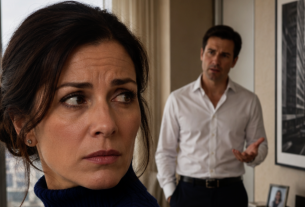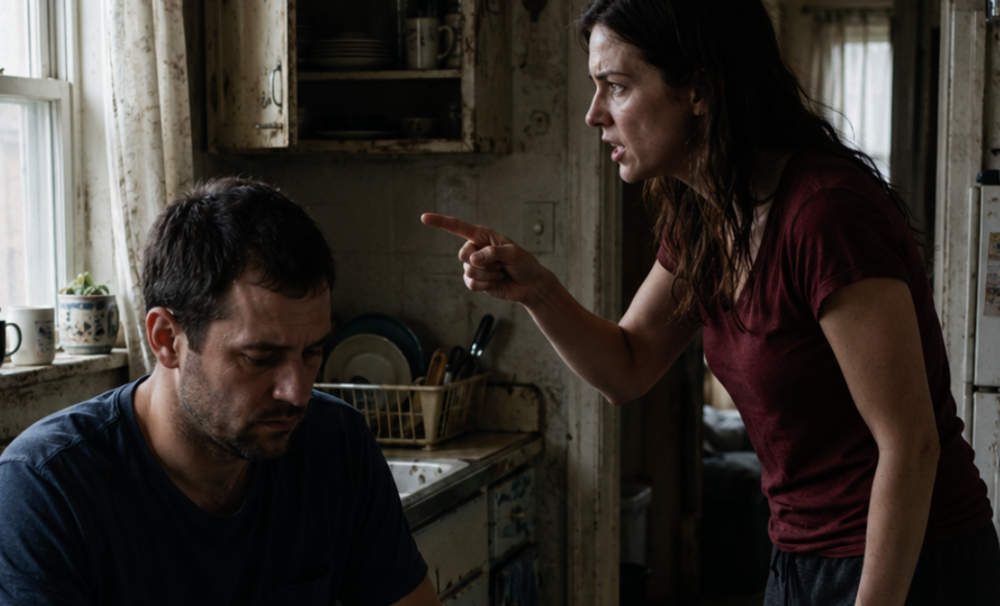
“What is this?” Svetlana froze in the kitchen doorway, her whitening fingers still clenched around the handle of the shopping bag. The bag with kefir and a loaf of Darnitsky bread hit the floor with a dull thud when she finally let go of the load, but even that sound did not make the man at the table look away from his smartphone screen.
“Where?” Anton drawled lazily, pretending to be absorbed in the news feed, though in reality he was simply scrolling through pictures of expensive cars. He was sitting in a sleeveless undershirt which, despite its nickname, was dazzlingly white and smelled of fabric softener — the very expensive one Svetlana bought only for his things.
“In the sink, Anton. In the damn sink!” Svetlana stepped forward, feeling her legs buckle from exhaustion. A whole day on her feet in the sales hall, ten hours running between shelves, smiling at fussy customers — all so she could come home and see this.
The stainless-steel sink was clogged with a thick, untidy mass. Overcooked star-shaped pasta, neatly diced carrots, potatoes, and herbs — all of it formed a disgusting still life, blocking the drain. Yellowish broth slowly gurgled down the pipe, leaving greasy streaks on the sides of the sink. It was soup. The very soup she had cooked yesterday until almost two in the morning, trying not to rattle the lids so she would not wake her “tired” husband.
Anton finally deigned to raise his head. His clean-shaven face, fresh after an afternoon nap, showed a mixture of boredom and mild irritation, as if he had been distracted from deciding the fate of the world over some utter nonsense.
“Oh, that,” he waved his hand with imperial disdain. “I poured out that brew. Impossible to eat. Sveta, I asked you: if you cook, then cook food, not swill for pigs. It was nothing but water and starch. Where was the richness? Where was the flavor? I scraped the bottom with my spoon — I didn’t find a single fiber of meat.”
Svetlana felt a hot, prickly lump begin to grow in her chest. She looked at her husband, at his well-kept hands, at his plump lips twisted into a disgusted smirk, and could not believe her ears.
“You poured the soup down the sink because there was ‘not enough meat’?! You’ve been living off me for three years, and you still dare to turn your nose up at food?! You want marbled beef steaks? Go unload freight cars! I won’t buy you so much as a crumb of bread anymore, you miserable gourmet!” his wife shrieked, staring at the ruined dinner.
Anton winced and demonstratively covered one ear with his palm.
“Don’t get hysterical, for God’s sake. Your ultrasonic screeching gives me a migraine. Understand this, silly woman,” he spoke slowly, deliberately, as people speak to the mentally challenged. “Nutrition is the foundation of productivity. How can I look for a worthy position, conduct negotiations, be creative, if my brain isn’t getting protein? Are you suggesting that I, a man in the prime of life, live on vegetable broth? It’s humiliating. I’m not a goat chewing cabbage.”
“Humiliating?” Svetlana choked with indignation. She came right up to the table, leaning her hands on the countertop so hard that her knuckles turned white. “Humiliating is asking your wife for two hundred rubles for cigarettes. Humiliating is me going to work in darned tights while you sleep until noon. And the soup was chicken soup, by the way! On bone broth!”
“Exactly! Bone broth!” Anton interrupted her, abruptly rising from his chair. Now he loomed over her, and his relaxed manner gave way to aggression. “Bones are for dogs! People need meat! You’re saving money on me, Sveta. You are deliberately lowering my standard of living so I feel like a nobody. That is psychological abuse, if you want to know. I’m used to a different level. And the fact that I’m currently having temporary career difficulties does not give you the right to feed me like a prisoner.”
He jabbed his finger toward the sink in disgust.
“Clean that up. It stinks of something sour. And come up with something normal for dinner. I saw an ad — Ribeye is discounted at Meat House right now. Order delivery. And a bottle of dry red wine, not that acidic three-hundred-ruble stuff you dragged home last time, but something proper, aged. I need to relieve stress after this gastronomic horror.”
Svetlana looked at him, and the veil of rage before her eyes turned red. She saw before her not the husband with whom she had once dreamed of children and cozy evenings, but a monstrous, bloated parasite who had grown into the sofa and believed the whole world owed him something simply because he existed.
“There is no money,” she said in an icy tone. “Three days until payday. Five hundred rubles in my wallet. That’s for transportation and bread.”
Anton rolled his eyes and sank back into his chair with a heavy sigh, showing with his whole body how much he suffered from her stupidity.
“You never have money. Because you don’t know how to manage finances. I’ve told you a hundred times: you need to invest in status, not pinch pennies. Borrow from Lenka. Or use the credit card. I’ll start working soon and pay off all your petty little debts with my first bonus. But right now I’m hungry, Sveta. Hungry and angry. And a hungry man is dangerous for the family climate.”
He buried himself in his phone again, considering the conversation over. For him, this was normal: make a complaint, issue orders, and wait for them to be carried out. It did not even occur to him that Svetlana herself was hungry. That she had not eaten since noon. That this soup had been her dinner too.
Svetlana slowly straightened. Something inside her clicked, as if an over-tightened string had snapped. The silence in the kitchen became thick and sticky, broken only by the sound of water dripping into the dirty sink. She shifted her gaze from the back of her husband’s head to the pile of pasta in the sink, then to her own hands — roughened, with a broken nail on her index finger.
“So, a dangerous climate?” she asked quietly, but Anton did not answer, enthusiastically typing a message to someone. Most likely to a friend just as idle as he was, complaining about his shrew of a wife.
Svetlana silently went to the sink. She did not clean up the mess. She simply turned the water on full blast. The stream struck the middle of the pasta heap, sending splashes in every direction — onto the clean countertop, onto the floor, and onto Anton’s white undershirt.
“Hey! What are you doing?!” he jumped up, brushing himself off, looking at her as if she were insane.
“Washing the dishes,” Svetlana replied calmly, without turning off the water. “You wanted cleanliness, didn’t you? Now it will be clean. Perfectly clean.”
She turned and left the kitchen, leaving the water roaring and Anton standing open-mouthed in the middle of the splattered kitchen. Her path led to the room where her laptop stood — the one she had bought on credit, the one Anton used in the evenings to play “tanks,” calling it “military strategy analysis.” She needed to check her card balance. Not to order steak, but to see whether she had enough money for what she had in mind.
Svetlana sat on the edge of the sofa, looking at the glowing laptop screen. The figures in her online banking account were not encouraging: the remaining loan for that very laptop, which Anton had begged for a year ago “for graphic work,” still hung over her like a heavy yoke. And his “graphic work” had turned out to be endless car forums and luxury real estate websites, where her husband spent hours dreaming of the life he believed he deserved.
The door to the room flew open and slammed against the wall. Anton burst in, pulling off his wet undershirt as he walked. Red blotches spread across his face — a sure sign that his precious calm had been disturbed.
“Have you completely lost your mind?” he barked, throwing the damp lump of fabric into the corner, right on top of a stack of ironed laundry. “Decided to splash water around? Is that what you call dialogue? That’s the level of a market woman, Sveta, not the wife of an intellectual!”
He collapsed into his favorite computer chair, which creaked pitifully under his weight. Anton demonstratively leaned back, crossed one leg over the other, and folded his arms across his chest, assuming the pose of an offended monarch.
“I’m waiting for an apology,” he hissed. “And for the dinner issue to be resolved. My stomach is starting to digest itself, and that can lead to gastritis. You know how expensive treatment is these days. Or do you want me to drop dead?”
Svetlana slowly closed the laptop lid. The room became darker; only the streetlamp picked out from the gloom the dusty shelves with his collection of model cars — the only thing he had spent his occasional earnings on a couple of years ago.
“Anton,” her voice was quiet, but steel rang in it. “You haven’t worked for three years. Three. Years. I pay for the apartment, electricity, water, internet, food, and your underwear. And you sit here talking about gastritis? Have you opened a job website even once this week?”
Anton rolled his eyes so hard it seemed he might see his own brain.
“There you go again!” he groaned theatrically. “How many times do I have to explain it to you? I’m not a loafer, I’m in active search. I send out résumés! But I’m not going to work a cash register at Pyaterochka or haul sacks of cement! I have two university degrees, Svetlana! I’m a manager! I’m waiting for a response from the holding company; they’re considering me for the position of head of logistics.”
“You’ve been waiting for their response for eight months,” she retorted. “In that time, you could have become a courier, a taxi driver, anyone, just to bring even a kopeck into the house!”
“A courier?!” Anton squealed, leaning forward. “You want acquaintances to see me with a yellow backpack on my back? You want to destroy my reputation? Who will hire me for a management position afterward if I stain myself with low-skilled labor? I have standards, Sveta, and I have no intention of lowering them for your petty bourgeois need for sausage!”
He stood up and began pacing around the cramped room, bumping furniture with his elbows. His voice gained strength, turning into the sermon of an offended prophet.
“You don’t understand the main thing. You drag me down! Your thinking is poverty thinking. You save on food, you buy cheap things, you’re soaked through with fear of the future. But money is energy! To earn millions, you have to feel like a million! How can I radiate confidence at an interview if I’m dressed in rags and filled with empty soup made from chicken skins?”
He stopped in front of her, pointing toward the kitchen.
“That soup is a symbol of your faith in me. Or rather, the lack of it. You feed me like a failure, and that’s why I can’t break through the financial ceiling. Steak, Sveta! Marbled beef! It’s not food, it’s an investment! It’s testosterone, strength, clarity of mind! If you loved me, you would find a way to provide your husband with a worthy diet.”
Svetlana listened to this nonsense and felt reality begin to swim around her. His words contained the monstrous, twisted logic of a parasite who had convinced himself of his own exceptionalism. He sincerely believed the world was obliged to provide him with a throne, and until there was a throne, his wife had to work for two so he would not lose his form.
“An investment?” she asked, rising from the sofa. “So I’m the investor? Where are my dividends, Anton? Where is the profit? In three years I’ve invested almost one and a half million rubles into this project called ‘Your Genius.’ My salaries, my bonuses, my nerves. And what did I get? A fat, insolent man who pours out soup because it isn’t elite enough for His Majesty?”
“Don’t you dare count my money!” he shouted, his face twisting with rage. “We’re a family! We have a shared budget! The fact that you’re the one earning right now is temporary. When I get back on my feet, I’ll shower you with gold! But right now you are obliged to support me! It is your duty as a wife! In sorrow and in joy, have you forgotten?”
“In sorrow — yes,” Svetlana cut him off. “But your idleness is not sorrow. It is your choice. And you know what? The investor is leaving the project. Funding is terminated.”
Anton froze. He looked carefully at his wife, trying to understand whether she was bluffing or not. But there was no familiar pleading or fear in her eyes. There was cold emptiness. It frightened him, but angered him even more.
“Oh, really?” he hissed, narrowing his eyes. “Decided to blackmail me with food? Fine. Then listen carefully. I’m under stress right now. You’ve driven me to a nervous breakdown with your complaints. My blood pressure is jumping, my heart is pounding. I need to calm down.”
He stepped toward her, holding out his hand, palm up.
“Give me the card. Or cash. I’m going to the store. I need a bottle of good cognac. Not that trash you drink on holidays, but proper Hennessy or Courvoisier. I need to dilate my blood vessels, otherwise I’ll have a stroke, and that will be on your conscience.”
“Are you joking?” Svetlana stepped back. “You’re asking for money for elite alcohol after pouring dinner into the toilet?”
“I’m not asking, I’m demanding!” Anton barked, finally losing all human appearance. “I am the head of the family! I am a man! I need to relieve tension! Do you have any idea how hard it is to live with a woman who doesn’t value you? Who saws at my brain from morning till night? I need a drink just to endure your presence in this apartment! Give me the card, now!”
He made a sharp movement, trying to grab her arm, but Svetlana dodged. Suddenly, everything in her head became crystal clear. All these years, she had been feeding not just a lazy man. She had been feeding a monster that lived off her life force, her self-esteem, her future.
“No,” she said firmly.
“What do you mean, no?” Anton choked with outrage.
“There will be no money for cognac. And no money for steaks. And none for cigarettes either.”
She turned and walked toward the wardrobe in the hallway. Anton rushed after her, stumbling over the threshold.
“Where are you going?! We haven’t finished talking! You have no right to limit my funds! This is violence! This is economic abuse! Sveta, come back! I’ll call my mother right now and tell her how you’re torturing me!”
“Call her,” she threw over her shoulder, opening the wardrobe doors. “Let your mother bring you cutlets. And I’m starting an inventory.”
Svetlana flung open the doors where they kept supplies of grains and canned goods. Anton stood behind her, breathing heavily, his fists clenching and unclenching. He still did not understand what was happening, but the animal fear of hunger had already begun to gnaw at him from within. The scandal was only gaining momentum, and there was no way back now.
Svetlana moved through the kitchen silently and quickly, like a robot whose empathy module had burned out. She did not scream, cry, or try to explain anything. She simply opened the wall cabinet and began methodically sweeping from the shelves everything that had any nutritional value.
“What are you doing?” Anton stood in the doorway, arms crossed over his chest, watching her actions with disgusted bewilderment. “Going hiking? Or decided to play Siege of Leningrad? Sveta, this is childish. Put the pasta back, I might want a snack at night, if you still don’t deign to order normal food.”
Svetlana ignored him. A pack of buckwheat, a jar of instant coffee, an opened package of tea, sugar, salt — everything flew into a large Auchan shopping bag, the same sturdy one she usually dragged from the market, weighing down her hands.
“Who am I talking to?!” Anton’s voice grew louder, shrill notes appearing in it. He did not like this silence. When she screamed, it was understandable; it was a game in which he always came out the winner, crushing her with intellect and guilt. But now she was simply annulling his existence.
After filling the bag with dry goods, Svetlana opened the refrigerator. A shelf with cheese, a dozen eggs, a piece of doctor’s sausage, a jar of sour cream. All of it followed the grains. The refrigerator emptied, its dull little light forlornly illuminating the white plastic interior. Only a jar of dried-out mustard and a half-opened bottle of ketchup remained.
“Hey!” Anton jerked toward her, trying to intercept her hand reaching for the carton of milk. “Put that back! That’s my calcium! You have no right to deprive me of basic food products! This is theft now! I, by the way, contributed to this budget too… once!”
Svetlana sharply slammed the refrigerator door shut right in front of his nose. Anton recoiled, barely managing to pull his fingers away.
“Contributed?” she finally said. Her voice was dry and rough, like sandpaper. “For three years you’ve been stuffing yourself like a pig and talking about higher things. Basic food products, you say? That’s too low for you. You’re elite, aren’t you? And the elite don’t drink discounted milk.”
She picked up the heavy bag, carried it into the hallway, shoved it into the closet, and, with a click of the key, locked the wardrobe door with the built-in lock. She put the key into the pocket of her house pants.
“You’re sick…” Anton whispered, staring at this madness with wide-open eyes. “You’re really sick. Hiding food from your husband? No woman would ever do that! This is rock bottom, Sveta!”
Svetlana returned to the kitchen. She took a small bundle out of the freezer, one she had hidden behind the ice tray. Inside lay a single pork escalope. Not marbled beef, of course, but a perfectly decent piece of meat with a thin layer of fat. She had bought it for herself two days ago, wanting to treat herself on the weekend, but there had never been time.
The stove igniter clicked. The frying pan landed on the burner. The oil hissed, and a minute later the kitchen filled with the thick, intoxicating aroma of fried meat. The smell was so rich, alive, and real that it instantly overpowered the stench from the sink.
Anton, who was standing by the window and demonstratively staring into the darkness of the courtyard, sniffed the air. His stomach betrayed him with a loud growl. He swallowed thick saliva. Pride battled with primal hunger inside him, and hunger, spurred on by the aroma of garlic and pepper, was beginning to win.
“Well, there,” he muttered without turning around, already softening his tone. “You can do it when you want to. You should have done this from the start. I told you I needed meat. Fine, I forgive your hysteria with the bags. Serve it. Just don’t overcook it. I like medium rare.”
He swaggered over to the table, pulled out a chair, and sat down, waiting for the dish to be served. In his head, everything had fallen into place: his wife had kicked up a fuss, let off steam, but then, realizing her guilt before the breadwinner — even if only the future breadwinner — decided to atone for her sin with a good dinner. He even picked up a fork and tapped it on the table, hurrying her along.
Svetlana turned the meat over. The crust was perfect — golden brown. She turned off the gas, took a plate, placed the sizzling piece on it, and cut a slice of black bread.
Then she sat down at the table. Across from Anton. And pulled the plate toward herself.
Anton froze with the fork raised in his hand. His eyebrows crawled up his forehead, folding into a frown.
“Sveta, did you mix up the plates?” he laughed nervously. “Where’s mine?”
Svetlana cut off a piece of meat, speared it on her fork, blew on it, and put it into her mouth. She chewed slowly, looking straight into her husband’s eyes.
“There is no plate for you,” she said calmly after swallowing. “This is pork, Anton. Ordinary pork from the supermarket around the corner. It is unworthy of your refined taste. You said yourself: ‘I’m not a goat, eating whatever.’ But I’m a simple woman. I’ll eat even this.”
Anton’s face began to turn crimson. He watched her cut off a second piece, watched the clear juice run across the plate, watched her dip bread into it.
“You… you’re eating meat in front of me right now?” his voice trembled with rage and humiliation. “Alone? And me? I’m supposed to watch?”
“You don’t have to watch,” Svetlana shrugged. “You can leave. You can drink tap water. It’s free. For now.”
“Are you mocking me?!” he roared, slamming his fist on the table so hard that the salt shaker jumped. “I’m hungry! I’m a man! I need meat! Give it here!”
He lunged across the table, trying to grab the plate. His fingers had already touched the edge, but Svetlana reacted instantly. She drove the fork into the table with force, a millimeter from his hand. The sound of metal striking wood was sharp and frightening.
“Don’t touch it,” she hissed, and there was so much cold hatred in her gaze that Anton pulled his hand back as if burned. “You want to eat? Sell your phone. Sell your collectible model cars. Go wash the floors in the stairwell. But you will never touch my food again. Never.”
Anton fell back against the chair, breathing heavily. He looked at his wife as if seeing her for the first time. This was not the Sveta who used to hang on his every word. Sitting before him was an enemy. Calculating and cruel.
“You bitch…” he exhaled. “You petty, greedy bitch. Reproaching your own husband over a piece of meat? I’ll…”
“You’re nothing,” she interrupted him, continuing to eat. “You’re an empty space, Anton. You’re not even a parasite; parasites at least adapt somehow. You’re just a tumor. And I’m beginning the operation to remove it.”
“I’ll call my mother right now!” he started his usual tune again, jumping up from the chair. The smell of meat was driving him insane; humiliation burned through his insides. “I’ll tell everyone you’re starving me! That you’re an abuser! That’s a criminal offense! Leaving someone in danger!”
“Call her,” Svetlana nodded, finishing the last piece and carefully wiping the remaining fat from the plate with bread. “Just don’t forget to tell your mother that you poured out the soup yourself. And that for three years you haven’t brought a single ruble into this home. We’ll see who feels sorry for you.”
Anton rushed around the kitchen like a tiger in a cage. He opened empty cabinets, slammed doors, hoping to find something — a cracker, a forgotten cookie, anything to fill the gnawing feeling in his stomach. But everywhere there was emptiness. Clean, washed shelves.
His gaze fell on the trash bin. There, on top of the bag, lay the remains of that same soup — soaked noodles and boiled carrots, which he had so pompously thrown away an hour earlier. His stomach twisted in a spasm. He swallowed, realizing that pride was now fighting physiology, and physiology was beginning to whisper terrible things to him.
“I hate you,” he hissed, looking at Svetlana, who was calmly washing her single plate. “Curse you and your meat. You’ll answer for this. You’ll crawl on your knees when I rise up!”
“When you rise up, call me,” she said, wiping her hands with a towel. “And now — get out of the kitchen. I’m closing the door.”
Anton flew out into the corridor, knocking into the corners. He was shaking. Hunger mixed with powerless rage. He felt like a cornered beast. He needed to answer with something. To strike where it hurt. To make her hurt the way she had hurt him with her indifference and that cursed fried meat. And then he remembered. He remembered the treasured bottle hidden in the tool cabinet, which he had been saving for the triumphant celebration of his “appointment.”
“Well, hold on, you snake,” he whispered, and his lips stretched into an evil smile. “Now we’ll see who wins.”
Anton returned to the room looking like a victor clutching the Holy Grail. It was a stout bottle of French cognac, its dark glass hiding an amber liquid of many years’ aging. He had saved it for six months, hiding it in the toolbox behind old screwdrivers, away from his wife’s “vulgar” eyes. It was his personal gold reserve, his ticket into high society — bought, of course, with Svetlana’s credit card that month when she was lying sick with the flu and asked him to buy medicine.
He demonstratively slammed the bottle onto the table beside the laptop, then went to the kitchen for a glass — the only decent snifter in the house. Svetlana stood at the sink with her back to him and did not even turn around. Her indifference lashed him more painfully than shouting.
“Do you see this?” Anton asked loudly, pouring the cognac. The amber stream struck the bottom of the glass, spreading through the room the tart, expensive aroma of oak and vanilla, which immediately clashed with the smell of fried meat and cheap wallpaper. “This is Hennessy. The very thing you would call a waste of money. But for me, it is a sip of freedom. While you choke on your pork, I will drink the nectar of the gods. I am above your petty domestic life, Sveta. You can take away my food, but you cannot take away my class.”
He lifted the glass to his nose, theatrically closed his eyes, and inhaled deeply, showing with his whole body how much he was enjoying the moment. His stomach clenched treacherously from hunger, demanding something to eat with it, but Anton suppressed the spasm with an effort of will. Now he would prove to her who was master in this house.
Svetlana slowly dried her hands with a towel and turned around. Her gaze fell on the bottle. She recognized it. Six months ago, fifteen thousand rubles had disappeared from her card. Anton had said then that “the bank’s security system had glitched” and that scammers had withdrawn the money, and he, like a real man, would “deal with it.” He was still dealing with it.
“So that’s where my boots are,” she said quietly, looking at the bottle. “That’s where my untreated teeth are.”
She stepped toward him. There was no hysteria in her movements, only the frightening determination of a predator. Anton, sensing something was wrong, tried to cover the glass with his palm, but it was too late.
“Don’t you dare!” he squealed, recoiling. “It’s mine! I personally chose the blend!”
Svetlana silently swept his hand away with one sharp movement and grabbed the bottle by the neck. Anton clutched it from the other side. For a second they froze, pulling the cold glass between them like a rope. Their faces were very close: his distorted by fear and rage, hers stone-like, with empty, faded eyes.
“Give it back!” he rasped. “You don’t understand! It’s a collector’s item! It’s an investment!”
“An investment in the toilet,” Svetlana cut him off. She yanked the bottle toward herself with all the strength accumulated over three years of humiliation. Anton, weakened by hunger and a couch-bound lifestyle, failed to hold on. The bottle slipped out of his sweaty fingers.
Svetlana turned and went to the bathroom. Anton, stumbling over wires and his own pride, rushed after her.
“Stop! You idiot! You’re pouring money away! Real money!” he screamed, grabbing her shoulder already in the bathroom doorway.
Svetlana shook off his hand, hitting him in the chest with her elbow, and leaned over the toilet. She turned the bottle upside down. The thick, oily liquid the color of dark gold rushed cheerfully into the porcelain abyss with a gurgle. The smell of alcohol and noble wood instantly filled the cramped room, mixing with the smell of bleach.
“No!” Anton howled, watching his “status” disappear into the sewer. He dropped to his knees beside the toilet, as if trying to catch the stream with his hands, but it was too late. The last drops fell into the water, tinting it a dirty yellow.
Svetlana pressed the flush button. The water noisily carried fifteen thousand rubles down the pipe.
“You poured out the soup because there was too little meat in it,” she said, looking down at him as if at a naughty kitten. “And I poured out your cognac because it was too good for this apartment. Balance restored, Anton. Now we’re even.”
Anton slowly rose from his knees. He was shaking. Red blotches spread across his face, his lips trembled. There was no more arrogance in his eyes, only pure, unclouded hatred.
“You… you ruined everything,” he hissed, spraying saliva. “You destroyed everything sacred that was in this house. I endured your wretchedness, your poverty, your boredom. I thought I could raise you to my level. But you are rock bottom, Sveta. You’re a swamp. I’m suffocating here!”
He flew into the hallway and tore his jacket from the hook.
“I’m leaving! Do you hear me? I’m leaving! My foot will never step in here again! You’ll rot here alone with your pots and pans! And I’ll find a woman who will value me! A woman who understands who I am!”
He waited. He waited for her to throw herself at his feet, grab his sleeve, start begging him to stay, promise to change. After all, that was how it had always been. All three years. He threatened to leave — she cried and gave him money.
But Svetlana stood in the bathroom doorway, arms crossed over her chest, and looked at him with icy calm.
“Good riddance,” she said evenly. “Put the keys on the nightstand.”
Anton froze with one sleeve on. This scenario had not been written into his play.
“You’re throwing me out?” his voice broke into falsetto. “Me? Your husband? At night? With no money?”
“You have talent, Anton, and two university degrees,” she smirked from the corner of her mouth. “You won’t perish. Invest your genius into finding somewhere to sleep.”
“Go to hell!” he shouted, finally losing all human appearance. He grabbed his keys from the shelf and hurled them onto the floor with force. The metal clinked against the tile. “I’ll leave! And when I become a millionaire, you’ll bite your elbows! You’ll beg me to come back, but I won’t even look in your direction!”
He yanked the front door open wide. Cold air and the smell of someone else’s tobacco drifted in from the stairwell.
“And take your game console,” Svetlana suddenly said. She quickly went into the room, pulled the cords out of the socket, grabbed the dusty console together with the controllers, and, returning to the hallway, simply threw it through the open door, straight onto the dirty concrete of the landing. The plastic cracked pitifully.
“You’re insane!” Anton squealed, rushing to save his only treasure. He jumped out onto the landing, pressing the box with wires to his chest.
Svetlana did not wait for the continuation. She stepped forward, grabbed the door handle, and slammed the door shut in his face.
The crash of metal echoed through the entire stairwell.
From the other side came the dull thud of a fist against the door and a stream of choice profanity. Anton was shouting something about court, division of property, and what a bitch she was. Svetlana calmly turned the lock. Once. Twice. Click.
The sounds outside became muffled, distant, as if coming from another dimension.
She pressed her forehead against the cold metal surface of the door. Her heart was pounding somewhere in her throat, her hands were trembling slightly, but it was not fear. It was liberation.
The silence in the apartment was no longer oppressive. It was clean. It did not smell of expensive cognac or sour soup. It smelled of the future.
Svetlana pulled away from the door, went to the kitchen, and opened the window to air out the smell of alcohol fumes and scandal. The cold autumn air rushed inside, cooling her burning cheeks. She looked at the empty sink, which she herself had washed an hour earlier. It shone. No leftovers. No dirt.
“Tomorrow,” she said aloud to herself, looking at the dark windows of the building across the way. “Tomorrow I’ll make myself coffee. Real coffee. And I’ll buy myself those boots.”
She turned off the kitchen light and went to bed, knowing for the first time in three years that in the morning no one would demand an accounting from her for a hundred rubles spent.