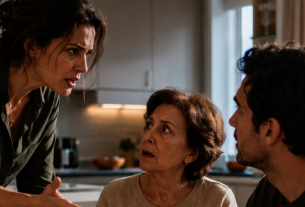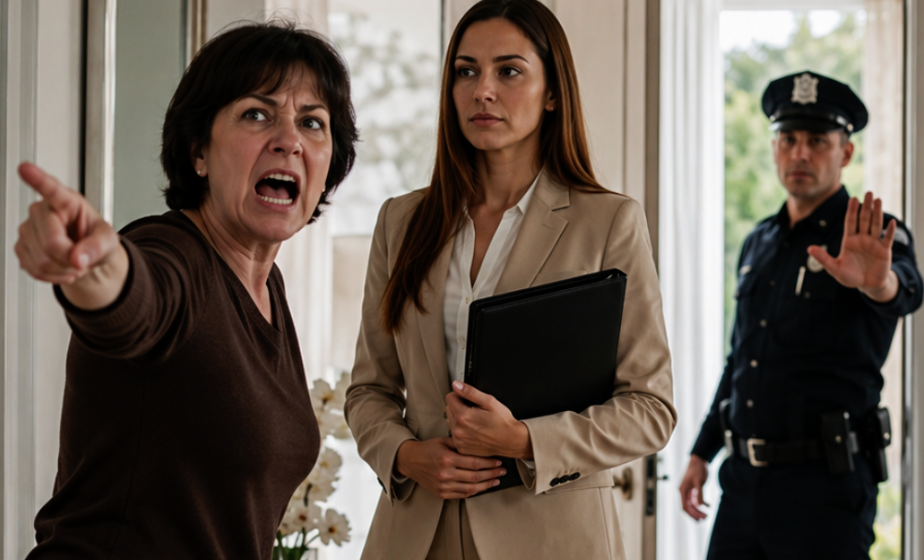
“The apartment belongs to my son, and you’re nobody here!” Nina Romanovna shouted in my hallway, clutching my document organizer. “Clear out the small room immediately. That will be my bedroom.”
I stopped by the front door.
Two unfamiliar bags stood on the mat. Against the wall lay a folding bed in a gray cover. On my shelf, where the utility bills and the keys to the storage room usually lay, someone else’s hairbrush had appeared, with long gray hairs caught in it.
“What bedroom?” I asked.
“Mine,” my mother-in-law said. “Oleg has already decided everything. A mother should be closer to her son. And don’t act like you’re the mistress here, Verochka. I’m the mistress here. I’m his mother.”
Lidia, Oleg’s sister, peered out of the living room. In her hands was my box with the documents for the appliances.
“Where should I put this?” she asked, as if I were a warehouse employee.
I did not answer right away.
I took off my jacket. Hung it on the hook. Slowly. Carefully. Because in moments like that, any unnecessary movement only delights those who have come to take charge of someone else’s life.
“Lidia, put the box back where it was,” I said.
“Oh, now she’s going to give orders too,” Nina Romanovna sneered. “Do you even understand where you are? This is my son’s home.”
I looked at the box.
The lid was slightly open. The edge of the warranty card for the washing machine was sticking out. I had bought that machine. And the refrigerator. And the wardrobe in the hallway. And everything that had stood in this apartment after I moved in.
And the apartment itself had belonged to me even before the marriage.
Under a deed of gift.
Ownership was registered on March 18, 2021. Oleg and I got married on July 9, 2022. They were simple dates. Clear ones. Without family interpretations or conversations about how “a man should feel like the master of the house.”
Oleg knew all of that.
Nina Romanovna knew it too. I had shown the documents when, after the wedding, they first came to “see how the newlyweds had settled in.” Back then my mother-in-law walked from room to room, felt the curtains, checked the water pressure, and said the apartment was “modest, but it would do for a start.”
Then her words began to change.
“A man without his own place is not a man.”
“A son should feel like the master.”
“A wife enters her husband’s family, not the other way around.”
Back then I laughed it off. Sometimes I stayed silent. Sometimes I went into the kitchen to cut salad so I would not have to answer. After every visit, Oleg said the same thing:
“Mom doesn’t mean any harm. She’s just worried about me.”
But on May 31, 2026, that worry arrived with a suitcase.
And with a ready-made plan.
A folding bed was already standing in the small room. My ironing board had been pushed against the wall. On the desk where I worked on reports in the evenings lay a bag of Nina Romanovna’s medicines, her phone charger, and an old wallet with a broken zipper.
“Who brought in the folding bed?” I asked.
“Oleg brought it this morning,” Lidia replied. “You were at work. He said he’d explain later.”
I called my husband.
He rejected the first call. The second one too. On the third, he answered.
“Vera, I’m busy.”
“Your mother is in my apartment with her things.”
“Well, yes. I wanted to talk tonight.”
“Talk now.”
He exhaled as if I were the one creating the inconvenience.
“Mom has a hard time alone. Lida’s place is cramped, the kids run around, there’s no space. We have two rooms. It’s nothing special.”
“We?”
“Don’t nitpick over words.”
“Oleg, your mother said this is her son’s apartment.”
He was silent for a moment.
“Mom probably expressed herself too harshly.”
Nina Romanovna heard his voice and stepped closer.
“Give me the phone,” she ordered. “I’ll talk to him myself.”
I stepped back.
“No.”
“You’re going to forbid me now?”
“Yes.”
On the other end, Oleg began speaking faster.
“Vera, don’t start. We’re family. Mom will live with us for a month or two. Then we’ll decide.”
The word “decide” turned out to be the key one.
Because they had already decided without me. In the morning, they brought in a folding bed. During the day, they set down the bags. In the evening, they informed me where “Mom’s bedroom” would now be.
“Oleg,” I said, “your mother and sister are going to collect their things and leave now.”
“Don’t make a scene.”
“This is my apartment.”
“There you go again. How much longer are you going to keep this up? I live here. I’m your husband.”
“You are not the owner.”
Nina Romanovna laughed. Loudly. With emphasis.
“The owner! Did you hear that?” she said, turning to Lidia. “She got a little piece of paper and put on a crown.”
I ended the call.
I did not start explaining. I did not start proving that I was not nothing. I opened the app with my documents. The scans were there: the deed of gift, the extract from the Unified State Register of Real Estate, the marriage certificate, the utility payment receipts, the contract with the management company in my name. I had not collected them for a battle. I was simply used to keeping my documents in order.
As it turned out, order sometimes works better than any shouting.
“Nina Romanovna,” I said. “You have ten minutes to collect your things and leave.”
“Oh, so that’s how it is?” She lifted her chin. “I’ll call the neighbors right now. Let everyone see how a daughter-in-law throws her husband’s mother out onto the stairwell.”
“Call them.”
She had not expected that answer.
“And I’ll call the district police officer!”
“Good idea. Only I’ll do it first.”
I dialed 112.
The operator’s voice was calm. I spoke calmly too. I gave the address. I said there were strangers in my apartment who refused to leave, were moving my belongings, and claimed the housing belonged to another person. I said I had ownership documents.
At first, Nina Romanovna looked at me with a smile. Then the smile disappeared.
“What are you doing?” she hissed. “Have you lost your mind completely?”
“I’m documenting the situation.”
“I am your husband’s mother!”
“You are a guest. And I am asking you to leave.”
Lidia quietly picked up the box and put it back on the shelf. More carefully this time.
“Mom, maybe we really should go?” she said.
“Be quiet!” my mother-in-law snapped. “She’s trying to scare us. Nobody is coming for a family conversation.”
They arrived twenty minutes later.
Two police officers came up to the floor together with the concierge. The concierge looked at Nina Romanovna with curiosity. That very morning she had helped her carry in a bag with a blanket, because Nina Romanovna had said, “I’m moving in with my son, my daughter-in-law is happy.”
Now there was no happiness.
“Who called?” the senior officer asked.
“I did,” I replied. “Vera Kovaleva. The owner of the apartment.”
“Do you have documents?”
I opened the extract from the Unified State Register of Real Estate on the screen and handed him the phone. Then I took out my passport. A paper copy was in the folder in the wardrobe, but the phone was enough to begin the conversation.
The officer checked the information. Then he looked at Nina Romanovna.
“Your documents.”
“Why do you need mine?” she protested. “I came to my son.”
“Documents.”
She took her passport out of her bag.
“Are you registered at this address?” the officer asked.
“No,” she replied. “But my son lives here.”
“Are you the owner?”
“No, but…”
“Do you have a lease agreement, an agreement with the owner, or written permission to reside here?”
“Why are you waving papers at me?” my mother-in-law snapped. “This is family!”
I did not interfere.
At that moment, Oleg appeared. He flew into the hallway in his jacket, a work backpack on his shoulder. He saw the police officers. He saw his mother. He saw me.
And immediately chose the wrong tone.
“Vera, are you out of your mind? Calling the police on my mother?”
“On strangers who refused to leave my apartment.”
“She is my mother!”
“To you. To my apartment, she is a stranger.”
Nina Romanovna gasped.
“Do you hear that, Olezhek? She called me a stranger!”
“Mom, calm down,” he said, but he was looking at me. “Vera, put the phone away and stop this disgrace.”
“The disgrace began this morning, when you brought a folding bed here without my consent.”
The officer turned to Oleg.
“Are you registered here?”
“No,” he muttered. “But I’m her husband.”
“Are you the owner?”
“No, but I live here.”
“The issue of spouses’ residence is resolved between the spouses and, in case of dispute, through the established legal procedure,” the officer said calmly. “Right now, the owner is asking citizens who are not registered here and have no documents granting them residence to leave the premises. We are recording the conflict.”
Oleg pressed his lips together.
“Vera, do you understand what you’re doing?”
“Yes.”
It was a short word. But for the first time in a long time, it was completely mine.
Nina Romanovna tried to go into the small room.
“I’ll get my medicines.”
“Of course,” I said. “In the officers’ presence.”
She spun around sharply.
“Don’t you dare speak to me in that tone.”
“There won’t be another one.”
While she gathered her bags, Lidia stood by the door and looked at the floor. There was no repentance on her face. Rather, the exhaustion of a person who had once again been dragged into someone else’s coordinated operation.
I noticed that one bag was filled not only with my mother-in-law’s things. My new towels were there, along with a package of cleaning supplies and the blanket from the small room.
“Leave those,” I said.
“I took them to wash them,” Nina Romanovna quickly replied.
“No. They stay here.”
The officer looked at the bag. My mother-in-law pulled out the towels and threw them onto the cabinet.
“Choke on your rags.”
“Please record that,” I said.
She fell silent.
That is what a uniform and a working intercom camera do to loud people. They are still angry. But they begin to count their words.
Ten minutes later, the hallway was empty. On the floor there remained only marks from suitcase wheels and cookie crumbs from whoever had eaten directly over my mat.
Oleg did not leave.
He stood in the living room and looked out into the courtyard.
“You got what you wanted,” he said.
“I took back what was mine.”
“She is my mother.”
“And this is my apartment.”
“You destroyed a family over a room.”
I opened the extract from the Unified State Register of Real Estate on my phone again and placed the screen in front of him on the table.
“Read it.”
“I’ve seen it.”
“Read it out loud.”
He looked at me with a heavy gaze.
“I’m not going to perform a circus act.”
“Then listen. Right holder: Vera Alexandrovna Kovaleva. Type of right: ownership. Basis: deed of gift. Registration date: March 18, 2021. Marriage to you concluded on July 9, 2022. You are registered at your mother’s address. You have no share in this apartment.”
“I set this place up.”
“You screwed in two shelves and chose the handles for the wardrobe. I paid for the materials. I paid the worker. There was no redevelopment. There were no capital investments that changed the status of the property.”
He turned away.
“Did a lawyer teach you that?”
“No. The documents did.”
Oleg sat down on the edge of the sofa. The same sofa his mother had decided that morning to move against the wall because “it would be more convenient for her to watch television that way.”
“Mom just wanted to live nearby,” he said more quietly.
“No. Your mother wanted to enter the apartment as the mistress. And you opened the door.”
He was silent.
“Where is the second set of keys?” I asked.
“Mom has it.”
“You get it back now. Or you write me a message saying the keys are lost and that you will no longer give access to third parties.”
“Vera…”
“Now.”
He called his mother. I could hear only his side of the conversation.
“Mom, give back the keys… No, not later… Yes, now… Because it’s necessary… Mom, don’t start.”
Half an hour later, Lidia came back upstairs. Alone. She handed over the key ring. She did not look at me.
“Mom said you’ll regret this.”
“Tell her that all conversations will now be in writing.”
Lidia left almost at a run.
Oleg placed the keys on the table.
“Happy?”
“No.”
“Then what else?”
“You’re spending tonight at your mother’s.”
He smirked.
“So you’re kicking your husband out?”
“I am cutting off access for a person who handed keys to third parties without the owner’s consent and tried to move them into my home.”
“You talk pretty.”
“I talk accurately.”
He began to get angry again. I could see it on his face. But after the police visit, his anger was already restrained. It could no longer spread through the whole hallway, could no longer command, could no longer drag other people’s bags through my rooms.
“And what if I don’t leave?” he asked.
I raised my phone.
“Then I ask the officers to return and record a new conflict. Then I file for divorce. Separately, I consult about terminating your right to use the residential premises. I don’t care how long it takes. But from today on, no one will live here without my consent.”
He looked at me as if he were seeing me for the first time.
Not the wife who gave in at family dinners. Not the convenient hostess who put an extra plate on the table for her mother-in-law. Not the woman to whom one could say “Mom is just worried,” and she would remain silent.
He saw the owner.
And he left.
He packed for a long time. Demonstratively. Took T-shirts from the wardrobe, slammed drawers, searched for the charger he himself had put in his backpack. I stood in the hallway and noted what he was taking. Not because I felt sorry for the things. Because I no longer wanted to live in a fog.
When the door closed behind him, I did not make any grand gestures. I did not write a long message to a friend.
I took a trash bag and collected what remained after the invasion: a cookie wrapper, a torn price tag, an old receipt from the store near Nina Romanovna’s house, napkins she had spread on my table. Then I wiped the shelf where she had placed her hairbrush.
I simply returned the apartment to its normal state.
The next day, I took half a day off. I went to a lawyer whom I had found through an acquaintance from the HR department. Not for a victory speech. For a plan of action.
The lawyer listened attentively, looked at the extract from the Unified State Register of Real Estate, the deed of gift, and the correspondence with Oleg, where he had written: “Mom will stay with us for now, don’t argue.”
“The apartment is your personal property,” he said. “But you must act calmly. Divorce separately. The issue of using the housing separately. No threats. Everything in writing.”
I liked that “in writing.”
For too long in my life, everything had been decided by Nina Romanovna’s voice. Loud, pressing, confident that if she repeated a phrase three times, it would become true.
More
Car repair
Family advice
Lawyer services
Now the documents were the truth.
I filed for divorce through the established procedure. Then I sent Oleg a message:
“Oleg, after the events of May 31, 2026, your relatives cannot reside in my apartment. Handing keys to third parties without my consent is unacceptable. Regarding your belongings, I suggest we agree on a date and time. Communication in writing only.”
He replied forty minutes later:
“You’ll regret this. Mom said we’ll prove the apartment is marital property.”
I forwarded it to the lawyer. He answered with one sentence:
“Save the correspondence.”
And I saved it.
Nina Romanovna began with voice messages. I did not listen to them live. I converted them to text. Everything familiar was there: “ungrateful,” “my son wasted his best years on you,” “we accepted you,” “you are nothing without us.”
Then she came to the entrance.
The concierge called me at work.
“Vera Alexandrovna, Nina Romanovna is here to see you. She says it’s urgent.”
“I’m not expecting anyone.”
“She says she is a relative.”
“I’m not expecting anyone,” I repeated.
A minute later, a message from my mother-in-law appeared in the messenger:
“You will still beg to come back. Oleg will not be left without housing.”
I replied:
“Send all claims regarding the apartment in writing through the court. Unarranged visits are not approved.”
I wrote nothing more.
Then there was a family council without me. Oleg told me about it when, a week later, he asked to meet “like human beings.” I agreed only at a café near the Multifunctional Center. In the daytime. For forty minutes.
He arrived tired. Without his former confidence. He placed a folder on the table.
“Mom says we need to file for division of property.”
“File.”
He grimaced.
“Do you even understand that it’s expensive?”
“I understand.”
“The lawyer said there’s almost no chance.”
“Your lawyer?”
“Yes.”
I nodded.
“A good lawyer.”
Oleg clenched the folder.
“You could have just let Mom stay for a month.”
“No.”
“Why?”
“Because she did not enter as a guest. She entered as an owner. And you opened the door.”
He lowered his eyes.
“I thought you would give in.”
There it was, the most honest phrase of our entire marriage. Not “I didn’t understand.” Not “Mom went too far.” Not “I wanted to help.” He thought I would give in.
“I used to,” I said.
“And now?”
“Now I have an extract from the Unified State Register of Real Estate, an application, correspondence, and the understanding that giving in in a place like this becomes an invitation.”
He was silent for a long time.
“I’ll pick up the rest of my things on Saturday.”
“In the presence of a witness. I’ll ask the neighbor from apartment three to sit in the kitchen.”
“Are you afraid of me?”
“No. I’m establishing order.”
On Saturday, he came with two bags. The neighbor, Raissa Ilyinichna, really did sit in the kitchen, sorting through her internet bills. She did not interfere. She was simply an adult, calm witness to the fact that things were being taken without scandal and without anyone “accidentally grabbing” something.
Oleg took his jackets, tools, sales books, and a box with sneakers. He paused at the door.
“Mom said you humiliated her.”
“I am not discussing Nina Romanovna.”
“You’ve become a stranger.”
“I’ve become separate.”
He left.
After that came small attempts to restore the old order. Sometimes he wrote that he had forgotten documents. The documents turned out to be an advertising brochure. Sometimes Nina Romanovna asked me to return “her blanket.” The blanket was mine, bought two months before the wedding. Sometimes Lidia called and asked whether they could at least take that same folding bed.
I gave back the folding bed. Through the concierge. With a receipt on an ordinary sheet of paper.
After that, Nina Romanovna wrote: “You are petty.”
I did not answer.
The divorce was finalized in the autumn. Oleg looked restrained at the hearing. He mentioned the apartment only once:
“I make no claims to my spouse’s personal property.”
The word “spouse” already sounded empty. Like a position from which a person had been removed by order.
After the hearing, he caught up with me at the exit.
“Mom still thinks you set everything up.”
“Let her think so.”
“She says the police were unnecessary.”
“The police were on time.”
He wanted to say something else, but he could not find words that could change the fact. The fact was simple. That evening, strangers entered my apartment with a suitcase and decided that a loud voice could replace ownership rights. It cannot.
A month later, I received a letter from Nina Romanovna. A paper one. In the mailbox. On the envelope, she misspelled my surname, though she had known it for five years.
Inside was a sheet of squared paper.
“Return at least half the cost of the investments to Oleg. He is a man; he needs to start over.”
I took out the folder. Found the receipts. Found the transfers to the worker. Found the order for the wardrobe. Everything was in my name.
I did not call. I did not explain. I simply sent a registered letter with a copy of the expense list and a note:
“Payment was made by me. I see no grounds for compensation. If you disagree, go to court.”
There was no court.
There were still conversations among relatives. Messages through mutual acquaintances. Lidia once wrote: “Mom, of course, went too far, but you could have been softer.” I replied: “Softer was before the folding bed.” And I ended it there.
Gradually, the apartment became mine again not only on paper, but in feeling.
I moved the desk back to the wall where the light fell better in the morning. I gave away the strange shelf Oleg had once brought without asking to a free exchange point. I ordered new labels for folders: “apartment,” “utility payments,” “contracts,” “court.” Not for beauty. For peace of mind.
Sometimes I remembered Nina Romanovna’s first phrase.
“The apartment belongs to my son, and you’re nobody here.”
A strange thing. Before that evening, I had indeed often behaved like a person without a voice. I gave in. Explained myself. Endured other people’s inspections, other people’s advice, other people’s keys on my shelf.
And then one document on a phone screen put everything in its place.
Not because paper is stronger than a person. But because a person who finally takes out their paper and says “no” stops being a convenient place for other people’s plans.
Now my desk stands in the small room. On it are a laptop, a lamp, and a clean folder with the extract from the Unified State Register of Real Estate. The folder is not lying in plain sight. I no longer need to frighten anyone with it.
It is enough to know that it exists.
In the evenings, I sometimes hear neighbors’ doors slamming, someone arguing on the stairwell, someone carrying bags, someone loudly proving to relatives their right to someone else’s corner. I close my work tabs, put the documents into the folder, and walk through the apartment without feeling that I owe anyone an explanation.
This is my home.
Not the home of Nina Romanovna’s son. Not a “family nest” for those who decided to move in without an invitation. Not a backup airfield for relatives whose own lives have become too cramped.
Mine.
And if a person comes into someone else’s home with a suitcase and shouting, sometimes it is useful for them to see not shouting in return, but an extract from the Unified State Register of Real Estate and a calm question from a police officer:
“Do you have documents granting you the right to live here?”
Nina Romanovna did not have them.
I did.