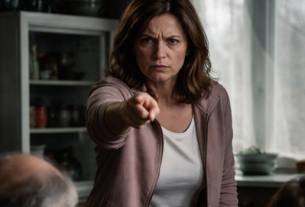
My ex-husband Kirill had a unique talent: he knew how to burst into someone else’s life with the grace of a bulldozer that, for some reason, believed it was a ballet barre. He appeared on the doorstep of my apartment at seven in the evening on a February Tuesday, shaking snow from a coat that cost as much as a Boeing wing, and immediately announced that my son and I had to vacate the dacha at once. The fact that the dacha had belonged to our twelve-year-old son for a year already did not seem to bother Kirill.
“Nina, this is a matter of principle and male honor!” he proclaimed, walking into the kitchen without taking off his shoes.
I sighed. Every time Kirill talked about honor, I felt like checking whether the silverware was still in place.
Roma, my twelve-year-old son, was sitting at the table, melancholically dipping a pancake into sour cream. When he saw his father, his expression did not even change. He merely lifted his left eyebrow slightly — a gesture he had copied from my mother whenever she saw the utility bills.
“Hi, Dad,” Roma muttered. “Are you here on business, or are you going to tell us again how spaceships are plowing through the vast expanses of your business plans?”
“Don’t clown around, Roman!” Kirill waved his hand. “I came to reclaim the family nest. Mother acted rashly. Old age, you know, sentimentality. She transferred the dacha to you, but in reality, it is a family asset. And the head of the family, despite our… creative split with your mother, remains me.”
I leaned against the wall, crossing my arms over my chest. The situation was beginning to resemble a cheap vaudeville show, but I had not bought tickets to it.
“Kirill,” I began gently, “I think you’re confusing your terms. A ‘family nest’ is something built over generations. That house in Zhavoronki was bought by your mother, Olga Mikhailovna, with her own money, back when you were still walking under the table and dreaming of becoming an astronaut, not a ‘free investor.’”
“Exactly!” Kirill seized on it, sitting down on a stool that groaned pitifully under the weight of his ego. “Mother bought it! That means it’s an inheritance. Mine! And then she went and made a deed of gift to her grandson. That’s manipulation! I consulted… people. They said it can be contested.”
“What people?” Roma asked without looking up from his tea. “The ones you owe money to for your last startup breeding chinchillas in a garage?”
“Is that any way to talk to your father?!” he said indignantly. “For your information, I’m taking care of your future. The dacha needs to be sold. The market is at its peak right now! I’ll invest the money… In a year, we’ll buy you two dachas like that. No, three!”
I looked at him and remembered an entertaining article from the magazine Young Naturalist that I had read as a child. You know, in nature there exists an amazing creature — the deep-sea anglerfish. The male of this species is dozens of times smaller than the female. He finds her in the darkness of the ocean, bites into her side, and gradually fuses with her through blood vessels. Over time, he loses his eyes, internal organs, and becomes nothing more than an appendage producing… ahem, the necessary biological material.
“Kirill,” I said, “do you know what ‘obligate parasitism’ is?”
He froze with his mouth open.
“What? Are you starting with your fancy words again? Nina, be simpler, and people will be drawn to you. People with money.”
“An obligate parasite cannot survive without a host,” I continued in the tone of a museum guide at a cabinet of curiosities. “It consumes resources, gives nothing in return, and sincerely believes it honors the host organism with its presence. Right now, you are trying to bite off a piece of your own son’s property to patch the holes in your budget. That’s not even parasitism, Kirill. That’s an evolutionary dead end.”
“I’m not biting anything off!” he shrieked, jumping up. “I’m saving the asset! The roof leaks there! The foundation has shifted! Roma won’t be able to handle the maintenance!”
“We fixed the roof in the summer,” Roma remarked calmly. “I negotiated with the crew myself. Grandma gave me the money. At the time, I think you were busy ‘finding yourself’ in Goa?”
Kirill began pacing nervously around the kitchen. Six steps from the refrigerator to the window. Back and forth.
“You’re all in this together!” he spat. “Two snakes and… a little snake. I’m his father! I have rights! I’m calling Mother right now, and she’ll cancel this stupid deed of gift. I’ll tell her you’re blackmailing me! That you… won’t let me see my son!”
“Call her,” I nodded, pointing to the phone.
Kirill triumphantly snatched out his smartphone. He was certain that his mother, Olga Mikhailovna, an honored teacher with forty years of experience, would melt at the sound of her beloved son’s voice. He had forgotten only one thing: Olga Mikhailovna loved two things — order and justice. And she could not stand idiots, even if she had given birth to them herself.
He put the call on speaker. The rings went on for a long, anxious while. Finally, she answered.
“Hello, Mom? Mom, can you imagine what’s going on here?!” Kirill shouted, adding tragic notes to his voice. “I came to Nina’s to discuss the future of the dacha, and they… they’re practically throwing me out! Roma is being rude! Nina is talking some nonsense about biology! Mom, you have to revoke the deed of gift. I found a buyer. A very serious person…”
There was a pause on the other end of the line.
“Kirill,” Olga Mikhailovna’s voice sounded as though she were reprimanding a failing student for smoking in the school bathroom. “Are you at Nina’s right now?”
“Yes! And they—”
“Shut up, please,” she asked politely. “And open the door. I’m parking by the entrance right now.”
Kirill turned pale. The phone nearly slipped from his sweaty palm. Three minutes later, the doorbell rang in the hallway. I opened it. Olga Mikhailovna was magnificent: wearing a mink coat that remembered Brezhnev but still looked better than Kirill’s entire life, and carrying a huge bag that smelled of raspberry pie.
She entered the kitchen and swept her gaze over the scene: tense Kirill, chewing Roma, and smirking me.
“Hi, Grandma,” Roma said. “Dad wants to sell my dacha and buy land in Bali.”
Olga Mikhailovna silently placed the bag on the table, removed her gloves, and slowly, deliberately said:
“Kirill, are you an idiot, or are you pretending so you can apply for disability benefits?”
“Mom, why immediately an idiot?” he whined, instantly deflating from a “business shark” into a schoolboy who had been caught misbehaving. “I’m a strategist.”
“A strategist…” my mother-in-law snorted. “I transferred the dacha to Roma precisely because I knew that sooner or later your latest ‘business’ would collapse and creditors would come. You’re up to your neck in debt, son. Your current… what’s her name… Isolde? She called me. She said that if you don’t bring her two hundred thousand by Friday, she’ll put your suitcases out on the landing.”
The kitchen became very quiet. The only sounds were the ticking of the clock and the collapse of the great investor’s reputation.
“You… you talk to Isolde?” Kirill croaked.
“I talk to reality, unlike you,” Olga Mikhailovna snapped. “The dacha is the only thing my grandson will have left. And you, my dear, are going to sit down, eat some pie, because you’re skinny as a worm, and then go look for a job. A real one. With your hands or your head, if there’s still anything left in it.”
“But Mom… I can’t work for someone else! I was born to manage processes!”
“Then start by managing the process of taking out the trash,” I cut in. “My bin is full.”
Kirill looked around at all of us. In his eyes was the universal sorrow of an unrecognized genius.
“You are cruel women,” he whispered. “You crushed the masculine principle in me.”
“Your masculine principle ended where financial responsibility began,” I retorted. “And by the way, speaking of ‘returning to reality.’ Kirill, you’re registered at your mother’s place, aren’t you?”
“Well, yes…”
“So,” Olga Mikhailovna said, taking not only the pie from her bag but also a sheet of paper folded in four, “I’ve been thinking. My apartment is large, but I want to live for myself. I’m changing the locks tomorrow. I packed your things; they’re with the concierge. You have one week to find a place to live. Isolde won’t take you without money, so… good luck with your investments.”
Kirill’s jaw dropped. He shifted his gaze from his mother to me, then to his son. Roma, having finished his last pancake, wiped his mouth with a napkin and said:
“Dad, I can lend you a thousand rubles from my piggy bank. But with interest. The Central Bank key rate plus five percentage points. The risks are high, after all.”
That was the finishing shot. Kirill silently stood up, buttoned his expensive coat all the way up as if it were body armor, and left the kitchen. We heard the front door slam. He even forgot about the trash.
Olga Mikhailovna sank heavily onto a chair and tiredly rubbed her temples.
“Lord, what did I raise…” she muttered. “Nina, pour me some of what you have in that little decanter. Cognac, I believe?”
“That’s exactly what it is, Olga Mikhailovna.”
“What about me?” Roma asked.
“You eat pie, bourgeois,” Grandma smirked, ruffling his hair. “Little landowner. And mind you, study well. So you don’t have to beg your own son for money when you’re forty.”
We sat in the kitchen, drank tea — and not only tea — while outside the February blizzard swept past the windows. Did I feel sorry for Kirill? No. Pity is something you feel for a sick puppy. For a grown man who decided to rob a child, you can only feel disgusted bewilderment.
You know, in physics there is the law of conservation of energy. But in life, there is the law of conservation of conscience. If somewhere there is less of it — as with my ex-husband — then somewhere else it will surely increase. For example, in the form of an iron-willed grandmother and a smart grandson who will not let anyone hurt them. And that, perhaps, is the fairest law in the universe.