Galina found a notary’s business card in her husband’s jacket. On the back was the name of a woman she did not know. In three days, everything was supposed to be settled.
Galina found the card on Thursday. She reached into the pocket of his jacket for the garage keys and pulled out a white cardboard rectangle embossed in gold.
“D. V. Komarov, Notary.”
On the back, written diagonally in pencil, were the words:
“Saturday, 11:00. Zhanna.”
She turned the card over. Then turned it over again, as though an explanation might suddenly appear on it.
The garage keys were in the other pocket. She took them out, closed the wardrobe, and went to the kitchen to put the kettle on. Her hands worked automatically: faucet, water, burner.
Meanwhile, her mind was already counting.
Thursday. Friday. Saturday.
Three days.
She and Viktor had been married for nineteen years. They had met at a mutual friend’s birthday party in the cramped kitchen of a Khrushchev-era apartment, where the air smelled of vinaigrette salad and someone was constantly bumping the refrigerator with an elbow.
She had been twenty-three. He had been twenty-five.
Back then, he wore a checked shirt tucked into his jeans and laughed so loudly that the neighbors banged on the radiator pipes.
Now he was forty-four. He had long since replaced checked shirts with polo shirts. He rarely laughed anymore. And when he did, Galina did not always understand what he found so funny.
The country house had been left to her by her grandmother. It was a wooden cottage in the Kaluga region, on a six-hundred-square-meter plot, with apple trees her grandmother had planted back in the 1970s.
Galina remembered gathering Antonovka apples into an enamel basin as a child while her grandmother stood beside her in a headscarf and gave instructions.
“Don’t touch the lower ones. Let them ripen.”
The basin was white, decorated with blue flowers. Galina still kept it in the attic.
When her grandmother died, Galina registered the cottage in her own name. Viktor helped with the paperwork, traveled to the government services center, and stood in lines.
Back then, he still did things like that.
“Register it in both our names,” he had said.
“Why? It belonged to Grandma.”
“Well, we’re a family.”
She did not argue. But she registered it in her own name.
Something inside her had warned her not to do otherwise. Not because she did not trust him. Her grandmother had simply left the property to her. To her personally. Changing that seemed wrong.
Viktor had taken offense. Not dramatically or loudly. He simply stopped speaking to her for two days and then pretended nothing had happened.
He was good at that.
Pretending.
When he came home from work that evening, Galina already knew she could not ask him directly. If she did, he would deny it. Or improvise a better story. Or claim the card belonged to someone else, that he had found it in the parking lot and absentmindedly put it in his pocket.
She placed a plate of buckwheat and a meat patty in front of him and sat down opposite.
“How was your day?”
“Fine. I’m tired.”
He ate quickly without looking up. His fork struck the plate at a steady rhythm, like a metronome.
Galina watched his hands. Large hands with short fingers and a wedding ring that had long since begun to dig into his ring finger. He had gained weight over the past few years.
“Do you have plans for Saturday?” she asked.
“Saturday?”
He froze for a second. His fork stopped halfway to his mouth.
“I need to stop by Sergey’s place. He asked me to help with some wiring.”
The lie was smooth, familiar, and perfectly fitted. Like the parquet flooring they had laid in the hallway three years earlier.
Not a single gap.
“All right,” Galina said.
She stood, put her plate in the sink, and turned on the water. Hot water rushed over her hands.
She did not pull them away.
That night, after Viktor fell asleep, she took his phone.
Not because she was jealous. She had stopped being jealous long ago. Jealousy required hope, and her hope had run out around the time he stopped kissing her before leaving for work.
Four years ago.
Or five.
She could no longer remember exactly.
The phone had no password. Viktor considered himself smarter than anyone who might suspect him.
She found the messages quickly. The contact was saved as “Zhanna S.”
Galina opened the conversation.
The first message from Zhanna read:
“Send me the address of the cottage. I need it for the documents.”
Viktor had replied:
“Kaluga Region, Maloyaroslavets District, Krivosheino village, Plot 17.”
She continued reading. Her fingers scrolled slowly, as though turning the pages of a book that made her nauseous but from which she could not tear herself away.
“The notary said we need the cadastral extract. Did you get it?”
“Yes. I already ordered it through the government services portal.”
“We’ll both be there Saturday at eleven. Don’t forget your passport.”
“I won’t. Kisses.”
Kisses.
Galina closed the phone and placed it facedown on the bedside table.
The bedroom ceiling was uneven, with a crack stretching from the corner to the chandelier. She had studied that crack every night for the past twelve years.
The crack never changed.
Everything else did.
He was planning to transfer the cottage.
Her grandmother’s cottage.
To a woman named Zhanna.
Galina lay on her back and breathed evenly, counting each exhale.
One.
Two.
Seven.
Fourteen.
On the fourteenth, she got up and went to the kitchen for a glass of water.
Friday morning smelled of coffee and rain. Viktor left early, kissed the air beside her cheek, and said:
“I’ll be home late tonight. The meeting is going to run long.”
Galina nodded.
She stood by the door in her robe and watched him tie his shoes.
Left, then right.
Always in that order.
When the door closed, she sat at the table and opened her laptop.
She typed into the search bar:
“Can a husband transfer his wife’s real estate without her consent?”
The answer was simple.
No.
The cottage was registered in her name and had been inherited before the marriage. It was her separate property. Viktor had no legal claim to it.
But Galina continued reading and found something else.
Had she registered the cottage in both their names, as he had wanted, everything would have been different. Joint ownership. Division of property. Bargaining. Court proceedings.
But his name was not on any of the documents.
So what was he planning to sign at the notary’s office?
She reread the messages. She had taken screenshots during the night and emailed them to herself.
A cadastral extract.
The address of the property.
A passport.
Everything made it seem as though he believed the cottage belonged to him.
Or believed he could somehow make it work.
Perhaps he had forged documents.
Galina called the Federal Service for State Registration.
An automated voice answered. Then came the waiting music, something from the 1980s. After eleven minutes, someone picked up.
“I need to verify the ownership information for a plot of land.”
“The cadastral number?”
She gave it to the woman. Galina could hear keys clicking on the other end.
“Registered owner: Galina Andreyevna Kuznetsova. There are no encumbrances. No transfer of ownership has been registered.”
“Are there any pending applications?”
“No.”
Galina hung up.
So he had not done anything yet. He was only preparing.
He was gathering documents the way people packed before moving, neatly and according to a list.
But why did he need a notary if he was not the owner?
Then she understood.
He might be preparing a power of attorney.
A power of attorney granting authority to himself, supposedly issued in her name.
He could forge her signature. Or invent something else.
She did not know exactly what he was planning.
But she knew her husband.
He always found a way around an obstacle. At work, people valued him for it.
At home, it was different.
At lunchtime, she called Rita, a friend with a law degree who worked for an insurance company and knew more about real estate than most agents.
“Rita, what could my husband do if he’s trying to transfer my cottage, the one I inherited?”
There was a pause. The sound of a keyboard.
“Without your consent? Nothing. If you inherited it before the marriage and you never changed the ownership arrangement during the marriage, it is your separate property. Period.”
“What if he tries to forge a power of attorney?”
“A notary is required to verify the identity of the person issuing it. You would have to be present in person. Forging your signature would be a criminal offense, Galya. Fraud and document forgery. He can’t be that stupid.”
Galina remained silent.
Outside, the rain intensified. The tapping against the windowsill grew faster and louder.
“Or can he?” Rita added cautiously.
“I don’t know. I thought I knew him. Almost twenty years.”
“Listen. Call the notary. The one on the card. Ask whether Kuznetsov has an appointment and when.”
“They might not tell me.”
“Try. Say you’re his wife and want to confirm the time. Or tell them the truth—that your husband may be trying to do something with your property.”
Galina wrote the advice down on a napkin. Her handwriting was small and crooked, the letters running into one another.
She called the notary at four o’clock. His voice was businesslike and even, the voice of someone accustomed to calls like this.
“Dmitry Vasilyevich Komarov. Notary’s office.”
“Good afternoon. My surname is Kuznetsova. My husband, Viktor Nikolayevich Kuznetsov, has an appointment with you on Saturday at eleven.”
“One moment.”
Galina heard the rustling of papers.
Or perhaps she only imagined it.
“Yes, I see the appointment. Viktor N. Kuznetsov and Zhanna A. Serova. A deed of gift.”
“A gift of what?”
“I cannot disclose the contents of the documents. But if you believe your rights may be violated, I recommend submitting a formal statement.”
“He is not the owner of the property he intends to give away. I am.”
“In that case, the transaction cannot be completed without your participation and consent. If the property documents do not confirm his ownership rights, I will not certify the agreement.”
Galina gripped the phone with both hands. Her knuckles turned white.
“But he’s coming. With documents.”
“If the documents prove to be forged, that is an entirely different matter. I will be obligated to notify law enforcement.”
“Thank you.”
She hung up and sat on the stool in the hallway, the one with the cracked leg that Viktor had promised to repair two years earlier.
The stool wobbled.
Galina straightened her back.
A deed of gift.
He was planning to give Zhanna her cottage.
Her grandmother’s cottage, with its Antonovka apple trees, attic, and white enamel basin decorated with blue flowers.
That evening, she did not cook dinner.
She simply did not.
Viktor came home at eight, saw the empty table, and frowned.
“Is there anything to eat?”
“There’s cheese and bread in the refrigerator.”
“I’ve been working all day, Galya.”
She was sitting on the sofa, turning the pages of an old photo album.
Her grandmother’s album.
Black-and-white photographs with torn edges. In one, her grandmother stood beside a currant bush, young and squinting into the sunlight.
On the back, written in pencil, were the words:
“Krivosheino, summer 1973.”
“Can you hear me?” Viktor asked.
“I can.”
“And?”
“And nothing. The cheese is in the refrigerator.”
He stood in the doorway for a moment. Then he went into the kitchen.
She heard the refrigerator door slam, the knife slicing bread, and water being poured into a glass.
The sounds of an ordinary evening in an ordinary apartment where nothing had been ordinary for a very long time.
Galina turned the page of the album.
Here were her grandmother and grandfather standing beside the porch. Her grandfather held a shovel. Her grandmother held a watering can. Between them stood a little girl in white tights—Galina’s mother.
Their faces were serious, as though they were posing for passport photographs.
Only Galina’s mother held a daisy in her hand, and instead of looking at the camera, she was looking off to one side at something outside the frame.
Viktor returned with a sandwich and sat in the armchair opposite her.
“Are you upset about something?”
“No.”
“Then what’s wrong?”
“Nothing, Vitya. Eat your sandwich.”
He chewed.
She turned pages.
Between them were one and a half meters and nineteen years.
Or whatever remained of them.
Galina did not sleep that night either. She lay on her side of the bed and thought.
Not about Zhanna.
Not about the cottage.
She thought about the moment when everything had broken.
Perhaps it had happened when Anton was born and she did not leave the apartment for three years. Viktor worked late and came home after the baby was already asleep. She fed him, washed clothes, and rocked him to sleep, while Viktor asked:
“Why is the house such a mess?”
Perhaps it happened when Anton started school and she returned to work.
“Why do you need that office job?” Viktor had said. “I earn enough.”
She went anyway.
She worked as an accountant at a medical clinic. The salary was small, but it was hers.
That mattered.
Or perhaps it happened five years earlier, when she and Viktor went to the cottage without Anton and she suggested sitting together on the porch in the evening, the way they once had.
“The mosquitoes will eat us alive,” Viktor had said.
Then he turned on the television.
Mosquitoes.
She lay there remembering those mosquitoes.
The summer evening. The smell of freshly cut grass near the neighbors’ fence. The orange sky behind the pine trees.
She had stood on the porch alone.
A soccer commentator’s voice came from inside the house.
That was when she had understood.
Not in words, but through that particular sensation that lived not in the mind, but somewhere in the spine, between the shoulder blades.
The feeling that you were alone.
Even when someone was beside you.
Saturday morning arrived.
The last of the three days.
Galina woke at six. Viktor was still sleeping with his face turned toward the wall.
She got up quietly, dressed, and went to the kitchen. She made coffee in a cezve, real coffee, the way her grandmother had taught her: over low heat, stirring with a spoon and never allowing it to boil.
The coffee smelled dark and bitter.
She took a sip and burned her tongue. The pain was precise and concentrated.
She focused on it.
Her plan was simple.
At eight, she called her mother.
“Good morning, Mom.”
“Galochka, what happened? You never call on Saturdays.”
“I need to talk to you. About the cottage.”
A pause.
Her mother lived alone in Tula, in a two-room apartment with a cat and geraniums on the windowsill. She was sixty-seven, but over the phone her voice sounded forty.
“What happened to the cottage?”
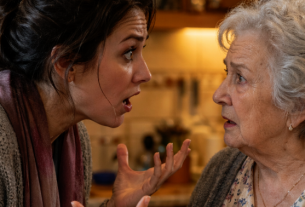
“Viktor is trying to transfer it to another woman.”
Silence.
Then her mother spoke quietly, without panic.
“He can’t. It belonged to Grandma.”
“I know. But he has an appointment with a notary today.”
“Did you check the documents?”
“I called the property registry. Everything is clear. I’m the owner. But he may have prepared something.”
“Galya, listen to me. Grandma held on to that cottage for thirty years. When Grandpa died. When the money ran out. When the roof was torn off in 1994. She never gave it away. And neither will you.”
Galina tightened her fingers around the mug. It was warm and rough, with a chip on the handle.
She closed her eyes.
“I won’t.”
At nine thirty, Viktor emerged from the bedroom. He was clean-shaven and wearing a fresh shirt.
He smelled of cologne she had never given him. It was sweet, with a hint of citrus.
He had once used a simple aftershave lotion from a blue bottle.
“I’m going to Sergey’s,” he said, pulling on his jacket.
The same jacket in which she had found the business card.
“All right,” Galina said.
He looked at her quickly, appraisingly.
Then he turned away.
“I’ll be back by lunchtime.”
The door slammed.
Galina waited two minutes.
Then she called the notary.
“Dmitry Vasilyevich, this is Galina Andreyevna Kuznetsova. We spoke yesterday.”
“Yes, I remember.”
“My husband is on his way to your office. He will claim that he has the right to dispose of my property. I want you to know that I have given no consent, issued no powers of attorney, and any documents he presents in my name are forged.”
“Have you filed a report with the police?”
“Not yet.”
“I recommend doing so. For my part, I will verify every document according to standard procedure. If I find any discrepancies, I will refuse to certify the transaction and will forward the information to law enforcement.”
“Thank you.”
She hung up and looked at the clock.
Ten twelve.
In forty-eight minutes, Viktor would enter the notary’s office carrying the documents he had collected in secret. He would be accompanied by a woman Galina had learned about only two days ago, confident that everything would go smoothly.
It would not.
Galina put on her sneakers and stepped onto the balcony.
It was October. Sunlight broke through the clouds. Boys were playing soccer in the courtyard. A faint mist rose from the wet asphalt.
She stood there, breathing in the cold air with its taste of damp leaves.
Then she called Rita.
“Rita, I need a lawyer. A good one. Someone who handles family law and real estate.”
“You’ve decided?”
“Yes.”
“To get divorced?”
Galina was silent for a moment.
The word was heavy. Not because of the word itself, but because of everything standing behind it.
“To get divorced,” she repeated.
She felt her shoulders drop.
Not from exhaustion.
From something else.
As though she had been carrying a bag she could have put down at any time, but for some reason had dragged it around year after year.
“Write this down. Olga Petrovna Larina. I’ve worked with her. She’s tough, but she knows what she’s doing. Tell her Margarita sent you.”
Galina wrote the number on the back of her grandmother’s photograph, the one with the currant bush.
Then she realized what she had done and copied it into a notebook.
Rita continued talking about documents, division of property, and the fact that the cottage could not be divided because it was inherited.
Galina listened and nodded, but her thoughts were elsewhere.
She was thinking about Anton.
Her son was seventeen. He would graduate in a year. He lived in the dormitory of a college in Podolsk and came home once every two weeks.
He was tall and awkward, with his father’s chin and her gray eyes.
What would he say?
How would he react?
Would he take his father’s side?
No.
She knew her son.
He would not take anyone’s side. He would put on his headphones and go to his room.
That would be his way of coping.
Viktor returned at one in the afternoon.
His face was as gray as rain-soaked asphalt. He took off his jacket, hung it on the hook, and went into the kitchen.
He sat at the table and pressed both hands against the countertop as though the table might roll away.
Galina stood by the window.
“How’s Sergey?” she asked.
He raised his head and looked at her.
There was something in his eyes that she had never seen before.
Not anger.
Not shame.
Confusion.
The expression of a man who had walked out of his house and discovered that the street no longer led where he expected it to.
“You know,” he said.
It was not a question.
“I know.”
“How?”
“It doesn’t matter.”
He rubbed his face with both hands. His palms were large enough to cover half of it. She could hear his heavy breathing beneath them.
“Galya, you misunderstood everything.”
“Did I?”
“Zhanna is just… I wanted to help her with housing. She’s in a difficult situation.”
“Help her with housing by giving her my cottage.”
“I thought we could somehow come to an agreement.”
“With whom? The notary? The property registry? Me?”
He said nothing.
His hands still covered his face.
“You aren’t even the owner, Vitya. You knew that, didn’t you?”
“I thought…”
“What?”
“That I could arrange it through a power of attorney.”
Something inside Galina made a faint ringing sound, like a spoon striking the rim of a glass.
She had expected anger.
Or shouting.
Or at least tears.
Instead, she felt something else.
A calmness so cold that it sent a chill down her spine.
“Were you planning to forge my signature?”
“No. I…”
“What?”
“I was going to ask you.”
“Ask me to give my cottage to another woman?”
He lowered his hands. His eyes were red, but not from tears.
“It doesn’t sound right when you say it that way.”
“It sounds exactly right.”
Galina turned toward the window.
The boys in the courtyard were still playing soccer. One of them fell, stood up, brushed off his knees, and continued running.
She watched him and thought:
It really can be that simple.
You fall.
You stand up.
You keep moving.
She did not shout. She did not ask questions about Zhanna, how long it had been going on, or whether he had ever truly loved her.
None of it mattered.
Not because she did not care.
Because the answers would change nothing.
“I’m filing for divorce,” she said.
“Galya…”
“I’ve already called a lawyer.”
He leaned back in the chair. It creaked beneath him.
“Because of the cottage?”
“No, Vitya. Not because of the cottage.”
She turned to face him. She looked directly at him, without narrowing her eyes, without trembling.
The way people looked when the decision had already been made and breathing had suddenly become easier.
“The cottage simply showed me what I have felt for a long time. That I don’t exist here. Not for you. My boundaries don’t exist. My property doesn’t exist. My voice doesn’t exist. There are only your plans, and I’m somewhere off to the side of them. Like that stool with the cracked leg you haven’t managed to repair for two years.”
He opened his mouth.
Closed it.
Then opened it again.
“I’ll repair it.”
“There’s no need.”
On Monday, Galina went to see the lawyer.
Olga Petrovna Larina turned out to be a woman in her fifties with short hair and heavy earrings that swayed whenever she moved her head.
The office smelled of leather and something pine-scented, probably an air freshener.
“So. The cottage is registered in your name and was inherited. He has no rights to it. That part is simple.”
She spoke quickly while writing something in a notebook.
“The apartment?”
“Purchased during the marriage. We paid the mortgage together.”
“Then it gets divided. The child?”
“Our son is seventeen. He turns eighteen in four months.”
“Child support will not be necessary. As for the division of property, the apartment will be split equally. The car?”
“His. He bought it before we married.”
“Good. Do you want the apartment or the money?”
“The apartment. For Anton and me.”
“Then we’ll offer him the option of buying your share, or you can buy his. Whichever is more financially practical.”
Galina sat in the chair and felt the lawyer’s words settle into place one after another, evenly, like bricks.
A wall.
She was building a wall.
And it was the right thing to do.
“Olga Petrovna, could he try something else with the cottage?”
“He can try. He cannot succeed. The ownership is registered in your name. Any attempt to transfer it without your consent would be a criminal matter. Fraud. Forgery. He understands that now.”
“I think so. The notary refused him.”
“Good. Sign here and here.”
The pen was heavy and made of metal, with an engraving on its side.
Galina signed.
Then signed again.
Her letters came out large and forceful.
She called Anton that evening.
She typed his number, erased it, and typed it again several times.
Not because she did not know what to say.
She did.
But whenever she thought about her son, something warm and prickly rose inside her at the same time.
“Hi, Mom. Did something happen?”
“Antosha, I want to tell you something in advance. Your father and I are getting divorced.”
Silence.
She could hear him breathing. There was another sound in the background, probably music in the dormitory.
“Why?”
“Because of many things. Not just one.”
“Okay.”
One word.
Even and undramatic.
She waited for something more, but he remained silent.
“How are you?” she asked.
“I’m fine, Mom. I’m sort of… not surprised.”
Something shifted inside her.
It did not burst or break.
It simply shifted.
“You noticed a long time ago?”
“Well, yes. You lived like roommates. I’m not a little kid.”
Seventeen years old.
She had thought she was hiding it. She had thought the façade was holding.
But he had seen through the walls the way children did—not by analyzing, but by feeling.
“The cottage will stay ours, right?”
“Yes. It belonged to Grandma.”
“Good. I’ll come in the summer and prune the apple trees. Two of them are really old now.”
She smiled.
For the first time in three days.
“Come.”
Viktor packed his belongings on Sunday.
Quietly.
Without a scandal.
Two suitcases, a bag of tools, and a box of books he had never read but had kept for some reason.
Galina sat in the kitchen drinking tea.
Real black tea, strong and plain.
She heard him moving through the apartment, opening wardrobes and pushing drawers closed.
At one point, he stopped in the kitchen doorway.
“I didn’t want it to turn out this way.”
“But it did.”
“If you had agreed back then to register the cottage in both our names…”
“What? It would have been easier to give away?”
“No. I mean…”
“I understand what you mean, Vitya. Grandma was a wise woman.”
He stood there for another second.
Then he left.
The door closed.
It did not slam.
The lock simply clicked.
Galina finished her tea, washed the mug, and placed it on the shelf—not upside down, but properly.
Beside her grandmother’s old mug with the pale blue rim.
In November, she went to the cottage.
Alone.
The journey took two and a half hours. A suburban train to Maloyaroslavets, then a bus to Krivosheino.
The bus smelled of diesel fuel and something sweet. Someone was eating tangerines.
The cottage stood silent in the autumn landscape.
Leaves covered the path. The gate had rusted and creaked in the wind.
Galina unlocked the door and entered the house.
The smell of old wood.
Mice.
Dust on the table.
She ran a finger across the tabletop, leaving a clean line behind.
In the attic, behind boxes of jars and a rolled-up carpet, stood the white enamel basin decorated with blue flowers.
She took it out, wiped it with a cloth, and carried it downstairs.
It was cold on the porch.
She sat on the step and placed the basin beside her.
The apple trees stood bare, their black branches outlined against the gray sky. The two outermost trees really were very old.
Anton would prune them.
Galina sat and looked over the property.
Six hundred square meters.
A fence with crooked wooden slats.
The currant bush from her grandmother’s photograph.
It had grown wild and overgrown.
But it was alive.
She took her phone out of her pocket and opened the photos. She found the screenshots of Viktor’s messages.
She looked at them.
Then deleted them.
Not because she wanted to forget.
Because she wanted to make room.
The wind stirred the dry grass beside the fence. Somewhere in the distance, a dog barked.
The air smelled of wet earth and fallen leaves, that particular autumn scent containing not sadness, but peace.
The basin stood beside her.
White, with blue flowers.
Neither the cottage nor Galina herself had disappeared.
They were both still there.