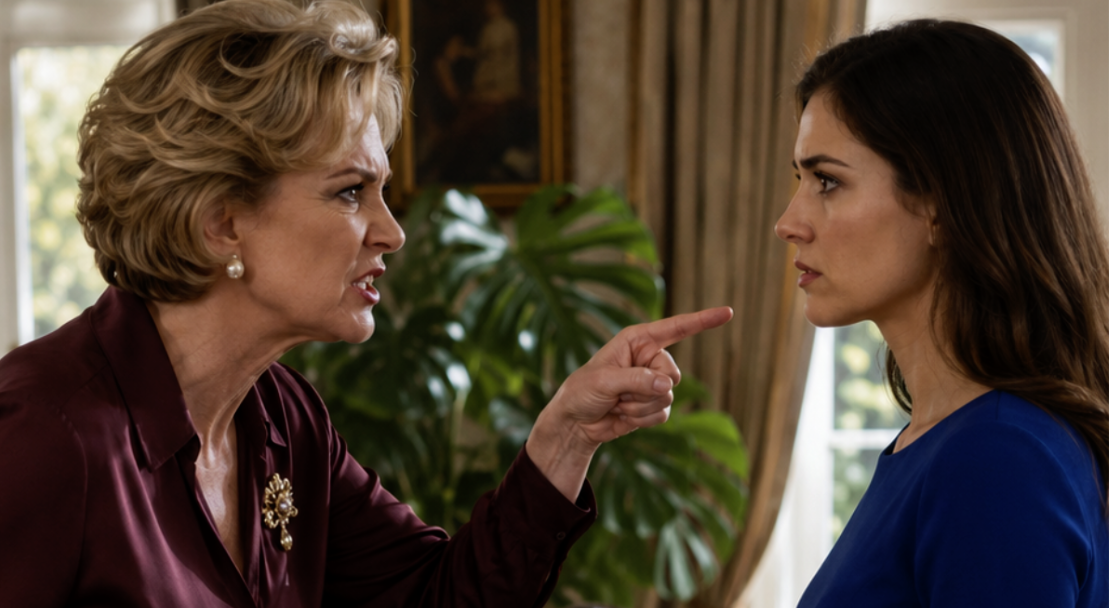
“Of course, forgive me, Sveta, but I’ve already paid the deposit,” Tamara Borisovna said, smoothing the printed estimate on the tablecloth and pushing it toward her daughter-in-law. “We’ll celebrate the anniversary at Granat. A banquet hall with a river view, a buffet for thirty-five people, and none of that cheap nonsense. It needs to be paid by Wednesday. The amount is underlined at the bottom.”
Svetlana did not touch the sheet. She looked at her mother-in-law and felt that same vein beginning to throb at her temples, the one her therapist called “the toxic environment indicator.” Outside the kitchen window, a cold April drizzle was falling. In the sink, a pot from yesterday’s pasta was soaking, and in the hallway, neatly lined up in a row, stood grocery bags from Pyaterochka. Sveta had stopped there after work, even though her legs were aching as if she had been unloading freight cars all day instead of pitching presentations to clients.
Her husband, Denis, was sitting right there, buried in his smartphone screen, pretending to study stock quotes. As if a service engineer earning sixty-four thousand rubles a month had any stock quotes to study, for God’s sake. He was simply hiding. Sveta knew this habit of his: whenever conflict appeared on the horizon, Denis suddenly became very busy. Checking email, retying his shoelaces, anything.
“Tamara Borisovna,” Sveta said after a pause, trying to keep her voice at the level of polite small talk, “let’s be clear. You booked a restaurant without asking us, and now you’re suggesting that I simply make the advance payment?”
“Why do you say without asking?” her mother-in-law said, adjusting a loose strand of hair that had slipped out of her bun. “I discussed it with Denis. He said, ‘Mom, do whatever you want, everything will be fine.’ Isn’t that right, Denis?”
Denis made an indistinct sound, something like a hamster grunting after getting caught in a trap, and mumbled:
“Sveta, what’s the big deal? It’s her anniversary. Sixty-five, after all. We should show some respect.”
“Wonderful. Respect is a beautiful thing,” Sveta said, pushing the estimate back. “Especially when it’s paid for with a card that has nothing to do with you.”
“Oh, the card!” Tamara Borisovna threw up her hands. “So that’s what you’re thinking about at a moment like this! Money. I worked my whole life, I worked three jobs in the nineties, raised my son alone — and now I don’t deserve one bright day without your accounting calculations?”
“What does accounting have to do with it? The point is that you didn’t even ask whether I was ready to hand over…” Sveta finally lowered her eyes to the paper and choked on the air. “Two hundred and ten thousand? Are you serious?”
“That also includes the photographer and live music. Nothing vulgar, everything very modest,” her mother-in-law said, pursing her lips.
“Modest is when people bring salads in plastic containers and sing along to a guitar. What you’ve described is a mid-level corporate party.”
“Sveta!” Tamara Borisovna pressed a hand to her chest so theatrically that she almost knocked off her cameo brooch. “Your salary is three hundred and eighty thousand! You’re the head of sales at a development company, you move millions around. And you’re pinching pennies for your own family? People will see that my son’s wife is a nobody if she can’t even spend money on his mother’s anniversary.”
There it was, the point of no return. Sveta felt something snap inside her — thinly, without a crack, like a thread on an old dress. It was not even the shamelessness of the request. It was the fact that Denis kept sitting there, silently scrolling through his feed, as if the fate of his marriage was not being discussed at the next table, but the weather forecast in Uryupinsk.
“Denis,” Sveta said, turning to her husband, “what do you have to say?”
“What am I supposed to say?” He shrugged, finally looking up from his phone. “Mom wants a celebration. You can afford it. Let’s not fight over nothing. Pay it, and we’ll sort it out later.”
“Sort it out later?” Sveta repeated, feeling a lump rise in her throat. “So I take two hundred and ten thousand out of my own pocket now, and then you might possibly give me back half later? From the income you don’t have, because you’ve been waiting three years for a promotion that never comes?”
“You bitch!” Tamara Borisovna exploded, jumping up from the table. “How dare you talk to your husband like that?! Humiliating him in front of his mother! You think that just because you have more money than sense, you can trample a person into the dirt? Denis, say something to her!”
“Sveta,” Denis said through clenched teeth, and his voice suddenly became foreign, cold as the tiled floor in an apartment building entrance, “you’re going too far. First of all, don’t you dare reproach me with money. Second, apologize to Mom. Right now.”
Sveta said nothing. Behind her, on the windowsill, an old fan was running, its rhythmic buzzing marking the seconds like a metronome. She looked at her husband — the man she had lived with for six years — and suddenly saw him as clearly and sharply as one sees a random fellow passenger on the subway. The suit she had bought him as a birthday gift. The watch she had spent a month choosing. And his eyes — empty, calculating, containing neither love nor pity, only irritation that the usual mechanism had malfunctioned.
“What should I apologize for, Denis? For being tired? For working twelve-hour days so that we can have this apartment, this food, these trips to your mother’s sanatorium? Or for not wanting to hand over what I earned for a party no one ordered from me?”
“You’re selfish,” Tamara Borisovna said, enunciating every word. “You only think about yourself. You don’t have children, yet it’s always ‘mine, mine.’ What do you need money for? You can’t take it to the grave with you. But family is sacred. Denis, if she doesn’t immediately understand that she was wrong, I wash my hands of it. Live however you want with this… this shark in a skirt.”
“Mom, calm down.” Denis stood up, and Sveta noticed his fingers trembling. Not from fear for her — from anger at her. “Sveta, maybe you really should get some air. Go somewhere for a couple of days. Cool off. Think about your behavior.”
“Are you kicking me out of my home?” Sveta asked slowly, almost syllable by syllable.
“I’m not kicking you out. I’m suggesting we take a pause. We’re all wound up. Mom feels bad, her blood pressure is going to spike any minute, and you’re deliberately escalating things.”
“Mom feels bad?” Sveta suddenly laughed, and the sound made Denis’s face stretch in surprise. “Denis, your mother doesn’t feel bad because of her blood pressure. She feels bad because the banquet might not happen. And you feel bad because you don’t know how to explain it to her now, because apparently you already promised her that ‘Sveta will pay for everything, she’s our millionaire.’”
A silence fell — the kind of ringing silence in which the whole truth is exposed. Tamara Borisovna breathed noisily through her nose like an angry goose. Denis said nothing. And there was more confession in that silence than in any words.
“Right,” Sveta said, rising. “Everything is clear. The setup is simple: first you, Denis, told your mother yes without asking me. Then the two of you came after my money. And now, when I refuse to be a wallet, you suggest I get out of sight. Well, that’s logical. In your family system, apparently, I was never a wife. I was a sponsor with expanded functionality.”
“How dare you!” Tamara Borisovna shouted, gasping for air. “I knew it, I knew it from day one, you were never our equal! Nothing is ever enough for you, you always turn your nose up! Soulless career woman!”
“And you are an experienced manipulator,” Sveta replied calmly. “And you know what? I’m no longer performing in your circus.”
She left the kitchen, went into the bedroom, and took an old travel suitcase down from the upper shelf. Her hands moved automatically: underwear, jeans, a sweater, a cosmetics bag, a charger, a folder with documents. Laptop. Tablet. The ring Denis had given her five years earlier she left on the nightstand — not as a gesture, but simply because it had suddenly become too tight, literally pressing into her finger.
Denis stood in the doorway and looked at her like a man life had unjustly insulted.
“Are you really leaving? Over some money? Because I asked you to help my mother?”
“Because you didn’t ask,” she said, zipping the suitcase and straightening up. “You presented me with a fact. And then you called me hysterical when I refused. This isn’t about money, Denis. It’s about the fact that to you, I’m a function. A convenient, profitable function with a good income and no bad habits.”
“You’re unbearable,” he said. “It’s impossible to talk to you. You always complicate everything.”
“And you always oversimplify everything. For example, you forget that the apartment is rented in my name and paid for by me. So the pause you’re suggesting will look like this: I’m leaving, but the lease expires in three weeks. I won’t be renewing it. If you want to live here, negotiate with the landlady and pay the money yourself.”
Denis turned pale.
“You can’t do that. That’s vile.”
“Vile is spreading out a bill for someone else’s party in front of a person and expecting them to wag their tail happily. That’s all, Denis. This conversation is over.”
In the living room, Tamara Borisovna sat clutching her folder of documents like a life preserver.
“Leaving?” she hissed. “Well, go on then, roll away. You think Denis will perish without you? He’ll find another one — prettier, more obedient, and without all your ambitions.”
“I wish you luck,” Sveta replied, putting on her shoes. “Only before you start looking for someone ‘more obedient,’ check what she’ll use to rent an apartment. In today’s reality, rent in this district is about sixty thousand. That’s almost your son’s entire salary. But you’re all about what’s sacred, about family. So you’ll help. With shelter, money, and scheduled bowls of borscht.”
Tamara Borisovna turned crimson, but Sveta was no longer listening to the reply. She stepped onto the landing, called the elevator, and only there, in the enclosed space of the mirrored cabin, allowed herself to exhale shakily. The button for the first floor glowed yellow. It smelled of chlorine and someone’s cheap cigarettes.
Outside, the same drizzle was still falling. She had no umbrella. Sveta called her friend.
“Dashka,” she said when she heard the familiar “Hello?” on the other end. “I left him.”
“Right,” Dasha’s voice immediately became businesslike, without a trace of panic. “Where are you? Standing in the rain?”
“At the entrance.”
“Order a taxi and come straight to me. Immediately. No ‘I don’t want to impose,’ no ‘maybe later.’ Do you hear me? You’ll sleep at my place tonight, and tomorrow we’ll figure it out. What happened?”
“My mother-in-law booked a restaurant for two hundred thousand. Offered me the honor of sponsoring her anniversary. I refused. Denis told me to get out.”
“One second,” dishes clinked on the other end of the line, “I’m just putting the kettle on, because news like that makes me nervous. So the two of them decided to spend your money, and you, apparently, turned out to be greedy and ruined all their fun. Classic.”
“Exactly.”
“Come over. You remember the address. The keys are under the mat in case I’m still in the shower. And don’t you dare cry in the taxi — that’s the version for weaklings. We’ll cry in the kitchen, with cognac.”
Dasha lived in an old Khrushchev-era apartment block on the fifth floor, where the entrance smelled of cats and the elevator had not worked since last September. But inside it was warm and smelled of sweet pastries and book dust — Dasha taught literature at a college and collected old editions.
“Shoes off,” she said from the doorway, giving Sveta a sharp once-over. “Suitcase in the corner, you in the kitchen. Tea, cognac, or straight to snacks?”
“First I need to wash my face.”
“Accepted. Towel’s on the hook.”
Twenty minutes later, Sveta was sitting cross-legged on an old sagging little sofa, drinking thyme tea from a large mug and recounting the events of the evening. Dasha listened without interrupting, only nodding occasionally, and in her eyes that dangerous little spark was beginning to burn — the one that usually foretold either a brilliant idea or a grand scandal.
“The most disgusting thing,” Sveta finished, “isn’t the money. The most disgusting thing is that he kicked me out. Just took it and kicked me out. Like a dog that had made a mess in the hallway. Because I refused to be a cash cow.”
“You forgot an important detail,” Dasha said, setting her cup aside. “You didn’t just refuse. You threw the truth in his face. And for people like your Denis, the truth is scarier than nuclear war. Because truth demands action. And he isn’t capable of action. He’s only capable of sitting on his backside and waiting for either his mother or his wife to solve his problems.”
“You know what hurts the most? I loved him.”
“You didn’t love him, Sveta. You loved an image. You loved the picture you invented for yourself: ‘We’re a family, we’re together, we’ll get through anything.’ Only that picture had a defect: you were ‘we’ in the sense of ‘I’ll solve everything, earn everything, pay for everything,’ and he was ‘we’ in the sense of ‘Mom, feed me.’”
Sveta fell silent, studying a crack in the ceiling.
“Do you think I was too harsh? Maybe I should have been softer? Agreed to pay half, found a compromise?”
“Listen,” Dasha leaned forward, “a compromise is when both sides give something up. What they offered you was a script with no options: ‘You pay, we celebrate, and be so kind as to smile in the group photos.’ That’s not a compromise. That’s robbery using family ties. So don’t lose your mind.”
That night, Sveta lay awake for a long time. Rain rustled outside the window, and in the next room the television played quietly — Dasha was watching some old film. Her phone pinged, and she flinched. The message was from the bank: “Transaction in the amount of 210,000 rubles on card *6789 declined. Reason: insufficient funds.” Below it was the transaction time: 00:42, and the location: “GRANAT RESTAURANT.”
Sveta sat up in bed, her heart pounding somewhere in her throat. The card was in her wallet, but of course the details were saved in Denis’s phone — she herself had allowed him to add them when they bought plane tickets to Sochi together. A year ago. A whole eternity ago, when she still believed a shared vacation could glue together a cracked marriage.
“Dasha!” she shouted. “Dasha, come here!”
Her friend ran into the room, squinting with sleep.
“What? What happened?”
“They tried to pay for the restaurant with my card. At night. Without asking.” Sveta showed her the screen with trembling hands. “That bastard Denis got into my account and tried to charge two hundred and ten thousand.”
“Right, stop,” Dasha woke up instantly. “Take a screenshot. And block the card. Immediately. Is there a ‘block’ button in the app? Press it!”
Sveta pressed it. Then, without thinking, she dialed her husband’s number. He picked up after the third ring.
“Hello?” Denis’s voice was hoarse and irritated.
“Have you completely lost your mind?” Sveta began without preamble. “You tried to charge two hundred thousand from my card? Without asking? At one in the morning?”
“Oh, that…” He faltered. “Sveta, well, you weren’t going to pay anyway. I thought maybe it would go through. We would have sorted it out later.”
“Sorted it out?” She could not believe her ears. “Do you understand that this is a criminal offense? Theft. Unauthorized access to someone else’s account. With one tap of your finger, you just moved from the category of ‘loser husband’ to the category of ‘person under investigation.’”
“Don’t dramatize,” he hissed. “Nothing was charged! There weren’t enough funds. So you didn’t lose anything. What’s the problem?”
“The problem, Denis, is that you tried to rob me. Not ask me. Not borrow from me. Rob me. Quietly, at night, thinking I wouldn’t notice. Do you even hear yourself?”
“I was acting in the interests of the family!” he exploded. “Mom is upset. You drove her to tears. Now she says she won’t survive such humiliation. And you with your money…”
“Enough,” Sveta interrupted. “That’s it. Period. Tomorrow I’m filing for divorce. And if you ever try to get into my accounts again, I’ll file a report. Not with the registry office — with the police. Understood?”
Silence hung on the line. Then there was a click — he hung up.
Sveta threw the phone onto the sofa and covered her face with her hands. Dasha sat down beside her and silently put an arm around her shoulders.
“Don’t cry,” she said quietly. “Today you lost a husband, but you kept yourself. That isn’t the worst trade. Honestly.”
A new life began in the morning. Sveta called a taxi and went to work, because a meeting with a key developer could not wait. Before she left, Dasha shoved a container of sandwiches and a flask of coffee into her hands.
“In the evening we’re going to a lawyer,” she said. “I’ve already arranged it. There’s this woman, Raisa Arkadyevna, who specializes in family law. They say she’s as toothy as a pit bull and has no sentimental nonsense. That’s exactly what you need right now.”
“How do you know everything?” Sveta smiled weakly.
“I teach at a college. There are such dramas every semester that your family theater is just a light warm-up. Pull yourself together. And remember: you are not a victim. You’re a person who saw the hole in the bottom in time and managed to jump off before the boat sank.”
Raisa Arkadyevna really did turn out to be a woman built like an armored vehicle. Small, dry, with glasses on a chain, she studied the documents with the same expression a bomb disposal expert would use to examine a mine.
“So, here’s the situation,” she said, summing up. “No children, jointly acquired property appears minimal based on what you’ve told me. The apartment is rented, the car is in your name, no joint loans. But I would recommend checking your husband’s credit history. If he tried to secretly take money from your card, there may be other surprises.”
Sveta checked it that same evening through the Gosuslugi government services portal. The picture was bleak: Denis had three consumer loans totaling almost seven hundred thousand rubles, all taken out over the past year. Plus credit card debt.
“Holy hell,” Dasha whistled, peering over her shoulder. “And where did he blow all that money? Not on his mother, surely.”
“I don’t know,” Sveta said, reading the lines while her fingers went cold. “Maybe sports betting? Or casinos? Lately he’s been constantly glued to his phone, saying he was ‘studying investments.’ And I believed him. God, what an idiot I am.”
“Not an idiot. You’re just used to trusting people. That’s not a flaw, it’s… a feature. But that’s it now. Finished. Enough.”
Two days later, Sveta came to the former apartment to collect her things. She had a “support squad” with her — Dasha and two colleagues from the office, big guys from the commercial department. Denis opened the door and grimaced when he saw the group.
“You brought security? Afraid?”
“Saving time,” Sveta replied. “We’ll be quick. Boxes, clothes, some equipment — everything bought with my money and backed by receipts.”
“Did you forget your conscience?” came a voice from the depths of the hallway, and Tamara Borisovna appeared. She was wearing a house robe and curlers in her hair, but her expression was that of a prosecutor at a treason trial. “So you came. To collect your little things. And you don’t think about the family you destroyed?”
“I destroyed it?” Sveta carefully set a box on the floor. “I wasn’t the one who tried to secretly take money from someone else’s account. I wasn’t the one who racked up seven hundred thousand in loans and kept quiet about it. I wasn’t the one who chose a banquet over a conversation.”
“Loans?” Tamara Borisovna shifted her gaze to her son. “Denis, what is she talking about? What loans?”
“Mom, not now,” he muttered, looking away.
“No, now is exactly the time!” Sveta pulled out her phone and showed the screen. “Here, admire it. Three loans in a year. Almost seven hundred thousand. Apparently he didn’t tell you where the money went. But he was very much hoping that I would pay for the anniversary, and part of the money could be redirected toward closing the debts. Isn’t that right, Denis? Did I reconstruct your clever little plan correctly?”
The hallway went quiet. Tamara Borisovna slowly lowered herself onto the little shoe bench and stared at her son.
“Is it true?”
“Mom…”
“I’m asking you, is it true?!”
“I wanted the best!” he exploded. “Yes, I got into debt. Yes, I tried to make money on the stock market. But it was all for us! For the future! I thought I’d earn money and we’d buy an apartment, and you’d stop nagging me over every kopeck! And then there’s Sveta with her millions, and she’s sorry to help her husband!”
“Help is when you ask, not when you steal,” Sveta said quietly. She was no longer shouting. Inside, everything felt empty and ringing, like a drum. “All right. This conversation is exhausted. Guys, take the boxes and let’s go.”
“And go to hell,” Tamara Borisovna hissed. “Just know this: we won’t disappear without you. We’ll manage.”
“Of course you will,” Sveta said, turning back at the door. “Now you’ll have a common enemy — me. That’s very unifying. And money… Money, Tamara Borisovna, you’ll now have to earn yourselves. Get a job. You’re a strong woman, aren’t you, the woman who worked three jobs in the nineties. So shake off the rust. Your son has debts to repay.”
She left without waiting for a reply. On the landing, Dasha took her by the arm.
“That was powerful.”
“That was terrifying,” Sveta admitted. “But you know, I feel as if I’ve taken off a backpack full of bricks. It’s easy to walk.”
After she filed for divorce, the chorus of voices began. Denis’s second cousin’s aunt from Tver called:
“Svetochka, how can this be? Six years together, and now everything goes down the drain? Denis is a golden boy, kind, easygoing. What are you thinking?”
“I’m thinking that your ‘golden boy’ tried to charge two hundred and ten thousand rubles from my card without my knowledge. If that doesn’t bother you, you can pay his debts yourself. I’ll send you the bank details.”
The aunt gasped and hung up. Then a message came from a family friend:
“I didn’t expect such harshness from you. You were always gentle. Maybe you’ll come to your senses?”
Sveta wrote back: “I was gentle until someone tried to turn me into a cash cow. Give Denis my regards and the number of a credit counselor.” There was no reply.
Two weeks later, Sveta accidentally saw photos from Tamara Borisovna’s anniversary on social media. The Granat banquet hall had turned into the cozy hall of an apartment. The table was set in the living room. On the white tablecloth stood salads in plastic containers, bottles of juice, and a lonely vase of candies. The cake was small, clearly from a supermarket, with “Tamara 65” written on it in crooked chocolate lettering. The birthday woman herself sat at the head of the table, smiling tensely, with relatives on either side diligently pretending that everything was going according to plan.
The caption under the photo read: “What matters most is warmth of the soul, not pomp. Thank you to my loved ones for being here.”
Sveta closed the tab. Warmth of the soul, then. Sure.
A month passed. Sveta rented a modest studio in a new district, with a panoramic window and a tiny kitchen. The furniture was very simple — a folding sofa, an IKEA table, a couple of chairs. But the air here was her own, and in the fridge were foods she liked, not “Denis doesn’t eat broccoli, he only wants cutlets.”
Dasha came to the housewarming with a pot of violets and a bottle of prosecco.
“Congratulations,” she said, clinking plastic cups with Sveta. “You’re a free woman now. How does it feel?”
“Strange,” Sveta admitted. “Sometimes I wake up and think, ‘I should apologize for something.’ And then I realize — there’s no one to apologize to. And nothing to apologize for. And it’s such a… relief. Almost shameful.”
“No shame. There should be pride. You got out of a toxic swamp. You didn’t sink in. Many people can’t do that.”
“Sometimes I think: maybe I should have done it earlier? Maybe I endured it for too long?”
“‘Too long’ isn’t about you,” Dasha said thoughtfully, turning her glass in her hand. “You endured exactly as long as your psyche needed to ripen into the decision. Everyone has their own timeline. The important thing is that you ripened, instead of rotting on the vine.”
The divorce went through routinely. Denis appeared in court with a rumpled face, but without any claims. Apparently, a lawyer had explained to him that the episode with the card could bring unpleasant consequences. He signed the documents silently, only throwing out at the end:
“I still think you ruined everything.”
“And I think that even now you don’t understand what happened. That’s the saddest part,” Sveta replied, and left the courtroom without looking back.
Spring turned into summer. The lindens in the courtyards were covered in young leaves, the city washed itself clean with thunderstorms and began to breathe. Sveta gradually settled in. Work was boiling: her department launched a new project, a residential complex called Sosnovy Bor, and Sveta disappeared at construction sites, meetings with contractors, and presentation revisions. She was tired as hell, but it was a pleasant tiredness — like after a good workout.
One day at the supermarket, standing by the dairy shelf, she noticed a familiar figure out of the corner of her eye. Denis. He was choosing cheese, but when he saw her, he froze with the package in his hands.
“Sveta? Hi.”
“Hi.”
“You… look great.”
“Thanks. I’m sleeping well.”
“I’m not, really,” he forced a smile. “Listen, can I have a minute? Not to ask for anything or reproach you. Just to say something.”
“Then say it.” She put her basket on the floor.
“I was an idiot, Sveta. A complete, total idiot. I lost money on the stock market because I fell for an ad from some broker who promised three hundred percent annual returns. Then I lied. I lied to Mom, I lied to you. And when things got hot, I decided you would save me — as always. Because you’re strong. And I’m… not.”
“You’re not weak, Denis,” she said, and was surprised to hear neither anger nor pain in her voice. “You’re cowardly. Those are different things. A weak person can ask. A coward steals.”
“Yes,” he lowered his eyes. “Yes, you’re right. I understand that now. I live with Mom now, slowly paying off the debts. Mom got a job as a cashier at a supermarket. Now the two of us are working like dogs. And you know what’s funniest? Now she scolds me with exactly the same words she used to use on you. That I don’t earn enough. That I’m lazy. That I don’t appreciate anything. I’ve been on your side of the barricades now. And let me tell you, it’s damn unpleasant.”
“I won’t feel sorry for you,” Sveta said. “But the fact that you’ve realized it is already something. Maybe next time, with another woman, things will go differently.”
“I don’t want another woman,” he said quietly.
“Then all the more reason,” she picked up her basket and took a step toward the checkout counters, “you have plenty to work on. Goodbye, Denis. I sincerely hope you get out of this.”
She left, and he remained standing by the dairy shelf, still clutching the package of cheese.
That evening, Sveta sat on the windowsill of her studio, drinking green tea and watching the sunset fade over the city. Her phone was silent. Her soul was calm, for the first time in many years — truly calm. Tomorrow she had a difficult meeting, then a planning session, then chaos over estimates. But it was her life. Her rhythm. Her money. Her solitude, which for some reason did not feel like loneliness at all.
The doorbell beeped. It was Dasha, without warning, carrying a pizza box and a bag of mandarins.
“I decided you were thinking too much today,” she announced from the doorway. “So we’re having a student-style dinner: pizza, mandarins, and a discussion of everything under the sun. How’s your ex?”
“I ran into him at the store today.”
“Oh, details!”
“He understands. He suffers. He’s working on his mistakes. But you know, Dash…” Sveta bit into a slice of pizza and squeezed her eyes shut. “I don’t care anymore. Honestly. It happened, and it passed. Like having a tooth pulled. It aches a little when the weather changes, but it doesn’t get in the way of eating anymore.”
“Excellent,” her friend nodded. “Then I have news for you. Remember you told me about that development conference in St. Petersburg? I found out registration is still open. And I think your director is just waiting for you to submit an application. Come on, go for it. The world is big. Your whole life is ahead of you.”
“I will,” Sveta suddenly said simply. “I’ll apply. Enough looking back. I lived for too long as if my main purpose was to be convenient for other people. Now my main purpose is to be.”
“Bravo,” Dasha raised a mandarin like a glass. “To you, Sveta. To the real you.”
Outside the window, it had grown completely dark. Windows lit up in the neighboring building. The city lived its evening life — humming, breathing, blinking with lights. Sveta looked at it and suddenly understood with absolute clarity: she was not alone. She had never been alone. She had only once believed that life meant being someone’s wife, someone’s daughter-in-law, someone’s debtor.
But now she knew: life was simply being herself.
And proving nothing to anyone anymore.